Why Your Child Running to Their Caregiver Is a Sign of Healthy Development
That Moment at the Door: What It Really Means When Your Child Runs to Their Caregiver
There is a moment you may not have expected. You arrive to pick up your child, and before you reach the door, you see it — your child running, arms open, toward their caregiver. Not toward you. Toward her.
And something moves through you in that instant that is difficult to name. Pride, yes. Relief, certainly — because it means your child is happy, safe, settled. But alongside it, something quieter and more complicated. A small, uninvited question that surfaces like a bubble from deep water: Do they love her more?
You are not wrong to feel it. And you are not wrong to examine it closely, because what that moment reveals is one of the most important — and most misunderstood — milestones in your child’s early development.
What you are watching is not a betrayal of your bond. It is the visible evidence of something your child’s brain has been quietly building since the day they were born, and it is happening exactly as it should.
The First Thousand Days: Where It All Begins
Between the moment of conception and your child’s second birthday, the brain builds itself at a speed it will never again reach. Over the course of a thousand days — roughly three years — your child goes from a completely dependent newborn to a walking, talking, emotionally complex little person who can feel joy, frustration, fear, and trust.
What makes that transformation possible is not a curriculum. It is not a facility. It is the quality of the relationships that surround your child during this window.
The brain, at this stage, is not yet ready to think abstractly about the world. It thinks in terms of people. It encodes its understanding of safety, of worthiness, of whether the world is a place where needs are met, through the human beings who hold it, respond to it, and remain consistent across time.
When a caregiver consistently meets a child’s needs — when they respond to a cry within seconds, when they match a child’s emotional state with warmth, when they are present and attuned in the way only a well-trained, deeply present adult can be — they are not simply providing comfort. They are laying the neurodevelopmental infrastructure that your child will carry into every relationship, every classroom, every challenge, and every act of courage they will encounter for the rest of their life.
Secure Attachment: What It Is and Why It Changes Everything
This is what developmental scientists call secure attachment. And it is one of the most powerful predictors of a child’s lifelong resilience, emotional regulation, and capacity for connection.
A child who has built secure attachment has an internal working model — a deep, unconscious understanding — that people are reliable, that they are worthy of care, and that the world is navigable even when it is difficult.
This is not something you can buy. It is not something a certificate guarantees. It is built, interaction by interaction, in the daily rhythms of care.
Here is what makes this both beautiful and, for many parents, quietly unsettling. Secure attachment does not require a single caregiver. It is not a finite resource that depletes when shared.
A child’s brain is designed to form multiple secure attachments — to a mother, to a father, to grandparents, to a trusted caregiver. Each secure bond adds to the child’s relational architecture. Each one builds the same underlying sense of safety and worth.
What matters is not the number of attachments but the quality of each one.
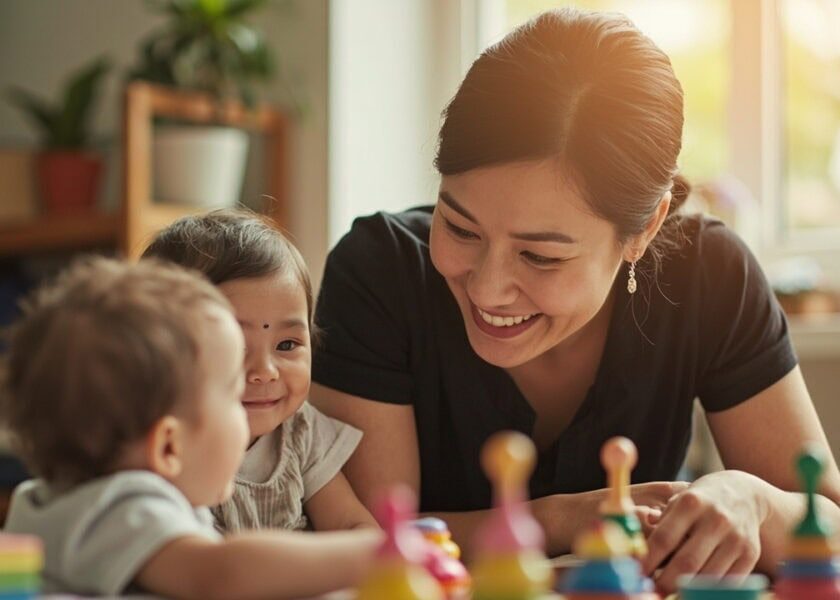
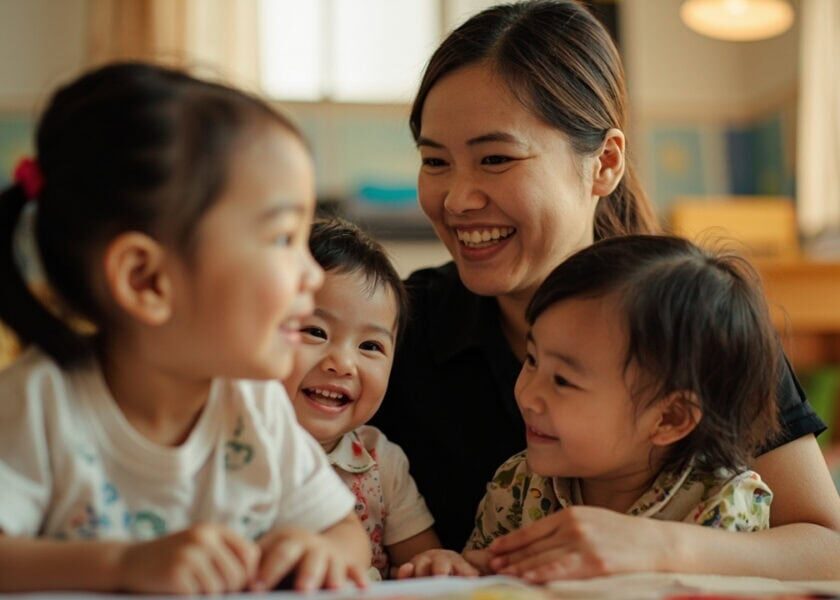
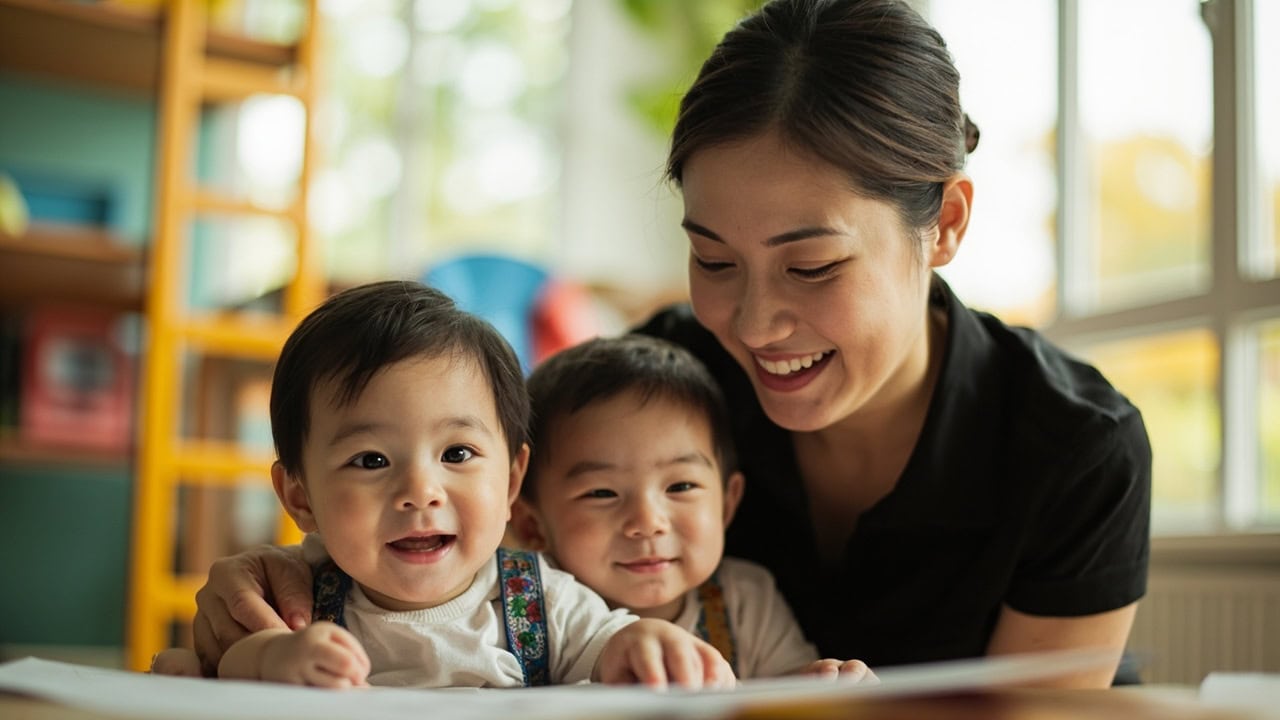
When your child runs to their EduNanny caregiver with open arms, they are not replacing you. They are building a second — or third — foundation of security.
And here is something that is rarely said clearly enough: every secure bond your child forms makes them better equipped to form the next one, including the bond with you. The caregiver is not taking something from you. She is giving your child a richer inner world to come home to you with.
What Intentional Caregiving Actually Looks Like
So what does it look like when a caregiver builds this kind of attachment intentionally? It is not accidental. It is not something that happens because a caregiver happens to be a warm person, though warmth is the foundation. It is a practice. A trained, deliberate, consistent practice.
Responsiveness
It begins with responsiveness — the simple, profound act of responding to a child’s communication, whether that is a cry, a coo, a gesture, or a word, in a way that tells the child: I hear you. I see you. You matter.
A caregiver trained in attachment-informed practice understands that every response is a message to the child’s developing brain. It says, “The world answers when you reach out.”
This is not gentle philosophy. This is neuroscience. The infant brain that receives consistent, warm responsiveness develops stronger neural pathways in the prefrontal cortex — the region responsible for emotional regulation, impulse control, and social cognition.
The infant brain that is inconsistently responded to, or responded to with stress rather than warmth, builds different pathways. Not broken pathways, but different ones — ones more oriented toward vigilance, toward scanning for threat, toward self-protection rather than exploration.
Attunement
It continues with attunement — the caregiver’s ability to read the child’s emotional state and meet them there.
Not to overstimulate a child who is already overwhelmed. Not to withdraw from a child who is reaching out. But to match. To be in rhythm with the child’s inner world in real time.
This is what trained EduNanny caregivers do. They are not managing children. They are in relationship with them. And the difference between those two things is everything.
Consistency
It deepens through consistency. The same caregiver, the same face, the same voice, the same rhythms of feeding, sleeping, playing, and comfort, day after day.
When a child knows who is caring for them and can count on that presence, their brain does not have to spend energy on anxiety and uncertainty. That energy goes somewhere else. It goes toward curiosity. Toward play. Toward the hard, beautiful work of learning what it means to be a person in relationship with other people.
Warmth
And it lives in warmth — the kind that is physical, genuine, and unconditional within the bounds of the caregiving relationship.
A hand on a back. Eyes that crinkle at a child’s first wobbly steps. A voice that softens when a child is tired.
This warmth is not a bonus. It is the medium through which the neurodevelopmental work happens.
Speaking Honestly to That Feeling
I want to speak directly to the feeling that brought many of you here — that complexity of watching your child love someone else and feeling something you cannot quite name in response.
Let me be honest with you, because you deserve honesty. That complexity you feel is real. It is not weakness. It is not irrationality. It is the response of a loving parent who has carried a child inside their body, who has been woken at 3 a.m. by that child’s cry, who has built their entire identity around the act of meeting this small person’s needs.
To watch someone else do that — and do it well — is a profound adjustment. It asks something of you that no one fully prepares you for.
But here is what I want you to understand, not as a comforting platitude but as a developmental fact: the very bond your child is forming with their caregiver is evidence that the system is working.
It is not a threat to your relationship with your child. It is the proof that your child is developing the way they were neurologically designed to develop.
A child who cannot form secure attachment to a caregiver is a child whose development is at risk. A child who forms it easily and visibly is a child whose brain is building exactly what it needs.
And there is something more. That caregiver — the one your child runs to — she is part of your village. Not a replacement for your village, but a member of it. The bond your child forms with her is not separate from your parenting. It is an extension of it.
Because you chose her. Because you made the decision, often with great deliberation and sometimes with great anxiety, to entrust your child to someone’s care. That choice, made thoughtfully, made with research and visits and questions and the kind of vigilance only a parent understands, is itself an act of love.
And it has produced a result: a child who feels safe enough to love widely.
How to Honour and Participate in This Bond
So what is your role now? How do you participate in this bond without guilt, without intrusion, without the sense that you are somehow secondary in your own child’s life?
You begin by asking your caregiver questions. Not surveillance questions — relational questions. What did they enjoy today? What was hard for them? What did they reach for when they were upset?
When you pick up your child and they run to their caregiver first, and you feel that familiar pang, you follow your child into that moment. You do not stand at the edge of it with your arms crossed. You step into it.
You greet your caregiver warmly. You acknowledge the bond.
“It looks like you two had a wonderful morning together.”
You are not pretending it does not affect you. You are naming it, honouring it, and in doing so, you are teaching your child something extraordinary: that love is not a limited resource. That relationships can be shared, not competed over. That a bigger village means a richer life.
You can reinforce this bond further by maintaining open, consistent communication with your caregiver. At EduNanny, this means you are kept genuinely informed — not just about meals and naps, but about your child’s emerging curiosities, their social discoveries, the small moments of delight that make up their day.
When parents and caregivers operate in a transparent, communicative relationship, the child feels it. They feel the ease between the adults who care for them. And that ease — that warmth between your home and your caregiver’s care — is the environment in which secure attachment deepens most powerfully.
EduNanny by BUTLER: Built Around Attachment Science
EduNanny operates within the ECDA Childminding Pilot, which means its caregivers are trained, its practices are structured, and its oversight is real. This is not informal care. This is a deliberate, quality-assured model that recognises what the science tells us — that the relationship between caregiver and child is the single most important element of early care — and builds every element of its service around that truth.
The Ratio That Makes Attachment Possible
Whether care is delivered in a home-based setting or a community or centre-based pathway, EduNanny maintains infant ratios of up to one to three. One caregiver for every three infants.
That is not an administrative detail. That ratio is the condition that makes genuine attunement possible.
You cannot attune to six infants at once. You cannot respond with the speed and quality a developing brain requires if you are managing a ratio designed for an institution rather than a child.
EduNanny’s structure exists because quality caregiving is not an accident. It is organised around the real developmental needs of real infants, with the discipline to keep group sizes small enough that every child is known, seen, and responded to.
Accessibility as a Principle
Fee structures within the pilot are designed with accessibility in mind, so that this quality of care is not available only to families with significant financial resources. Your child’s CDA and Baby Bonus can be used, and care blocks run Monday through Friday, supporting the rhythms of working families across Singapore.
This reflects a belief that secure attachment should not be a privilege reserved for those who can afford premium private arrangements. Every child deserves a caregiver who has been trained to build it.
Support That Meets You Where You Are
EduNanny’s Thomas AI Chatbot speaks to something real about modern parenting. You are juggling a thousand things. You cannot always be present at the door at 6 p.m. You have questions that arise at odd hours, about feeding and sleep and developmental milestones and whether what you are observing is normal.
Thomas is there. It is a tool, not a person, and it does not replace conversation with your caregiver. But it closes the gap between the questions you have and the answers you need. It makes the system more responsive to you — and responsiveness, as we have been discussing, is not just for infants. It is what makes any relationship work.
Questions to Ask When Choosing Infant Care
If you are currently researching your options, here are the questions that actually matter — the ones that get beneath surface-level marketing to the quality of care your child will receive:
- What is the caregiver-to-infant ratio? The research is clear: ratios above 1:3 make genuine attunement difficult to sustain throughout a day.
- What training have caregivers received? Look for specific mention of attachment-informed practices, not just general childcare certificates.
- How is consistency maintained? Will the same caregiver care for your child most days, or will faces change frequently?
- How does the service communicate with parents? Is there regular, genuine sharing of your child’s day — not just a log of meals and naps?
- What is the observation-to-response pattern? When a child signals a need, how quickly and warmly does the caregiver respond? This is harder to assess but can be observed during visits.
- Is the service regulated and quality-assured? In Singapore, the ECDA Childminding Pilot provides structured oversight for participating providers.
The Moment at the Door, Understood
What you witnessed when your child ran to their caregiver with joy and trust was not a moment to worry about. It was a moment to recognise as what it was: a developmental milestone. As significant in its own way as their first steps or first words.
It told you that your child is building the neural architecture they need to navigate the world — not just now, but for the rest of their life. It told you that your choice of caregiver was the right one. And it told you that your child, in their beautiful, instinctive, unselfconscious way, is already learning one of the most important lessons there is: that people can be trusted, that care is reliable, and that love grows when it is shared.
You do not need to feel guilt about this. You do not need to feel displaced. You need to feel what you are already feeling — the tenderness, the complexity, the wonder — and you need to understand it for what it is.
You chose this. You chose a caregiver who has been trained to do this work. You chose a model that keeps ratios low, that invests in caregiver training, that communicates with you honestly and consistently.
And your child is thriving because of that choice, and because of the secure bond they are building with the person who holds them, talks to them, plays with them, and responds to them with the same consistency and warmth that you yourself would provide.
That caregiver is not your replacement. She is your partner. And your child’s love for her is not a threat to your family. It is the sound of your village growing, of your village doing exactly what it was always meant to do: raising your child together with you, not instead of you.
The next time you pick up your child and see that same joy on their face, directed at someone other than you, I want you to do something.
I want you to pause. Not out of anxiety. Out of recognition.
I want you to see, in that moment, the evidence of your child’s healthy development, the proof of your thoughtful choice, and the beginning of a relational life that will carry them through far more than these early years.
That moment is not the end of something. It is the beginning of everything they are becoming.
And you — with your questions and your doubts and your fierce, complicated love — are at the centre of it. You always have been. You always will be.
The caregiver simply walks beside you.
Ready to Explore Care That Understands This?
If this article has resonated with you and you are ready to learn more about how EduNanny structures care around the science of secure attachment, we invite you to reach out.
We welcome your questions. We encourage visits. We believe the right caregiving relationship is one you enter with your eyes open, understanding exactly what you are building and why it matters.
Your village is waiting.
Learn more about EduNanny Singapore or get to know our approach. We are also happy to answer your questions directly.