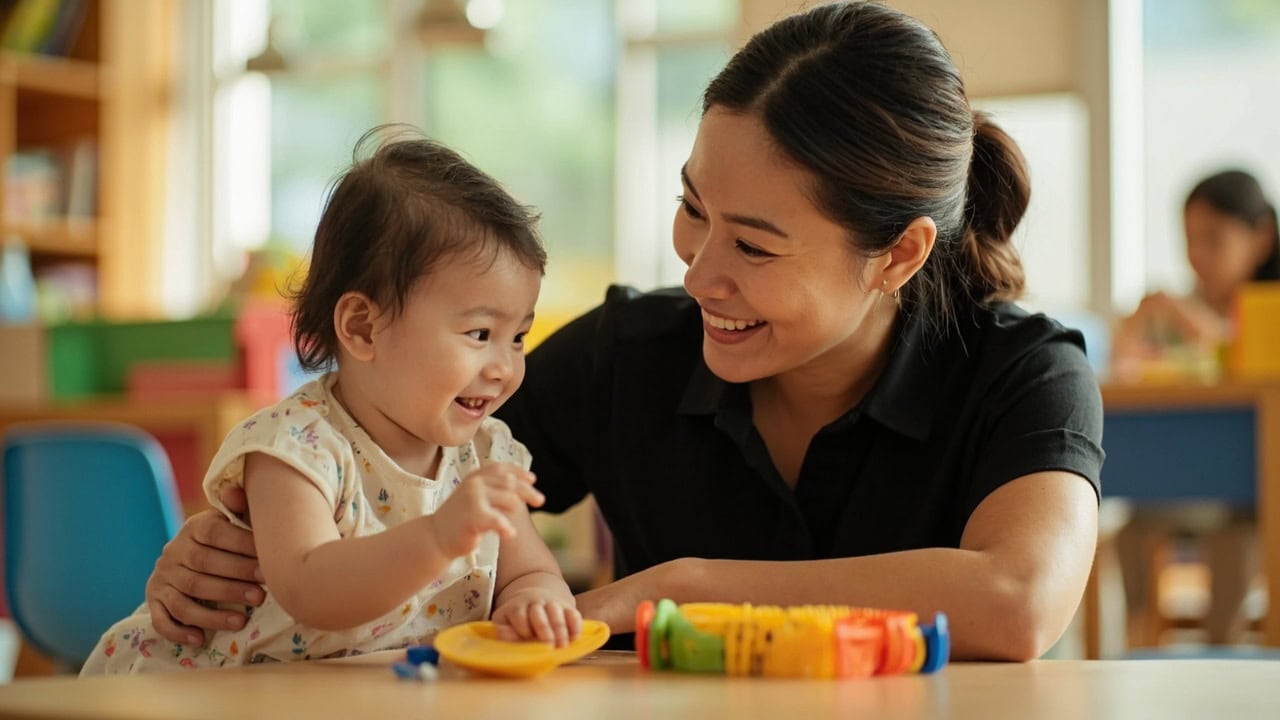
The Daily Practice That Turns Childcare Into Real Partnership
Quick Summary: What This Article Covers
- The daily handover moment and why it matters more than you think
- What separates routine exchanges from genuine parent-caregiver partnership
- Practical frameworks for what to ask your child’s caregiver and when
- How to read and receive the observations your caregiver shares
- Why reciprocal trust is the foundation of high-quality infant care
- How EduNanny Singapore builds the structures that support real collaboration
After Enrollment: The Gap Most Parents Don’t See Coming
There is a moment that happens every single morning in homes across Singapore. It is brief. It is often slightly rushed. A parent hands their child to someone they have chosen to trust with the most precious thing in their life, exchanges a few words about how the night went or what the day might hold, and steps out the door.
In that moment, something is handed over that no contract can fully capture and no orientation session can completely prepare either party for. What is handed over is not just a child. It is a relationship in its earliest, most fragile, most consequential form.
After the paperwork and settling visits and first tearful drop-offs have passed, parents find themselves in a quiet, ongoing negotiation with uncertainty. What should I be asking my child’s caregiver? What should I be watching for? How do I know if this is working? How do I build something real with someone I rely on but do not fully know?
These are not questions that appear on intake forms. They are not questions that orientation sessions typically answer. They are the persistent, underrated questions that sit beneath the surface of daily handover moments across Singapore.
Most of what is written about choosing childcare focuses on that threshold moment—the decision, the criteria, the checklist of questions. But the families we work with at EduNanny Singapore have learned something important: the decision, while important, is only the beginning of a far more nuanced daily practice that most parents navigate largely on instinct, without a map, without a vocabulary for what they are actually trying to build.
The gap we want to speak to is not the gap between choosing and deciding. It is the gap between enrollment and genuine partnership. The daily, quiet, consequential work of building a real collaborative relationship with the person who cares for your child while you are not in the room.
Because that relationship, more than any logo on a door or ratio printed on a certificate, is what determines whether your child is not just safe but truly seen. Whether your child’s caregiver is not just competent but genuinely attuned. Whether the hours you spend apart are hours that are building something rather than simply passing time.
The Architecture of Daily Caregiver Communication
Most parent-caregiver exchanges happen at two natural inflection points: the morning handover and the evening pickup. These moments are constrained by time, by the logistics of arrivals and departures, by the natural reticence that comes from interacting with someone you know primarily through a professional arrangement.
In most families, these exchanges stay safely on the surface. The child slept well. She ate okay. He was in good spirits. These are not nothing. But they are a beginning, not a destination.
What transforms a routine exchange into the foundation of genuine partnership requires something that neither party can do alone. It requires the caregiver to move beyond transactional updates into proactive sharing—to notice not just what happened but what it might mean, to bring observations forward with both specificity and humility.
It requires the parent to move beyond listening for reassurance toward active curiosity, to ask questions that invite depth rather than simply confirming that the day passed without incident.
The Morning Handover: An Underrated Opportunity
When you arrive with your child, the quality of your few minutes with your caregiver sets the tone for the entire day. Parents who rush through this moment, eager to get to work and trusting that the day will take care of itself, are missing an invitation.
Parents who use it well arrive with a sentence or two about what they noticed at home the night before. A change in sleep patterns. A new word emerging. A preference that surfaced over the weekend. This is not overcommunication. This is essential context, and caregivers who receive it consistently begin to see your child with a richer, more integrated understanding.
Consider what a single sentence can do. “She woke up twice last night—I’m not sure if she’s coming down with something or if it’s just the heat.” This gives your caregiver a frame for the day. She can watch more carefully, respond with more patience when tiredness surfaces, adjust activities if needed.
The Evening Pickup: Returning What You Receive
What you share at pickup matters just as much. A caregiver who knows that your child has been fighting sleep because of a developmental leap can adjust the day’s rhythm accordingly. A caregiver who knows that your toddler has been struggling with sharing can be prepared to scaffold those moments with patience and intention rather than reactive redirection.
The parent who says, “She was really clingy this morning—I think she may be coming down with something,” is giving their caregiver a gift of vigilance. The caregiver who responds, “We noticed she was a bit off this afternoon—let’s keep an eye together,” is returning that gift.
This is the beginning of the collaborative intelligence that makes childcare exceptional. It is not dramatic. It does not announce itself. It is built in the small, daily exchanges that most people overlook.
What to Ask and When: A Practical Framework
The parents who feel most connected to their child’s care are not necessarily the ones who ask the most questions. They are the ones who have learned what to ask, when to ask it, and how to listen in a way that invites their caregiver to share more.
Questions Worth Asking at Morning Handover
- What was her mood like when she arrived? Some children are different at drop-off than they are an hour later.
- Is there anything from yesterday’s routine that we should continue or adjust today?
- Are there any patterns you’ve noticed that I might not see at home?
- What seemed to soothe her best yesterday?
Questions Worth Asking at Evening Pickup
- How did she respond to [specific activity or situation] today?
- Were there any moments where she seemed frustrated or upset? What helped?
- Did she eat and sleep as expected, or differently than usual?
- Is there anything I should know about how she was playing with the other children?
These questions signal curiosity rather than surveillance. They invite your caregiver to share what she knows rather than reporting back defensively. And they communicate that you see her as a source of genuine insight, not just a pair of hands.
The Questions That Build Partnership Over Time
Beyond the daily exchanges, there are questions that signal you are thinking about your child’s care as a long-term collaboration.
- What do you notice about her that I might not see at home?
- Are there things we do differently here that seem to help her feel more settled?
- What do you think she’s working on developmentally right now?
- Is there anything you’d like us to try at home to support what you’re doing here?
These questions take relationship beyond transaction. They say: I trust that you see my child in ways I cannot, and I want to learn from that.
Learning to Read What Your Caregiver Notices
Caregivers who are genuinely attuned to children develop a lens that parents, who see their children in different contexts, may not have. They notice how a child behaves in a peer group. They notice what calms a child who is overstimulated. They notice the subtle shifts in mood or appetite or play that might signal something beginning, before it fully arrives.
These observations are not a judgment on your parenting. They are simply a different perspective on the same child, and when they are shared thoughtfully and received openly, they add to your understanding in ways that you cannot replicate.
What Genuine Attunement Looks Like
When your child’s caregiver says, “He seemed a bit frustrated during free play today—I wonder if he might be ready for more challenge,” that is an invitation. An invitation to think together about what your child needs, and to adjust.
When you respond with, “I’ve noticed that too at home. I think he gets frustrated when he can’t do something immediately. What seemed to help when you saw it today?” you are building the kind of collaborative thinking that elevates care from supervision to genuine attunement.
The parents who benefit most from caregiver observations are not the ones who worry most. They are the ones who have learned to receive observations without defensiveness, to ask follow-up questions without catastrophizing, to trust that their caregiver is a partner in noticing rather than a monitor reporting back.
Reading Between the Lines of Daily Updates
As you build this partnership, you will begin to recognize the quality of communication your caregiver offers. Notice the difference between:
- “She was fine” versus “She was herself today—especially animated during outdoor time, but needed extra comfort during the nap transition.”
- “He ate well” versus “He ate well but seemed less interested in food than usual. I wondered if the heat is affecting his appetite.”
- “They played together” versus “There was a moment during free play when she seemed unsure about joining the group. She watched for a while and then joined in. I wonder if she might benefit from some structured playdates to build that confidence.”
The specific, reflective updates are windows into genuine attunement. They tell you that your caregiver is not just minding your child but noticing, thinking, and caring.
Building Trust That Holds: The Quiet Work of Genuine Partnership
Trust that is merely hoped for is fragile. Trust that is built through consistent evidence, through open doors and honest conversations, through a caregiver who shares what she noticed and a parent who shares what she knows—this trust is durable.
It holds up under the ordinary stresses of daily life. It deepens over time. And it creates a context in which children flourish, because they are not caught between two disconnected worlds. They are held within a coherent web of attentive adults who are communicating, collaborating, and working toward the same understanding of who they are and what they need.
What Parents Can Offer
- Context from home: Sleep changes, family stressors, new words or milestones, shifts in routine. This information helps your caregiver understand your child more completely.
- Feedback on what works: What soothes your child when upset? What does he resist? What routines does she thrive on? Your caregiver cannot know these things unless you share them.
- Curiosity and questions: Not interrogation, but genuine interest in what your caregiver observes. This signals that you value her perspective.
- Receiving observations with openness: When your caregiver shares something that sounds concerning, resist the urge to immediately defend or explain. Listen first. Ask questions. Think together.
What Your Caregiver Brings
- Observations in context: What she notices about your child’s behavior, development, and wellbeing across the day.
- Professional insight: Training and experience that help her recognize developmental stages, behavioral patterns, and signs of emerging needs.
- Responsive adjustments: The ability to adapt the day’s rhythm and activities based on what your child needs.
- Honest communication: Even when observations might be difficult to hear, a trusted caregiver shares them because your child’s wellbeing is the shared priority.
The Recognition Your Caregiver Deserves
The caregiver who cares for your child is not a service provider in the way that a cleaner or a delivery driver is a service provider. She is not delivering a task and moving on. She is doing work that is intimate, consequential, and irreplaceable. She is holding your child’s world together while you are building the other parts of it.
This is not sentimentality. This is a recognition of the actual nature of what is happening when you leave your infant in someone’s care. That person is not merely watching your child. She is shaping, alongside you, the early architecture of your child’s sense of security, of self, of how the world responds when you are not there.
How EduNanny Singapore Makes This Partnership Possible
We believe that the daily intelligence you experience in your childcare partnership is downstream of the culture we build within EduNanny. That culture is built on the conviction that caregiving is a profession of dignity and depth, not a task to be performed and forgotten.
That is why we invest in our caregivers as seriously as we invest in our families. A caregiver who feels valued communicates differently than one who feels like a replaceable function. A caregiver who is coached in observation and reflective practice brings a different quality of attention to your child than one who is simply told to keep things safe and orderly.
Built for Singapore Families
EduNanny operates within the ECDA Childminding Pilot, designed to make infant care and childminding more accessible to Singapore families. Through this pilot, we offer care pathways that include both home-based arrangements and community or centre-based options, with ratios that allow for the kind of individualized attention that infants and young children genuinely need.
Our infant ratios of up to one to three mean that your child’s caregiver is not dividing attention among a room full of children. She is present, attuned, and available in a way that larger group settings cannot replicate.
Transparency as a Philosophy
Quality care benefits from being seen. Where CCTV measures are deployed, families know what is happening in the spaces their children occupy. Where communication protocols are in place, families receive updates that are specific, timely, and useful rather than generic reassurances.
Our fee structures are designed to be transparent and accessible within the pilot framework. We support the use of CDA funds and Baby Bonus contributions, and we help families navigate the practical steps involved so that the administrative side of care does not become a barrier to entry.
Supporting the Daily Partnership
We believe so strongly in the value of caregiver intelligence that we have built tools to make it easier for parents to access and act on it. Our Thomas AI Chatbot is designed not to replace the human conversation at the heart of parent-caregiver partnership but to support it—to help parents formulate the right questions, offer frameworks for interpreting what you are hearing, and make the architecture of effective communication more visible and more accessible.
Because the parents who feel most confident are not the ones who have the most information. They are the ones who know how to listen, ask, and share in ways that build genuine understanding.
Daily Habits That Deepen Your Partnership
If you are already enrolled in childcare or considering enrollment, here are the daily habits that parents who feel genuinely connected to their child’s care have developed.
Practices Worth Building
- Arrive five minutes early for handover. Not to extend the conversation indefinitely, but to give yourself space to breathe, to listen, to share what matters.
- Offer one specific observation from home each day. Something your caregiver might not otherwise know: a new word, a sleep disruption, a family change.
- Ask one reflective question at pickup. Not “was she okay?” but “what did you notice about her today that I should know about?”
- Receive observations as gifts. When your caregiver shares something that sounds concerning, resist defensiveness. Say “thank you for noticing that” before asking follow-up questions.
- Share what worked. When you discover something that helped your child at home, pass it on. When something your caregiver tried seemed to help, acknowledge it. This bidirectional sharing builds trust.
Signs That Partnership Is Working
- Your caregiver shares specific observations without prompting
- You feel curious rather than anxious when you pick up your child
- Your caregiver suggests adjustments based on what she has noticed
- You find yourself thinking about your child’s day even when you are apart
- Your child seems comfortable and happy in both home and care environments
- You trust your caregiver’s perspective even when it challenges your assumptions
Addressing Concerns That Parents in Singapore Carry
The cost of quality care: We know that quality care and affordability are often presented as goals that need to be traded off against each other. We disagree. Through the ECDA Childminding Pilot structure, we are able to offer care pathways designed to be accessible within Singapore’s subsidy framework.
The guilt of working parents: The guilt that creeps in when work demands pull parents away from moments they wish they could be present for is real. We see it in the families we work with every day. The hours your child spends with a genuinely attuned caregiver are not hours lost. They are hours in which your child’s world is being held, noticed, and responded to by someone who is paying attention. What matters is not whether you are present for every moment. What matters is whether the adults in your child’s life are communicating, thinking together, and building a coherent experience for your child.
Navigating information overload: Modern parenting often feels like navigating a sea of opinions—apps and communities and well-meaning relatives all have views about what your child should be eating, sleeping, achieving, becoming. Amid all of that noise, the signal that often gets missed is the one coming from the person who is with your child every day in a context you cannot replicate at home. The caregiver who sees how your child plays with others, notices the moment when a developmental leap begins to express itself, and knows through accumulated daily experience what soothes your particular child in ways that generic parenting advice cannot.
The Daily Work That Matters Most
The most important work in childcare is not what happens during the search. It is not what happens on orientation day. It is the daily, quiet, unspectacular work of building a real partnership with the person who holds your child in your absence.
It is the habit of sharing what you know. It is the discipline of asking what you need to learn. It is the courage to receive difficult observations with openness rather than defensiveness. It is the recognition that your child’s caregiver is not an extension of you or a replacement for you. She is a collaborator, and like all meaningful collaborations, the relationship requires intention, practice, and mutual respect.
Your child deserves more than supervision. Your child deserves a web of attentive adults who are thinking together about who he is, what she needs, and how best to hold the world steady while she grows into it.
And you, as a parent, deserve more than reassurance that you made the right choice. You deserve the daily experience of genuine partnership, of collaborative intelligence, of knowing that when you hand your child over each morning, something meaningful is being built.
That is what we believe childcare can be. That is what EduNanny Singapore is working toward, every day, with every family we are honored to serve.
If you are ready to become a full, active, intelligent participant in your child’s care, we would welcome the conversation. We cannot do this work for you. But we can hold the space where it happens, provide the structures that support it, and walk alongside you as you build the kind of partnership your child deserves.
At EduNanny Singapore, we believe that great childcare is built in the daily moments—through open communication, mutual trust, and a shared commitment to your child’s wellbeing. Learn more about how we support Singapore families, or get in touch to begin a conversation about your child’s care.