What Quality Childcare Builds in Your Child’s First Three Years
Quick Summary: What Quality Childcare Builds in the First Three Years
Each phase builds upon the last, and each phase requires something specific from the adults and environments surrounding your child. Here is what this article covers:
- 0–3 months: The neural architecture of security and attachment
- 3–6 months: Motor competence as the foundation for cognitive growth
- 6–12 months: Language circuits wired through responsive human interaction
- 12–24 months: Social-emotional skills built through secure attachment and peer engagement
- 24–36 months: Holistic readiness for life—not just school
The Architecture of Becoming: Why Early Experiences Shape Everything
There is a moment every parent recognizes. It comes without warning, often during the most ordinary instant of the day. You are watching your child play, or perhaps you are simply holding them, and suddenly you notice something new. A gesture you have never seen. A word that arrives fully formed. A way of looking at you that feels suddenly, inexplicably older.
And the question rises in you, quiet and wondering: where did that come from?
You know, intellectually, that children grow. You have read the books, absorbed the expectations, perhaps even charted the curves on a growth app. But this moment is different. This moment is visceral. Your child has done something, become something, that you did not teach them.
Somewhere in that wondering lies a truth about childhood that we at EduNanny Singapore have made it our life’s work to understand: your child’s capabilities do not emerge from nowhere. They are built. Deliberately. Patiently. By hands that understand exactly what they are constructing.
In the first years of life, your newborn’s brain produces more than one million new neural connections every second. Every experience either strengthens some of those connections or prunes them back. The infant who is consistently responded to—who learns that her cues produce predictable, nurturing responses—is building a brain that will later find it easier to regulate emotion, to trust others, and to persist at difficult tasks.
This is not metaphor. This is the architecture of human development, and it is most actively being constructed in the years before your child ever says they want to go to school.
What Quality Care Builds: A Developmental Journey
0–3 Months: Security as the Foundation
In the earliest weeks and months, your newborn is not the blank slate that older psychology once imagined. She arrives with reflexes, with preferences, with a nervous system already tuned to the human voice and the sensation of being held.
What she needs now is not curriculum. She needs responsive care. She needs a caregiver who notices when she is stirring before she cries, who speaks to her in the gentle cadence that language researchers call parentese, who holds her with the particular kind of attention that tells her nervous system: you are safe, you are known, you matter.
This is the foundation upon which everything else will be built. Not in some soft, sentimental way, but in the most literal neurological sense.
- Responsive caregiving: Tracking your baby’s cues—facial expressions, body tension, breathing patterns—and responding appropriately before distress escalates
- Warm verbal interaction: Talking, narrating, singing, even when your baby cannot yet respond with words
- Physical attunement: Holding that communicates security, skin-to-skin contact when appropriate, gentle movement that regulates your baby’s nervous system
The infant who experiences this consistently is building the neural architecture of security. She is building the capacity for attachment. She is building the sensory foundations that will later support motor coordination, visual processing, and auditory discrimination. She is building the hardware upon which all subsequent software will run.
3–6 Months: The Body as Mind’s First Laboratory
As your baby moves into the months that follow, you will notice something remarkable happening. The reflexes that dominated early infancy begin to give way to voluntary movement. The grasp that once closed automatically around an offered finger becomes intentional reaching. The head that once needed support begins to hold steady, then to turn, then to nod.
Your baby is discovering that she has a body, and that her body can do things.
Motor development is not separate from cognitive development. This is a distinction that older models of child development got wrong, and that we now understand completely: the body is not merely the vehicle for the mind. The body is the mind’s first laboratory.
When your infant kicks her legs against a firm surface and discovers she can move, she is not merely exercising muscles. She is learning cause and effect. When she grasps a rattle and brings it to her mouth, she is building the neural circuits that will later support fine motor control, hand-eye coordination, and eventually the pencil grip that will allow her to write her name.
When she rolls from tummy to back and back to tummy, she is constructing the proprioceptive awareness that will support balance, spatial reasoning, and eventually the confidence to climb, jump, and navigate the physical world.
- Safe, stimulating environments: Space for babies to practice reaching and grasping, rolling and crawling, pulling to stand
- Appropriate challenge: Not too easy, not too hard, but exactly calibrated to where the child is now and what she is ready to discover next
- Freedom to move: Time outside bouncers and carriers to develop strength and coordination that free movement provides
6–12 Months: Language Comes Alive
Somewhere around your child’s first birthday, you will notice another transformation. The babbling that once filled your home with musical sounds begins to crystallize into words. First one, then a few, then many.
Language acquisition is perhaps the most visibly dramatic of early developmental achievements, and it is also among the most sensitive to the quality of early care.
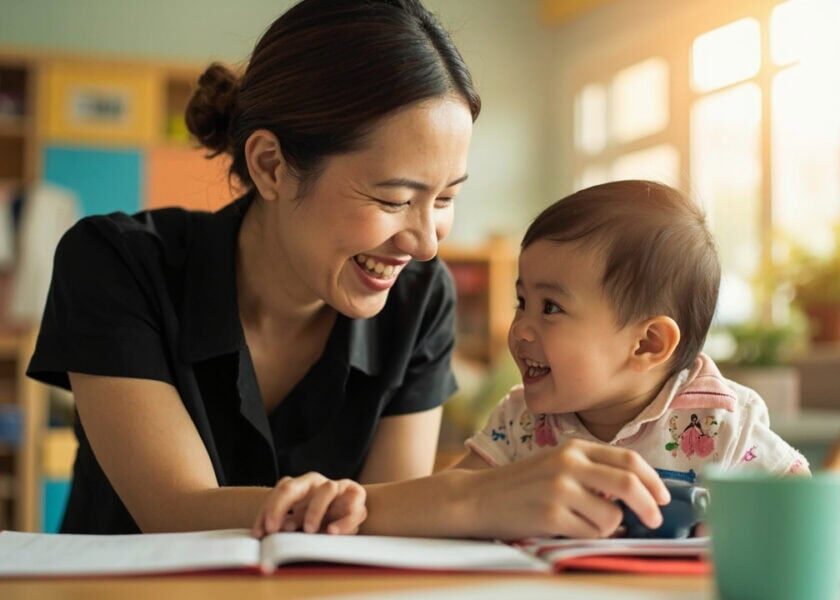
Children do not learn language from screens. This is worth stating plainly, because the temptation to believe otherwise is real. Children learn language from people. From real, responsive, interactive human beings who speak to them, listen to them, expand upon their attempts at communication, and surround them with the rich, repetitive, emotionally attuned language that the developing brain needs to wire its language circuits.
In the first year of life, your infant’s brain is exquisitely tuned to the sounds of human speech—better at discriminating between phonetic distinctions that adults can no longer hear than at discriminating between many other types of sound. This sensitivity is not permanent. It fades.
By the end of the first year, the child who has heard only one language begins to lose the ability to distinguish the sounds of other languages. This does not mean she cannot learn other languages later. But it does mean that the first year is a critical window, one that quality infant care recognizes and maximizes.
- Responsive interaction: Caregivers who listen to babbling as if it matters, who expand single words into sentences, who treat every attempt at communication as worthy of response
- Rich verbal environment: Reading, singing, narrating throughout the day—not as background noise, but as genuine engagement
- Singapore context: Exposure to Singapore’s multilingual environment, where quality care can introduce the sounds and rhythms of Mandarin, Malay, Tamil, and English
12–24 Months: The Social-Emotional Leap
Somewhere around your child’s second year, you will notice yet another transformation—one that may be as surprising as it is challenging. Your toddler, who was once content to play beside other children, begins to notice them. She may grab a toy, or protest when another child takes something, or follow another child around with an intensity that looks like obsession but is actually the earliest form of social interest.
Welcome to the world of social-emotional development.
This is perhaps the least understood of all developmental domains, and also the most consequential for long-term outcomes. The child who builds strong social-emotional foundations in the first years of life is building:
- The capacity to form healthy relationships
- The ability to regulate her own emotions
- The understanding of perspectives and feelings different from her own
- The persistence to continue when tasks are difficult
- The resilience to recover from setbacks
These are not soft skills. Research increasingly shows they are among the strongest predictors of adult wellbeing, educational attainment, and even physical health.
The infant who has formed a secure attachment with responsive caregivers has built the internal working model of relationships that will guide her social expectations for life. She expects that people will be available when she needs them, that her communications will be received and responded to, that the social world is fundamentally trustworthy.
This is not naivete. It is the secure base from which healthy exploration and risk-taking become possible.
- Consistent, warm relationships: Caregivers who stay with your child long enough for attachment to form
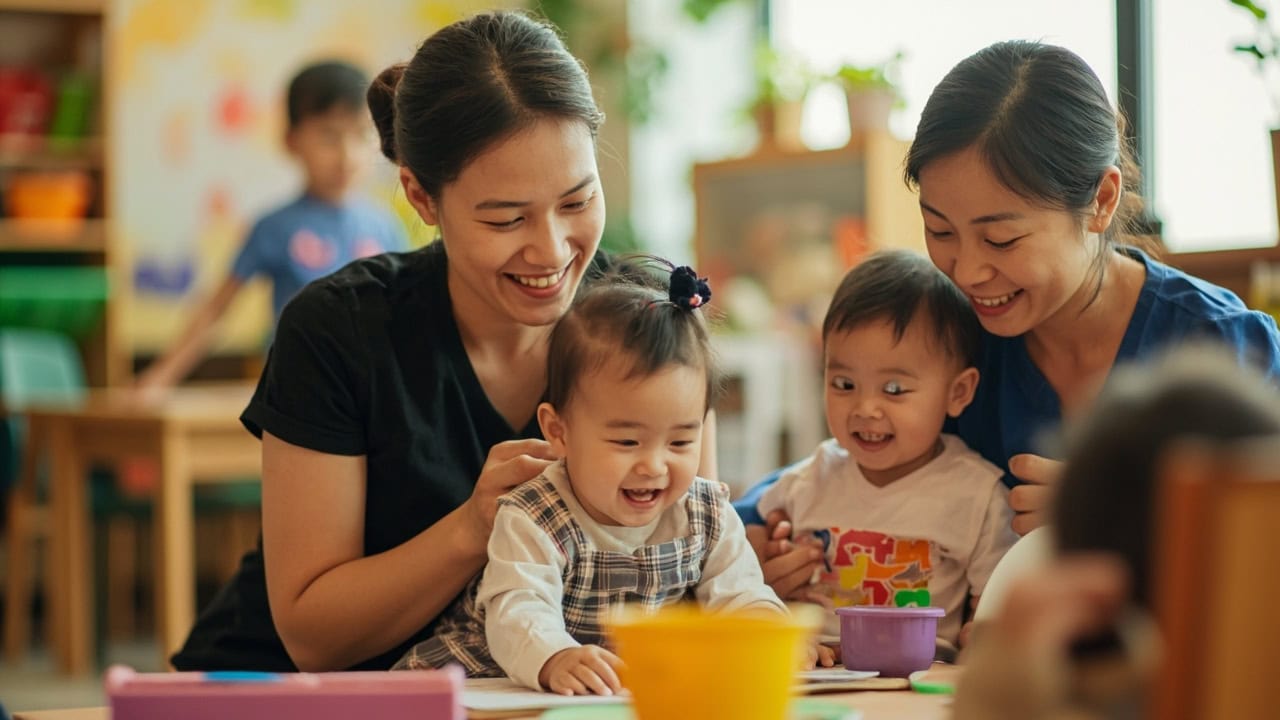
- Scaffolded peer interactions: Opportunities to practice social engagement with other children, with adult support when conflicts arise
- Emotional vocabulary: Naming feelings, validating them, and teaching strategies for managing frustration, disappointment, and anger
- Modeling: Caregivers who demonstrate the social behaviors they want children to learn—turn-taking, active listening, respectful negotiation
24–36 Months: Becoming a Person
As your child moves toward the end of the third year, you will notice something striking: she is becoming a person. Not a baby who happens to be larger, but a person with preferences, opinions, humor, and creativity.
She has ideas about what she wants to wear, what she wants to eat, what stories she wants to hear. She solves problems, generates hypotheses, tests them, revises them. She imagines scenarios and acts them out. She asks questions that you cannot answer.
This is the child who is emerging from three years of careful building. Not because anyone has done something magical, but because they have done something consistent.
The question we are often asked is: what should my child be ready for? Our answer is always the same: ready for life.
- Ready to approach new situations with curiosity rather than fear
- Ready to persist when tasks are difficult
- Ready to form healthy relationships with peers and adults
- Ready to communicate their needs and understand the needs of others
- Ready to learn because they have discovered that learning is joyful
This is what quality early care builds. Not children who can recite letters or count to one hundred. Children who are capable, confident, and complete.
Development Is Not a Race
Here is what we have learned, in our years of partnering with Singapore families, that parents often find most reassuring: development is not linear, and it is not competitive. Every child follows their own trajectory, and every trajectory is legitimate.
We live in a culture that can sometimes conflate development with achievement, early capability with future success. Parents worry that their child is not walking yet, not talking yet, not toilet trained yet, not reading yet. They compare their child to others and feel anxiety when the comparison seems unfavorable.
This anxiety is understandable, but it is also a misunderstanding of what development is for.
Development is not a race. It is an unfolding, a process, a journey.
The child who walks at ten months and the child who walks at fifteen months are both walking by age two. The child who speaks in sentences at eighteen months and the child who speaks in sentences at two and a half are both speaking in sentences by age three.
What matters is not the timeline but the direction, not the speed but the quality of the building.
Quality, in early development, means something specific: caregivers who notice, attune, and respond. Experiences matched to where your child is now, not where they “should” be. Environments that invite exploration, discovery, and growth. Predictable routines and relationships that build security.
What to Look For: A Practical Guide for Singapore Parents
You want to know that your child is genuinely growing, learning, and developing in childcare. That is a reasonable desire. Here is what to look for, and what questions to ask:
At the Infant Stage (0–12 months)
- Do caregivers speak to your baby before she cries, anticipating needs?
- Are babies held frequently, not just when feeding?
- Is there ample floor time for motor exploration?
- Do caregivers narrate what they are doing, building language foundations?
At the Older Infant and Toddler Stage (6–24 months)
- Are children given freedom to move, or are they in containers for extended periods?
- Do caregivers expand on children’s attempts at communication rather than just responding with yes or no?
- Are there opportunities for peer interaction, even if brief?
- Do caregivers help children manage frustration with words and strategies rather than just distraction?
At the Toddler and Preschool Stage (24–36 months)
- Does your child seem curious and interested in new things?
- Can she persist at a task even when it is difficult?
- Does she show awareness of other children’s feelings?
- Can she express her own needs and emotions in words?
Questions to Ask Any Provider
- What is the caregiver-to-child ratio, and why does it matter?
- How do you track and communicate my child’s development to me?
- What does a typical day look like, and how does it change as my child grows?
- How do you handle separation anxiety, feeding challenges, and sleep transitions?
- What training do your caregivers have in child development?
The EduNanny Singapore Approach
At EduNanny Singapore, our approach to infant care begins with understanding what we are actually doing: participating in the construction of your child’s brain.
This is why we maintain caregiver ratios that allow for genuine responsiveness. This is why we train our caregivers in the science of early attachment and development. This is why we build our days around feeding and sleep and sensory exploration in an environment that is not merely safe but actively enriching.
We know what we are building. And we take that responsibility with the seriousness it deserves.
Home-Based Childminding
We offer home-based childminding, which means your infant or toddler is cared for in the environment that is safest and most familiar to them—by caregivers who are trained, supported, and held to standards that meet or exceed what you would expect. For families who prefer it, we also offer community and centre-based pathways.
Partnership, Not Replacement
We know that Singapore families face pressures that families nowhere else quite understand. The cost of living, the demands of careers, the high expectations, the hours in traffic, the hours at work. We know that parents in Singapore love their children with an intensity that is sometimes almost painful, and that this love often comes bundled with anxiety about whether they are doing enough, being enough, providing enough.
This is why EduNanny exists. Not to replace you, but to partner with you. You are the expert on your child. We are the experts on early development. What your child needs is both.
Transparency and Trust
Communication matters so much to us. Parents receive regular updates about their child’s day, their development, their discoveries and challenges. Where CCTV measures are deployed, parents have visibility into the environment their child spends their days in. This is not about surveillance. It is about partnership.
- Care operates Monday through Friday, in blocks designed to match the rhythms of working family life
- Communication and payment systems designed so that CDA and Baby Bonus funds can be used
- Part of the ECDA Childminding Pilot, operating within a framework designed to make quality infant care accessible and affordable
A Final Reflection
Let us return to where we began. That moment you recognized, when you noticed something new in your child and wondered where it came from.
The answer, now you know, is that it came from everywhere.
From you—from the love and attention you have poured into them since before they were born. From their own inner drive to grow, to learn, to become. And from the environments and relationships that have surrounded them, shaping their developing brains with every experience, every interaction, every day.
We at EduNanny Singapore are honored to be part of that shaping. We do not take that honor lightly.
Every child in our care is a world in the making. And we know that what we do matters not just for the child in front of us, but for the adult they will become, the relationships they will form, the contributions they will make, the life they will live.
This is what quality childcare builds. Not just children who are ready for school, though they will be that. Not just children who are behind on nothing, though they will not be that either. It builds human beings who are capable of living fully, loving deeply, and contributing meaningfully to the world they will inherit.
We would be honored to build that with you.
If you are exploring infant care or childminding options in Singapore and would like to learn more about how EduNanny supports families, we invite you to speak with our team. Your child’s first thousand days are a foundation you cannot rebuild. We would be glad to help you build them well.
Learn more about EduNanny Singapore · Get in touch