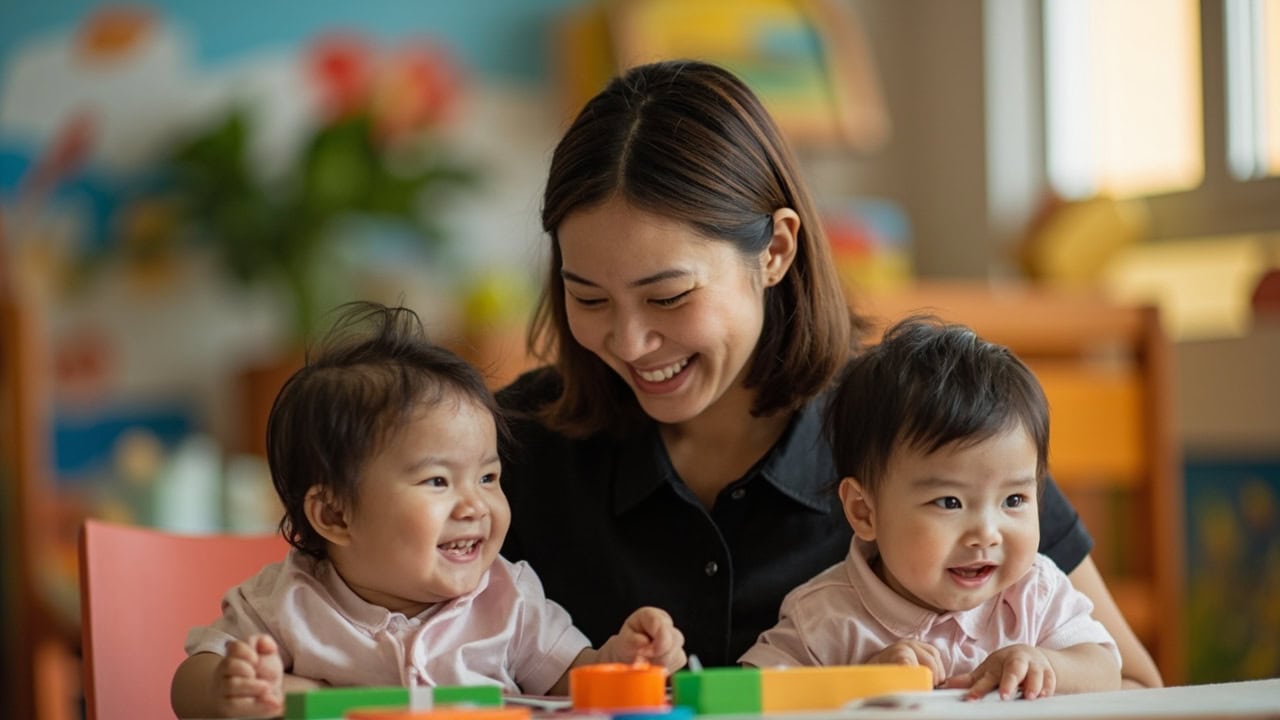
What Your Baby Absorbs During Those Unseen Childcare Hours
Quick Summary: What Your Child Absorbs in Their Unseen Hours
- Children experience environments differently than adults — their sensory systems are still developing, meaning they absorb everything: sounds, smells, light quality, emotional tones
- The first thousand days are extraordinary — the brain forms connections faster than at any other time, and sensory and emotional experiences during this window shape neural architecture for life
- Quality care addresses the whole child — not just observable behaviour but the internal sensory and emotional experience that parents cannot see
- Your instincts matter — you are the interpreter of your child’s inner life, and those observations are a form of deep knowledge
- The right environment makes a real difference — not visible in a single day, but accumulating over months and years into a child who is calmer, more curious, and more secure
The Invisible Architecture of Your Child’s World
A child’s senses do not develop in sequence. They develop together, woven into a single experience of being in the world. Long before your child has words to describe what they are experiencing, their entire sensory system is wide open, absorbing everything — the hum of an air conditioner, the particular quality of light in a room, the smell of hand lotion on a caregiver’s hands, the way a chair feels when they push against it with their feet.
These are not background details. For a child in the first thousand days of life, these are the raw materials of development.
Neuroscience has given us a way to understand what parents have always sensed intuitively: that young children do not experience their environment the way adults do. Their sensory systems are still forming. They lack the filters, the learned ignores, the neural shortcuts that allow us to screen out stimulation.
What we walk past without noticing, they feel fully. What we tune out, they absorb.
- The sound level in a room that feels normal to an adult can be overwhelming to a toddler
- The visual complexity of a cluttered space can be overstimulating rather than engaging
- The emotional tone of a space — warmth or tension, calm or chaos — registers not just in their minds but in their bodies
In Singapore’s climate, where air conditioning is constant and indoor spaces are the norm for much of the day, these sensory considerations become even more significant. The quality of artificial light, the ambient sound levels in a room of playing children, the air circulation and any associated scents — all of these register differently in a developing nervous system than they do in an adult’s.
This is the invisible architecture of early childhood. It is invisible because we cannot see it with our eyes. But it is architecture nonetheless — a structure that shapes everything that is built upon it.
Why the First Thousand Days Matter More Than You Know
You may have heard of the first thousand days. This is not a marketing phrase. It is a window of extraordinary developmental sensitivity that runs from conception through approximately the first two years of life — and in some frameworks, through the first three.
During this period, the brain forms connections at a speed it will never again achieve. The sensory systems calibrate. The stress response system learns what safety feels like and what danger feels like. The foundations of language, of social-emotional intelligence, of cognitive flexibility, and of physical coordination are all being laid — and they are being laid in response to the environment the child inhabits.
What this means for parents is both a responsibility and a gift. It means that the environments your child inhabits during these days matter in ways that are difficult to overstate. And it means that the work of finding quality care is not about ticking boxes or comparing credentials alone — it is about finding an environment that understands what your child is experiencing during those unseen hours and that is designed with that experience at its centre.
A Morning in Quality Childcare: What It Feels Like from Inside
Consider, for a moment, what a single morning in quality care might feel like to your child.
They wake, perhaps still drowsy, and the room they enter has a particular quality of light — not the harsh overhead glare that can feel clinical and destabilising, but a softer, warmer illumination that communicates: this is a place you can settle.
There is a smell in the air — not the sterile non-scent of industrial cleaning products, but something gentler, perhaps a natural scent used in small amounts that creates a sense of place and familiarity. The sounds are varied but not chaotic — the murmur of other children, the particular rhythm of a caregiver’s voice reading a story, the sound of their own hands working with a material, building something, figuring something out.
Around them, the space has a kind of spatial rhythm. Objects are arranged in a way that makes sense to a child — within reach, in a proportion that feels right, arranged to invite movement and discovery without overwhelming. There is room to move. There is room to be still. The space breathes.
And then there is the caregiver — not just present in body but attuned in that deeper way that young children are exquisitely sensitive to. The caregiver notices when a child’s body tenses and responds with a calm presence that communicates safety. They notice when a child is seeking connection and offer it in a way that meets the child exactly where they are. They notice when a child is becoming dysregulated and intervene before the child is fully overwhelmed.
This attunement is not something that can be scripted or systematised. It is a quality of presence that must be cultivated, supported, and valued as a core competency of quality care.
In this environment, a child’s nervous system learns something essential: that the world is a place where their signals are received, where their needs are met, where they are understood. This is not a small thing. This is the foundation upon which all future learning is built.
A child who feels safe is a child who can explore. A child who feels seen is a child who can grow.
What EduNanny Singapore Was Built to Hold
EduNanny Singapore was built on a simple but powerful premise: that quality infant and toddler care is not a transaction. It is a relationship. It is an environment. And it is, most importantly, a response to the whole child — not just their observable behaviour but their internal experience, their sensory world, their emotional landscape.
We are part of the ECDA Childminding Pilot, a government-supported initiative that recognises the vital role of childminding in Singapore’s early childhood ecosystem. This pilot makes quality care more accessible and more affordable for families, with fee structures designed to reduce the financial burden that so many parents carry.
It opens pathways both for families who prefer home-based care — where a trained childminder cares for your child in a familiar, smaller-scale environment — and for those who choose community or centre-based arrangements that offer their own rhythms of learning and connection.
In infant care settings within this framework, ratios are kept intentionally small — up to one to three infants per caregiver — because the reality is that newborns and toddlers do not benefit from being part of a large group. They benefit from being seen.
We know that Singapore parents need more than philosophy. You need to know what is happening when you are not there. You need to feel that the invisible world your child inhabits is not actually invisible to the people caring for them.
That is why communication and transparency are woven into how EduNanny operates — where measures such as CCTV are deployed, parents have visibility into the environment. That is why regular updates, open dialogue, and genuine partnership with families are not extras but part of how we work.
Practical matters matter too: Monday to Friday care blocks that align with working life, the ability to use your Child Development Account and Baby Bonus funds, options that work within the rhythms of Singapore family life. These are not secondary concerns. They are how we make quality care a real possibility, not just an aspiration.
Your Role as Parent: The Interpreter of Inner Life
So what is your role, as a parent, in all of this?
You are not an evaluator. You are not a quality auditor. You are something more profound: you are the interpreter of your child’s inner life.
You are the one who knows the particular quality of your child’s laughter, the specific way they seek comfort, the unique texture of their curiosity. You are the person who notices when something has shifted — not because of anything you were told, but because of something you sensed in the way your child moved through the evening, or reached for you at pickup, or talked about their day in the language they are still learning.
This is not a burden. It is a gift. Because it means that your instincts are not something to override or second-guess. They are a form of deep knowledge that deserves to be honoured.
When you choose a care environment, you are not looking for a service that merely satisfies a checklist. You are looking for a place that will see your child the way you do — a place that will hold the invisible world with the same care and attention you bring to it.
Questions Worth Sitting With
- How does the space feel when you walk in? Not just to you — but notice how your child responds. Are they drawn to explore, or do they cling? Do they seem tense or relaxed?
- What is the sound environment like? Is there a constant hum of noise, or is there variation and rhythm? Can you hear the difference between a space for active play and a space for quiet?
- How does the light feel? Harsh overhead lights, or warmer, more diffused illumination that feels settled rather than stimulating?
- How do the caregivers interact with children who are not their own? Are they warm, responsive, patient? Do they notice small moments of distress or need?
- What is the ratio of caregivers to children? Especially for infants and toddlers, smaller numbers allow for the attunement that matters most.
- How do they communicate with parents? Is there a genuine partnership, or does it feel like a transaction at pickup?
- When you observe, do the children seem at ease? Not perfectly behaved — children in quality care are allowed to be fully themselves. But do they seem safe?
No checklist will answer every question. But these observations, combined with your own instincts as your child’s interpreter, will give you a picture that no brochure can provide.
Addressing the Concerns You Carry
Singapore parents face real pressures: the cost of quality care and the weight of that financial commitment, the logistics of two-career households and the rhythms of working life, the guilt that can accompany even the most thoughtful decision to return to work, the uncertainty of whether the choice you have made is the right one.
These are not weaknesses. They are the honest costs of loving deeply. And they deserve an answer that is more than reassurance — they deserve a different kind of care.
If you feel guilty about leaving your child, know this: the guilt you carry is not a sign that you are making the wrong choice. It is a sign that you take this responsibility seriously. Children are shaped by many environments — and a thoughtfully chosen, quality care environment is one of them. What matters is not whether you are present every moment, but whether the environments your child inhabits are worthy of them.
If you wonder how to know what is really happening when you are not there, look for a care arrangement that offers transparency — regular updates, open communication, visibility into the daily environment. Ask how they handle moments of distress or transition. Ask to observe, more than once, at different times of day. The best care will not just allow this scrutiny — it will welcome it.
And if you worry about making the wrong choice: you will make the best choice you can with the information you have. And then you will continue to observe, to listen to your child, to trust your instincts. Quality care is not a single decision — it is an ongoing relationship that includes the ability to adjust as your child’s needs change and as your understanding deepens.
The World Your Child Is Living Inside Right Now
There is a truth that every parent comes to understand in their own time: that the most important things are often the ones that cannot be seen.
The way your child feels when they are held. The way they light up when they discover something new. The way they carry a memory of safety into a room full of strangers. These are not measurable. They do not fit on a report card. But they are the things that matter most.
Your child is living inside an environment right now — whether it is with us or elsewhere — that is shaping who they are becoming. They are absorbing sounds and smells and textures and light and the particular quality of a caregiver’s voice. They are building a sense of whether the world is a safe place. They are forming memories that will not surface in words for years but that are already influencing how they see themselves, how they relate to others, how they trust.
You cannot be in that room with them. But you can choose a room that deserves to hold them. You can choose a place that understands what it means to be small in this world and that takes that responsibility with the seriousness it deserves.
EduNanny was built to be that place. Not because we have all the answers — no one does — but because we are committed to the question. We ask, in every decision we make: what is this like for the child? What are they sensing? What are they feeling? What are they building inside themselves that we cannot see but that will matter for the rest of their lives?
This is not the kind of question that leads to easy answers. But it is the kind of question that leads to better care.
We cannot show you the invisible architecture of your child’s day. But we can promise you that it is something we think about — in the design of our spaces, in the training of our caregivers, in the rhythms we create, in the way we receive your child each morning and release them each afternoon.
Your child is living inside a world you cannot see.
Let it be a good one.
Ready to explore what quality infant and childminding care looks like at EduNanny Singapore?
We welcome you to schedule a conversation, visit our environment, and learn more about who we are and what we offer. Choosing care is one of the most important decisions you will make — and we are here to support you through it with honesty, warmth, and the genuine care your child deserves.
We also invite you to learn more about our participation in the ECDA Childminding Pilot and how this makes quality, subsidised care more accessible for Singapore families.