Genuine Attunement: The Childcare Standard Worth Demanding
The Question That Keeps Singapore Parents Awake
Singapore parents are extraordinarily diligent. They research ratios and compare environments. They ask about meal plans, screen time policies, and developmental milestones. They read reviews, tour centres, and cross-reference frameworks. These are not the wrong questions to ask. But they are not the question that surfaces at 2 a.m. when the house is quiet and your child’s tomorrow looms.
The question that keeps you awake is this: Will the person caring for my child in those quiet, formative hours truly know them? Not in the way a responsible professional knows their charge, but in the way that matters to your child’s sense of safety and to your own peace of mind.
Will they notice when my child is not quite themselves today? Will they understand the difference between my child’s particular way of expressing need and another child’s entirely different way? Will they care about the answer?
Most childcare conversations avoid this question because it feels too vulnerable to name. It sounds soft, subjective, unmeasurable. And so we default to what can be evaluated: ratios, certifications, facility cleanliness. But the relational quality of care is where the actual work happens. It is what your child’s developing nervous system responds to—and what determines whether early childcare becomes a foundation or an obstacle.
What Genuine Attunement Looks Like in Daily Practice
The observable truth of relational quality is simpler than we make it. You can see it in moments so small that we are trained to overlook them.
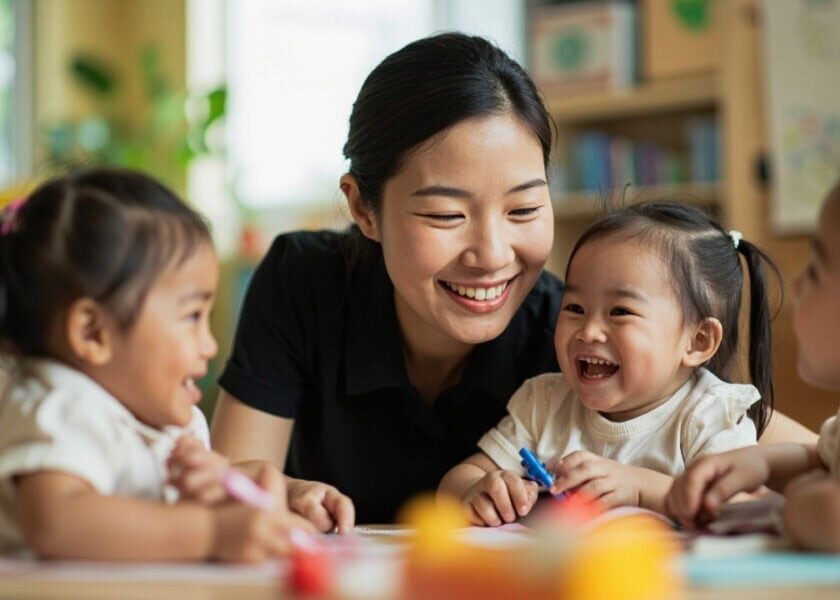
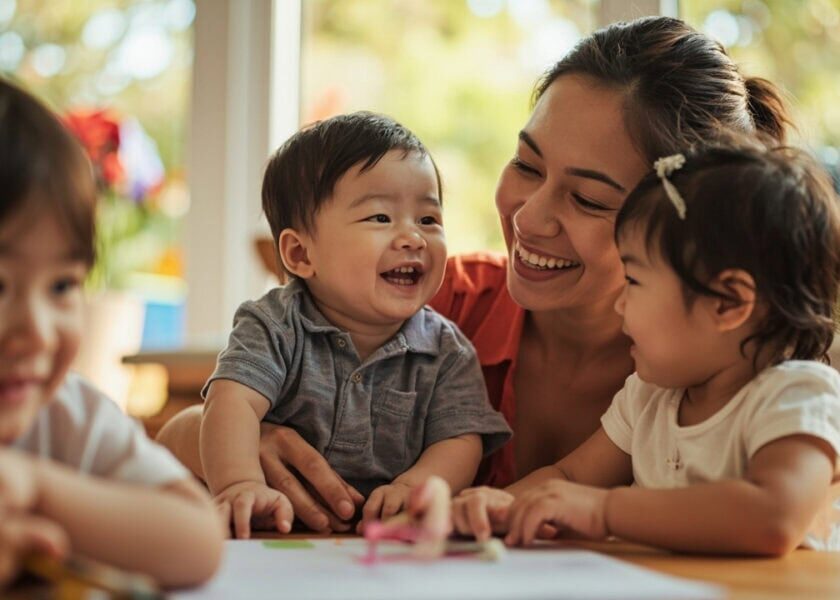
Consider the caregiver who bends down to a child’s level—not just physically but attentively—before speaking. There is a quality to that attention that a child can feel and an observant parent can notice. It is not performed. It is simply present.
Consider the pause before a response. In a world of rapid, habitual reactions, the caregiver who pauses suggests that what the child said was actually heard and considered rather than filed away. This is not a technique. It is a disposition—one that becomes visible in the small gaps between interactions.
Consider the caregiver who notices that today, this child who usually runs toward the sandpit has chosen to sit with the blocks instead, and who gently acknowledges that shift without making a production of it. “I see you’ve decided to build today.” That noticing—simple, specific, unforced—is the grammar of a relationship.
A child’s nervous system learns language from that grammar long before they can articulate what they are learning. Here is what attuned caregiving looks like when it is working well:
- The caregiver notices when a child’s play has shifted from exploratory to frustrated and offers a subtle extension—a question, a material, a moment of shared attention—that re-engages without taking over.
- The caregiver notices when a child needs proximity and offers it naturally, without being summoned.
- The caregiver notices when a child’s verbal expression does not match their emotional state and gently names what might be underneath—helping the child learn that their inner experience is legible, and that another person can help them understand it.
This kind of attunement is not soft or sentimental. It is the most rigorous form of childcare, because it requires the caregiver to be genuinely present to a specific human being in each moment rather than executing a routine or maintaining a pleasant atmosphere.
How Children Reveal Their Care Relationships
Children do not hide their care relationships. They reveal them in ways that bypass our adult defenses and filters.
A child who feels genuinely safe with their caregiver will not perform safety. They will simply be present in a way that is qualitatively different. You may notice it in how they move through the morning drop-off—not the absence of reluctance, because even beloved caregivers experience the pull of parent-attachment, but the willingness to turn back, to engage, to trust that the transition will be manageable because the person on the other side is steady, warm, and known.
You may notice it in how they speak about their caregiver at home. Not in effusive praise—young children rarely offer that kind of commentary—but in the small details they choose to share. The caregiver who sang a special song today. The caregiver who helped them build something that collapsed and who helped them try again. The caregiver who noticed they were tired and sat with them quietly.
These are the data points of connection, and they are available to any parent who is paying attention. When you hear your child mention these moments, pay attention. They are telling you something real about what is happening in those hours when you are not there.
What the Right Conditions Make Possible
This is the anxiety that sits deepest for Singapore parents, and it deserves honest acknowledgment: You are not just looking for evidence that things are good. You are looking for evidence that you would know if things were not good—that your child’s caregiver would tell you, that they would notice, that the systems and structures around them would catch what might otherwise be missed.
Quality in infant care is not primarily a product of curriculum design or facility design, though those matter. It is primarily a product of human attention, and human attention requires the right conditions to exist.
The caregiver who is rushing from activity to activity, who is managing a group size that leaves no room for pause or spontaneous play or following a child’s lead rather than a schedule, cannot offer your child the quality of presence that transforms early experience into developmental fuel. This is true regardless of how caring or well-trained that caregiver may be.
When a caregiver can only half-see your child because they are perpetually split between three others who are also needing something, the quality of connection suffers in ways that are invisible in the short term but accumulate over time. This is not a criticism of caregivers who work in under-resourced environments. It is a recognition that the best intentions require the right conditions to flourish.
With thoughtful ratios, caregivers have the space to actually know the children in their charge. They are not managing seven infants while trying to notice subtleties. They are present, available, and able to attend to the small shifts in mood or need that tell them something important about a child’s day. Communication structures that are in place—not just for emergencies, but for daily transparency—create the conditions for you to be genuinely informed about your child’s day. This is not surveillance. It is the basic architecture of trust: you can know what is happening, and you can be told when something matters.
The Parent’s Role: Partnership, Not Surveillance
Too often, the conversation about childcare positions parents as consumers making a purchase decision, or as partners in an abstract institutional sense, or as anxious observers whose input must be managed. Here is a different framing.
You are not a consumer. You are the primary knowing presence in your child’s life, and no childcare arrangement, however excellent, can replace or replicate what you offer. What the right model makes possible is not a substitute for your relationship with your child. It is an extension of your values into the hours when you are not present—a complement, not a replacement.
This means that your role in supporting the caregiver relationship is not peripheral. It is essential. When you communicate genuinely with your child’s caregiver—sharing the small truths about your child’s moods, preferences, and the things that have been happening at home—you are offering information that makes attunement more precise.
When you speak about the caregiver in your child’s presence with respect and warmth, you are teaching your child that this person is trustworthy. When you approach the relationship with openness rather than surveillance, you create the conditions for the caregiver to be fully present rather than defensively performing competence.
There is a kind of trust that is earned through management and oversight, and there is a kind of trust that is earned through genuine human attention over time. The first kind has its place. The second kind is what your child actually needs. And the second kind can only exist when both caregiver and parent are allowed to be fully human with each other—imperfect, learning, open to feedback, committed to the child’s wellbeing.
What to Look For: Practical Guidance for Singapore Parents
When evaluating infant care options in Singapore, here is what to look for beyond the brochure:
- Observe the caregiver’s attention, not just the environment. Watch how they speak to and about the children—not scripted warmth, but genuine engagement. Notice whether they seem rushed or present.
- Ask about ratios and what they enable. A good ratio is not just a number. It is the condition for genuine knowing. Ask how caregivers actually spend their time.
- Inquire about how they handle the moments that matter. Not just their policy on sleep or feeding, but how they respond when a child is distressed, when a routine breaks down, when something unexpected happens. Listen for specificity and attunement in their answers.
- Notice the communication structures. How will you know what happens in a day? How are concerns escalated? Can you speak freely with your child’s caregiver?
- Trust what your child shows you. After a settling period, pay attention to how your child moves through drop-off, what they share about their day, and how they behave at home. Children reveal their care relationships honestly.
The Bigger Picture: Singapore’s Investment in Early Childhood
We live in a city that is deeply committed to the development of its children. Singapore invests in early childhood education in ways that many countries do not. The infrastructure of ECDA, the support for pilot programs, the integration of subsidy structures and parental leave policies—all of this reflects a collective understanding that the early years matter enormously.
But there is a difference between investing in childcare systems and investing in the relational quality of care. The first is measurable, fundable, and politically legible. The second is harder to quantify, harder to inspect, and requires a kind of sustained institutional commitment that goes beyond compliance.
Some organizations have chosen to invest in the second—not as a marketing position or a brand differentiator, but as a conviction about what children actually need and what the people who care for them are capable of when given the right conditions.
The caregivers in such a network are not interchangeable workers executing a service. They are trained professionals who understand the developmental significance of their work and who are supported by a structure that allows them to do it well. This matters for your child. It also matters for the caregivers themselves—the work of caring attentively for infants and young children is profound, and those who do it deserve to be trained, supported, and valued as the professionals they are.
The Question Worth Asking
There is a question that Singapore parents often do not know how to ask, because it sounds too simple, too subjective, too soft for the kind of decision they have been taught to treat as administrative.
The question is this: Is the person caring for my child going to notice them? Are they going to care about their happiness, their comfort, their small daily triumphs? Are they going to hold my child’s experience as important?
This is not a question that can be answered by a tour or a brochure or a regulatory compliance certificate. It can only be answered over time, through the evidence of your child’s behavior, through the quality of communication you receive, through the small daily moments that reveal whether the person in your child’s life is truly with them.
What the right model can offer is a system designed to make that question answerable in the affirmative—not perfectly, because humans are involved and humans are imperfect, but reliably, consistently, and with genuine institutional commitment. The ratios allow for genuine knowing. The training supports attunement. The communication structures create transparency. The culture values the relational dimension of care as much as the structural one.
And what is asked of you is this: pay attention. Trust what you see. Communicate openly. Allow the relationship to develop. Understand that your role is not to manage or audit but to partner with someone who is walking alongside you in the raising of your child.
Because that is what this is. Not a service transaction. Not an institutional placement. A relationship, supported by structures that protect it, that gives your child the experience of being truly known in those crucial, foundational hours of their lives.
Your child is ready to be known. They have been ready since the day they were born. What matters now is finding the conditions that make that knowing possible—day after day—in the hands of people who have chosen this work and who do it with the seriousness and care it deserves.
Ready to explore what thoughtful, development-oriented childminding looks like in Singapore? Speak with our team to understand how the EduNanny ECDA Childminding Pilot model creates the conditions for genuine caregiver attunement—ratios that allow for real knowing, training that supports responsive care, and communication structures that keep you connected to your child’s day.
Learn more about who we are and the ECDA Childminding Pilot programme, or visit edunanny.com to begin a conversation.
#SingaporeChildcare #InfantCareSingapore #ChildmindingSG #EduNannySingapore #EarlyChildhoodDevelopment