The Evidence Singapore Parents Learn to See in Their Own Child
The Quiet Moment Every Singapore Parent Knows
There is a particular kind of quiet that settles into a Singapore home in the weeks after a parent returns to work. It is the quiet of a door closing behind you, and then another door opening somewhere else. It is the quiet of a photograph sent by a caregiver at midday, and the half-second pause before you open it, when something in your chest tightens without quite knowing why.
You are not worried that your child is in danger. You chose carefully. You read the reviews. You visited the centre, or you welcomed someone into your home, and you felt the warmth in the room, and you thought, yes, this feels right.
And then you left. And now you are at your desk, and the photograph arrives, and you find yourself doing something that every parent in Singapore does, something so ordinary and so telling that we rarely name it.
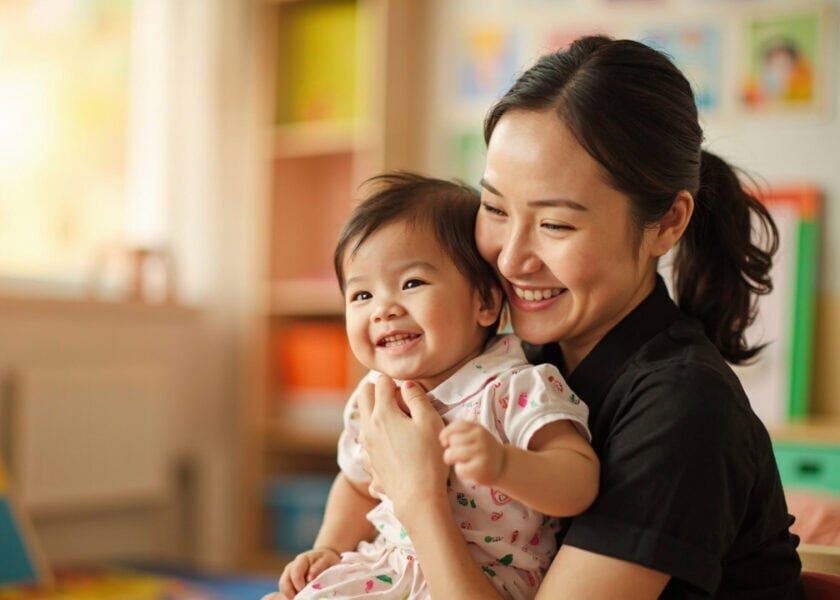
You search the image for evidence. You are looking for a sign — of happiness, of belonging, of the particular quality of ease that would tell you, without a doubt, that your child is all right.
That searching is not weakness. That searching is not distrust. That searching is the beginning of something that most parenting guides never properly name, something that sits at the very heart of what it means to raise a child in a city where the choices are many and the certainty is hard-won.
What you are doing, in that quiet moment with your phone in your hands, is trying to read your child.
You Are Closer to the Answer Than You Know
What we want to tell you today is this: you already have access to the most important information about your child’s care. You see your child every morning. You know the particular way she stiffens when she is working something out, the way his face changes when he is about to cry, the sound she makes when she is genuinely amused rather than politely so.
You know your child. The challenge is not access. The challenge is learning to trust what you already see.
This is what we call observational fluency — and it may be the single most important skill a parent in Singapore can develop. Not because it replaces good judgment, but because it transforms good judgment from something borrowed from others into something that belongs to you.
The Difference Between Watching and Understanding
Fluency is not the same as watching. Watching is passive. You can watch your child all day and still feel uncertain. Watching is what you do while scrolling through parent forums at midnight, looking for someone who has already lived the answer you need.
Fluency is the ability to take what you see and understand what it means. It is the difference between hearing a language spoken and being able to speak it yourself.
A parent with observational fluency does not need a checklist to know that something has shifted in her child over the past month. She notices it in the way her daughter greets the caregiver now — not with the hesitant sideways glance of the first weeks, but with a quick, almost conspiratorial look, as if to say, yes, she is here, and I know what that means.
A parent with observational fluency does not need a report card to know that his son is absorbing something from the rhythm of his days. He sees it in the way the boy has started lining things up, in the newfound patience with which he watches a ladybug crawl across the railing, in the half-sung melody that appeared out of nowhere last Tuesday evening and has not left since.
These are not dramatic revelations. They are small. They are quiet. And they are, in fact, exactly the kind of information that tells you whether your childcare is working — not because someone else told you what to look for, but because you have learned to see it for yourself.
Why Singapore Parents Look Outside Themselves
There is something worth naming about the particular pressures that Singapore parents carry. This is a city that runs on precision. We plan our pregnancies around career timelines. We think about school zones before our children can walk. We are, by nature and by necessity, exceptional planners, and that orientation serves us well in so many ways.
But it can create a peculiar tension when it comes to something as organic and unpredictable as a child’s development. Because growth arrives in its own time, in its own order, and it shows up in moments so small that they are easy to miss — unless you have trained yourself to notice.
A Singapore parent, more than almost anywhere else, is surrounded by benchmarks. Developmental milestones are listed on well-designed infographics. Weight charts appear at every clinic visit. Somewhere, someone has already written a blog post about exactly when your baby’s first word should arrive, and by which month she should be pulling to stand, and whether the fact that she is not yet doing either of these things is a reason for calm or concern.
And so a parent notices these things and then does what she has been taught to do. She looks outside herself for the answer. She Googles. She asks. She compares. And in that looking outward, she sometimes loses sight of the very thing that is most informative: her own direct, daily, unhurried observation of her own child.
This is not a failure of intelligence. Singapore parents are some of the most well-researched, deeply engaged parents in the world. It is simply that the culture of validation we have built around childcare decision-making can make a parent feel as though her own perception is the last piece of evidence to be trusted — as though the opinion of a stranger on a forum carries more weight than the morning she watched her child deliberately put a toy into a container and then take it out again, six times in a row, with absolute concentration in her eyes.
That morning was not ordinary. That was a milestone. That was a window into a mind that is building, that is growing, that is doing exactly what it is supposed to be doing. And the parent who sees it and wonders if it means anything, who hesitates to trust what she saw — that parent has been let down by a system that taught her to look everywhere except at the most obvious and important place: directly at her child.
How Observational Fluency Develops Over Time
Observational fluency is not a gift that some parents have and others do not. It is a practice. It deepens over time, and it changes everything about how you experience your child’s early years.
The First Weeks: When Everything Feels Uncertain
In the first weeks of a new childcare arrangement, most parents are in a kind of survival mode. You are adjusting. Your child is adjusting. There may be tears in the mornings — yours or hers or both — and the days feel long and the updates feel insufficient and the photographs feel like proof of life rather than windows into flourishing.
This is normal. This is the beginning. And it is precisely the time when observational fluency is most difficult to practice, because everything feels uncertain and you are not yet sure what you are looking at.
The Shift: When Your Eye Sharpens
But then something begins to happen. Slowly, over the weeks, your eye sharpens.
You start to notice the way your child responds when you say the caregiver’s name at home — the quick lift of the head, the almost electric alertness, the beginning of recognition that has nothing to do with words yet and everything to do with trust.
You notice that the morning goodbye is getting shorter, not because your child cares less, but because she trusts the sequence. Drop-off. Brief warmth. And then a small hand releasing yours with confidence, not abandonment.
That is data. That is the clearest signal you could ask for about the quality of the relationship your child is building.
The Signs of Growth You May Be Missing
You begin to notice the language that is appearing — not just the words, which are exciting and shareable and which grandparents rightly celebrate, but the quality of the communication itself:
- The pointing
- The gesturing
- The way your child brings you objects not to give you the object but to share the experience of showing you something
- The way she looks at your face after she shows you something, searching for your reaction, and the way that look is becoming more specific, more purposeful, more like a conversation
These are not things that appear on a checklist. They are not things that a review can fully capture. They are the actual texture of your child’s development, and you are the one who is closest to them.
The Profound Shift
This is where the shift happens — and it is a profound one. It is the shift from being a consumer of childcare, searching for reassurance from outside, to being a partner in your child’s development, reading the evidence of growth with your own eyes.
It does not mean you stop asking questions or seeking support. It means that the foundation of your confidence is no longer borrowed. It is rooted in something real and close and irreplaceable: your own sustained, attentive relationship with your child.
What Quality Childcare Looks Like — and Why It Matters
We want to be honest with you, because honesty is part of what we are building at EduNanny, and because Singapore parents deserve more than reassurance. They deserve clarity.
EduNanny is part of the BUTLER family, and we participate in the ECDA Childminding Pilot — a government-supported initiative that reflects something important about how Singapore is thinking about the future of early childhood care. That future is not one-size-fits-all. It recognizes that different families have different needs, and that for infants and very young children, the quality of individual attention matters in ways that aggregate statistics cannot fully capture.
The Structural Conditions That Support Observation
What does quality look like in practice? Consider these elements:
- Ratios that allow true knowing: Up to one caregiver to three infants in infant rooms — not a number from a marketing deck but a genuine structural commitment to proximity
- Consistency that builds rhythms: Monday through Friday care blocks that give families the consistency they need to settle into patterns rather than constantly adjusting to change
- Communication that keeps you in the picture: Transparent, ongoing sharing — photographs, updates, the kind of information flow that supports your own observation of your child
- Transparency where it matters: Where CCTV measures are in place, they serve a quiet, practical purpose — creating a layer of clarity that supports trust
- Accessibility: Fee structures within the pilot’s affordability framework, pathways through the Child Development Account and Baby Bonus contributions, because observational fluency is not a skill that only parents with certain resources can develop
The Caregiver Is Not a Background Figure
The childminder in your home, or the infant educator in your community, is not a background figure. She is not a logistics solution or a convenient service. She is a person who is doing some of the most important work that exists — holding the daily conditions of your child’s early experience, often with far less recognition than she deserves.
At EduNanny, we believe that the quality of care a child receives is inseparable from the way the caregiver herself is regarded. A caregiver who feels respected, trained, and supported does not merely follow protocols. She notices. She responds. She builds the kind of knowledge about your child — his particular rhythms, his sensitivities, his joys — that no manual can provide.
The brain of a child in her first thousand days is building at a rate that will never be matched again. Every interaction — every warm response to a cry, every patient waiting while a clumsy hand tries to grasp a cup, every playful exchange that makes a baby laugh out loud — is shaping neural architecture that will underlie everything that follows: the ability to regulate emotion, to focus attention, to form relationships, to learn.
The caregiver is not a babysitter filling time. She is an active participant in the most consequential developmental period of your child’s life.
The Partnership Model
This is what distinguishes a thoughtful childcare arrangement from an adequate one. It is not the fancy curriculum or the branded facilities. It is the depth of the relationship that can form when there are enough attentive adults and enough consistent days and enough genuine communication to allow a parent to see what is actually happening.
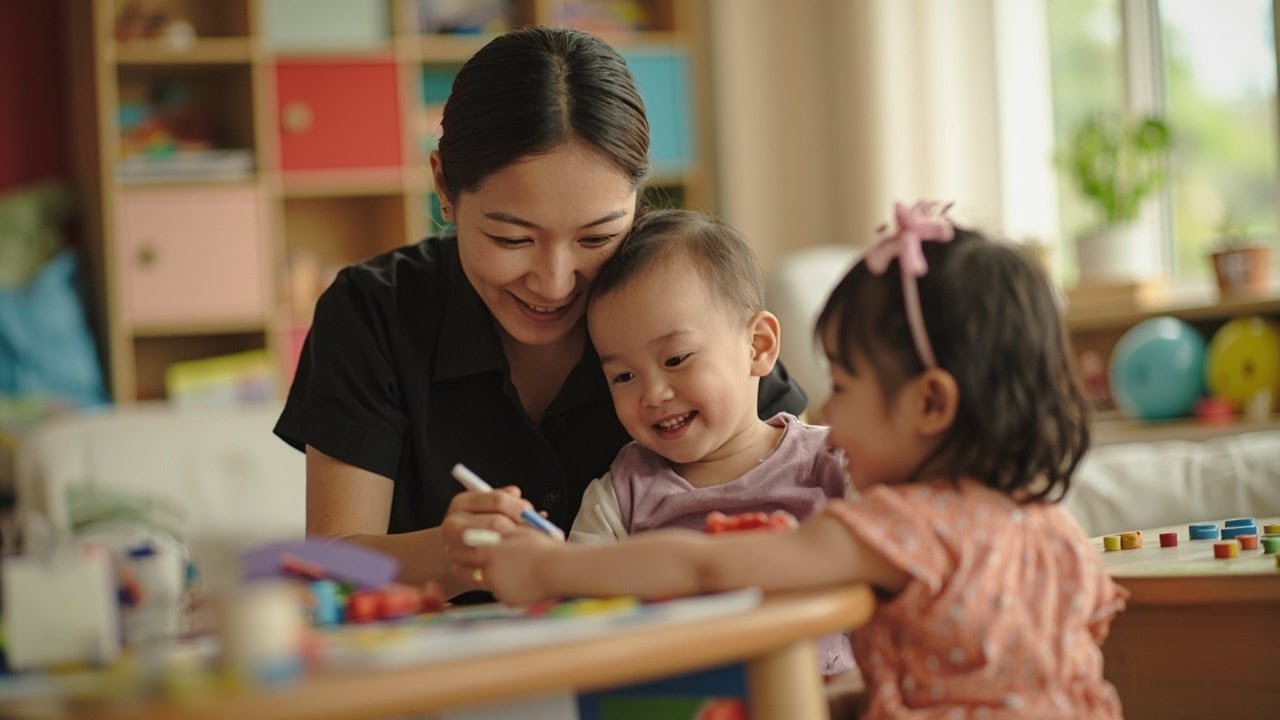
When that is in place, something remarkable becomes possible: the parent and the caregiver become partners in observation. They are both watching the same child. They are both noticing the same small eruptions of growth. And they are both contributing to a shared understanding of who this particular child is, and who she is becoming.
A caregiver who observes your child closely will tell you what she sees. She will say, I noticed today that he spent fifteen minutes watching the way the leaves moved in the wind, and he was completely still, and I think something is shifting in his ability to sustain attention.
She will say, She has started doing something new — when she drops a toy and it bounces, she looks at me before looking at the toy, as if checking that I saw it too.
That is not small talk. That is developmental intelligence, shared in real time, and when it enters your awareness as a parent, it sharpens your own ability to notice.
This is the conversation we want every parent in Singapore to be able to have with the person caring for their child. Not a transactional exchange of updates, but a genuine dialogue about growth — informed, specific, rooted in shared observation of an actual human being who is becoming more herself every single day.
You Do Not Need to Become an Expert
Here is what is, perhaps, the most quietly revolutionary idea in everything we have talked about today.
You do not need to become an expert in child development to know your child. You do not need to memorize the milestone charts or complete a certification or read the latest research to be able to tell whether your child is growing in healthy, responsive, nurturing conditions. What you need is the willingness to stay present with what you are already seeing, and the confidence to trust that what you are seeing is real.
Because here is the thing that no childcare review can tell you, and no expert checklist can capture: your child is already showing you who she is.
- Every morning when she reaches for you and then, a little while later, reaches for the day
- Every afternoon when she brings you a book and sits in your lap with her whole body, not just her body but her trust
- Every evening when she says something — a word, a sound, a name — and you hear in it the accumulated weight of a day spent in the world, learning, absorbing, growing
These moments are not decorative. They are the evidence. They are the data points that no algorithm can generate and no review can substitute.
Addressing Common Parent Concerns
How do I know if my child is truly happy in care?
Look for the signs of genuine ease rather than mere tolerance. A child who is happy in her care environment will show you through her body language — the way she moves toward the caregiver, the way she settles into activities, the way she greets you at pickup not with desperate clinging but with the confident warmth of someone who has had a good day and is glad to see you. These are not written in any checklist. They are written in your child, and you are the one who knows how to read her.
What if I miss something important?
You will not miss what matters most, because what matters most tends to show up repeatedly and consistently. A child who is not developing well in care will show you through patterns — changes in behavior, in sleep, in appetite, in the quality of her engagement. These patterns are hard to miss if you are paying attention, and you are paying attention because you are her parent. The caregiver adds another set of eyes, not a replacement for yours.
What if my child has a bad day — does that mean something is wrong?
A single difficult morning does not indicate a problem. Children have hard days. They have preferences they cannot articulate, small frustrations that seem enormous from the inside, mornings when leaving you feels impossible even though leaving you yesterday felt manageable. What indicates a problem is consistency — a pattern of distress that persists over weeks, a change in your child’s baseline that does not resolve.
What indicates health is resilience — your child having hard moments and recovering from them, building trust in the routine, learning that separation is survivable and that the people caring for her are reliable.
How do I evaluate childcare without becoming obsessed?
Set a clear baseline for what matters most: Is my child building a relationship with this caregiver? Is she settling into the rhythm of her days? Is she growing in the way I would expect, based on what I know of her? Then let the small details sort themselves out. You do not need to evaluate every photograph for signs of optimal stimulation. You need to stay present and attentive, and trust that the larger picture will become clear over time.
A Path Forward — Starting Today
There is a moment, if you stay present and attentive over the weeks and months of your child’s time in care, when something shifts. It usually happens quietly.
You realize that you have stopped reaching for your phone at midday to search for reassurance. You realize that when the caregiver tells you something about your child’s day, you already half-knew it — not because you have ESP, but because you have been watching, and the watching has been building into something deeper.
You realize that you can look at your child at the end of a long day and read in her face the whole story of what she experienced, and that the story is good, and that you know it is good not because someone told you but because you have learned, slowly and carefully, to trust your own eyes.
What You Can Do Starting Today
- Notice before you decide. Before you choose a childcare arrangement, spend a few days simply noticing your child — her rhythms, her responses, the way she communicates without words. This becomes your baseline.
- Ask about observation practices. When evaluating a caregiver or centre, ask how they share what they observe. Look for partners who want to build your observational fluency alongside theirs.
- Trust the early signs. In the first weeks of a new arrangement, trust that the uncertainty is normal and that your ability to read your child will sharpen over time.
- Build the dialogue. Share what you observe at home with the caregiver. Ask what they observe during the day. Over time, you will find that you are both watching the same child and building a shared understanding.
- Let go of the need for constant reassurance. You do not need to feel certain every single day. You need to stay present, keep noticing, and trust that the larger picture will emerge.
The Partnership We Are Building Together
You came to this moment — to the search for childcare, to the careful weighing of options, to the decision to trust someone else with the most precious thing in your life — and it would be easy to frame that as a handing off. A delegation. A necessary compromise in a city that demands so much of its parents.
But we do not see it that way at EduNanny. We see it as the beginning of a collaboration — between you and your child, between you and the caregiver, between the structures and support that Singapore is building through its pilot programmes and the intimate, irreplaceable, day-by-day knowledge that you are building about your own child.
This is what EduNanny is here for. Not to tell you what to see, but to create the conditions — the ratios, the consistency, the communication, the trained and attentive caregivers, the transparent and respectful partnerships — in which you can see it for yourself. We are not here to replace your judgment. We are here to support it, and to trust it, and to help it grow.
Begin Today
What we want you to know — what we want you to carry with you, not as a slogan but as a quiet, steady conviction — is this:
You are already doing this.
You are already watching. You are already noticing. You are already reading the small, extraordinary signs of your child’s growth and wondering what they mean. You have been doing it since the day she was born, and you have been doing it so well that you may not have noticed how skilled you are becoming.
So stay with it. Trust it. Let the watching become knowing, and let the knowing become confidence — not the borrowed, fragile kind that depends on constant external reassurance, but the deep, rooted kind that grows from your own sustained, attentive, daily presence in your child’s life.
That is what EduNanny is here to walk alongside you in. That is what we believe childcare should be: not a service you purchase but a partnership you build.
And at the centre of that partnership, always, is your child — showing you, every single day, exactly who she is.
We welcome parents who want to learn more about our approach to infant care and childminding in Singapore. Speak with our team to explore how we can support your family, or visit edunanny.com to learn more about what we do.