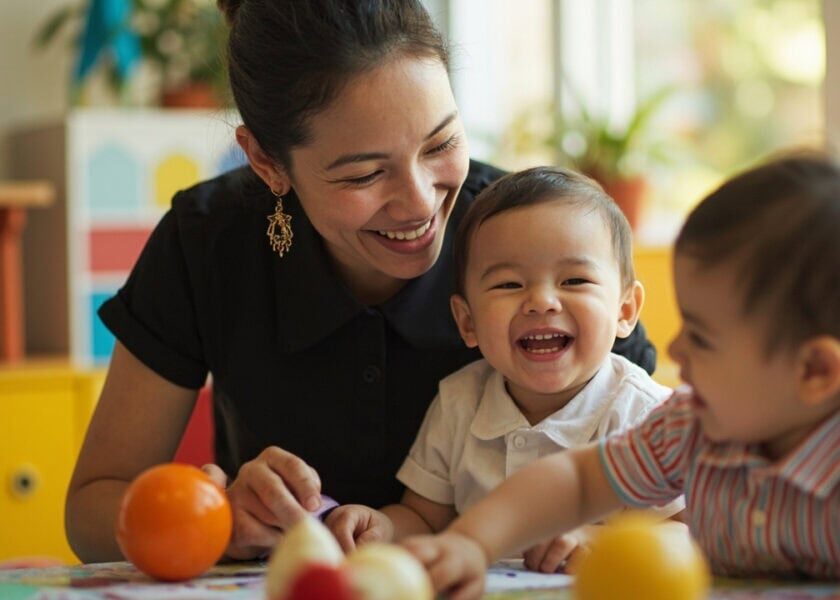
What Your Child Learns While You’re Not There
What Your Child Is Actually Learning While You Are Apart
In the first years of life, a child is not merely growing in size or acquiring skills. A child is constructing the architecture of their inner emotional world—the foundation upon which every relationship, every learning experience, every challenge, and every joy they will ever know will be built.
Developmental science has shown us, with increasing clarity, that this architecture is real. The neural pathways that regulate emotion, the attachment patterns that shape trust, the relational templates that determine how a child will connect with others decades later—these are being laid down in the earliest years with a speed and plasticity that will never be matched again.
When a baby feels safe, when their needs are met not just adequately but responsively, with warmth that communicates “I see you, you matter,” something profound happens inside them. Their nervous system begins to learn a lesson that becomes their default setting for life: the world is reliable. People can be trusted. I am worthy of care.
This lesson is not learned through lectures or explanations. It is learned through thousands of small moments—the way a caregiver picks them up when they cry, the way a voice softens when they are frightened, the way a face appears at eye level and says, without words, “You are not alone.”
What Quality Childcare Actually Looks Like
You might wonder: but how does this happen in practice? What does a day in quality childcare actually look like inside your child’s experience?
Imagine your eighteen-month-old entering a childminding environment in the morning. The transition may have its moments—perhaps a brief hesitation at the door, a backward glance. This is normal. This is a child who knows what they want and where they belong. But what happens next is what matters.
A familiar face appears. A voice says their name. Small arms are offered, and inside, your child begins a process that is deeply developmental: they begin to expand their sense of who the world contains.
This is one of the most beautiful and underappreciated gifts of quality childcare. Your child is learning that love is not confined to home. That there are other people who can meet their needs, who can comfort them, who can delight in them. This is not a diminishment of your role as a parent. It is an expansion of your child’s world.
Within a carefully calibrated environment—where ratios such as up to one to three infants ensure that every child receives individual attention—your child is encountering experiences that are directly shaping their emotional and social intelligence.
Empathy, Self-Regulation, and Belonging
In a quality childcare setting, your child will encounter other children. They will not always share easily. They will experience the small, sharp disappointment of a toy taken, and the transformative experience of a toy returned. They will watch another child’s face and begin, slowly, to understand that others have feelings too.
They will experience frustration—a block tower will fall, a cracker will crumble before it reaches their mouth. In a nurturing environment, a caregiver will not rush to eliminate every frustration. What the caregiver does is stay close. They name the feeling. They say, “You worked so hard on that tower, and it fell. That feels disappointing, doesn’t it?” And in that naming, in that quiet companionship in the face of difficulty, your child begins to learn that feelings are manageable.
By the end of the first weeks, your child will recognize the routine. They will know which mat is theirs, which songs come after lunch, which caregiver sings the good morning song. They will develop a sense of place, of community, of “we.”
This sense of belonging to something outside the family is not a threat to family attachment. Research consistently shows the opposite: children who form secure attachments in multiple caring environments show greater resilience, not greater anxiety. They are learning that the world is a trustworthy place—and that is a gift that will serve them for the rest of their lives.
Reading the Signs: What Your Child Is Telling You After Pickup
You drop your child off in the morning, and by the time you pick them up, something has happened to them. They come home different in some way—not worse, not necessarily better in any simple sense, but changed by the hours you were not there.
How do you read what you are seeing? These are not random behaviors. They are windows.
The child who seems clingy may be processing the experience of separation and reunion. They are testing, in the safety of your presence, whether the world they trusted in your absence still holds. This is not a sign that childcare is harmful. It is a sign that your child’s attachment system is active and working—that they are capable of the kind of deep connection that makes both separation and reunion meaningful.
The child who comes home talking about friends is showing you something precious: empathy is taking root. They have begun to see others as significant beings with whom they share a world.
The child who sings a new song is showing you that their mind is absorbing, integrating, building. The child who reaches for a comfort object may be telling you that the day had moments of overwhelm, and that they used the tool they have learned to soothe themselves.
All of this is development. All of this is growth.
The Caregiver’s Role: Emotional Architect, Not Just Supervisor
In quality childcare, these moments are not left to chance. In a well-designed, sensitively staffed infant care or childminding environment, your child is not simply being watched. They are being held inside a web of responsive attention that is actively teaching their developing heart what safety feels like.
The caregiver is not merely a supervisor. They are, in the truest sense, an architect of emotional development—someone whose every interaction with your child is contributing to the structure of who that child will become.
When a caregiver tells you that your child comforted another child today, or tried a new food, or explored a new texture with wonder, understand what you are being told. You are being given evidence of the invisible architecture being built inside your child’s heart.
Questions That Reveal Whether Childcare Is Building Something Precious
If you are researching childcare options, here are questions that go beyond the surface—questions whose answers will tell you whether a childcare environment is simply supervising your child, or actively building something precious inside them:
- How do caregivers respond when a child is distressed? What language do they use to name emotions?
- What does a typical day look like in terms of routines, transitions, and individual attention?
- How are peer interactions guided? Is conflict seen as a learning opportunity?
- How will I know what my child is experiencing during the day? What kind of updates can I expect?
- What training do caregivers receive in early social-emotional development?
- How are transitions handled—both when you drop off and when you pick up?
Singapore parents carry something acutely. We live in a society that values achievement, preparation, and optimization. It is easy to approach childcare with the same mindset—to evaluate it based on the skills it produces, the milestones it accelerates, the advantages it might confer.
There is nothing wrong with wanting the best for your child. That wanting is a form of love. But I want to invite you, just for a moment, to set aside the question of what your child is learning to do, and ask instead: what is your child learning to feel?
Because the answer to that question will shape every answer to every other question for the rest of their lives.
The child who grows up knowing they are worthy of care will approach challenges differently than the child who grew up uncertain of their worth. The child who learned, in those early months and years, that the world contained reliable, responsive, warm human beings will carry that knowledge like a light inside them—a light that will guide them through moments of darkness, through setbacks, through disappointments, through the inevitable difficulties of growing up.
This is the curriculum that quality childcare teaches. It is not in any workbook. It does not appear on any report card. But it is the most important curriculum your child will ever encounter, because it is the foundation upon which all other learning will be built.
How EduNanny Singapore Approaches Your Child’s Emotional World
EduNanny Singapore was created with this understanding at its center. When the service was established under the ECDA Childminding Pilot, it was designed to address a very real gap in Singapore’s childcare landscape. Parents needed options that were not just affordable and accessible, but that honored the emotional depth of early childhood—the understanding that these years are not merely a passage to be endured before “real” learning begins, but a time when the most profound learning of all is actively occurring.
EduNanny by BUTLER offers pathways that recognize the diversity of Singapore’s family structures and needs. Whether through home-based childminding, where your child is cared for in a smaller, familial setting with a dedicated caregiver, or through community and centre-based options that offer rich peer environments, the commitment to quality is consistent.
The ratios—up to one to three infants in relevant settings—are not bureaucratic specifications. They are deliberate design choices that ensure every child receives the responsive attention that emotional development requires.
The fee structures within the pilot framework have been designed to make quality care accessible, and parents can utilize available instruments such as the Child Development Account and Baby Bonus schemes, making this not only an emotionally sound choice but a financially manageable one. Care operates during Monday to Friday blocks that align with the rhythms of working family life.
Throughout all of this, communication remains central. When CCTV measures are deployed, they are not simply about safety protocols—they are about building a bridge of transparency between the childcare environment and the parent’s mind. When caregivers provide updates, they are not simply fulfilling a requirement—they are inviting you into your child’s day, offering you glimpses of what is growing inside the hours you cannot see.
Trusting the Hours You Cannot See
There is a question I would like to leave with you today. It is not a question about childcare structures or pilot programs or fee frameworks. It is a question about your child:
What is your child’s inner life like?
I ask this because I believe that the moment you begin to ask it—to become genuinely curious about what your child feels, what they wonder about, what makes them afraid and what makes them brave in those early years—you become a different kind of parent. Not a more anxious one. A more present one. A more connected one.
The parent who understands that the hours of childcare are not a void to be worried about, but a world to be trusted. The parent who can look at their child’s post-pickup behavior and see not confusion or concern, but evidence—evidence of growth, of expansion, of a heart learning to hold more than it could yesterday.
The parent who can drop their child at the door of a childminding home or centre and walk away not with guilt, but with quiet confidence: my child is in a place that sees them. My child is in a place that is building something precious inside them. My child is okay.
And so, in a way you are only beginning to understand, are you.
EduNanny Singapore was built for this moment. For the moment when a parent stands at the threshold of a childcare decision and asks not just “will my child be safe?” but “what will my child become?” For the moment when a parent realizes that the love they have for their child is so vast that it reaches even into the hours they cannot be present—and that there are places and people who can extend that love with the same tenderness they would bring themselves.
The caregivers at EduNanny are not simply staff. They are companions in the most important work there is: the work of raising a human being who will one day walk into the world with confidence, with empathy, with the deep internal knowledge that they are worthy of love and capable of giving it.
Every feeding, every comforting, every moment of eye contact and gentle words and patient presence is a brick in the structure your child is building. And that structure will stand for a lifetime.
This is what we believe. This is what EduNanny is here to offer. Not just childcare, but heartcare. Not just supervision, but presence. A place where your child’s emotional world is seen, supported, and nurtured with intention and skill.
You have already shown, by being here today—by caring enough to wonder what happens inside your child when you are not there—that you are exactly the parent your child needs.
To learn more about how EduNanny Singapore supports your child’s emotional development, we invite you to get in touch with our team or schedule a visit to see our childminding environment firsthand.