Why Your Child’s First Friends Are Part of What Childcare Is For
The Quick Summary
- Peer relationships in childcare are a curriculum, not an accident. While you are evaluating caregiver qualifications and curriculum frameworks, your child is learning emotional regulation, conflict resolution, and social confidence from other children every single day.
- Social skills built in early childcare predict Primary One readiness more reliably than academic indicators. Children who can navigate a peer group, manage disappointment, and feel a sense of belonging adapt to school with significantly less distress.
- You can learn to see and evaluate the peer environment. With the right questions and observations, you can assess whether a childcare arrangement will support your child’s social development—or merely supervise it.
- EduNanny Singapore structures its environments with this awareness. Small group sizes, intentional caregiver ratios, and daily rhythms that allow organic peer interaction are deliberate choices, not coincidences.
Why Peer Relationships Matter More Than We Usually Think
For years, we have become skilled at evaluating what we can see. Caregiver qualifications. Classroom layouts. Curriculum frameworks. Safety certifications. How our children respond in the first minutes after arrival. These are important questions—the right questions to ask.
But they do not account for something that runs through every single day of your child’s time in childcare like a current beneath the surface: the peer world. The social curriculum that operates quietly alongside every other form of care your child receives.
This article is about that world. Not because it is more important than the others, but because it is the one we have most consistently failed to name, examine, or understand. In that failure, we have left an enormous gap in how we evaluate what we are truly choosing when we choose childcare.
When a child enters a childcare environment, they enter a social ecosystem. From the very first week, something begins to form that has nothing to do with what adults teach and everything to do with what children teach each other. They learn, in real time, how to exist near someone who is not their parent. They learn how to notice another child’s emotions. They learn that their actions produce reactions in people who are not responding out of love but out of their own emerging personhood.
These are not small lessons. These are the foundational lessons of human social life, and they are being learned every morning—before most parents have finished their first cup of coffee.
Emotional Regulation
Emotional regulation is often discussed as something caregivers impart. And caregivers do model and guide emotional expression. But the deeper practice happens in the peer environment.
When two children reach for the same toy and neither has the words yet to negotiate, there is a moment of tension, a flash of frustration, and then one child backs away or finds another toy or looks to the caregiver for help—or does not. The range of outcomes in that single moment teaches your child something about how the world works: how their presence affects others, how to carry disappointment alongside the ongoing possibility of connection.
This is not supervised play. This is the raw material of social development, and it is happening whether we name it or not.
Conflict Resolution
Children in peer groups develop conflict resolution skills that are qualitatively different from those they learn with adults. With a caregiver, there is always an authority figure, a mediator, a resolver of disputes.
With peers, there is negotiation. There is trial and error. There is the discovery that certain approaches work and others do not, and that the social world has its own feedback system that operates faster and more honestly than adult-mediated resolution ever could.
A child who pushes will see another child cry. A child who shares will see a face light up. These cause-and-effect relationships between social behavior and social outcome are the most powerful teachers available to a developing human being.
Belonging and Identity
And then there is belonging, which is perhaps the most quietly profound thing that happens in a quality peer environment.
When a child has a friend at childcare—when there is a name they call out at arrival or a face they scan for in the room—something shifts in their sense of self. They are not just cared for. They are known. They are chosen by someone their own age who has no obligation to choose them.
In that being known, in that being chosen, the child begins to understand that they have a place in the social world. That they matter to others. That they are capable of connection independent of their parents.
The child who belongs in a peer group is building something that will serve them in every social context they ever enter—not just now, but in Primary One, in secondary school, in the workplace, in marriage, in parenthood. The capacity to form healthy attachment to peers, to trust that the social world is navigable and rewarding, begins here.
What Quality Actually Looks Like in a Singapore Childcare Setting
Let us be specific, because specificity transforms insight into useful knowledge.
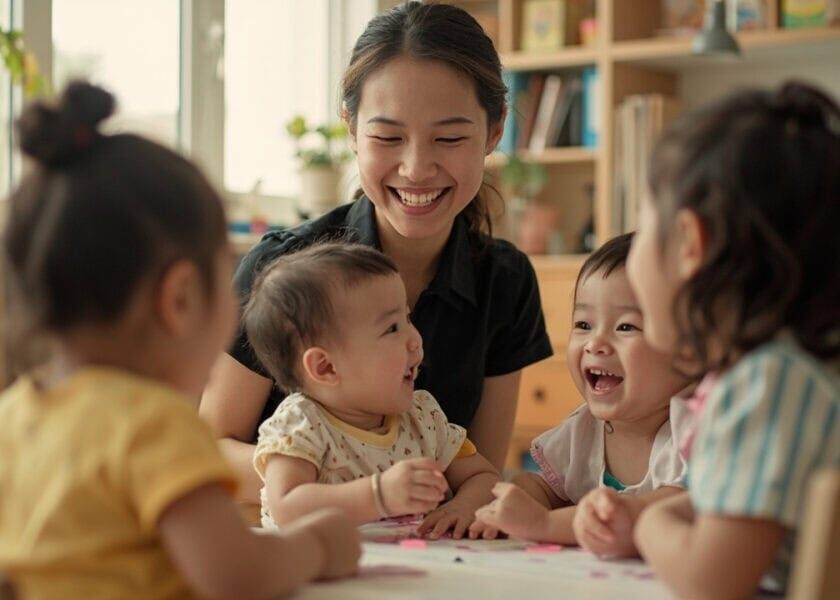
A quality peer social environment is one where children have sustained time to play together without constant adult interruption. Not a frenetic rotation of activities, but genuine blocks of open play where children can initiate, negotiate, abandon, and restart social interactions at their own pace.
You should see children at varying distances from each other—some engaged in parallel play, some in genuinely cooperative endeavors, some observing from the periphery. All of these are valid social positions. A child who watches before joining is not a shy child; they are a socially intelligent child gathering information before committing to an interaction.
You should see conflict arising and, in many cases, resolving without immediate adult intervention. Not because supervision is absent, but because the environment has been structured to allow children the dignity of working through small social problems themselves. When a caregiver does intervene, you want to see them guiding rather than dictating—asking questions, offering perspective, facilitating resolution rather than imposing it.
You should see a range of social roles emerging. The child who leads, the child who mediates, the child who includes, the child who invents games. In a healthy peer ecosystem, these roles shift and rotate. No single child dominates, and no child is permanently sidelined.
The caregiver’s role in this environment is less about directing social interaction and more about maintaining the conditions that make it possible—ensuring group size is manageable, space is conducive, schedule allows for organic play, and emotional temperature remains safe.
Why Group Size Matters
The group size point deserves particular attention because it is one of the most concrete things parents can evaluate during a tour.
In an infant room, a ratio of up to one caregiver to three infants is not just a regulatory standard—it is the difference between a caregiver who can observe and gently facilitate social interaction and one who is simply maintaining safety. At that ratio, with small group sizes, something remarkable becomes possible: the caregiver can notice which children are seeking connection, which are withdrawing, which are beginning to form the first threads of preference and friendship, and can create conditions that support those nascent social needs.
Why This Matters for Primary One Readiness
Many parents in Singapore understandably focus on academic preparedness when they think about school readiness. And yet the research on what predicts success and wellbeing in Primary One is remarkably consistent: it is not whether a child can recognize letters or count to twenty.
It is whether they can navigate the social environment of a classroom, form relationships with peers, manage the inevitable disappointments and conflicts of group life, and feel a sense of belonging in their school community.
Children who arrive at Primary One with strong peer competencies—confidence in social settings, basic conflict resolution skills, the ability to negotiate and cooperate—adapt to school with significantly less distress than children who arrive academically prepared but socially anxious.
The social curriculum is not a complement to academic readiness. In the earliest years, it is the foundation on which everything else rests.
How EduNanny Singapore Approaches the Social Curriculum
EduNanny Singapore, operating under the ECDA Childminding Pilot, structures its environments with exactly this awareness. Both home-based and community-based pathways offer the kind of small-group intimacy where peer relationships can form organically rather than being processed through.
The pilot fee structures make this level of intentional social development accessible in a way that has not always been possible in the Singapore childcare landscape. The use of CDA and Baby Bonus funds means families can access this quality without cost becoming a barrier.
But the physical structure is only part of the picture. The other part is what the adults in the environment understand about what they are supporting.
Because there is a profound difference between supervision and intentional social development, and that difference is visible in how a caregiver responds when a child is struggling to join a group, when two children are in conflict over a toy, when a child is sitting alone and watching.
Supervision asks: Is everyone safe?
Intentional social development asks: What does this child need right now to grow in their capacity for connection, and how can I provide it without doing the work for them?
This is the distinction that separates a childcare environment where children happen to be together from one where peer relationships are recognized as the curriculum they truly are.
Trust and Transparency
The communication and transparency measures that EduNanny implements—including CCTV in deployed settings—reflect a deeper commitment to trust. Parents in Singapore often navigate childcare arrangements with a background level of anxiety that is entirely understandable given how much of their child’s day happens outside their presence.
Knowing there are windows into the environment, that there is regular communication about how their child is doing not just academically or physically but socially, that there is a genuine partnership between caregiver and parent in supporting the child’s whole development—this matters. It is the kind of trust that allows parents to relax into the knowledge that their child is not just cared for but is flourishing.
Staying Engaged with Your Child’s Social World
The Thomas AI Chatbot, available to parents, represents a thoughtful integration of technology into the parenting experience. It is not a replacement for human connection but an amplification of it—a way for parents to access information, reflect on their child’s development, and stay engaged with the questions that matter most.
In a city where parents are often time-pressed and information-saturated, having a thoughtful digital companion that can help them make sense of what they are seeing and experiencing is genuinely valuable.
Questions to Ask During Your Childcare Search
Here is where we want to give parents practical language, because the instinct to ask the right questions is there, but the vocabulary is often missing.
During the Tour
- Ask not just about curriculum and activities but about social time. How much of the day is dedicated to unstructured or lightly structured peer interaction?
- Ask how conflicts are handled—whether the approach is to step in immediately or to allow children space to problem-solve first.
- Ask about group sizes and ratios in the infant and toddler rooms specifically.
- Observe, if possible, how children relate to each other—not performative observation time but genuine interaction time, because that is where you will see the social curriculum operating.
At Pickup
The questions you ask matter. Instead of “What did you do today?”—which often produces a monosyllabic answer—try asking about the social landscape:
- “Who did you play with today?”
- “Did anything funny happen with another child?”
- “Who was in your room this morning?”
These questions signal to your child that their social world is interesting to you, that it matters, and they often unlock surprising information about how your child is navigating their peer environment.
Of Caregivers
You can also ask the caregiver directly, in a spirit of partnership rather than interrogation:
- “How is she relating to the group?”
- “Does he seem to be finding his people?”
- “Are there any children he seems particularly connected to?”
Caregivers who understand the social curriculum will have real observations to share. They will notice the small social victories—the child who finally joined a group, the child who offered a toy without being asked, the child who defended another child’s turn. These are the milestones that rarely make it onto a parent communication app but that represent some of the most important growth your child is experiencing.
The Real Choice You Are Making
The choice of childcare is often framed as a logistical decision—location, cost, hours, availability. And those things matter. But beneath the logistics is a decision about what kind of social world your child will inhabit in the years when their social capacities are being formed most rapidly.
That decision has a shape. It has consequences. It is, in the deepest sense, one of the first community decisions a parent makes for their child. Not the community of family, which is given. But the community of peers, which is chosen.
When you choose a childcare arrangement, you are choosing the first community your child participates in by virtue of their own developing identity, not by virtue of where they were born or who their relatives are. You are choosing the soil in which their capacity for friendship, cooperation, conflict navigation, and social confidence will take root.
The next time you are evaluating a childcare arrangement, we invite you to look not just at what the caregivers are doing but at what the children are doing with each other. Notice the social temperature of the room. Notice who is connecting and who is struggling to connect. Ask the questions that surface the peer curriculum.
EduNanny Singapore was built for exactly this: for parents who want more than supervision, for children who deserve environments that understand what they are becoming, and for a city that is beginning to recognize that the early years are not just about preparation for later. They are, themselves, the years when the most important things are being built.
Your child’s first friends are not a byproduct of childcare. They are part of what childcare is for.
If you are researching infant care or childminding options in Singapore and want to understand how the social environment factors into your decision, we welcome you to explore what EduNanny’s ECDA-licensed Childminding Pilot has to offer. Schedule a conversation with our team to learn more about how small-group, relationship-focused care creates the conditions for your child’s social development to flourish.