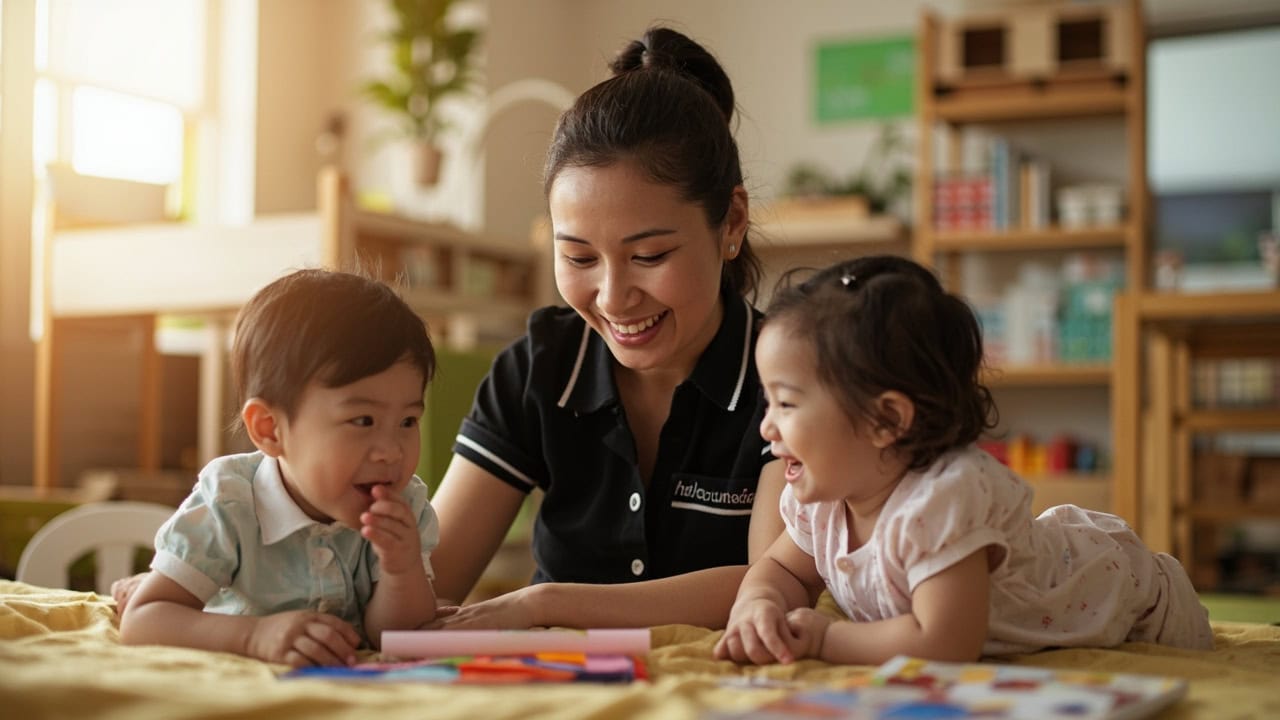
Beyond Choosing: How Singapore Parents Become Architects of Their Childcare System
The Moment That Changes Everything
There is a particular moment, familiar to many parents, when you realize your child has a life happening outside the hours you share together.
It does not arrive dramatically. It comes quietly—in the small details: a preference for how they like to be held that someone else has learned, a new sound they make that you did not teach them, a comfort they find in a routine you did not create.
And in that moment, something in you asks: what is my role now? Where do I fit in a story that seems to be unfolding in my absence?
This is the quiet discomfort we want to name today. Not because it is a failure or a fear, but because it is the most honest starting point we know. Because until we name it, we cannot move through it. And moving through it is where something genuinely different begins.
From Choosing to Building: The Reframe That Changes Everything
For too long, the conversation around childcare in Singapore has framed this moment as a choice—a decision to make, a provider to select, a checklist to complete. We talk about credentials and ratios, about safety measures and location convenience. We arm ourselves with questions for interviews and criteria for comparison.
And then, having made the choice, we are left with a quiet question that no checklist answers: what happens after I choose? Where do I go from here, as a parent, as a presence in my child’s daily world?
The truth is that quality childcare has never been a destination. It is not a service you hand off and walk away from, nor is it a fixed structure you install and forget. Quality childcare is a system you build—slowly, intentionally, in collaboration with the people who share your child’s days.
And the parent is not a passenger in this system. The parent is its architect.
When you choose childcare, you make a decision. When you build a childcare system, you begin a relationship.
What This Looks Like in Practice
If childcare is a choice, your job is done once you have made it. You have delegated. You have entrusted. You have placed your child in capable hands and you can, with relief, step back.
But if childcare is a system—one that you design, participate in, and evolve alongside—then your role does not diminish when professionals are involved. It evolves. It becomes something more intentional, more collaborative, more deeply your own.
- A parent who chooses care and waits to hear reports versus a parent who shares daily observations that help caregivers understand their child
- A parent who provides a schedule versus a parent who explains why mornings are harder and what helps their child ease into the day
- A parent who lists allergies versus a parent who tells the story behind a sensitivity so caregivers can respond with understanding, not just caution
The second approach in each case is not about micromanaging or hovering. It is about building a shared language. It is about the daily exchange that happens not just at drop-off and pick-up, but through the quiet observations you bring home and the thoughtful questions you ask.
The Knowledge Only You Have
It begins with the recognition that you know your child in a way no caregiver, however excellent, can fully know. You know the quality of light that soothes them. You know the particular sound that means they are working something out, not just fussing. You know that your child reaches for connection differently in the morning than they do in the afternoon.
This knowledge is not incidental. It is the foundation of everything.
When you share this knowledge—when you approach your child’s caregiver not as someone to trust and leave, but as someone to inform and collaborate with—you are not diminishing your own role. You are exercising it. You are saying: this child has a language, and I am the one who can help you read it.
The caregiver who knows your child’s favorite song is valuable. The caregiver who knows why your child cries when a certain texture appears, and who has been told the story behind that sensitivity, is working with something altogether different.
The Caregiver’s Perspective
We also want to name something that is often missing from conversations about childcare: the dignity of the caregiver. When we speak of co-architecting, we do not mean that parents design and caregivers execute.
We mean that both are architects.
The caregiver brings professional knowledge, observational skill, and a consistency of presence that shapes the child’s world profoundly. When you walk into a childcare relationship treating your caregiver as a collaborator rather than a service provider, you are not just being kind—you are building better outcomes for your child. Because a caregiver who feels respected brings more to your child’s day than one who feels evaluated.
Why This Matters in Singapore
We want to speak honestly about why this reframe matters so much in the Singapore context, because the pressures here are particular.
- The cost of living makes childcare a significant financial commitment
- Dual-income households are the norm, not the exception
- Distances between work and home eat into time with children
- A culture that values achievement and preparation adds its own weight to parenting expectations
Singapore parents are not short on love or intention. They are often short on time, on bandwidth, on the margin to be present in the way they wish they could be. And so the temptation is to simplify: find good care, trust it, move on. Make peace with the trade-off.
But what if the parent who remains engaged—who builds the system rather than just choosing it—actually experiences less guilt, not more? Not because they have been absolved, but because they have found their place. Because they are no longer standing at the edge wondering, but walking alongside knowing.
What Partnership Actually Looks Like
When you are building a childcare system rather than just selecting one, certain things begin to matter more than others.
The Daily Rituals That Make You a Partner
- Observations you bring home—not just what happened, but what you noticed
- Questions that go beyond “did they eat and sleep well”
- Sharing the small things: a new word, a milestone, a moment that surprised you
- Asking about what you cannot see: what did they discover today? How did they respond to the group?
- Feedback that flows both ways—not just reports from caregivers, but your own input shaping what happens next
Understanding Over Information
There is a difference between information and understanding. A schedule tells you when things happen. Understanding tells you why. Quality childminding means sharing not just the child’s routine, but their temperament. Not just their allergies, but their values. Not just their meals and naps, but their rhythms and what signals they send.
When this kind of information flows between parent and caregiver, something shifts. Suddenly you are not observers of your child’s life. You are participants in it.
Questions Worth Asking
Rather than defaulting to routine check-ins, consider questions that invite story and insight:
- How did they seem today—not just their behavior, but their mood?
- What surprised the caregiver about your child?
- Was there a moment today when they seemed particularly engaged or particularly challenged?
- What might I expect tonight based on how their day went?
The Long View: Why This Compounds
The thousand days—the early window from conception through roughly three years—have been shown to be profoundly consequential for development. We make this point not to frighten or to overwhelm, but to honor the weight of what you are doing.
Every day in these early years is not just a day. It is a brick in a structure that will stand for a lifetime.
- The language foundations being built
- The emotional patterns forming
- The sense of security or anxiety taking root
These are not abstractions. They are happening now, in the hours you share and the hours you do not.
Small daily investments in communication, in alignment, in partnership—these do not seem significant on any single day. But over months and years, they become the invisible architecture of your child’s world. And that architecture will shape everything that comes after.
The EduNanny Approach: Built for Partnership
This is what EduNanny has been designed to make possible—not as a philosophy alone, but as an operational reality.
Our Foundation: The ECDA Childminding Pilot
EduNanny operates within Singapore’s ECDA Childminding Pilot, and we believe this matters not just as a regulatory detail, but as a statement of values. The pilot exists because Singapore recognizes that families need more than one pathway to quality care—that home-based and community-based options, alongside centre-based ones, can serve different needs and different lives.
Small Ratios, Big Difference
Our ratios reflect our belief that attention is not a luxury. With up to one to three infants in our care during the pilot, we are building environments where each child can be seen, known, and responded to as an individual. This is not an accident of scale. It is an architectural choice—one that makes the kind of partnership we are describing possible.
Communication as the Spine
Parents are not left to imagine what their child’s day looks like. Where deployed, our transparency measures—including CCTV arrangements—mean that trust is not assumed but demonstrated. But beyond technology, we believe in the everyday transparency of conversation.
Questions like these are not bureaucratic check-ins. They are the currency of partnership:
- What did your child eat?
- How did they sleep?
- What did they discover today?
When you share something—a new word your child said, a milestone you noticed, a concern that crossed your mind—there is a place for it.
Affordability and Support
On fees, we are committed to keeping quality care within reach during the pilot phase. We know that affordability is not an afterthought for families—it is often the deciding factor.
We also know that life in Singapore moves fast, and that parents need support that meets them where they are. That is why we have developed Thomas, our AI chatbot—a tool designed not to replace the human relationship, but to make the practical elements of parenting and childminding easier to navigate. Questions about CDA usability, Baby Bonus arrangements, care schedules, developmental milestones, communication protocols—these are real questions that arise in real time, often at moments when you have neither the energy nor the bandwidth to search for answers. Thomas is there.
Ready to Begin
That quiet discomfort. The sense that when your child’s days expand beyond your direct presence, something is shifting that you cannot quite name.
We want to tell you something we believe deeply: your role does not shrink when professionals enter the picture. It transforms. And the way it transforms depends on the choices you make—not just the initial choice of a provider, but the ongoing choices you make every day to stay engaged, to stay curious, to stay present in a different way.
You have not come here to choose a childcare provider. You have come here to begin building the system that will hold your family for the years ahead.
That system will grow and change. It will have seasons of ease and seasons of challenge. It will require communication, patience, and trust—not in a vague or passive sense, but in the active, daily practice of showing up as a partner.
EduNanny exists to build that plan with you. Not to take something from your family, but to add to it. Not to replace your voice, but to amplify it. Not to make the parenting journey smaller, but to make it more intentional.
The architecture is yours to design. We are here to build it with you.
Curious about what partnership-based childminding could look like for your family? We would be glad to hear from you.