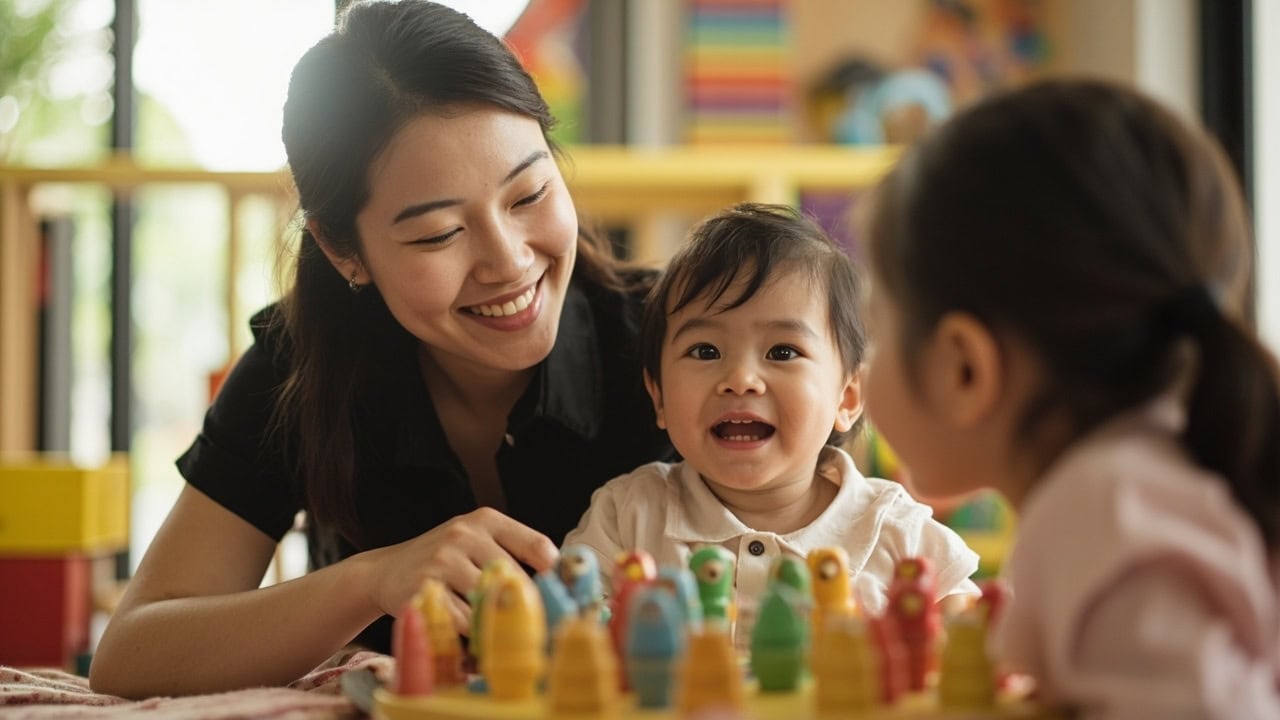
The Invisible Architecture of Your Baby’s First Year
What Your Infant Is Actually Learning (And Why You Cannot See It)
There is a moment, perhaps you have seen it, perhaps you have lived it. A parent, sitting on the floor with their infant, watching their child reach out with that deliberate, uncertain grasp toward a soft textured ball. The parent wonders, in that quiet way parents wonder about everything, whether this moment matters. Whether the texture is interesting because of its color, or whether there is something deeper happening in those small fingers, that curled wrist, that furrowed brow of concentration.
Here is what I want to tell you: this moment matters. That every moment like it matters. That the invisible architecture taking shape inside your infant’s body during the first year of life is, in many ways, the most important work your child will ever do.
Understanding what is actually being built beneath the surface can transform not just how you see your infant, but how you choose who cares for them while you are apart.
- Why what you observe—crying, feeding, sleeping, play—is only the surface of development
- How sensory-motor systems build upon each other in the first year
- The critical difference between passive stimulation and intentional caregiving
- What trained caregivers notice that untrained observation misses
- How to evaluate whether your childcare environment is supporting your infant’s development
- Simple practices you can reinforce at home after pickup
The Gap Between What You See and What Is Being Built
Singapore parents understand value. You have internalized the research about the first thousand days, about brain plasticity, about critical windows that open and close. You know, in the abstract, that the first year matters.
But here is what often remains abstract, despite all the reading: you cannot see what is actually being built.
You see crying, and you do not see the sensory system learning to modulate itself. You see your infant grasp a finger, and you do not see the proprioceptive pathway forming—the neural circuit that will one day allow your child to navigate a crowded school hallway without bumping into every person in it. You see feeding, and you do not see the oral-motor coordination developing, the sensory integration that will later make speech possible. You see sleep, and you do not see the brain consolidating, the motor memories being stored, the sensory experiences of the day being woven into something permanent.
This gap creates something specific: a feeling of not quite understanding what is happening to your child. A quiet anxiety beneath the joy of watching them grow. A sense that you are loving them beautifully but perhaps missing something important about who they are becoming.
This is the tension we want to help you resolve—not by adding to your worry, but by showing you what trained eyes can see in every moment of your infant’s day.
The Sensory World Your Infant Is Building
From birth, your infant is flooded with sensory information. Light and shadow. The warmth of skin and the coolness of air. The weight of their own body against a surface. The sound of your voice, which they recognize from inside the womb, which soothes them not because of what you say but because of its rhythm, its vibration, its texture.
Every sensation that reaches your infant is new. Their nervous system has no choice but to begin the immense work of learning what to do with all of this information.
This is where sensory-motor development begins. Not as a curriculum, not as a lesson plan, but as the fundamental task of being human. Sensory systems must learn to receive information. Motor systems must learn to respond. And crucially, these systems must learn to work together.
A sound must become connected to a turning of the head. A touch must become connected to a reaching of the hand. A shift in balance must become connected to a bracing of the core, a repositioning of the limbs.
What a Simple Reach Actually Requires
Consider the simple act of reaching for an object. It looks effortless when you do it. You decide to reach, and your hand moves.
But for your infant, this act requires the coordination of dozens of systems:
- The visual system must locate the object and track its movement
- The vestibular system must report the position of the head in space
- The proprioceptive system—the sense that tells you where your body is without looking at it—must provide constant updates about the position of the arm, the hand, the fingers
- The motor system must execute the movement with appropriate force, speed, and precision
All of this must happen in milliseconds, smoothly, automatically, without conscious thought.
Now consider that your infant has never done this before. Every reach is new. Every successful grasp is a victory for the nervous system, a strengthening of a pathway that will be used thousands of times in the coming years.
The pathways that are strengthened are not just the motor pathways. They are the sensory pathways. They are the integration pathways. The infant who reaches for a wooden block and the infant who reaches for a soft plush toy learns something different from each. They adjust differently. They build slightly different neural connections.
This is why repetition matters. This is why variety matters. The textured mat your infant explores with their hands, the different surfaces they are placed on, the different ways they are held and moved and allowed to roll and stretch and kick—all of this is not decoration. It is curriculum. The most important curriculum that will ever be taught to your child.
The First Year: A Window That Cannot Be Recaptured
In the first year of life, your infant’s brain is building itself at a speed that will never be matched again. Neural connections are forming faster than they will at any other point in human development. Synapses are being pruned and strengthened based on use.
The sensory pathways that are used repeatedly become efficient, automatic, permanent. The pathways that are not used begin to disappear.
This is the nature of brain development. It is use it or lose it. And because the first year is when the most rapid construction is happening, it is also when the environment is most influential, most shaped by the quality of care received.
Understanding the nature of developmental windows can be deeply freeing rather than frightening. When you know that the first year is a time of extraordinary opportunity, you can approach it with purpose rather than confusion. You can seek out environments that understand what they are holding. You can ask better questions. You can recognize quality when you see it.
Why This Matters for Primary 1 Readiness
Singapore parents are, by and large, preparing their children for a lifetime of learning in a system that demands attention, focus, emotional regulation, and the ability to sit with challenge. You know this system. You have navigated it yourselves.
The children who arrive at Primary 1 with the strongest foundation for learning are not necessarily the children who were taught to read earliest. They are the children whose sensory-motor systems are well-integrated.
They are the children who can sustain attention because their bodies feel secure. They are the children who can manage frustration because their nervous systems have been taught, through consistent responsive caregiving, that they can survive being upset and return to calm. They are the children who can sit still not because they have been drilled into stillness but because their bodies know where they are in space and feel regulated enough to remain seated.
The sensory-motor foundation is not separate from academic readiness. It is the platform upon which academic readiness is built.
Sensory Stimulation Is Not the Same as Intentional Caregiving
There is a distinction that matters enormously for how you evaluate the care your infant receives. The difference between sensory stimulation and intentional sensory-motor caregiving.
Sensory stimulation is what happens when a toy makes noise and your infant hears it. When a mobile turns above the crib and your infant sees it move. When a caregiver smiles and your infant sees the expression. These are not bad things. They are part of life. But they are passive. They are received.
Intentional sensory-motor caregiving is something different:
- A caregiver who notices your infant has been looking at a hanging toy for several seconds and gently brings it closer, creating the opportunity for reaching
- A caregiver who narrates what they observe, not because the infant understands the words, but because the rhythm of adult speech helps the auditory system learn to parse meaningful sound from noise
- A caregiver who positions your infant’s body in slightly different ways throughout the day, with awareness of which muscles have been active and which need new input
- A caregiver who understands that a certain type of crying means the infant is overstimulated and needs a quieter environment, while a different type means they are understimulated and need more sensory input to feel regulated
This kind of caregiving cannot be improvised. It requires training. It requires observation. It requires the willingness to see every interaction as an opportunity for development and every moment as data about what this particular infant needs on this particular day.
Two Systems You Cannot Afford to Overlook
Proprioception: Building the Body’s Internal Map
The proprioceptive system is one of the most underappreciated systems in infant development. Proprioception is the sense that tells your body where it is in space without looking at it. It allows you to walk in the dark without falling, to type on a keyboard without watching your fingers, to catch a ball without calculating trajectories.
For your infant, proprioception is being built moment by moment. Every time they are held firmly, they receive proprioceptive input. Every time they are swaddled. Every time they are encouraged to push against a surface with their feet, to press their palms together, to feel resistance in their body.
Why does this matter? Because proprioceptive development is directly connected to something every parent cares about: emotional regulation.
When the proprioceptive system is well-developed, the body knows how to calm itself. Deep pressure, resistance, heavy work with the body—these are sensory experiences that signal safety to the nervous system. Infants who receive consistent, intentional proprioceptive input through caregiving touch, through being held, through the resistance of pushing up on their arms or pressing into a caregiver’s chest, are building the neurological foundation for the day when they will need to calm themselves down after a tantrum, to focus during a lesson, to sit still when sitting still is hard.
The Vestibular System: Movement as Development
The vestibular system, housed in the inner ear, detects movement and head position. It is profoundly important for balance, for coordination, for the ability to maintain alertness and attention.
And it develops through movement. Gentle rocking. Slow tilts. Being held upright and feeling the shift of weight from hip to hip.
The caregiver who rocks a fussy infant is not just soothing them. They are providing vestibular input that helps the nervous system learn to process motion, to maintain equilibrium, to develop the postural control that will later allow sitting upright in a classroom chair.
What Trained Caregivers Notice That You Might Miss
A caregiver who has been trained in infant development does not simply watch your baby. They observe. They have a framework for understanding what they are seeing.
When your infant reaches for a toy, a trained caregiver notices:
- Whether the reach is coordinated or flailing
- Whether both arms are participating or one is dominant
- Whether the grasp is palmar or moving toward a pincer grip
These are not trivial observations. They are data points in a developmental picture.
When your infant is placed on their tummy and fusses, a trained caregiver does not simply soothe them and move on. They assess:
- Is the fussiness because the infant dislikes the position, which tells them something about core strength and tolerance?
- Is it because the infant wants to be held, which tells them something about attachment and regulation needs?
- Is it because the infant is bored, which tells them it is time to change the sensory environment?
Trained caregivers notice the body signals that untrained observation misses:
- The way an infant’s fingers spread when they are ready to grasp
- The way their eyes widen slightly before a reach
- The way their breathing changes when they are transitioning from sleep to waking
- The way their body tenses before a cry, so that intervention can happen before the infant becomes dysregulated
These are the invisible communications of the body, and they are the language that trained caregivers learn to read.
Evaluating Your Childcare Environment: Questions and At-Home Practice
Questions Every Parent Should Ask
You are handing your infant to someone else. Not just someone. Your infant. The most precious thing in your world. This is not a small act. It is an act that requires trust, and trust requires knowing what you are trusting in.
When you understand what is happening in your infant’s sensory-motor development, you can evaluate the care your child receives with real understanding rather than blind hope.
Ask about observation practices:
- How do caregivers track my infant’s development?
- What do the daily updates include beyond feeding and sleeping?
- How do you notice if my infant is progressing in their motor skills?
Ask about the sensory environment:
- What kinds of textures and surfaces does my infant have access to?
- How is my infant’s body positioned throughout the day?
- What kinds of movement experiences are provided?
Ask about caregiver responsiveness:
- How do caregivers respond to different types of crying?
- What training have caregivers had in infant development?
- How do caregivers support my infant when they are frustrated or overwhelmed?
These questions will help you know whether you are receiving intentional developmental care, or whether your infant is in an environment that is simply safe and warm and hoping for the best.
What You Can Do at Home After Pickup
Quality infant care does not happen only in the hours your child is in care. It is a partnership, and the things you do after pickup matter too.
Hold your infant firmly. When you pick them up and feel the weight of their body against yours, you are providing proprioceptive input that calms and regulates.
Narrate your evening. Describe what you are doing as you change their clothes, as you prepare their bath, as you settle them for the night. You are providing the auditory experience of human speech that builds language pathways.
Offer textured toys. Let them feel the difference between smooth and rough, warm and cool, soft and firm. You are adding to the sensory library they are building.
Notice what they notice. Respond to their reaching and exploring with interest and encouragement. The sensory-motor development that happens in quality childcare is reinforced and extended by the sensory-motor experiences of home life.
You do not need to be their therapist. You do not need to turn your home into a developmental intervention. You simply need to be present, engaged, and curious about what your infant is experiencing.
Every infant develops along their own timeline. What matters more than hitting specific milestones on schedule is the sequence and quality of development. Focus on whether your infant is showing increasing control over their movements week by week, responding to sensory experiences with growing engagement, and building tolerance for different positions and sensations.
EduNanny’s Approach: Seeing the Architecture
At EduNanny, trained caregivers observe with intention, document what they see, and understand the developmental trajectory of each infant in their care. They know that what looks like random play is actually a sequence of sensory-motor experiences that build upon each other. They know that the order in which milestones appear matters, not for comparison, but for understanding the individual developmental path of each child.
This is what we mean when we say quality caregiving is different from custodial care. Custodial care keeps an infant safe, fed, and clean. Quality caregiving does this too, but it also understands that every moment is an opportunity for development, and it creates the conditions for that development to unfold naturally, supported, and responsive to the individual needs of each child.
The Environment Is Designed for Development
In our home-based infant care settings, we maintain ratios that allow for this kind of observation. With up to three infants in care at a time, our caregivers can notice, respond, document, and tailor the sensory environment to the developmental needs of each child.
The environment itself is designed with intention:
- Textured surfaces that invite touch
- Different positions throughout the day that challenge and develop different muscle groups
- Sound environments that vary between calm and stimulating, teaching the auditory system to modulate
- Natural light where possible, gentle where artificial
The kind of environment that feels warm and safe and also, without the infant knowing it, is doing educational work.
Accessible Quality for Singapore Families
For families in our ECDA Childminding Pilot program, these standards are met with accessibility in mind. We understand that quality infant care should not be a privilege available only to those with significant financial resources. The pilot fee structures are designed to be within reach for families who want this level of intentional developmental care. CDA and Baby Bonus funds can be used, and this is not an incidental feature. It is an acknowledgment that when we make developmental quality easier to access, we are investing in the children who will grow up in this city.
Transparent Communication
Communication with parents is ongoing and transparent. You receive updates not just about what your infant ate and how they slept, but about what they explored, what they reached for, what they noticed, what they seemed to enjoy. Some of our settings include CCTV access, because we understand that trust is built through transparency, not through blind faith. When you can see what is happening in the care environment, you can relax into confidence rather than anxiety.
Care blocks are structured for working families, Monday through Friday, because we know the reality of Singapore work life. You are not choosing between childcare and development. You need both, in the same place, with integrity.
Seeing This Moment Differently
Let us return to that moment. A parent, sitting on the floor with their infant, watching their child reach out with that deliberate, uncertain grasp toward a soft textured ball.
Now, having shared what I have shared today, you see this moment differently.
You see the proprioceptive input happening in those small fingers. You see the visual-motor integration firing in the brain. You see the vestibular system registering the position of the head. You see the motor pathways strengthening with each successful grasp and release. You see the neural connections forming that will one day allow your child to write their name, to button a shirt, to play a musical instrument, to type on a keyboard.
You see that this moment, which looked like simple play, was actually education of the most profound kind.
Every textured surface your infant touches is teaching them something about the physical world. Every guided reach, every responsive interaction, every moment when a caregiver notices what your child is trying to do and helps make it possible, is quietly building the architecture of a person.
A person who will one day walk confidently into Primary 1. Who will solve problems you cannot imagine yet. Who will manage emotions with resilience you cannot predict. Who will pursue passions that have not yet been named.
This is what the first year holds. Not just growth, but construction. Not just development, but architecture.
The environment that holds your infant during these crucial months is not incidental. It is not just a place where they are kept safe until you return. It is a developmental environment, and its quality matters for what is being built inside your child’s body and brain.
EduNanny exists because we believe that the first year deserves this kind of understanding, this kind of intentionality, this kind of care. We believe that trained caregivers who observe with developmental eyes make a measurable difference in the lives of the children they serve. We believe that when parents understand what is happening beneath the surface, they become partners in their child’s development in the deepest sense.
If you are searching for infant care in Singapore, we invite you to look beneath the surface with us. To understand what your infant is building. To choose a place where the invisible architecture is not invisible at all, but recognized, respected, and intentionally supported.
Your infant is building themselves, every single day.
Let us help you see it happening.
To learn more about EduNanny’s approach to infant care, visit our about page or explore our homepage to see how we support Singapore families.