How Brothers and Sisters Teach Each Other Without Knowing It
The Quiet Learning Between Brothers and Sisters
There is a moment every parent of more than one child knows, and it arrives quietly, without announcement. It comes in the morning, perhaps, when you are buckling one child into a stroller and the other is pulling at your sleeve. It comes at bedtime, when you are reading a story to one while the other calls out from the next room. It comes in the childcare pickup line, when your two children see you and something in your chest tightens — not with love alone, but with something heavier. The quiet worry that you have not been enough for both of them today.
If you have felt that, I want you to know something. You are not failing. You are navigating one of the most complex acts of care that exists: the raising of more than one child simultaneously, in a city that does not slow down, in a life that does not simplify on its own.
And today, I want to tell you about something that is already happening inside that complexity — something your children are doing with and for each other that you may not have had the distance to see. Something powerful. Something that quality childcare does not merely accommodate, but actively protects and amplifies.
What the First Thousand Days Actually Look Like
We talk a great deal in Singapore about the first thousand days of a child’s life. We are right to do so. The neuroscience is clear and compelling — those early years lay down neural pathways at a speed that will never be matched again. Synapses fire, connections form, and the architecture of a person’s capacity for learning, for empathy, for resilience is quite literally being built, brick by brick, in the first years of life.
But here is what we rarely talk about with the same urgency: the first thousand days do not happen in isolation. They happen inside families. They happen inside relationships. And for a child with siblings, some of the most formative learning of those thousand days is not happening between the child and the adult in the room. It is happening between one child and another.
Siblings are, by nature and by necessity, each other’s first teachers. Not because they set out to be — not because a three-year-old wakes up thinking, “Today I will teach my younger sibling patience” — but because that is what happens when two or more young minds occupy the same developmental space. The older one refines their understanding by explaining what they know. The younger one reaches upward toward what the older one has already mastered. And between them, in the space where neither parent nor caregiver can fully intervene, a curriculum of extraordinary richness unfolds.
Developmental psychologists call this horizontal learning — learning that happens between peers, rather than vertically, from adult to child. The evidence across decades of research is consistent: peer-mediated learning in the early years produces developmental gains in language, in problem-solving, in social cognition, and in emotional regulation that adult-led instruction alone cannot replicate.
Why? Because when a child learns from a peer, something changes in the nature of the challenge. The peer is close enough in development to be understood, yet slightly further ahead — close enough to model, just beyond easy reach. That precise gap is where learning lives. It is not too simple, as adult modelling can sometimes feel. It is not too advanced, as abstract instruction can sometimes be. It is exactly the right distance for a young mind to stretch toward.
The Invisible Curriculum Siblings Create
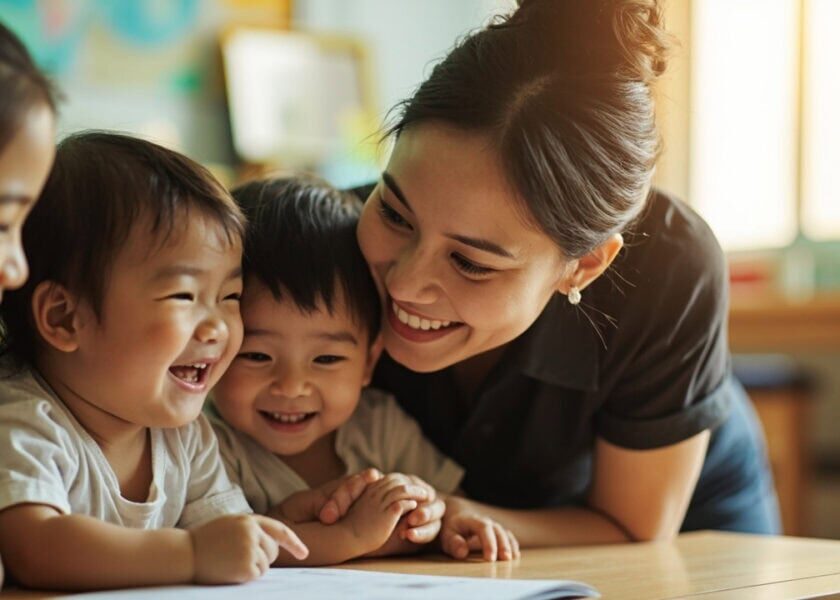
Let me begin with a scene you might recognise. An older toddler, perhaps two and a half, sits on the floor of a childcare room building a tower from soft blocks. Beside her, her younger brother — not yet two — watches intently. He watches how she places each block. He watches the tilt of her wrist, the way she tests the base before adding height. He is not being taught this. No caregiver has directed him to observe her. He is simply there, in her presence, and something inside him is taking notes.
A few weeks later, he picks up a block. He places it on the ground. He looks at it the way she looked at hers. And then he adds another.
That is not imitation. Or rather, it is imitation — but imitation is only the surface. Beneath it, something deeper is at work. Your children are beginning to construct an understanding of the world together, and they are doing it through a language that predates words, predates programmes, predates every curriculum ever written.
There is a concept in early childhood education that I find quietly revelatory: the invisible curriculum. The visible curriculum is what we plan — the activities, the songs, the structured learning moments. But the invisible curriculum is what children absorb simply by being in an environment with others, by watching how people move through space, how they handle frustration, how they celebrate small victories, how they ask for help, how they give it.
For a child with siblings in quality care, the invisible curriculum is doubly rich. They are learning from the trained educators around them — and they are simultaneously learning from the brother or sister who shares their room. The older child teaches patience through the natural frustration of waiting for a turn. The younger child teaches persistence through the sheer determination to keep trying at something the older child does effortlessly. Both are learning empathy — not because they have been told to consider another’s feelings, but because they feel those feelings directly, in real time, in the body of someone who matters to them.
Speaking to the Guilt You Carry
I want to pause here and speak directly to something I know many of you carry. The guilt. The quiet, persistent concern that you are splitting yourself in two — that when you give attention to one child, the other is somehow receiving less. That your youngest may be growing up in the shadow of your eldest’s milestones. That the bond between your children, which you hope will become one of the great relationships of their lives, is happening mostly out of your sight, and you cannot know what shape it is taking.
The research on sibling relationships in early childhood consistently points in one direction: siblings who spend significant, quality time together in the early years — time that is safe, structured, and observed — develop a depth of social understanding that only children simply do not. They learn to read nonverbal cues earlier. They develop stronger conflict-resolution skills. They build what psychologists call “theory of mind” — the capacity to understand that another person has thoughts, feelings, and perspectives different from their own — at a notably accelerated rate.
And here is what is most striking: this happens not despite the presence of a caregiver, but because of it. When children are in an environment where a trained educator is present — where ratios are low enough that the educator can observe and gently guide the sibling dynamic rather than merely supervise it — the sibling relationship becomes a protected developmental space. The children know they are safe. They know the adult is close. And that security gives them the freedom to explore each other fully — to fight, to cooperate, to model, to emulate, to fail and try again together.
What Quality Childminding Actually Looks Like
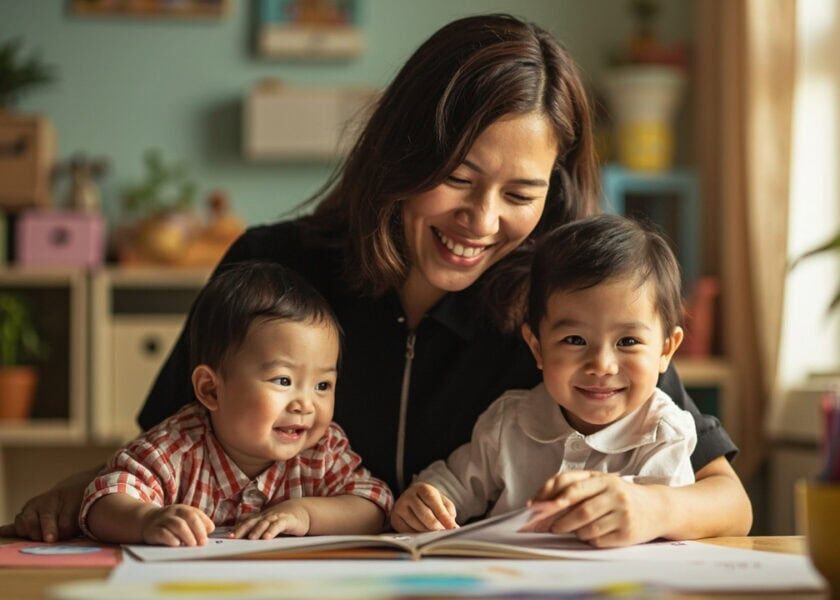
Imagine that sibling learning is not left to chance. Imagine it is not simply happening in the background of a childcare day, overseen by an adult who is managing logistics, keeping order, ensuring safety. Imagine instead that the environment is structured — observed, understood, and gently facilitated — so that this sibling-to-sibling learning becomes visible.
So that the educator in the room can see when one child is ready to model and another is ready to absorb. So that the conditions for that learning are protected, the distractions minimised, the space made safe enough for a younger child to take a risk because an older sibling has just showed them it is possible.
That is not childcare as supervision. That is childcare as catalyst.
In Singapore, this is precisely what the ECDA Childminding Pilot is designed to enable. Whether through home-based care or community-based settings, the pilot creates conditions where ratios of up to one to three infants mean that a caregiver can do more than watch. They can witness. They can note which children are drawing each other into learning. They can create moments where an older sibling’s natural impulse to help is channelled into something genuinely educational. They can step in when the dynamic tips from productive to harmful, and they can step back when it is reaching exactly where it needs to go.
This is not an accident of scheduling. It is pedagogy in practice.
Can we afford quality care for two children?
The ECDA Childminding Pilot, including pathways through EduNanny by BUTLER, has been designed with the understanding that quality childcare should not be a luxury available only to families with significant means. Within the pilot fee structures, care is structured to be accessible. And the financial tools that Singapore provides — the Child Development Account, which you can use for approved childcare arrangements, and the Baby Bonus Cash Gift — are there precisely to ease this burden. The system, imperfect as it may sometimes feel, is designed to say: this matters enough that we want to help you afford it.
How do I know what is happening when I am not there?
Monday to Friday care blocks, offered through home-based and community pathways, are structured to align with the actual rhythms of a Singapore working life. This is not childcare built around an idealised family. It is childcare built around the reality of how Singapore families actually live.
The transparency — the CCTV measures deployed in some settings, the daily communication, the open channels between caregiver and parent — all of it exists for one reason: so that the distance between you and your children’s day is as small as possible. So that you do not have to imagine what they are doing. So that you can know, and in knowing, trust.
What if my children fight more than they cooperate?
Sibling conflict is not a sign that the arrangement is failing — it is often a sign that the sibling relationship is working. When children feel safe enough to argue, to compete, to push back against each other, they are building the negotiation skills, the emotional resilience, and the relationship depth that will serve them for life. The role of the trained educator is not to eliminate conflict but to ensure it remains productive, to step in when it tips into harm, and to step back when it is reaching exactly where it needs to go.
Questions to Ask When Choosing Care for Multiple Children
If you are researching care options for two or more children, here are the questions that matter most:
- What are the caregiver-to-child ratios? Lower ratios mean more observation, more intentional facilitation, more protection of sibling learning moments.
- How does the environment observe sibling interactions? Ask how educators track and report on sibling dynamics, not just individual progress.
- What is the communication like? You should hear regularly — not just that your children are safe, but specifically what they are doing together.
- Is the space designed for sibling proximity? Look for environments where children can see each other, work alongside each other, and naturally draw each other into learning.
- Do educators understand horizontal learning? The best caregivers know that siblings teaching each other is not a distraction from learning — it is learning.
The Sibling Effect
There is a moment, in a quality childcare environment, when a younger child does something they could not do before. They place a block on a tower. They share a toy without being asked. They wait for a turn without tantrum. And the educator who witnessed it knows something you, at home, might not: this moment did not happen because of a lesson. It happened because an older sibling showed them it was possible.
That is the sibling effect. And it is one of the most powerful, most underestimated developmental advantages a child can have.
A child in a quality care setting alongside a sibling has access to a developmental resource that no programme, however excellent, can manufacture for an only child in the same setting. That resource is the sibling relationship itself — the daily, sustained, emotionally charged, deeply personal encounter with another human being who is growing alongside them, who shares their history, who will know them across the entire arc of their lives.
This is not a feature of the curriculum. It is not an activity on the schedule. It is a living, evolving relationship that shapes both children in ways that no external intervention can replicate.
When your children are in the right childcare environment, something shifts. You hear, in the daily updates, in the photographs, in the quiet observations shared at pickup, that your younger child has been watching your older child build something — and that yesterday, without any prompting, the younger one built it too. You learn that your eldest, who can be reticent in new situations, softened completely when their younger sibling wandered into the play area. You hear that the two of them negotiated a turn-taking system for the sandpit that the caregiver had not suggested.
You begin to understand that the sibling relationship is not just a source of occasional squabbling — it is a crucible of social development, and it is producing results that you could not have engineered if you had tried.
That knowledge changes how you feel about your children. It changes how you feel about your own parenting. And it eases, in ways that are hard to describe until you have experienced them, the weight of the guilt we talked about at the beginning.
A Place Where Siblings Can Grow Through Each Other
Our role — the role of quality childcare, of trained and caring educators, of environments built to observe, protect, and amplify this learning — is not to replace the sibling relationship. It is to make space for it. To guard it. To give it the conditions it needs to flourish.
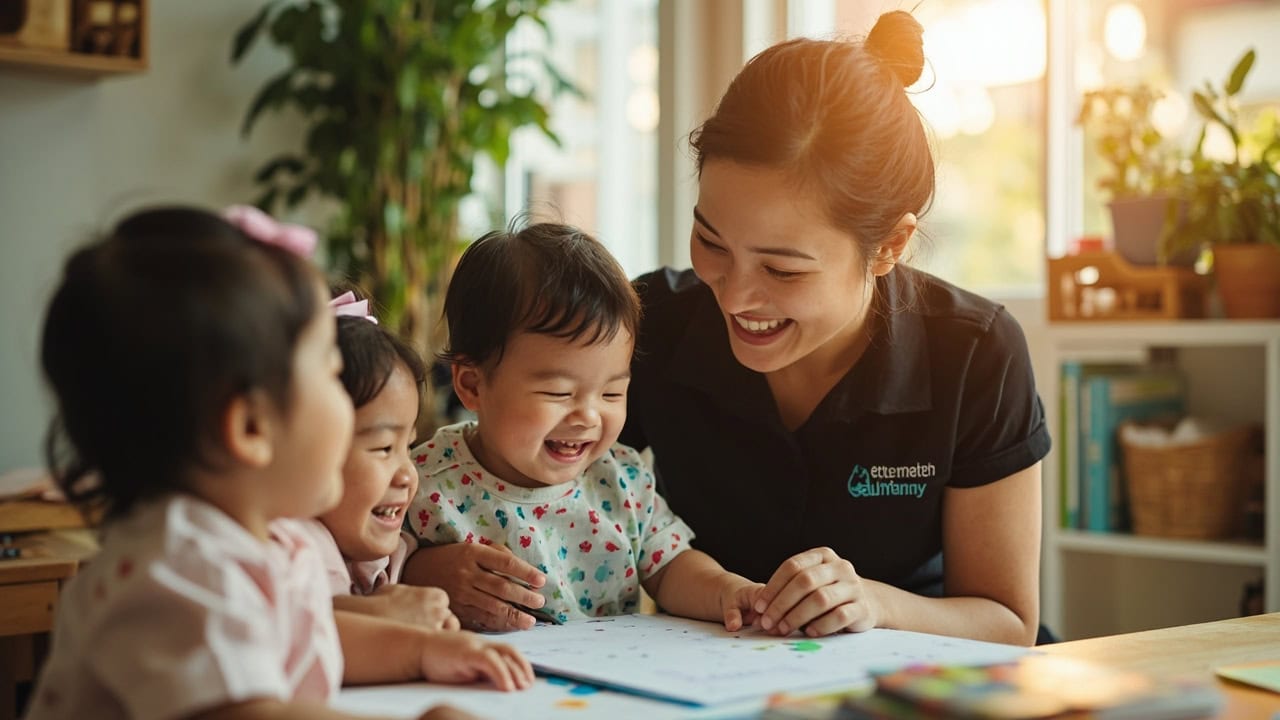
At EduNanny by BUTLER, we believe that when siblings are in the right environment, they do not just grow alongside each other. They grow through each other. And that growth — that quiet, daily, sibling-to-sibling construction of understanding and connection — is one of the most important curricula your children will ever encounter.
You chose to give them each other. Let us help you give them the place where that choice can do its finest work.
If you would like to explore what quality sibling care looks like for your family, speak with our team or learn more about our approach.