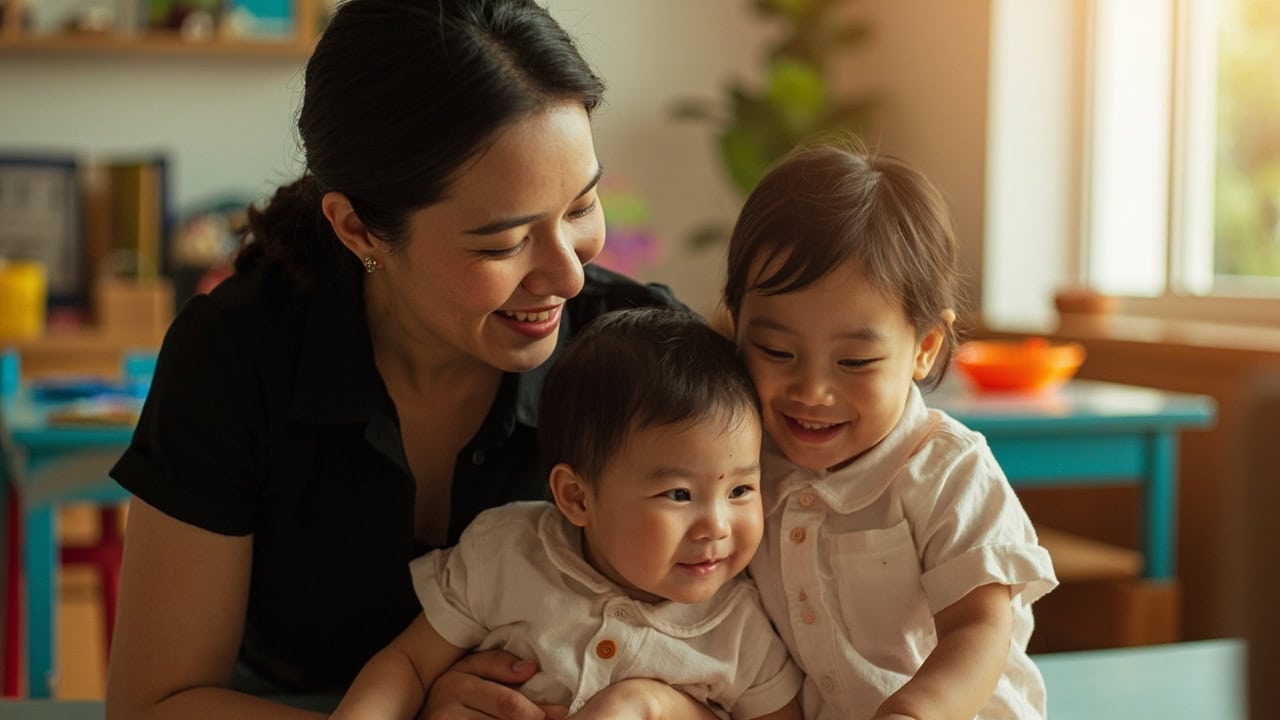
Why Professional Childcare Can Make Grandparents in Singapore Shine Brighter
The Reality of Multi-Generational Childcare in Singapore
We live in one of the most multi-generational societies in Asia. Large numbers of Singapore children are raised with active grandparent involvement — not as occasional visitors, but as primary or co-caregivers woven into the daily texture of a family’s life.
And for good reason. Grandparents bring availability, they bring love that is unlike any other love, and they bring generational wisdom that no manual or training can replicate. Your child will learn things from your mother that she will learn from no one else. The songs she sings, the rhymes she knows, the way she holds a child with hands that have held you — this is inheritance. This is family. And no thoughtful parent would trade it.
But here is what we do not say enough, because saying it feels like betrayal: wanting more than grandparent love is not the same as rejecting grandparent love.
The Particular Kind of Guilt Singapore Parents Carry
There is a specific guilt that belongs to parents navigating this terrain. It is quieter than the guilt of working parents who leave their children with family. It is more complicated.
Because when a grandparent offers to help, and you say yes, and then later you begin to wonder whether your child’s language development is on track, or whether she is getting the stimulation she needs, or whether the way she speaks to you at the end of the day reflects a full day of meaningful interaction — the guilt does not come from choosing not to rely on family.
The guilt comes from the suspicion that you might want something for your child that your own parents cannot give, and that wanting it makes you ungrateful.
So the conversation never really happens. The honest one. The one where you say, I love that Mama wants to help. I also need my child to be in an environment that is shaped around her developmental needs. Both of those things can be true.
Why Silence Is the Real Problem — And What Professional Caregivers Actually Do
What we have come to understand through conversations with hundreds of Singapore families is this: the silence is the real problem. Not the generational differences in childcare philosophy — though those are real. Not the gap between what grandparents expect and what parents want — though that gap is real too.
The silence is the problem. Because silence does not protect relationships. It starves them.
When a family brings in a professional caregiver — whether through home-based care or centre-based pathways — the most successful outcomes do not happen when the caregiver replaces the grandparent. They happen when the caregiver becomes the third partner in the child’s life, in a way that actually strengthens the grandparent relationship instead of threatening it.
Your mother has spent forty years being a mother. She raised you. She has opinions, habits, instincts, and expectations about what children need. She also, if she is honest, has moments of exhaustion she does not admit to, moments of doubt she covers with confidence, and a desire to be involved that goes far deeper than childcare logistics.
She wants to matter in her grandchild’s life. Not as a substitute for you, but as herself.
The Reframing That Changes Everything
A trained caregiver does not enter your home to do childcare better than your mother. That is the wrong frame.
A trained caregiver enters your home to do something your mother was never meant to do alone — to carry the full weight of your child’s developmental care, day in and day out, with consistency, with intentionality, with an understanding of the first thousand days that goes beyond what any loving grandparent, however devoted, has been trained to provide.
And here is the part that changes the family dynamic entirely: when a skilled caregiver is present, your mother gets something she may not even know she has been longing for. She gets to be a grandmother.
Not a fallback. Not a childcare solution. Not the person responsible for structuring your child’s day, managing milestones, worrying about whether she is doing it right.
She gets to walk in, scoop up your child, and simply love her. She gets to spoil her a little. She gets to take her to the hawker centre and buy her chwee kueh and tell her stories about when Mummy was little. She gets to leave at the end of the day feeling full instead of depleted.
This is not a small thing. This is the grandparent-grandchild relationship at its most genuine, most sustainable, most joyful. And it is only possible when the professional caregiver has taken on the role that professional training prepares them for.
What Quality Childminding Actually Looks Like
Understanding the difference between childcare and quality childminding matters, especially when you are navigating complex family dynamics.
Quality childminding in the early years means developmental intentionality — every interaction, every routine, every moment of stimulation is shaped by an understanding of how children learn and grow in these foundational years.
It means consistency and continuity — the caregiver builds a relationship with your child over time, learning their rhythms, their needs, their emerging personality.
It means evidence-informed practice — approaches that reflect what we know about early childhood development, from attachment science to language acquisition.
And it means whole-family awareness — understanding that the child exists within a family system, and that supporting that system supports the child.
This is different from what even the most loving grandparent can provide, not because grandparents lack wisdom, but because the role of primary developmental caregiver requires training, support, and bandwidth that goes beyond what any family member should be expected to carry alone.
The Family Ecosystem Approach in Practice
The approach matters as much as the placement. Because the family system is complex, and no caregiver — no matter how skilled with infants — can succeed if they are dropped into a household without an understanding of its emotional architecture.
When you bring a caregiver into your home who understands the family ecosystem model, they arrive not just as a childcare provider but as someone who can read the room. They understand that your mother-in-law may have strong opinions about sleep training, that your father may feel sidelined if he does not have a specific role in the daily routine, and that the unspoken tension between your vision for your child’s early years and your parents’ vision is real and deserves to be acknowledged, not ignored.
Caregivers working within this model communicate with grandparents as respected members of the care team, not as obstacles to be managed. They share updates not because they are required to, but because they understand that transparency is what builds trust.
Building Trust With Grandparents
Distance from information is the problem. Feeling sidelined is the problem. Not being trusted to understand is the problem. Grandparents are not the problem in multi-generational childcare.
In homes where families have questions or concerns, the best outcomes come from conversation, not authority. When a grandparent has a question about why things are done a certain way, the response invites dialogue: Here is why this approach matters for your grandchild’s development, and we would love for you to be part of understanding it.
What This Looks Like in Real Families
We have seen it in the families we work with across Singapore. The grandmother who was initially resistant to a professional caregiver coming in, and who six months later texts the caregiver to ask how the baby slept — because she genuinely wants to know, not because she is checking up. The grandfather who attended one of our family information sessions and said, I did not know so much had changed in what we know about early childhood — I want to learn too. The mother who told us she finally stopped dreading Sunday lunch because she no longer felt like she was carrying a secret.
The peace in that family was not the peace of avoidance. It was the peace of honesty.
Why the First Thousand Days Matter
There is something worth pausing on here, because it goes to the heart of why thoughtful childcare choices matter.
The first thousand days of a child’s life — from conception to roughly age three — are now understood to be a period of extraordinary brain development. The architecture of language, of emotional regulation, of secure attachment, of curiosity itself, is built during these years with a speed and a permanence that makes every care decision significant.
This is not a belief held loosely. The research in developmental psychology and neuroscience continues to deepen our understanding of these critical years. And honoring that understanding means taking seriously the responsibility of who cares for your child during these thousand days.
But — and this is the other thing we believe equally firmly — parents do not need to choose between their child’s developmental needs and their family’s emotional needs. These are not opposing forces.
The reason they so often feel like opposing forces is not because they genuinely are. It is because the systems around families have not been designed to hold both truths at once. This is what we designed our approach to do: hold both truths.
How EduNanny Works With Your Family
Through the ECDA Childminding Pilot, EduNanny offers home-based care with ratios that allow for genuine attention — up to three infants in a home setting, with caregivers who are trained, supported, and held to standards that parents can trust.
Key aspects of how we work:
- Trained caregivers — Our caregivers receive training in infant care and child development, but also in understanding family dynamics
- Monday to Friday care blocks — Designed to fit the rhythms of working parents
- Grandparent-inclusive approach — Caregivers are briefed on the family system, including how to communicate respectfully with grandparents and involve them as part of the care team
- Financial accessibility — Fee structures are designed to make quality care accessible, with Child Development Account or Baby Bonus schemes where applicable
The caregiver is not a replacement for your mother. She is not a status symbol or a parental shortcut. She is a skilled professional who has chosen to work within your family system — not above it, not outside it, but within it — and who carries the training, the values, and the emotional intelligence to do that work with care.
What Your Family Gets
What a skilled caregiver gives back to your family is not just the quality of care your child receives. She gives back clarity — that lets you stop negotiating your own judgment. She gives back space — that lets your mother be the grandmother she became a grandmother to be. And she gives back trust — that lets a family function as a family, rather than as a childcare arrangement held together by guilt and good intentions.
Addressing Common Concerns
Will my parents feel replaced? When quality care is in place, grandparents typically feel more included, not less. The professional caregiver handles the daily developmental heavy lifting — which means grandparents are free to show up as grandparents, not as substitute parents. The dynamic shifts from you’re doing it wrong to thank you for being here.
How do I have this conversation with my parents? Start with what you appreciate, not what you want to change. Acknowledge what your parents bring to your child’s life. Then, speak from your own role as a parent: I want to make sure our child gets the best start, and I want you to be part of that in the way that feels joyful for you, not obligatory.
Will it seem like I don’t trust my parents? Trust is not the issue. The issue is scope. You trust your parents to love your child. You also know that the demands of modern early childhood development have evolved since they raised you. Wanting professional support is not a statement about their love. It is a statement about what you know now.
What if my parents are hurt by this decision? Some hurt may be inevitable when expectations shift. But hurt that comes from honest communication can heal. Hurt that comes from silence, from resentment, from the slow erosion of trust — that is harder to repair. Choose the honest conversation, even when it is difficult.
Questions to Ask When Choosing Infant Care in Singapore
If you are exploring professional childcare options while navigating multi-generational family dynamics, here are questions worth asking:
- How does this care arrangement involve or communicate with extended family? The best care models see grandparents as part of the ecosystem, not as peripheral or problematic.
- What training do caregivers receive in family dynamics, not just child development? Technical skill matters, but so does emotional intelligence.
- How is information shared with families? Transparency builds trust; opacity breeds anxiety.
- What does the daily rhythm look like? Intentional, developmentally-informed care should have structure and purpose.
- How does the model protect the grandparent-grandchild relationship? Good care should strengthen family bonds, not strain them.
You Are Not Being Selfish. You Are Being a Parent.
If you are a parent in Singapore right now, caught in that familiar tension — grateful, torn, wanting to honor your parents and wanting the best for your child and feeling like those two desires are pulling you in different directions — we want you to know something.
You are not being selfish. You are not being ungrateful. You are being a parent.
And being a parent means advocating for the whole ecosystem your child lives in, not just the parts that are easiest to defend.
Your mother brought you into this world and raised you with everything she had. The best way to honor that is not to replicate her childcare, as if the last thirty years of developmental research did not exist. The best way to honor it is to build something that lets her step into her role with joy, with freedom, and with the certainty that her love — her specific, irreplaceable, generational love — is not being compared to or replaced by anything.
It is being protected by it.
Start the Conversation
We would be honored to be part of your family’s story — not as a replacement for the love your child receives from grandparents, but as a complement to it. A skilled caregiver becomes a bridge between generations, allowing each person to play the role they were meant to play.
Your child is not a project. Your family is not a problem to be solved. And the choice you make about who cares for your child in these first thousand days is not just a childcare decision. It is a declaration about what kind of family you want to be.
If you are ready to explore what childminding looks like when it is designed to see the whole family, we invite you to start a conversation with us.
Learn more about who we are and what EduNanny stands for.