Why Your Second Child Changes the Childcare Equation
What the Second-Child Decision Really Asks of Parents
Adding a child to your family changes the mathematics of everything.
With one child, you are managing a set of variables. Sleep rhythms, feeding schedules, developmental milestones, the relationship with your caregiver, the rhythm of mornings and pickups and weekends. It is complex, but it is one complex thing.
With two children, you are managing multiple sets of variables that interact with each other in ways you cannot fully predict. Your infant needs one kind of attention and your toddler needs another. Your older child has a relationship with the caregiver she has known since she was six months old, and now a new routine is forming around a second child. Your older child is old enough to notice change, to test boundaries, to ask questions. Your infant is new to everything.
And you, in the middle of all of this, are supposed to hold it together with the same hands that are already full.
What I have observed, working alongside families in Singapore across many years, is that the second-child reckoning is not really about the second child at all. It is about the first child having made you more discerning.
When you were a first-time parent, you did not know what you did not know. You chose based on instinct, on recommendation, on the feeling you had when you walked into a space or met a caregiver for the first time. And that was right. That was enough to get you started.
But now you have been through it. You have seen what a caregiver who truly knows your child looks like. You have experienced the difference between a competent arrangement and a warm one. You know what it feels like when your child runs toward the caregiver at pickup, not because she has to, but because she wants to.
You have seen what good looks like. And now that you are considering your second child, you refuse to accept anything less.
This is not perfectionism. This is what wisdom looks like on a parent.
The Family as a System, Not a Sequence
Here is what I want every Singapore parent with more than one child to understand: the childcare decision gets better with each child, when you have the right partner.
Not harder. Better.
Not because the stakes are lower, but because you know more. Not because the complexity is less, but because you have learned what to look for. Not because it matters less, but because you have seen what a thoughtful start can do for a child, and you want that for every child in your family.
A family with siblings is not simply a first-child arrangement plus one. It is an ecosystem. It has its own rhythms, its own dynamics, its own narrative. The older child is learning what it means to have a sibling. The younger child is entering a world that already has shape and expectation and history. The caregiver is not just managing two children in sequence but holding space for two different developmental stages, two different temperaments, two different relationships, within the same environment.
Quality looks like the caregiver knowing each child not just as an individual, but in relation to the whole. Your toddler is not the same toddler when a new baby is in the house. She may regress in some ways, advance in others, test limits she never tested before, or suddenly become extraordinarily helpful. A caregiver who understands sibling dynamics will notice these shifts without pathologizing them. She will give your older child age-appropriate ways to feel important and included. She will protect your younger child’s need for slower, gentler attention while honoring your older child’s need to not feel replaced.
At pickup, something small but meaningful happens. Your toddler comes out holding the baby’s hand, or showing you a picture she drew during naptime, or telling you that she helped feed the baby her bottle. This is not incidental. This is the sibling experience in childcare doing exactly what it should do: giving your children a shared world, a shared vocabulary of care, a place where they belong together rather than in parallel.
Compare this to a family that has had to fragment their arrangements. Different caregivers, different locations, different routines for each child. The coordination alone becomes a full-time job. The siblings do not have shared experience. The caregiver relationships are isolated from each other. And the parents are constantly managing the seams.
The complexity of raising siblings is often invisible to everyone outside the family. What families need is not more advice about how to manage their children. What they need is a childcare partner who understands that this complexity exists and who is equipped to hold it.
Why Continuity Changes Everything
Think about what it means for a caregiver to know your family across years and children.
With your first child, the caregiver learns your child’s cues, preferences, fears, and joys. She learns what calms your child down and what makes her laugh. She learns that your child hates having her face wiped but will tolerate it if you sing a particular song.
When your second child arrives, that caregiver already knows your family culture. She knows your parenting values. She knows how you handle transition, how you communicate, what you consider non-negotiable. She does not have to rebuild trust from scratch. She simply extends the relationship to include your new child, with the same care, the same intentionality.
This is longitudinal trust. And it is rare.
In most childcare arrangements, continuity is an accident. You might get lucky and have the same caregiver for years. But the system is not designed for it. The system is designed for transactions. You need care, you find care, and when circumstances change, you start again.
There is another dimension to continuity that matters for how children see themselves. When siblings are in the same childcare community, your older child is not just a child with a new baby in the house. She is a child who has her own relationship with her caregiver, her own place in the childcare world, her own memories and rituals. The arrival of a sibling does not erase that. The caregiver makes sure of it.
She involves your older child in age-appropriate ways. She narrates the sibling relationship with warmth and curiosity. She creates moments where your children are together, where your older child’s role as mentor and guide is celebrated, where your younger child has a model of what growing up looks like.
At pickup, when your toddler runs out with your baby in the caregiver’s arms, and your toddler says, “We were playing and she laughed,” or “I showed her the picture book,” you are witnessing something that took months of careful, quiet work. Work that a good childcare ecosystem makes possible.
What EduNanny Offers Singapore Families
When you work with EduNanny, you are not finding a caregiver for your infant and then searching again for your toddler and then searching again for your preschooler. You are entering into a relationship that is designed to grow with your family. The same standards of attention, the same communication practices, the same commitment to knowing your children individually and as members of a sibling system.
This continuity is not a nice-to-have. It is a structural advantage for your family.
The ECDA Childminding Pilot Framework
EduNanny operates through the ECDA Childminding Pilot, which means families have access to regulated, structured childcare that meets government standards for quality and safety. For infant care specifically, the pilot maintains ratios of up to one to three, meaning your infant receives the focused attention that the early months require.
For families, this means affordability is within reach. The pilot fee structures are designed to make quality childcare accessible, and existing government support mechanisms—including the Child Development Account and Baby Bonus schemes—can be applied. This is not incidental. It means that families do not have to choose between quality and sustainability. EduNanny offers both.
Pathways That Match Your Family’s Rhythm
EduNanny offers home-based and community or centre-based pathways, depending on what works best for your family’s rhythm. Some families prefer the intimacy of home-based care, where the caregiver comes to you or your child is in a small, consistent environment. Others prefer the community dimension of centre-based care, where children have access to peers and broader programming. Both pathways maintain the same commitment to knowing each child, supporting each family, and building the kind of continuity that makes the sibling experience work.
Communication and Support That Meet You Where You Are
Communication and transparency are built into the arrangement. Where deployed, CCTV measures provide families with additional peace of mind. But more than the technology, it is the culture of communication that matters—caregivers who understand that parents of multiple children are already managing enormous complexity, and who take it upon themselves to be clear, consistent, and responsive.
Monday to Friday care blocks are structured to align with the rhythms of working families in Singapore. The childcare arrangement that cannot accommodate the actual shape of your life is not a real solution. EduNanny is designed around the lives that Singapore families actually live.
EduNanny also offers the Thomas AI Chatbot, which provides parents with an accessible, intelligent resource for questions about childcare, development, and the practical decisions families face. The questions do not only arise during pickup or scheduled reviews. The middle-of-the-night uncertainty, the quick check before a meeting, the query about developmental norms or feeding schedules or sibling dynamics—these also deserve thoughtful answers. Thomas is available when you need it, and because it is built into the EduNanny ecosystem, the answers it provides are grounded in the same philosophy of care that shapes the actual service.
Common Questions From Parents Considering a Second Child
“Will my second child receive the same quality of attention?”
Quality care for siblings is not about splitting attention in half. It is about a caregiver who understands developmental stages and knows how to meet each child where they are. Your infant needs physical closeness and consistent routines. Your toddler needs independence encouraged and boundaries held. A caregiver who knows your family can hold both at once, because she is not learning your family culture for the first time.
“Will my older child feel replaced?”
This is a real concern, and it deserves a real answer. A caregiver who understands sibling dynamics will give your older child age-appropriate ways to feel important. She may involve your toddler in gentle “helper” activities with the baby. She will protect one-on-one moments with your older child so that the arrival of a sibling does not feel like a subtraction.
“What if the arrangement doesn’t work for both children?”
With EduNanny, you are not locked into a rigid structure. The relationship is designed to be responsive. If your family’s needs evolve—if your toddler’s schedule changes, if your infant’s needs shift—the conversation continues. The caregiver knows your family well enough to adapt thoughtfully rather than reactively.
“How do I know if this will actually work for my family?”
Trust your instincts, but also trust the process. Ask to observe. Ask questions about how the caregiver handles sibling dynamics. Ask about communication practices. Pay attention to how your toddler responds to the caregiver, not just how your infant does. The signs of a good fit are the same signs you looked for the first time—warmth, attentiveness, confidence, genuine connection.
The Decision That Grows Better With Each Child
I want to be careful here, because I do not want this to sound like a platitude. I mean something specific.
With your first child, you learned what quality looks like. You learned what questions to ask. You learned what your non-negotiables are. You learned, through experience, what it feels like when care is right and what it feels like when something is off.
With your second child, or your third, you bring all of that knowledge. You are not starting from zero. You are starting from wisdom.
But wisdom without a partner to act on it is just frustration. If you know what you want and you cannot find it, you end up compromising. You end up fragmenting your arrangements. You end up rebuilding trust over and over because the system keeps requiring you to.
The right partner changes this. The right partner means that your growing family is an asset, not a liability. That the experience you have gained makes each new transition smoother, not harder. That your caregiver’s knowledge of your family deepens with each child, creating a richness of understanding that cannot be replicated by any amount of searching and interviewing and hoping.
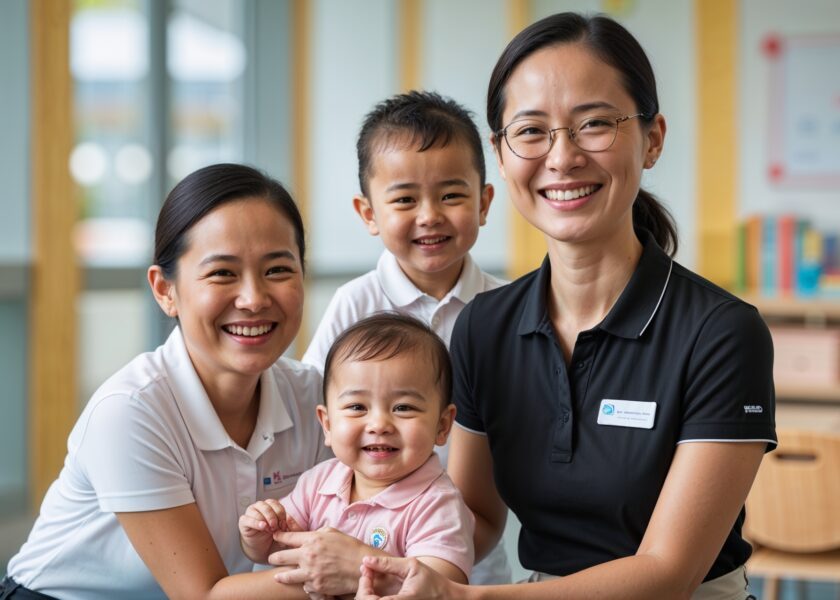
Imagine this: a family walks into a community space. There is a toddler, steady on her feet, pulling gently at the hand of a caregiver she has known since she was an infant. There is a baby, held securely, looking around with wide eyes at a world that already feels familiar. And there are the parents, watching, for just a moment, before heading off to work or to the rest of their day.
The toddler turns back and waves. The baby reaches toward the caregiver with absolute trust. The parents exchange a look that says everything. They know their children are known. They know they do not have to explain again, or worry again, or rebuild again. They know that this—this arrangement, this relationship, this village—is going to hold.
That kind of knowing. The quiet confidence that comes from a childcare partner who has been with you across years and children. Who has watched your family grow and has grown alongside it. Who treats each child as an individual and the sibling system as something worth protecting and nurturing.
This is what EduNanny offers. Not just childcare. A partnership that grows.
If you are standing at that fork in the road, wondering how to bring your second child into the same world of care that served your first so well, you do not have to choose between continuity and expansion. You do not have to start over. You do not have to rebuild trust from the ground up.
The right partner makes each decision better than the last.
Explore how EduNanny can support your growing family. Get in touch with our team to learn more about infant care and childminding options that adapt to your family’s story.
#SingaporeChildcare #InfantCareSingapore #ChildmindingSG #SiblingCare #EduNanny