What Your Child Is Really Learning When You’re Not There
The Invisible Curriculum Running Beneath Every Care Day
In Singapore, we are extraordinarily fortunate to live in a city that takes early childhood seriously. We have frameworks, accreditations, ratios, and curricula. We have conversations about school readiness, bilingual development, and developmental milestones. All of that matters.
But there is a curriculum running beneath all of it — quieter, less visible, and in many ways far more consequential — that rarely gets named in the brochures, the open houses, or the morning drop-off rush. It is your child’s inner world. It is what they are learning to feel, to manage, to trust, and to become during the hours you are building your own life outside theirs.
Consider, for a moment, the child who has just learned — in the past few months — that when they feel frustrated, someone will notice. Not punish the frustration. Not distract from it. Notice it. Name it. Stay with them while it moves through their body. Perhaps offer a calm voice and a steady hand.
That child is not just being comforted. They are learning, at the deepest level, that feelings can be survived. That someone is big enough to hold the big feeling alongside them. That they do not have to manage everything alone.
What the Science Tells Us
This is not metaphor. In the first thousand days of life, and extending well beyond, a child is constructing the architecture of their emotional life. The circuits that govern how a human being experiences safety, processes stress, reads another person’s face, manages disappointment, reaches for comfort, or extends trust to someone new — these are not present at birth in their final form. They are built, day by day, through experience.
The most powerful experiences are relational ones. They happen in the presence of a consistent, responsive, emotionally attuned caregiver who notices what the child is feeling and responds not just to the behavior but to the feeling beneath it.
This is the invisible curriculum. And if your child is in quality care, it is running every single day — whether or not there is a report about it, whether or not you have the framework to ask the right questions.
Co-Regulation: The Gift That Cannot Be Lectured
Developmental psychologists call the process I am describing co-regulation, and it is one of the most consequential gifts a caregiver can offer a young child.
It is different from being told to calm down. It is different from a time-out. It is the quiet, skilled act of being with a child’s emotional state in a way that gradually, over months and years, teaches the child to do that for themselves.
Self-regulation — the capacity to manage one’s own impulses, emotions, and responses — is not a skill you can lecture into a child. It is a skill you grow inside them through repeated, consistent, loving co-regulation.
What This Looks Like in Practice
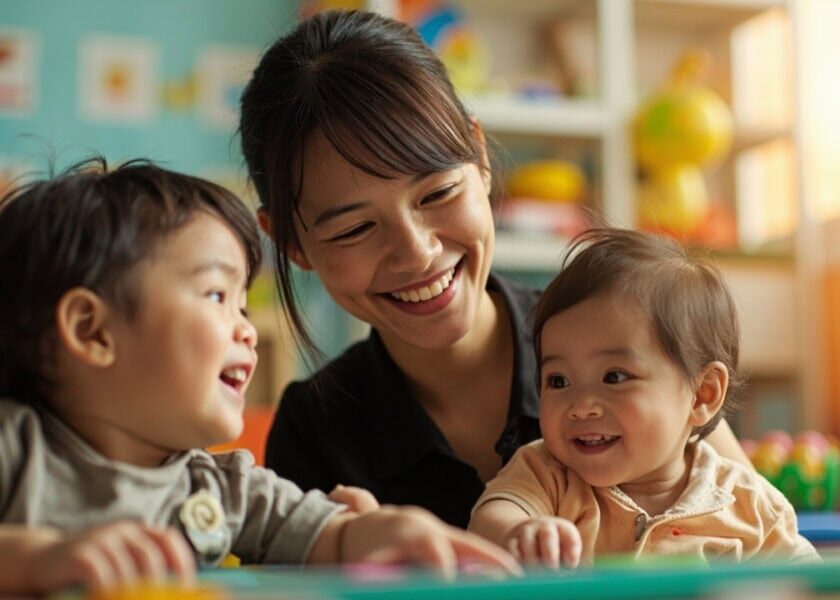
A skilled caregiver does not simply manage behavior. They read emotional states. They notice when a child who usually engages is withdrawing. They notice when a child’s play has taken on a new quality, when a pattern emerges in how a child responds to transitions, when a child is practicing a skill with the focused intensity that signals a developmental leap.
They notice, and they remember. And when you arrive to pick up your child, they translate what they have seen into language you can use.
When the caregiver says, “Your child seemed happy today,” pay attention to what that means in context. A trained caregiver who notices your child’s inner life will be able to tell you more than that. They might say:
“Your child was really focused on the water table today — she spent almost forty minutes experimenting with pouring, and when another child interrupted her, she looked to me and I saw she was processing a big feeling. We sat with it together.”
That is the invisible curriculum being reported on. That is a caregiver who is not just supervising but translating your child’s inner experience for you.
The Miracle of Trust: Widening the Circle of Safety
Now think about trust. Not the abstract concept — the living, breathing, everyday practice of trust that your child is building with adults outside your family. This is one of the least discussed miracles of quality childcare.
Somewhere between the ages of eight months and three years, your child is doing something remarkable. They are learning that the world contains other trustworthy people. That Mum and Dad are not the only ones who can keep them safe. That another adult can know their name, anticipate their needs, comfort their tears, and delight in their discoveries.
The psychologist John Bowlby called this the secure base — the reliable presence from which a child can venture out to explore and to which they can return for comfort. When a caregiver becomes a secure base for your child, they are not replacing you. They are extending your child’s capacity to love, to trust, and to relate.
They are widening the circle of safety your child knows.
The way this happens is not dramatic. It happens through the mundane, repeated moments of consistency — the same greeting each morning, the same routine at naptime, the same voice that says, “I see you. I know you’re tired. Let’s get your blanket.”
Learning to Be With Other Children
There is something else your child is doing during these unseen hours that deserves to be named. They are learning to be with other children. Not playing alongside them — learning to be with them.
In the infant and toddler years, peer interaction is not the polished, cooperative play we imagine from older childhood. It is raw, experimental, and full of big feelings.
A toddler who grabs a toy from another is not being aggressive. They are experimenting with the social world — testing boundaries, experiencing the consequences of their actions, and beginning, very slowly, to learn that other people have needs and feelings too.
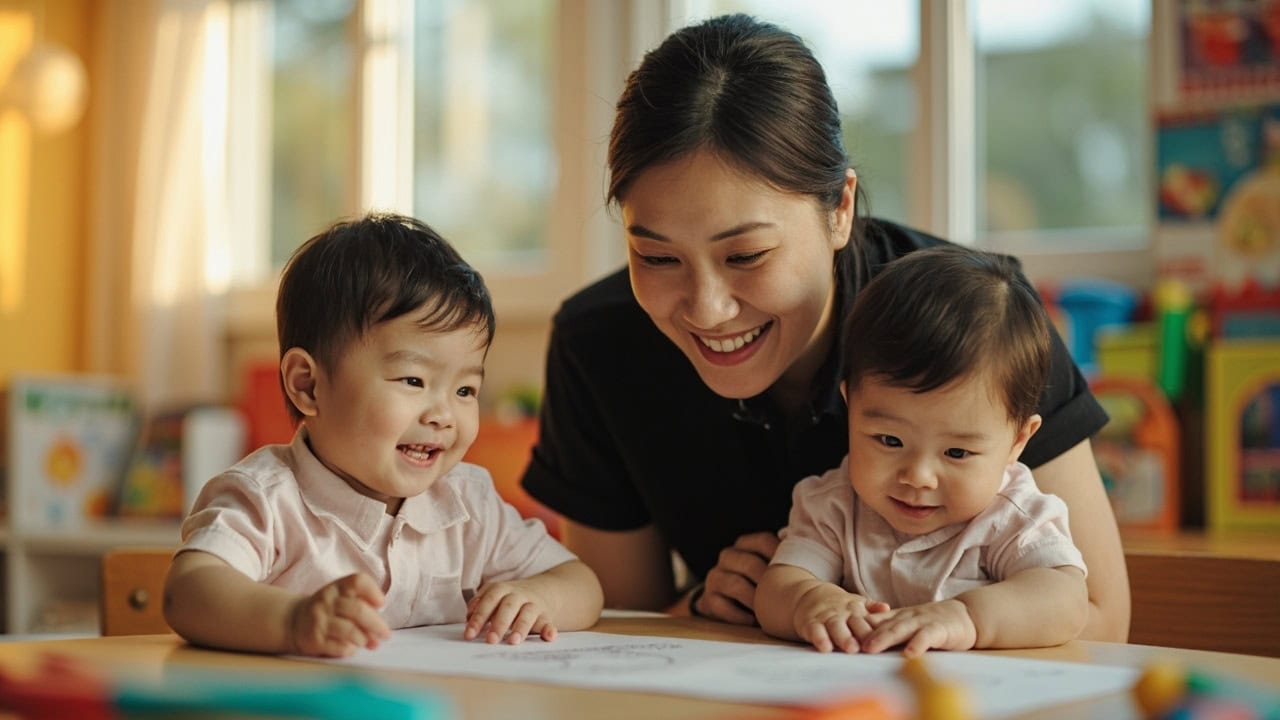
A skilled caregiver does not intervene to end this exploration but guides it — teaching words, modelling sharing, holding the emotional space when disappointment erupts. This is social navigation at its earliest, most formative stage.
What Quality Childminding Actually Looks Like
So how can you know — not guess, not hope, but actually know — that your child is in a place where this invisible curriculum is running?
A quality caregiver, and this is the distinction I want you to hold, does not simply supervise children. They observe them. And not just their activities — their emotional states.
Signs of Quality Emotional Care
- The caregiver’s expression reflects genuine attentiveness when interacting with your child — not perfunctory, but present
- Your child shows a baseline sense of comfort in the space, moving with a sense of freedom rather than shutting down
- The caregiver can tell you about your child’s emotional day, not just what they ate or when they slept
- Routines are consistent — the same greeting, the same transitions, the same words of comfort
- The caregiver notices patterns: when your child struggles, when they thrive, what triggers big feelings
Questions to Ask at Pickup
Ask questions. Not interrogations — genuine questions. A quality caregiver will welcome these, because they already know the answers. They have been watching.
- How does my child handle transitions during the day?
- Who does my child gravitate toward during play?
- Has my child been practicing any new skills — emotional, social, or otherwise — that I should know about?
- What was my child’s emotional tone today? Was there a moment that seemed significant?
- How does my child respond when they are frustrated or upset?
What Quality Care Is Actually Building
| What You Might Assume Is Happening | What Is Actually Happening in Quality Care |
|---|---|
| Your child is being supervised and kept safe | Your child is learning that the world is a trustworthy place, one consistent interaction at a time |
| Your child is playing with other children | Your child is experimenting with the social world — learning that others have needs and feelings |
| Your child is being distracted from big feelings | Your child is being co-regulated — learning that feelings can be survived with help |
| Your child is following routines | Your child is building the internal architecture of security and predictability |
| Your child seems happy | Your child is building the emotional vocabulary and relational trust that will serve them for life |
Where the Invisible Curriculum Becomes the Work
This is where the distinction between childcare and quality childminding becomes most visible. The invisible curriculum I have been describing should not be left to chance. It should be intentional. It should be trained. It should be resourced. And it should be the animating purpose of every care arrangement you make.
EduNanny Singapore, operating as part of the ECDA Childminding Pilot, is built on this understanding. Quality early childminding is not supervision with warmth added — it is the deliberate, skilled practice of supporting your child’s emotional and social development, with all the training, ratios, and frameworks that such work deserves.
The EduNanny Standard
- Trained caregivers held to standards that recognize the depth of what they are doing
- Thoughtful ratios — up to one to three infants — so your child is not one face in a crowd but one person who can be truly seen
- Intentional care in home-based settings, designed to hold the relational warmth infants and toddlers need
- Accessible pricing within pilot fee structures, supported by CDA and Baby Bonus usability
The emotional curriculum I have been describing should not be a privilege. At EduNanny, it is the standard.
Beyond Supervision: The EduNanny Difference
The word “childminder” can sometimes carry less weight than it deserves. In some contexts, it suggests someone who simply watches a child. That is not what we are talking about.
A skilled childminder — and this is the standard at EduNanny — is a professional who:
- Understands child development
- Can read a child’s emotional state with precision
- Practices co-regulation as a craft
- Documents what they observe with honesty and care
- Communicates that observation to parents in a way that builds trust rather than anxiety
This is not babysitting. This is a professional standing in the gap between your presence and your child’s need, doing so with skill, with warmth, and with genuine investment in what your child is becoming.
Transparency in Service of Trust
EduNanny understands that parents who feel informed feel confident, and confident parents are better partners in their child’s care. Tools like the Thomas AI Chatbot are designed to give parents a channel through which they can engage with their child’s care experience, ask questions, receive thoughtful responses, and stay connected to what is happening in those unseen hours.
This is technology in service of relationship, not in place of it. Communication is ongoing, structured, and purposeful — not just a daily log of meals and naps, but an ongoing conversation about your child’s emotional and social development.
Addressing Your Real Concerns
“Am I letting my child down by not being there?”
You are not failing your child by working. You are providing for your child, and you are also — when you choose quality care — giving them something irreplaceable: the experience of widening their circle of trust, of building emotional resilience with skilled caregivers who have time to notice what you, in the rush of parenting, may miss.
“How do I know what’s really happening when I’m not there?”
You ask. You observe at pickup. You notice your child’s emotional state — how they climb into your lap or pull away, the quality of their sleep that night, the ease or difficulty of the next morning’s drop-off. You build a relationship with the caregiver so that communication becomes a partnership, not a transaction.
“Is my child really learning anything meaningful in childcare?”
Every moment in quality childcare is a lesson in emotional development. The way frustration is held, the way trust is extended, the way other children’s needs are slowly recognized. These are not trivial lessons. They are the foundation of every relationship your child will ever have.
“What if my child seems ‘fine’ but something is wrong?”
This is exactly why trained observation matters. A quality caregiver notices withdrawal, changes in play quality, shifts in engagement. They see what you cannot see because they are present in the moments you miss. That is why communication between caregiver and parent is not optional — it is essential.
A New Lens for Pickup
Come back to that moment at pickup. Because this is where everything I have been saying becomes personal.
When you collect your child at the end of the day, you are not just collecting a body. You are collecting their emotional day. Their social day. The accumulation of every interaction, every small triumph, every frustration, every moment of being held — literally or figuratively — by a trusted adult.
Your child is bringing it home. Not in words. In the way they climb into your lap or pull away from you. In the quality of their sleep that night. In the ease or difficulty of the next morning’s drop-off.
So what should you be looking for?
- Look for the child’s general ease. Not a forced cheerfulness, but a baseline sense of comfort in the space. Are they moving with a sense of freedom? Are they exploring, or are they shut down?
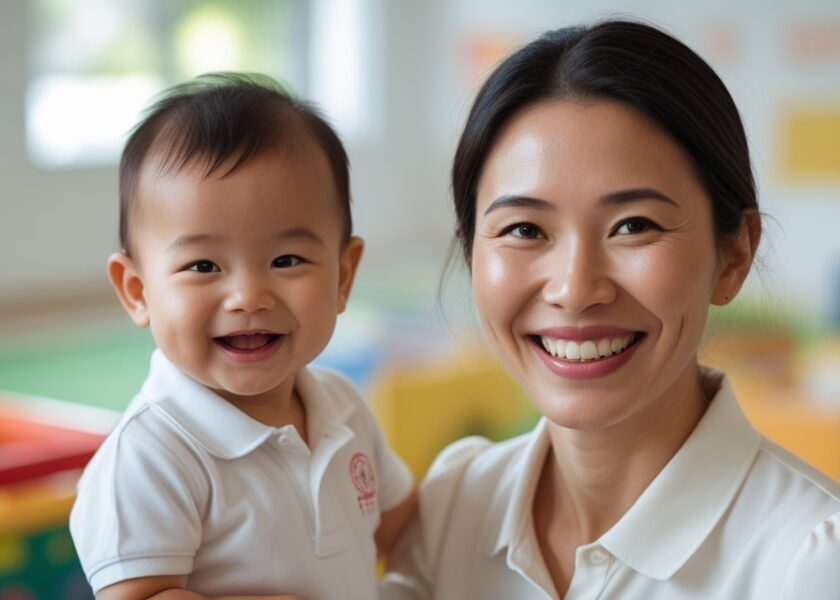
- Look at their face when they are engaged in play. Look at the caregiver’s face when they are interacting with your child. Does the caregiver’s expression reflect genuine attentiveness, or is it perfunctory?
- Notice the quality of attention. The real-time, in-the-moment attentiveness — this is the single most important indicator of what your child is receiving.
The Foundation That Outlasts Everything
The emotional foundation your child is building in these early years is not less important than their cognitive development. It is not a soft, optional extra.
It is the thing that will determine how they handle their first day of school, their first friendship ending, their first experience of failure, their first intimate relationship, and the countless moments in adulthood when they will need to manage something that feels unmanageable.
The child who has been consistently co-regulated, who has learned that big feelings are survivable, who trusts adults beyond their parents, who knows how to be with other people — that child is carrying something precious.
And the care you have chosen, if it is quality care, has been pouring that foundation, quietly and deliberately, in the hours you were not there.
So the next time you stand at the gate and your child is handed to you, and you notice something in their face that you cannot quite name — do not let that uncertainty become anxiety. Let it become curiosity. Let it become an opening.
Because your child is not just being minded. Your child is being seen.
And the people who are seeing them — the caregivers, the observers, the co-regulators, the translators — they are building something inside your child that will outlast every toy, every lesson, and every milestone you are currently tracking.
That thing is the capacity to feel, to connect, to recover, and to love. It is the most human curriculum there is. And it deserves to be taken as seriously as any academic program you could name. Because it is the foundation on which everything else is built.
When you cannot be in the room, what matters most should be in the right hands. Choose care where the invisible curriculum is not an accident — but the work.
If you are looking for childminding and childcare in Singapore that takes the invisible curriculum seriously, we would be glad to hear from you.