Beyond Academics Building Genuine Readiness for Singapore Primary One
When Primary One Starts Feeling Real: The Quiet Question Every Singapore Parent Carries
There is a moment, familiar to countless parents in Singapore, when the calendar flips and suddenly Primary One feels less like a distant milestone and more like a destination approaching at speed. It comes around the time your child turns four, or perhaps when friends’ children start collecting Primary School registration documents. Sometimes it arrives at midnight, when you find yourself scrolling through forums, searching for some version of the answer to a question you have not quite said aloud.
Will my child actually be ready?
You are not alone in that moment. That unspoken question lives in households across Singapore, carried quietly by parents who want nothing more than to walk their child to the school gates on the first day feeling genuine confidence instead of cautious hope.
Here is what we know, after years of walking alongside families through this transition: readiness is not what most parents have been led to believe it is. It is not a stack of completed worksheets. It is not the number of enrichment classes attended. It is not the ability to read early or do arithmetic ahead of the curriculum, despite what marketing materials may suggest. Readiness is something deeper, quieter, and far more important. And the genuinely reassuring news is that it is something quality childcare builds naturally, every single day, in ways that truly matter when that first bell rings.
Quick Summary: What Real Primary One Readiness Looks Like
- Physical and motor development for classroom stamina and handwriting
- Executive function for self-regulation and sustained learning
- Social-emotional skills for navigating peer relationships and teacher expectations
- Language and early literacy foundations aligned with the Singapore curriculum
- Independence and daily living skills for the rhythms of primary school
What Primary One in Singapore Actually Demands
When a child steps into a Primary One classroom, they enter an environment that requires far more than academic knowledge. Children need physical stamina to sit through a full school day, manage the fine motor demands of handwriting, and navigate stairs, corridors, and canteen queues.
They need executive function—that constellation of mental skills that allows them to hold instructions in mind, switch between tasks, manage impulses, and regulate emotions when something feels hard or frustrating. They need social fluency, the ability to navigate thirty children in a shared space, to take turns, to resolve small conflicts, to read social cues and adapt. They need language and early literacy foundations aligned with the Singapore English curriculum. And they need independence—the quiet confidence that comes from knowing how to manage oneself, to ask for help when needed, to move through the rhythms of a school day without constant adult direction.
These are the real pillars of school readiness. And here is what is so often misunderstood: these pillars are not built by worksheets at home. They are not built by academic acceleration in the years before Primary One. They are built through play, through relationships, through responsive environments. The child who enters P1 with these foundations does not merely perform better academically. They arrive at school as a complete person, ready to learn.
Singapore parents face a particular pressure. The Primary School Registration System, streaming conversations, and the competitive enrichment landscape can make academic acceleration feel like the safest path. But experienced P1 teachers consistently observe that the children who struggle most in their first year are rarely the ones who knew more. They are the ones who arrived without the foundational capacities to access what they already knew.
The Physical Foundation: Why Motor Skills Matter More Than You Think
It is easy to overlook physical development in discussions of school readiness, yet it is foundational in ways that become immediately visible the moment a child picks up a pencil for the first time in Primary One.
The strength in a child’s hands, the coordination in their fingers, the posture they can sustain through a morning of written work, the gross motor skills needed to navigate a large school campus, the stamina to last through a full day of learning—these are not academic skills, but they determine whether a child who knows the answer can actually write it down.
Children who have spent their early years in environments that encourage active play, outdoor exploration, and varied physical activity arrive at P1 with the motor foundations that make classroom participation possible. This is often the first place where the gap between a prepared and an unprepared child becomes visible, and it is so frequently missed because parents are looking elsewhere.
Building Motor Foundations Through Play
- Sensory play with sand, water, and playdough builds hand strength
- Outdoor climbing and running develops gross motor coordination
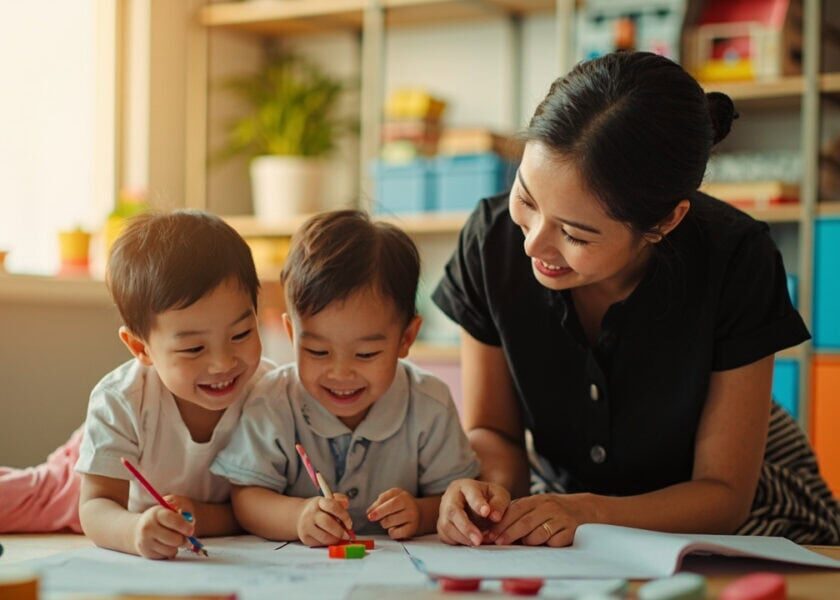
- Drawing, cutting, and manipulation activities prepare fingers for handwriting
- Active play throughout the day builds the stamina a full school day requires
Executive Function: The Invisible Infrastructure of Learning
If you have spent any time reading about child development recently, you have likely encountered the term executive function. In practical terms, it refers to the self-regulation skills that allow a child to pause before acting, to hold information in working memory while completing a task, to shift flexibly between activities, and to manage emotional responses when things do not go as expected.
In a Primary One classroom, these skills are constantly in demand. A child must sit when asked to sit, listen when instructions are given, manage the frustration of a difficult sum, transition from literacy to mathematics to a bathroom break without falling apart. Executive function is the invisible infrastructure of classroom learning.
Children who arrive with strong executive function are not smarter than their peers. They are simply better able to access what they already know, because their minds are organized and regulated in ways that make learning possible.
Quality childcare environments attend to executive function development through structured play, guided transitions, and warm but boundaried interaction that teaches children how to manage themselves. It is not about discipline. It is about building capacity. And it is among the most important things your child will carry into Primary One.
Social-Emotional Readiness and Language: Foundations That Work Together
Primary One is a social environment of surprising complexity. Thirty children, all adjusting simultaneously, all learning the rules of a shared space, all navigating the normal challenges of peer relationships at the same time.
The child who has had rich experience in quality childcare—who has learned to take turns, to manage disappointment, to read a peer’s emotions, to ask an adult for help appropriately, to enter and exit play with grace—enters this social environment with practical wisdom that no worksheet can provide.
Children who struggle socially in Primary One struggle academically as well, because social stress consumes the cognitive resources they need for learning. This connection is rarely discussed but profoundly important.
Key Social-Emotional Capacities for P1
- Ability to take turns and share resources
- Skills to manage minor conflicts without adult intervention
- Capacity to read basic social cues from peers and teachers
- Comfort asking for help when needed
- Ability to manage disappointment and frustration
Social-emotional skills are learned in relationship, in the daily texture of interacting with other children under the gentle guidance of responsive adults. And they are not optional for school success.
Language and Early Literacy Aligned with the Singapore Curriculum
Language and early literacy matter, and here it is important to understand what the Singapore English curriculum actually expects from children entering Primary One.
The curriculum builds quickly on oral language foundations, expecting children who can listen for meaning, participate in discussions, recognize an expanding bank of sight words, and engage with texts at a level that assumes prior exposure to rich language experiences.
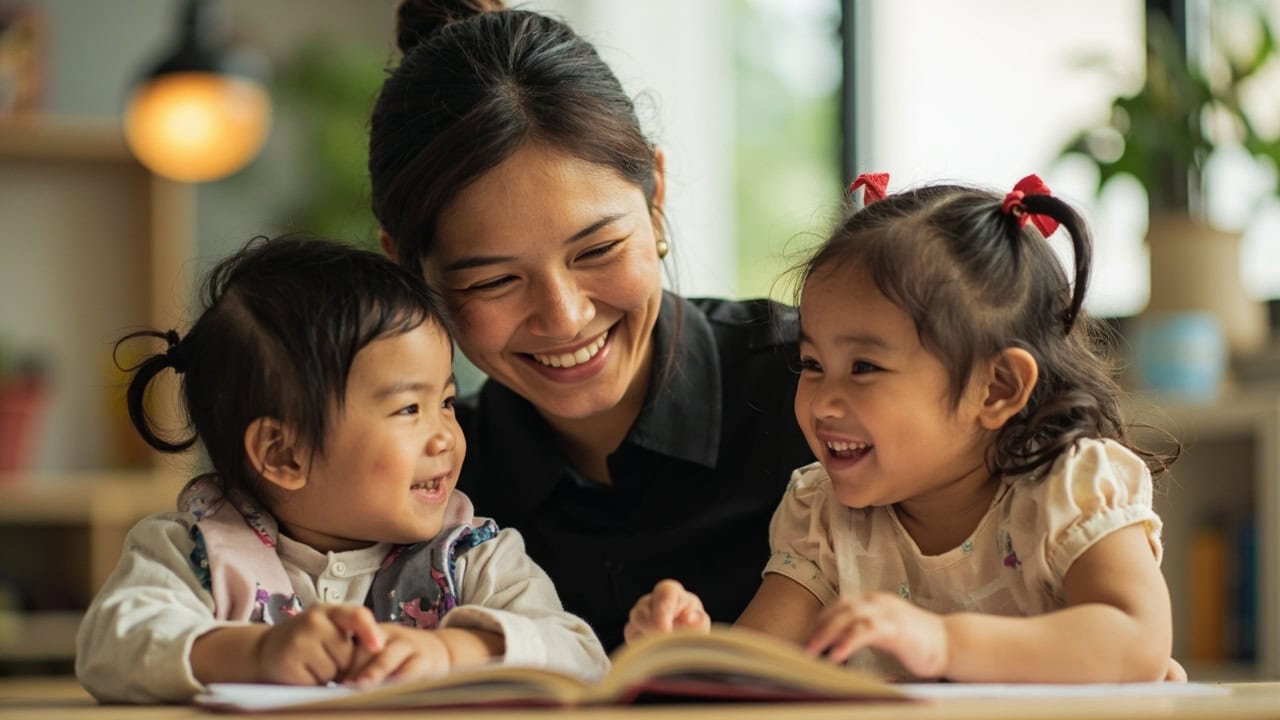
Strong oral language, developed through conversation and storytelling and shared reading, is not a nice-to-have. It is the platform upon which literacy is built. And the best place to nurture it is in an environment where children are talked with, listened to, read to, and invited into the pleasure of language every single day—not drilled or tested, but nurtured naturally through the kind of language-rich interaction that quality childcare provides.
Independence: The Most Underappreciated Pillar of Readiness
Every teacher who has spent time with new Primary One students will tell you how central independence is. Yet it remains the most underappreciated dimension of school readiness.
The child who can manage their own belongings, use the toilet independently, eat lunch without needing constant assistance, follow a simple sequence of instructions, and move from one activity to the next with minimal distress—that child has cognitive resources free for learning.
The child who knows how to ask for help, who has the quiet confidence to raise their hand and say, “I do not understand,” has something even more valuable. They have the beginning of agency—the recognition that they are capable of navigating difficulty and that adults are available to support them.
Independence is built gradually, in environments that offer just enough support and just enough challenge, that expect children to try things for themselves while remaining close enough to catch them if they falter. It is built through the daily rhythms of quality childcare, where children are given age-appropriate responsibilities and guided with patience toward mastery.
Why Quality Childcare Builds These Foundations Best
There is a reason that the real pillars of school readiness are best developed in quality childcare rather than at home with worksheets and screens. It comes down to three things: relationships, environments, and intentional guidance.
The Power of Relationships
Children develop capacities, not just skills. Capacities like executive function, social fluency, and independence are not learned through instruction. They are learned through relationship, through the daily back-and-forth of interacting with responsive adults who model, guide, and support.
In quality childcare, children have consistent, warm relationships with caregivers who know them deeply. This security is what allows them to take risks, to try new things, to manage frustration, to grow.
Environments Designed for Development
Quality childcare environments are not just safe spaces. They are intentionally designed environments where every element—from the layout to the materials to the daily rhythm—is considered for its developmental impact.
Play spaces that encourage active movement. Quiet corners for focused activities. Social zones for peer interaction. Routines that teach transition skills. These environments build readiness without children even knowing they are learning.
Guided Play and Intentional Care
Quality childcare is not supervision. It is not entertainment. It is guided play and intentional care, where trained caregivers understand the developmental journey each child is on and attend to it with purpose.
When a child struggles with a puzzle, the caregiver knows when to step in and when to step back. When two children conflict over a toy, the caregiver guides resolution in ways that build social skills. When a child needs to build hand strength, the caregiver structures activities that develop it naturally.
EduNanny: Where These Foundations Are Built
This is where EduNanny by BUTLER comes in. As part of the ECDA Childminding Pilot, EduNanny was built on a simple but powerful understanding: the earliest years are not just a time to be cared for. They are a time to be built. And the building that happens in those years, in the right environment with the right guidance, is what determines whether a child arrives at Primary One ready to thrive.
Our model reflects this understanding at every level. We offer home-based childminding, because we know that young children, particularly in their earliest years, develop best in environments that feel warm and contained, where ratios are low enough for genuine responsiveness.
Our infant ratio of up to one to three means that your child is not one of many. They are one of a few, known deeply by the caregiver who holds them, guides them, and responds to them with consistency and care. This is not a luxury. It is a developmental necessity, and it is how the foundations of school readiness are built most effectively.
We are guided by the ECDA Childminding Pilot framework, which means our approach is aligned with the developmental expectations that Singapore’s own regulatory body has identified as essential for early childhood. We are not working from assumptions. We are working from evidence, from frameworks, from the kind of intentional design that ensures every day in our care is a day that contributes meaningfully to your child’s readiness.
What EduNanny Offers Your Family
- Home-based childminding with small ratios for genuine responsiveness
- ECDA Childminding Pilot alignment with Singapore’s developmental expectations
- Monday through Friday care designed for working families
- Pilot fee structures with affordability in mind
- CDA and Baby Bonus payment options available
- Communication tools and transparency measures for peace of mind
- Partnership approach with families as foundational to how we work
What to Look for in Childcare: A Practical Guide
If you are researching infant care or childminding options in Singapore, here are the questions that matter most:
Look for Responsive Relationships
- What is the caregiver-to-child ratio?
- How consistent is the caregiver relationship over time?
- Do caregivers respond to children individually, not just as a group?
Look for Developmentally Intentional Environments
- Is the environment set up to encourage active play and movement?
- Are there opportunities for fine motor development through play?
- Is there a balance of structured and unstructured time?
Look for Social-Emotional Guidance
- How are conflicts between children handled?
- Are children guided to manage emotions, not just managed?
- Is there time and space for peer interaction?
Look for Language-Rich Interaction
- Do caregivers talk with children, not just at them?
- Is shared reading a regular part of the day?
- Are children given time to express themselves and be heard?
Look for Growing Independence
- Are children encouraged to do things for themselves?
- Is there guided support that builds capacity, not just assistance?
- Are age-appropriate responsibilities part of the routine?
Your Child’s Best Possible Start
The foundations of school readiness are not built in a single dramatic moment. They are built in ten thousand ordinary moments.
- In the morning greeting that teaches a child they are valued
- In the shared story that builds language and imagination
- In the guided play that builds executive function
- In the peer interaction that builds social fluency
- In the patient encouragement that builds independence
Each of these moments is small. Each of them, individually, seems almost insignificant. And together, accumulated over months and years, they create something remarkable. They create a child who is ready, in the truest sense of the word, to step into Primary One and to flourish.
When you choose quality childcare, you are choosing readiness. You are choosing to invest in the foundations that will support your child not just in Primary One, but in everything that follows. And you are choosing to trust that the daily rhythms of responsive care, of guided play, of language-rich interaction, of growing independence, are exactly what your child needs to arrive at that school gate feeling capable and curious and ready to learn.
EduNanny is committed to building these foundations, every day, in partnership with families like yours—because the first thousand days matter, and the days that follow matter too, in ways that quietly shape everything your child will become.
Trust the process. Trust the foundations. And trust that when you place your child in a place where they are truly known, truly guided, and truly loved, you are giving them something no worksheet ever could. You are giving them the best possible start.
Ready to learn more about how EduNanny builds the foundations for Primary One readiness?
Connect with us at EduNanny Singapore to discuss how our home-based childminding service can support your child’s development through the critical years before school.
Learn more about EduNanny and our approach to thoughtful, development-oriented childminding for families in Singapore.