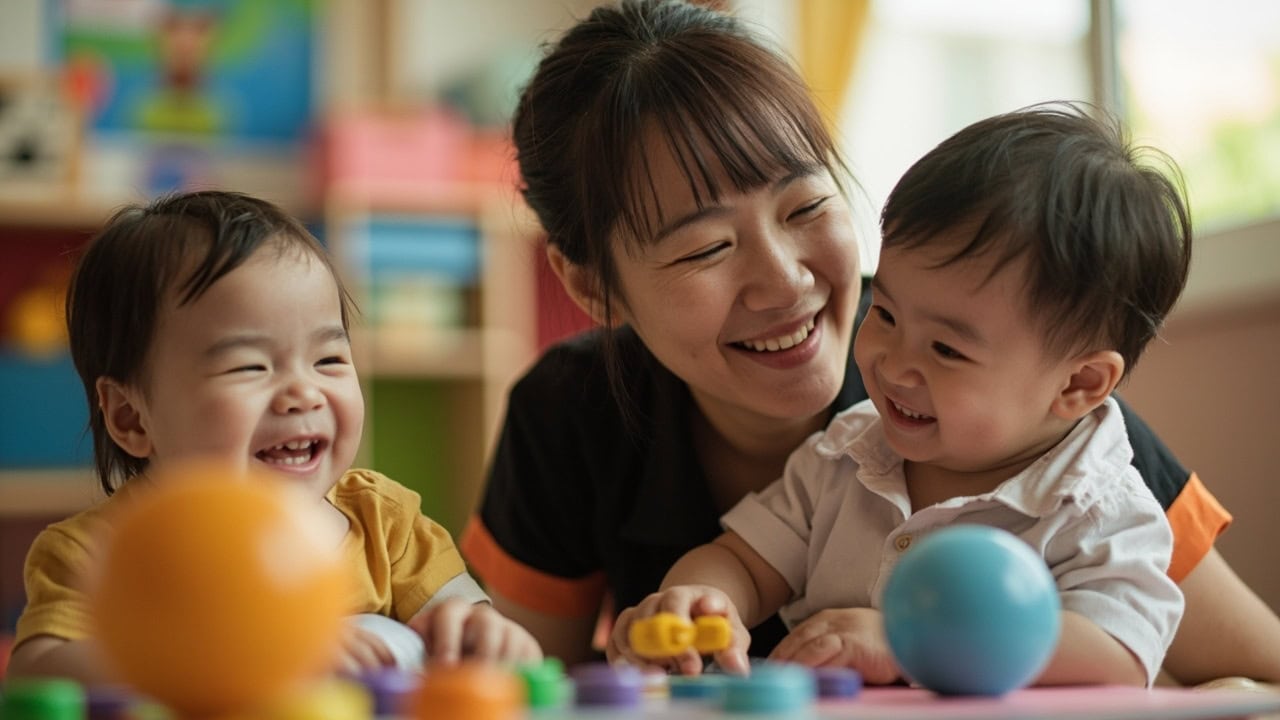
Beyond Professional Distance Singapore Parents and Caregiver Partnership
The Gap Nobody Talks About
This is the gap that most parenting conversations about childcare never address. We talk endlessly about choosing, vetting, recognising quality, and the first days of settling in. We rarely talk about what happens after — the slow, quiet work of building a relationship with the person who becomes, in some ways, the most consistent adult presence in your child’s waking life outside of you.
We talk about finding good care. We do not talk about what it means to know the person providing it.
And this matters because the relationship between you and your child’s caregiver is not incidental. It is foundational. It shapes your child’s daily experience of the world — and yours too. The quality of your peace of mind, the texture of your mornings and evenings, the way you think about the hours you are apart.
What Your Caregiver Actually Does
Here is what most parents do not see: the caregiver’s quiet observation work.
When your child is at the centre or with the minder, there is an ongoing act of attention happening that mirrors, in some ways, what you do at home. The caregiver is noticing. The way your daughter’s eyebrows draw together slightly before she needs the potty. The rhythm your son finds most soothing when he is overtired. The song that makes one child go still and another go wild with delight.
These are not observations written in any report. They live in the caregiver’s body — in their practical knowledge of this particular child.
Developmental psychologists call this attunement — that quality of responsive noticing that tells a child they are seen. And here is what is easy to forget: your child’s caregiver is doing this too. They are building, over weeks and months, an understanding of your child’s inner world that is real, deep, and earned through daily presence.
But they cannot share it if they do not feel invited to.
The Singapore Barrier
And this is where Singapore parents find themselves at a crossroads that is entirely of our culture’s making.
We live in a society that values professionalism, respects boundaries, and prizes politeness. We do not want to intrude. We do not want to micromanage. We do not want to be that parent who calls to check if the water is warm or hovers during pickup.
So, with the best intentions, we hold back. We keep the conversation light. We ask only what can be answered easily. We let the professional relationship stay professional — and we tell ourselves that this is right and mature and good.
But somewhere along the way, we realise that we have kept it so professional that it has become, in a sense, hollow. We have protected boundaries so carefully that we have built walls. And the person who knows our child best during the day — who sees the full arc of their morning, their struggles, their breakthroughs, their small triumphs — remains, in the most important ways, a stranger.
Why Genuine Knowing Matters
Before we talk about what to do, it is worth understanding why this matters so deeply — for your child, and for you.
It Changes Your Child’s Experience
Children are profoundly attuned to the emotional alignment between their parents and their caregivers. They feel, in their small bodies, whether the adults in their world are connected or separate, aligned or at odds.
When a child senses that their parent and caregiver are in genuine partnership — that they communicate, that they share understanding, that they are united in their care — something deep in the child’s nervous system registers safety. Developmental researchers call this co-regulation. When parents and caregivers are emotionally aligned, they model for the child a way of being in relationship that is cooperative, trusting, and secure.
The child does not have to manage two separate worlds. They experience one world, in which the important adults are connected and consistent.
In the early years, when the brain is developing at its most rapid pace and when the foundations of emotional regulation and social trust are being laid, this felt consistency matters enormously. It is one of the hidden gifts of truly knowing your caregiver — not just that your experience as a parent deepens, but that your child’s experience of security deepens too.
It Changes Your Experience of Parenting
There is something else that shifts when the parent-caregiver relationship moves from transactional to genuinely known. You stop carrying alone what was never meant to be carried alone.
Parenting, at its best, is not meant to be done in isolation. It is meant to be shared — with partners, with family, with community, and yes, with the extraordinary people who care for our children when we cannot be there ourselves.
When you have a caregiver who truly knows your child, and who knows you as a parent, the hours of separation feel different. They feel less like a gap and more like a continuity. Your child is held — by someone who understands them.
Professional Intimacy: What It Actually Means
There is a word for the kind of relationship I am describing: professional intimacy.
This is not friendship. It is not the same as the relationship you have with your mother or your spouse or your closest friend. It does not require you to share your personal struggles or to socialise outside of work. But it is intimate in the sense that it involves a genuine knowing of one another, a mutual respect that goes beyond the transactional, and a shared commitment to the same small person that makes you, in a very real way, partners.
Think of it this way. There are certain professionals in your life with whom you have this kind of relationship: your child’s paediatrician, perhaps, or a teacher who has known your family for years. You trust them not because they are obligated to you, but because you have developed a working understanding that goes deeper than their professional function. They know your child’s history. They have seen patterns you have not noticed. They offer insights that feel like gifts rather than intrusions because they come from a place of genuine investment.
This is what is possible with your child’s caregiver — and what thoughtful, development-oriented childcare arrangements can cultivate. Not as an accidental outcome of good chemistry, but as a deliberate, structured part of how care is experienced.
Building a Real Partnership: A Parent’s Practical Guide
So what does this actually look like in practice? How do you move beyond the polite pickup exchange into something more?
Start With How You Think About Communication
Most parents approach caregiver communication as a one-way channel: they receive updates, they share instructions, they manage logistics. This is necessary and fine — but it does not build knowing.
Knowing requires bidirectional exchange. It requires you to give something, not just receive.
What you give is your child. Not in the abstract — not a list of allergies or a schedule — but in the specifics that make them who they are.
Tell the caregiver about the book your daughter wants read three times in a row, every time, because it is the one where the bear gets found. Tell them about the way your son processes big feelings — that he needs to be held quietly first, before any words. Tell them about the joke that has been his obsession for three weeks, and how he delivers it at completely unexpected moments.
These are not trivial details. They are the texture of your child’s inner life — and when a caregiver receives them, something shifts. They begin to see your child differently. They begin to see you differently too — not as a client, but as a parent who is entrusting them with something irreplaceable.
Learn to Receive With Trust
And then — and this is where the practice becomes harder — you must learn to receive.
When your caregiver tells you something that surprises you, or challenges something you believed, or raises a concern you had not noticed, the instinct is to defend, to explain, to deflect. But receiving with trust is one of the most powerful things a parent can do to deepen a caregiving relationship.
Your child’s caregiver sees your child in situations you cannot see. They have witnessed your child’s behaviour in a peer group, in a moment of frustration, in a morning when you were not there to smooth the landing. Their observations are not criticisms of your parenting. They are gifts — pieces of information that help you know your child more fully.
When you receive these insights with openness rather than defensiveness, something extraordinary happens. You become co-investigators in your child’s development. You become a team.
Addressing Common Concerns
You might be wondering: Am I overstepping?
Parents fear overstepping. They fear being seen as demanding or difficult. They fear that if they push for more connection, they will breach some unspoken contract about what the relationship is supposed to be.
Here is the reframe: connection is not intrusion. Reaching out to share something meaningful about your child is not micromanagement. It is an act of respect. It says, “I trust you with what matters most, and I want you to know what I know so we can care for this child together.”
Most caregivers are not trained to draw close to families — but they are often longing for it. When a parent shares the real stuff, the specific stuff, the daily texture of their child’s inner world, it is a gift that validates the caregiver’s role and deepens their capacity to serve.
And if you wonder, What if the caregiver doesn’t want this? — know that some caregivers, in some settings, have been trained — explicitly or implicitly — to keep professional distance, to share only what is necessary, to maintain an appropriate boundary that, in practice, can feel like an emotional wall.
This is a structural issue, not a personal one. The right care arrangement will not require you to fight against the system to build connection. It will be designed to support it. When you encounter a caregiver who seems closed off, it is worth asking whether the environment they work in has taught them to be guarded.
The question to ask is not only, “Do I like this caregiver?” but “Does this care arrangement support the kind of relationship I want to have?”
What Quality Childminding Actually Looks Like
If you are evaluating childcare options in Singapore, here are some markers of quality that go beyond the basics of safety and certification:
- Observation is visible. Good caregivers notice and remember. Over time, they should be able to tell you things about your child that reveal depth of knowledge — not just what they ate, but how they ate, what mood they were in, what they were drawn to.
- Communication is bidirectional. You feel you can share, not just receive. The caregiver asks questions about your child, shows interest in your family’s rhythms and values.
- The caregiver speaks about your child as an individual. Not “the babies” or “the group” but “your daughter, who loves…” — language that reveals personal attunement.
- There is consistency of presence. Knowing requires time. A caregiver who is with your child day after day, week after week, builds the kind of familiarity that becomes a foundation for safety.
- Insights are offered, not just delivered. A quality caregiver will share observations that help you understand your child better — not just reports of meals and naps, but moments of meaning.
How EduNanny Singapore Makes This Possible
EduNanny Singapore was built on a specific understanding: that the relationship between parent and caregiver is not a nice-to-have — it is the thing that makes quality care feel like family.
Within the ECDA Childminding Pilot framework, EduNanny structures care in ways that make deep knowing possible rather than accidental.
Ratios and Presence
With ratios of up to one to three infants — and even more favourable ratios in many settings — the caregiver has the time and attention available to truly observe, truly respond, and truly come to know each child in their care. This is not a luxury. It is a prerequisite. Deep knowing requires presence, and presence requires time — and time requires structural support.
Pathways That Fit Families
The pilot offers both home-based and centre-based pathways, allowing families to find the arrangement that best fits their lives. Whether care comes to your child in your home, or whether your child goes to a community setting, the principles of professional intimacy and cultivated knowing remain the same.
Communication as a Core Principle
EduNanny treats the parent-caregiver relationship as a core element of quality, not an afterthought. Communication, transparency, and structured check-ins are built into the ongoing experience. Where assurance measures are deployed, they serve not as surveillance but as foundation — allowing both parents and caregivers to know that there is nothing to hide and everything to trust.
Affordability as Foundation
Quality care should not be available only to those who can pay a premium. Fee structures within the pilot are designed to be accessible, and eligible subsidies — including CDA and Baby Bonus — can be used, easing the financial reality for Singapore families.
The Difference That Changes Everything
This is the difference between childcare as a service and childcare as a relationship. One is transactional. The other is transformative.
When you find care that structures knowing into its foundation — when the caregiver is given time to observe, when communication is bidirectional, when the relationship is treated as a partnership rather than a performance — something shifts. The hours apart feel less like separation and more like continuity. Your child is held by someone who knows them. Your peace of mind deepens. Your experience of parenthood becomes, in small but real ways, less lonely.
You chose childcare. You did not choose to do this alone.
If you have been reading this thinking, Yes, that is exactly what I have been missing — I want to name that longing. It is not unreasonable. It is not ungrateful. It is a sign of your care — for your child, for the relationship, for the quality of life you are building together.
The honest answer to the question — do I truly know the person caring for my child? — is that it is possible. It is not guaranteed, but it is possible. It is possible to move beyond the polite update, beyond the professional distance, beyond the transactional exchange. It is possible to build a relationship with your child’s caregiver that is real, deep, grounded in mutual respect and genuine knowing.
It requires you to reach out — to share what is unique about your child, to ask the questions that matter, to listen with trust rather than suspicion. It requires you to see your caregiver not as a service provider but as a partner, a professional whose expertise in your child’s daily life is real and valuable. And it requires finding a care arrangement that structures this knowing into its foundation, rather than leaving it to luck or chemistry.
EduNanny Singapore is here to walk that path with you — to build, together, the kind of knowing that changes everything.
If you are considering infant care or childminding in Singapore and want to understand what a relationship-first approach to childcare could mean for your family, EduNanny Singapore invites you to start a conversation. Find out how the ECDA Childminding Pilot might fit your family’s life — and how the hours apart could feel different.
Explore more about EduNanny’s approach to quality childminding, or get in touch to begin a conversation about your family’s needs.