Beyond Supervision: How Childcare Builds Your Children’s Sibling Bond
The Hope Behind Every Sibling Bond
There is a hope that lives quietly in the hearts of parents who decide to have more than one child. It is not always spoken aloud, and it rarely appears in the logistics checklists that accompany the arrival of a second or third child. But it is there—a quiet, persistent wish that your children will not merely share a house, a surname, a genetic inheritance. You want them to share a life.
You want them to be the people who call each other first when something wonderful happens. You want them to argue, as all siblings do, and then find their way back to each other. You want them, someday, to be each other’s great comfort.
This hope is not naive. It is, in fact, one of the bravest things you carry as a parent. Because you know that sibling relationships are not guaranteed. Biology does not write the story. Proximity does not ensure closeness. And yet you lean into the possibility anyway, bringing another child into the world partly because you believe—hope, work, and pray—that these two or three or four small people will grow into adults who choose each other, who show up, who carry a bond that outlasts the years when you are no longer the center of their universe.
Why the Sibling Bond Must Be Built, Not Assumed
If this hope lives in you, then you need to know something important: the sibling bond is not something that simply happens because children share a family. It is built through daily experiences, through moments of being seen and supported together, through conflicts navigated well and victories shared.
One of the most powerful—yet often invisible—builders of that bond is the quality of childcare your children receive. Most childcare conversations focus on infant development milestones, safety ratios, curriculum frameworks, and caregiver credentials. All of that matters. But beneath all of that, there is a quieter, more profound question: what kind of relationship are your children building while you cannot see them? And who is paying attention to that relationship?
When siblings are cared for together in a high-quality environment, something remarkable happens. They begin to share an inner life. They develop what child development experts sometimes call shared meaning-making—the process by which two people experience the same events and come away with a common understanding, a shared story, a sense of “we were there together.”
For siblings, this shared meaning-making begins in earliest childhood, in the daily rituals of eating together, playing together, being comforted together after minor setbacks, and celebrating small victories together. A quality childcare environment becomes the architecture of these shared experiences—the scaffolding on which the sibling bond is constructed, one ordinary day at a time.
What This Looks Like in Practice
When your children are in a childcare setting that understands sibling dynamics, they are not merely being supervised in parallel. They are:
- Learning to read each other’s cues—noticing when a brother is frustrated, when a sister needs space, when someone is proud of what they accomplished.
- Learning that their sibling is a partner, not a rival. They discover that when their sister succeeds at something, it creates joy in the whole family. They learn that comfort flows both ways.
- Building neural pathways that will later allow them to be attuned to each other, to anticipate each other’s needs, to fight and reconcile and fight again—because they know, at a deep and cellular level, that the relationship is safe enough to survive conflict.
The Caregiver’s Role in Protecting and Strengthening the Bond
The caregiver’s role is so much more than supervision. They are, in a very real sense, the keeper of the sibling relationship during the hours you are apart.
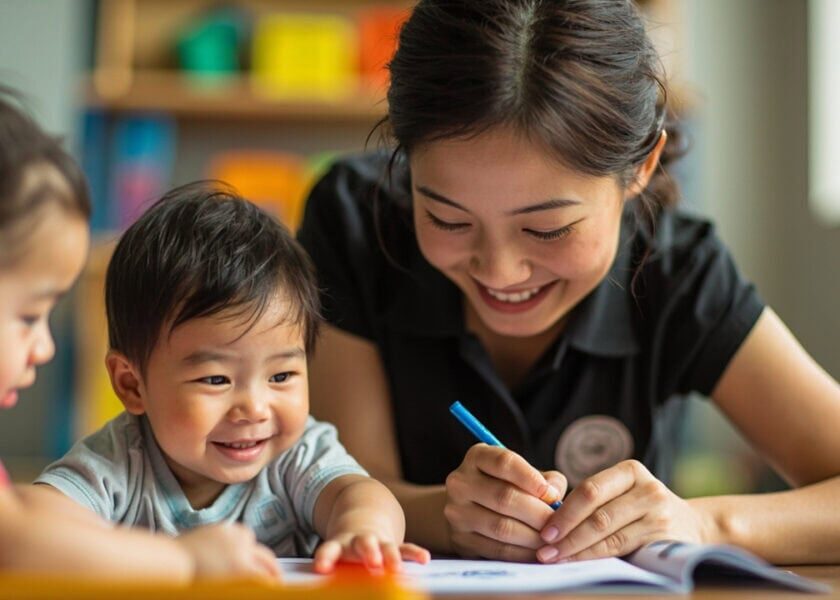
When a skilled caregiver notices that one child is beginning to frustrate and intervenes not by separating the siblings but by helping them navigate the tension together, something powerful occurs. The children learn that conflict is not a threat to their bond. It is an opportunity for their bond to deepen. They learn that someone trusted believes they can work this out, and that their sibling is a partner in solving problems.
The way conflicts are handled either strengthens or weakens the sibling bond. In a setting where sibling conflict is merely suppressed—where children are separated at the first sign of friction—the underlying tension does not disappear. It goes underground. The children learn to hide their disagreements, to compete in private, to resent rather than resolve.
But in a setting where skilled caregivers guide children through conflict—helping them use words, helping them understand each other’s perspectives, helping them find solutions that honor both children’s needs—the sibling bond actually becomes more resilient. The children learn that they can survive disagreement, that their relationship is big enough to hold their differences, and that their sibling will still be there on the other side.
What Quality Sibling Care Provides
Quality sibling care gives children something else that is harder to name but deeply important: it gives them a witness. A witness to their childhood. Someone who was there. Someone who remembers the way the afternoon light fell in the childcare room, the song they all learned together, the joke that made everyone laugh, the day when everything felt uncertain and they had each other to hold onto.
This witness is not interchangeable. A caregiver can be a wonderful witness, a loving presence in your children’s lives. But the sibling is the witness who shares their blood, their history, their family name, their inheritance of being parented by you.
When siblings are cared for together, they become co-witnesses to each other’s lives. They build a shared archive of experience that belongs to no one else. This is the gift of quality sibling childcare: it protects and enriches that shared archive, adding to it every day.
The Small Moments That Build the Bond
Quality sibling care is not built on grand gestures. It is built on the accumulation of small, intentional moments:
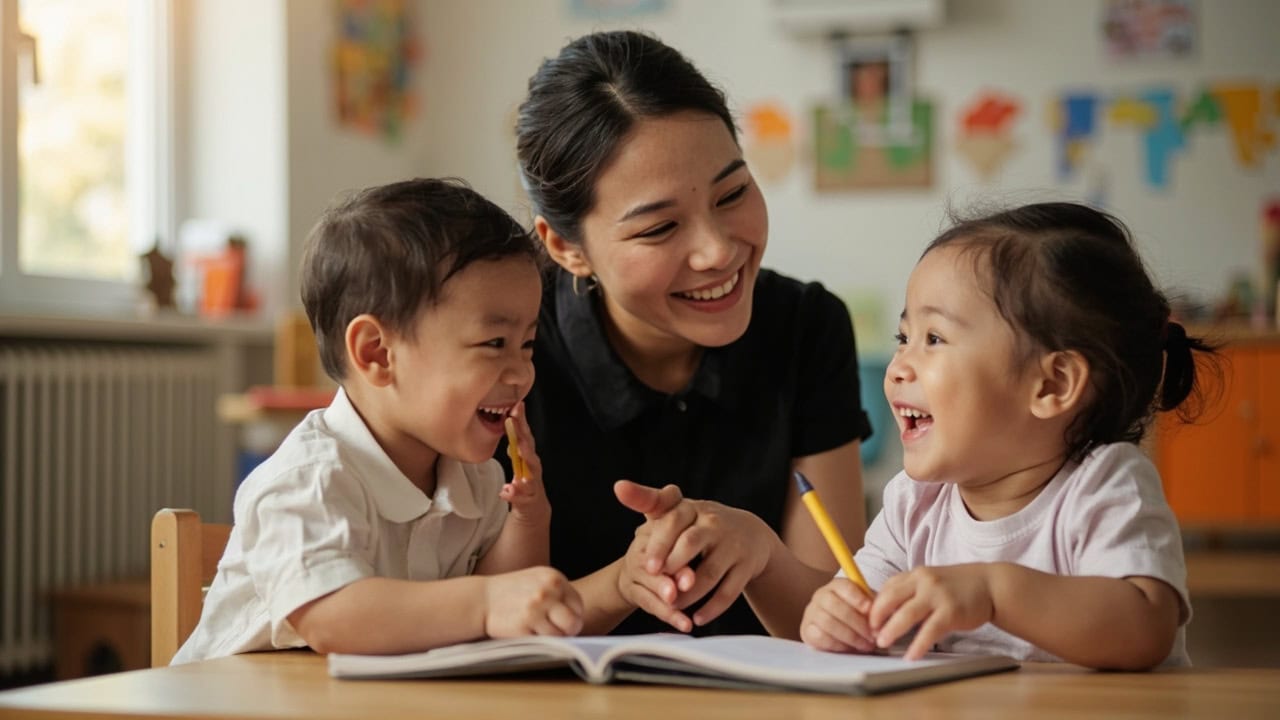
- Celebrating together. When one sibling completes a puzzle, the caregiver invites the other to notice. “Look, your sister finished the puzzle! She worked so hard on it.” The shared pride becomes shared joy.
- Collaborating on tasks. Setting up activities where siblings work toward a common goal—building a block tower, completing a sensory bin, acting out a story. They learn to delegate, compromise, and celebrate together.
- Being present during setbacks. When a child falls and scrapes their knee, the caregiver notices if the sibling offers comfort—and names it. “It was so kind of you to bring her a tissue. She felt better when you were with her.”
- Creating shared rituals. A morning greeting song, a handwashing routine, a special goodbye wave. These rituals become the texture of their shared life.
How EduNanny Singapore Approaches Sibling Care
At EduNanny Singapore—a participant in the ECDA Childminding Pilot—this is the question we ask every single day: what kind of relationship are your children building while you cannot see them?
It is the question that shapes how we think about caring for siblings—not as two children who happen to be in the same room, but as two people whose bond is actively taking shape, hour by hour.
Our caregivers are trained to observe sibling dynamics not as a checklist item, but as a core part of their work. They watch for the moments when siblings support each other, and they name those moments: “I saw how you helped your sister with that puzzle. That was so kind.”
They watch for collaborative play, for the way children delegate roles, solve problems, and create shared narratives together. And they celebrate those moments—because children who grow up knowing that their sibling relationship is noticed and valued carry that knowledge into their adult lives.
Our home-based and community-based pathways are designed to create the kinds of small, consistent environments where sibling bonds can flourish. With ratios that allow caregivers to truly see what is happening between your children, with communication practices that keep you informed, and with a philosophy that treats every sibling interaction as an opportunity, we work to be the kind of childcare that builds the bond you hoped for when you decided to grow your family.
Common Questions Singapore Parents Ask
“Will my children lose their individuality if they’re cared for together?”
Quality sibling care does not flatten individuality—it contextualizes it. Your children remain distinct people with their own temperaments, preferences, and developmental trajectories. But they also learn that being part of a family means being in relationship with others, and that relationship can be a source of joy, not just obligation.
“What if my children fight more because they’re together all day?”
Some increase in conflict is natural when siblings spend more time together—and this is not a sign of poor care. It is a sign of a relationship that is alive. The question is not whether conflict occurs, but how it is handled. In a setting with skilled caregivers, conflict becomes a classroom where children learn to negotiate, empathize, and repair. This is the work of a healthy sibling relationship.
“Can we afford quality sibling care?”
We know that Singapore parents carry real pressures. The cost of living, the demands of dual-income households, the longing to be present for your children while also providing for them. These are not abstract concerns. They are the lived reality of modern parenthood, and they shape the decisions you make about childcare.
EduNanny is designed to be accessible within the pilot fee structures, with options to use CDA and Baby Bonus funds, because we believe that quality sibling care should not be a luxury reserved for families with unlimited resources. Every child deserves to grow up knowing they have a sibling who was there, who shared their history, who chose them.
What to Look For in a Provider
How can you know if a childcare provider understands sibling dynamics as a developmental relationship and not just a logistical arrangement? Here is what to look for and ask about:
- Ask how they handle sibling conflict. If their answer is about separation and timeouts, that tells you something. If their answer is about guided resolution—about helping children find their way back to each other—that tells you something different.
- Ask how they create opportunities for siblings to collaborate. Look for evidence that the caregiver sees your children not as individuals in the same space but as siblings whose relationship is worth cultivating.
- Observe how caregivers speak about sibling interactions. Do they notice and name moments of support? Do they celebrate sibling wins? Do they treat conflict as a learning opportunity or a disruption to manage?
- Notice the physical environment. Is it set up for parallel play only, or does it encourage joint problem-solving and shared experiences?
- Ask about communication. Will you hear about the moments between your children—not just about nap times and meals, but about how they played together, supported each other, and navigated their day as siblings?
The Relationship That Will Outlast Your Lifetime
There is a moment, and anyone who has watched siblings grow up together has seen it: a parent picks up their children from childcare and watches them interact in the car or at home. The children are bickering about something trivial, and the parent sighs, thinking, “Here we go again.”
But then something shifts. One child says something that makes the other laugh, and suddenly the bickering dissolves into shared laughter, and the parent realizes: these two have an inside world. They have references and rhythms and understanding that I am not entirely part of. They have a bond that belongs to them.
This is what quality sibling childcare creates. It creates a bond that belongs to them—a relationship that is not defined by parents but by the two people who share it. Over years of accumulated days, it builds something durable: the experience of being known, seen, and companioned by someone who shares your blood and shares your history of being loved well together.
We are not suggesting that childcare alone can guarantee that your children will be close throughout their lives. Sibling relationships, like all relationships, are shaped by many forces, some of which are beyond any caregiver’s control.
But we are suggesting something equally important: the hours your children spend in quality childcare are not neutral hours. They are hours that are actively shaping the relationship between them. And when those hours are guided by caregivers who understand sibling dynamics, who create the conditions for connection, who celebrate sibling alliance and navigate sibling conflict with skill—those hours become a gift to your children that will outlast your own lifetime.
Your Next Step
If you are considering childcare for more than one child and want a provider who understands that you are entrusting them with more than supervision—you are entrusting them with a relationship—EduNanny Singapore welcomes the conversation.
Visit our website to learn more about our ECDA-approved childminding pathways, or reach out to schedule a visit and see how our caregivers nurture sibling bonds in practice. We would be honored to be part of the story you are building for your children.