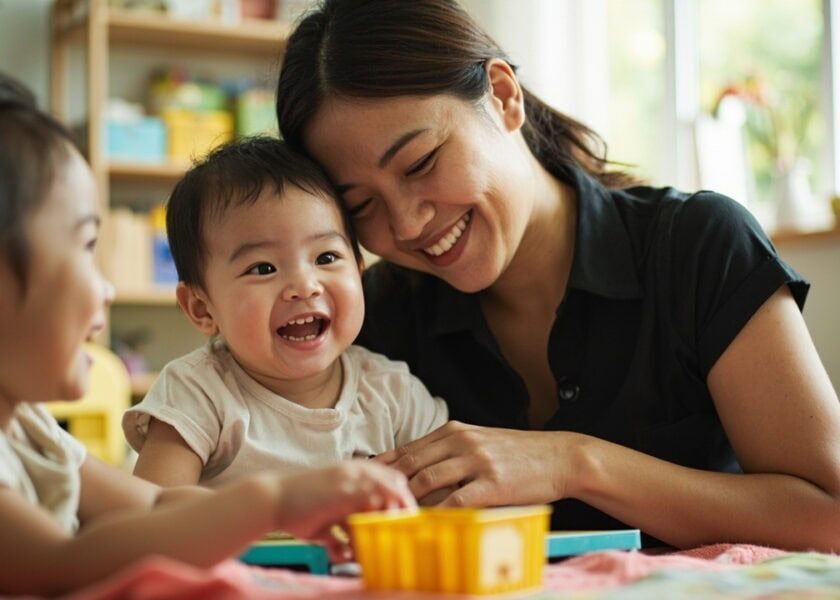
Beyond the Sting: When Your Child Loves Their Caregiver
Why This Tension Feels So Acute in Singapore
Let us begin with why this conflict feels so particularly sharp here, in Singapore, at this moment in your parenting journey.
Singapore is a place where excellence is expected, where pressure is ambient, where the desire to give your child the best possible start is not merely a preference but a cultural current that runs through every conversation at the playground, every check-in at the infant care centre, every late-night scroll through parenting forums. We are a nation that understands the weight of the early years. We know that the brain develops faster in the first thousand days than at any other time. We know that secure attachment in infancy correlates with emotional regulation, academic achievement, relationship quality, and mental health across a lifetime. We have internalized the science. We believe it. We want it for our children.
But Singapore is also a place of profound structural complexity. The dual-income family is not an exception here—it is the norm. Grandparents often play a significant role, though increasingly from a distance, with their own lives, their own aging bodies, their own boundaries. The extended family networks that once distributed childcare across multiple trusted adults have, for many families, contracted to a handful of reliable people—or to one.
And into that contraction comes the caregiver: the professional, the trained childminder, the person who will spend more waking hours with your infant than perhaps anyone else in their early life.
Here is the tension: you need this person. Desperately. Your child needs this person. The research is unambiguous—children who have secure attachments with multiple caregivers, including non-parental ones, develop more robust social-emotional skills, greater adaptability, and deeper capacity for trust. The warmth and attunement of a secondary caregiver does not dilute a child’s attachment to their parents. It expands it. It creates a wider web of security from which your child can safely explore the world.
And yet.
There is a voice inside you that whispers: What if she becomes more important than me? What if he starts to prefer her? What if, one day, my child runs to her and not to me?
This is not vanity. This is not selfishness. This is the oldest mammalian instinct in your body: the protective drive to be your child’s primary attachment figure because, in evolutionary terms, that attachment kept them alive. Your nervous system is still calibrated for a world where the primary caregiver was the only safe harbor. Anything that threatened to dilute that bond was, quite literally, dangerous.
But we do not live in that world anymore. And your child is not living in that world either.
The Science Behind Secure Attachment
Let us talk about what attachment research actually demonstrates, because it is both clarifying and, I think, deeply reassuring.
Attachment theory, first articulated by John Bowlby and expanded through decades of research by Mary Ainsworth, Dan Siegel, and many others, describes a fundamental truth about human development: children need secure base relationships to thrive. A secure base is a person who is consistent, responsive, and emotionally attuned—who provides a foundation from which a child can explore the world and to whom a child can return when that world becomes overwhelming.
Bowlby’s original insight was that this primary secure base is typically provided by the parent. Subsequent research has refined this understanding. What we now know is that children can and do form multiple secure attachments—not replacing the parent bond, but adding to it.
A child who has a secure attachment to their mother and also develops a secure attachment to a warm, consistent, professional caregiver is not confused or conflicted. They are expanding their capacity for trust. They are learning that the world contains reliable people, that relationships can be safe, that love is not a finite resource that depletes when shared.
This is not sentiment. This is neuroscience. Children with multiple secure attachment figures show stronger prefrontal cortex development—the region responsible for executive function, emotional regulation, and impulse control. They demonstrate greater resilience when facing stress. They show more curiosity and persistence in novel situations.
And here is what I find most beautiful about this research, and what I want you to hold onto: when a child feels secure with their caregiver, they are not less attached to their parents. They are more free to be attached to their parents.
A child who knows that their needs will be met by their caregiver throughout the day arrives at the evening reunion with their parents more present, more available, more able to fully engage—not less. The caregiver bond does not compete with the parent bond. When it is healthy, it supports it.
So when you watch your child run joyfully to their caregiver in the morning, what you are witnessing is not a diminishment of your role. You are witnessing an expansion of your child’s world. You are watching them build the capacity for trust that will allow them, someday, to build healthy friendships, to engage fully in school, to form their own secure partnerships as adults.
You are not being replaced. You are being accompanied.
The Reframe That Changes Everything
And yet. The feeling remains. The sting persists.
This is where I want to pause and honor what is real. It would be easy to tell you that the anxiety is irrational, that you should simply trust, that the solution is to release your fear and embrace the caregiver relationship fully. But that would be dismissive, and you deserve better than dismissal. You deserve honesty.
The fear you feel is not irrational. It is adaptive. It kept your ancestors vigilant, protective, invested. It is part of what makes you a good parent—not the fear itself, but the awareness that you are feeling something that requires your attention, your reflection, your intention.
The question is not whether the fear is valid. The question is what you do with it.
The parents who raise the most secure, most confident, most emotionally grounded children are not the parents who feel no fear. They are the parents who acknowledge the fear, examine it honestly, and choose to act from a place of wisdom rather than protection.
There is a difference—and this is crucial—between protective instinct and protective wisdom.
Protective instinct says: hold back. Do not let yourself trust too much. Do not let your child get too attached. Keep the distance. Keep the exit. If something goes wrong, you will be less hurt.
Protective wisdom says: I feel afraid, and I understand why. I also understand what my child needs. I understand that the greatest gift I can give my child is not my exclusive presence, but my capacity to help them feel safe in a world that contains many people who can care for them well. I choose to build trust—not blindly, not naively, but thoughtfully, deliberately, with a caregiver who shares my values and meets my standards.
This is the reframe that changes everything: trusting your caregiver is not about letting go of your child. It is about building a secure base for your child—together.
Healthy Attachment: Signs to Look For
So how do you know if the attachment bond between your child and their caregiver is healthy? How do you distinguish between secure base formation and problematic over-reliance?
Signs of Healthy Caregiver Attachment
- Your child is glad to see their caregiver, but adapts easily when the caregiver leaves or changes.
- They use the caregiver as a launching point for exploration—they play, investigate, wander, and return.
- Your child shows no signs of anxiety about the caregiver’s presence or absence.
- They sleep well, eat well, and show normal developmental exploration.
- The caregiver bond and the parent bond feel complementary, not competitive.
- Your child can move fluidly between relationships. They do not treat you and the caregiver as interchangeable, but they do treat both as safe.
Signs of Problematic Over-Reliance
- A child who cannot be soothed by anyone except one caregiver—even the parent struggles to settle them.
- Extreme distress at caregiver transitions that does not ease over time.
- A child who does not explore, who remains clingy and vigilant even in familiar environments.
These patterns suggest that the caregiver relationship may be filling a gap rather than expanding a capacity—that the child may be using the caregiver as a substitute for a missing secure base rather than an addition to an existing one.
The difference often comes down to the quality of the caregiver relationship and the presence or absence of parental engagement. A professional caregiver who is warm but not enmeshed, who supports the child’s relationship with their parents rather than competing with it, who communicates transparently and respects the parent’s role—this is the caregiver who builds healthy attachment.
What Quality Childminding Looks Like
Understanding attachment science is one thing. Finding care that actually supports healthy attachment is another. Here is what parents should look for when evaluating infant care and childminding arrangements in Singapore.
Continuity and Consistency: Change is the enemy of trust, both for children and for parents. A caregiver who is with your child for months or years—not weeks—builds the security that supports exploration. When evaluating arrangements, ask: How stable is this placement? What happens if the caregiver is ill? Is there a backup plan that prioritizes my child’s need for consistency?
Individualized Attention: Secure attachment forms when a caregiver can attune to one child—or a very small group. Infant-to-caregiver ratios matter enormously. A child who receives individualized attention throughout the day develops the regulatory capacity that supports lifelong emotional health. Ask: What is the caregiver-to-child ratio? Will my child receive consistent, focused attention?
Transparent Communication: Trust cannot be built in the dark. Parents who can see—even partially—what their child’s day looks like, who receive regular updates, who feel like partners rather than outsiders, are parents who can relax into trust. Ask: How will I know what my child is doing? How will you communicate with me? What happens if there is an issue?
Professionalism and Boundaries: A caregiver who respects your role, defers to your parenting choices, and maintains appropriate professional boundaries is essential. This is not coldness—it is clarity. Ask: How does the caregiver handle disagreements? How do they support the parent-child bond? What training have they received?
In Singapore, the Early Childhood Development Agency (ECDA) provides oversight for registered childcare and childminding arrangements. Caregivers in the ECDA Childminding Pilot operate under clear standards and regulatory accountability. This framework protects the integrity of the care relationship and gives parents recourse if something goes wrong.
EduNanny’s Approach: Built for Parents Who Want to Trust
This is where the structural model becomes relevant—not as a sales point, but as a genuine answer to the tension we have been exploring.
EduNanny was built with an understanding that Singapore parents want to trust. They desperately want to trust. But they have often been burned—disrupted by sudden caregiver changes, undermined by poor communication, left in the dark about their child’s day, or simply left anxious by the absence of professionalism that would allow them to fully release their protective vigilance.
EduNanny’s approach addresses this at the structural level.
When a caregiver is part of the ECDA Childminding Pilot—with ECDA oversight, clear standards, and regulatory accountability—there is a framework that protects the integrity of the care relationship. When infant ratios are maintained at one-to-one or one-to-three, your child receives the individualized attention that builds genuine security, not the diffuse supervision that leaves them anxious and under-regulated.
When care blocks are consistent—Monday to Friday, predictable hours—your child can form the routines and anticipations that are the bedrock of secure attachment. Stability is its foundation.
And for families navigating the practical realities of childcare in Singapore, there are real supports that make this kind of quality care accessible. CDA and Baby Bonus funds can be utilized. Pilot fee structures are designed to be affordable. These are not abstractions. They are mechanisms that allow more Singapore families to access the kind of care that supports secure attachment.
Communication and transparency are woven into the model. When parents can see, even partially, what their child’s day looks like—when there are mechanisms for observation, for dialogue, for partnership—the anxiety that drives protective distance begins to ease. Trust requires light. EduNanny’s approach recognizes this, creating the conditions under which parents can see enough to believe, and can believe enough to trust.
The Trust Triangle
EduNanny is not promising to replace you. No good childcare model makes that promise. What EduNanny offers is something more nuanced and, I believe, more valuable: the conditions for a healthy trust triangle.
- You at one point of the triangle—the parent who chose this arrangement, who remains engaged, who is the emotional anchor.
- Your child at the center—the person whose security and development is the entire purpose.
- Your caregiver as a stable, professional, caring point of support—not replacing you, but holding a piece of the circle so that the entire structure becomes stronger, more resilient, more spacious.
When this triangle is in place—when you trust your caregiver, when your caregiver respects your role, when your child moves fluidly between the warmth you provide and the warmth your caregiver provides—something remarkable happens. Your family becomes larger without becoming diluted. Your child’s world expands without becoming insecure. And you, as a parent, get to breathe.
You get to work. You get to be a whole person—not just a vigilance system, not just a protective shield, but a mother, a father, a partner, a professional, a person with your own needs and ambitions and identity beyond the early years.
Common Concerns, Honestly Addressed
“What if my child prefers the caregiver?”
Children are exquisitely attuned to the adults who meet their needs. Your child may show great joy in seeing their caregiver during the day—and this is healthy. But preference for a daytime caregiver does not mean preference for life. Children understand, at a deep developmental level, that parents are the permanent base. What you are building is not a competition. It is a network.
“What if something goes wrong and I’m not there?”
This fear is valid. The solution is not to avoid care—it is to choose arrangements with clear protocols, professional training, and transparent communication. A caregiver who tells you what happened is far safer than one who hides it. A model with regulatory oversight gives you recourse. The goal is not to be present for every moment. The goal is to build a system trustworthy enough that your child’s safety is genuinely protected.
“I feel guilty for wanting help.”
Guilt is often protective instinct dressed up as wisdom. Ask yourself: Would I feel guilty for working with a pediatrician? For enrolling my child in a quality preschool? Childcare is not a failure of parenting. It is a structure that supports your family’s wellbeing—including yours.
“How do I know I can really trust someone?”
Trust is built over time, with evidence. Look for arrangements that give you windows into your child’s day. Look for caregivers who communicate proactively, not just reactively. Look for models with regulatory oversight and professional standards. Trust is not blind. It is earned through consistent, transparent, professional care—and it is appropriate to expect nothing less.
Moving Through the Tension
If you are a Singapore parent navigating this tension, here is what I want you to know.
The sting you feel when your child runs to their caregiver is not evidence that something is wrong with your care arrangement. It is evidence that something is right about your love. You feel the sting because you love your child so much that you are afraid of anything that might matter to them. That your heart is so full of them that there is barely room left over. That the very intensity of your fear is evidence of the depth of your love.
And now you have a choice.
You can let the sting harden into distance. You can let it convince you that trust is dangerous, that warmth is threatening, that the best way to protect your child is to never let them—or yourself—fully believe in anyone else.
Or.
You can do something harder, and braver, and more loving than staying afraid.
You can choose a caregiver who deserves your trust. You can build the relationship with intention and attention. You can stay engaged, stay curious, stay present—without staying anxious. You can let your child run joyfully to someone else, and you can feel the sting, and you can let it pass, and you can trust.
This is not the parent who has given up on their child. This is the parent who has trusted their child to have a big enough world.
This is not letting go. This is reaching further.
And your child—your magnificent, curious, exploring, expanding child—will thank you for it. Not with words, not yet. But with every secure step they take away from you and back to you. With every time they run to their caregiver and then come home to you, whole and happy and loved in more ways than one. With every new capacity they build, every new person they trust, every new corner of the world they learn to believe in.
The first thousand days matter. And so does the peace you find in them.
EduNanny is here to walk this path with you. Not to replace you. Not to dilute your family. But to be part of what makes your family strong enough, secure enough, and spacious enough to hold all the love you have to give.
If you are ready to explore care arrangements that support healthy attachment—for your child and for your peace—start a conversation with us. Because you deserve to feel confident in your choices, and your child deserves to have a world that is big enough to trust.
The gift of healthy caregiver attachment is this: it frees you to be present when you are present, rather than spending your evenings depleted by the effort of constant worry. It allows your child to benefit from the security you provide and the additional security your caregiver provides. It makes your family more resilient, not less.
The parent who trusts their caregiver is not the parent who has let go of their child. They are the parent who has built a secure enough family that it can hold more.