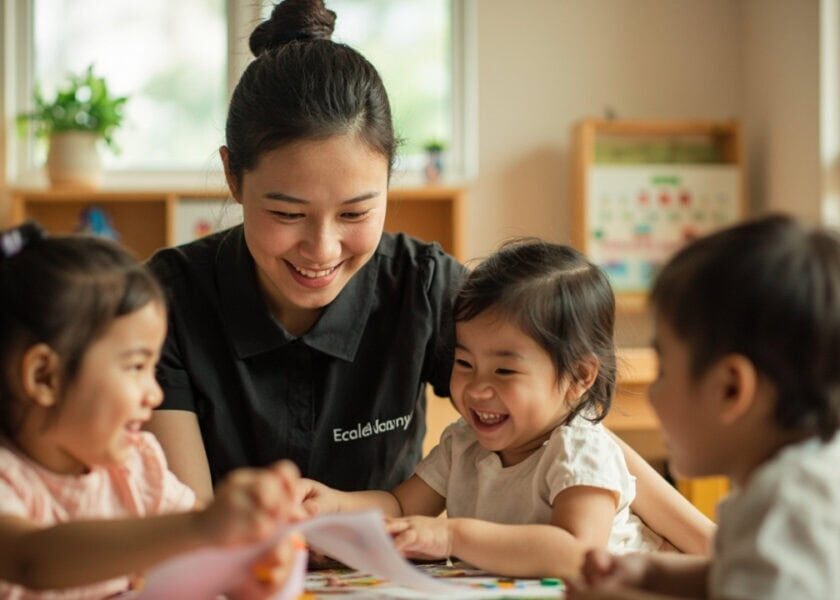
Why Singapore Parents Should Trust Their Childcare Instincts
The Exhaustion of Doing Everything Right: An Honest Conversation About Finding Childcare in Singapore
There is a particular kind of tiredness that does not come from sleepless nights. You know it. It is the fatigue of having read everything, compared everything, cross-referenced every review against every framework against every instinct — and still lying awake wondering if you have missed something crucial.
If you recognize that feeling, I want you to know something right away. That exhaustion is not evidence that you are underprepared. It is evidence of how much you care. And it is the most important thing I can tell you today.
We live in an age where information is abundant and wisdom feels scarce. Singapore parents, in particular, have become extraordinarily diligent researchers. You build mental spreadsheets. You read forums at midnight. You tour centres with the focus of someone evaluating a medical procedure — because for a parent, it is that serious.
And somewhere in all of that reading and touring and asking, something important has quietly gotten lost. Not knowledge. The quieter thing beneath it. The sense that you already know more than you give yourself credit for.
The Hidden Question Keeping You Awake at Night
There is a question that sits at the heart of every childcare search in Singapore, and it is rarely asked aloud. It is not, Is this centre or caregiver good enough?
The question underneath that one — the one that keeps parents up at night, the one that makes the search feel endless — is actually: Am I good enough at making this decision?
That is the hidden burden. Not the logistics. The doubt.
Here is what makes it so difficult to recognize: it masquerades as thoroughness. It feels responsible to keep researching. It feels wise to wait for more data. But the truth is, at some point, the searching stops being about gathering new information and starts being about avoiding the discomfort of commitment.
This is not a character flaw. It is a perfectly human response to one of the most important decisions a family can make. But it is also, quietly, a cost that no one talks about.
The cost is not just time. It is the erosion of something that matters far more — your confidence in your own judgment as a parent. Every time you second-guess an instinct you already had, every time you dismiss a feeling because you cannot back it up with a checklist, you are telling yourself that your wisdom is insufficient. And that is one of the most damaging messages a parent can internalize.
What Quality Actually Looks Like
You already know what quality looks like. Not in theory. In your body. In the way you notice whether a caregiver bends down to meet a child’s eye. In the way you register whether a space feels warm or merely clean. In the way an infant settles — or does not — when placed in someone’s arms.
That responsiveness is not a coincidence. It is not something that needs to be replaced by expertise. It is the beginning of expertise you already possess.
The Observation Framework Trap
Our culture has constructed an elaborate machinery around the idea that choosing childcare is a test — one where the right answers are somewhere out there, waiting to be found, if only you research hard enough.
But children are not standardized problems. Care is not a product. And the people who love these children most — their parents — are not clients to be assessed. They are the primary experts on their own child’s needs. No observation framework, however well-designed, replaces that knowledge. It can only support it.
Signs of Genuine Quality You Already Know How to Look For
- Responsiveness over performance. Does the caregiver react to a child’s needs before they become cries? Do they notice the quiet child in the corner?
- Ease over management. Is the atmosphere calm, or is it controlled? Is there laughter, or just compliance?
- Individual attention. In infant care especially, ratios matter. When the ratio is one to three — or better — a caregiver has the space to notice, to respond, to remember small things. That this child is teething on the left side. That this one needs a moment to warm up.
- The way your child responds. Watch their body language when they are held. Notice whether they reach for the caregiver’s hand, or pull away. That answer is data. Trust it.
From Evaluation to Partnership
We are not here to evaluate parents. We are not here to provide another checklist, another certification matrix, another set of boxes that, once ticked, grant permission to feel calm.
We are here because we believe that the parents who have done the work — the reading, the touring, the reflecting — are ready to be treated as the thoughtful, capable adults they are. They do not need more guidance. They need a partner who respects the judgment they have already exercised.
That distinction matters more than it might seem at first. Because the moment you shift from being evaluated to being trusted, something changes. The search stops feeling like a trial. It starts feeling like the beginning of a relationship.
The Word We Use Carefully: Trust
Trust is the thing that parents in Singapore are searching for — not just in a caregiver or a centre, but in themselves. They want to trust that they have made a good choice. They want to trust that their child will be safe, nurtured, known. And they want to trust that choosing is not the same as gambling.
We were built on the understanding that this kind of trust cannot be manufactured through marketing or promised through accreditation alone. It is earned through transparency, through consistency, through the quiet daily work of showing up for families.
That is why we participate in the ECDA Childminding Pilot — not because a badge gives parents peace of mind, but because it represents a commitment to standards that are meaningful and measurable, standards we believe in and help shape.
What Quality Childcare Looks Like in Practice
Let me speak plainly about what our childminding pathways look like in practice, because practical clarity matters here.
- Home-based care — where a trained caregiver comes to your home, maintaining the familiarity and routines your infant already knows
- Community and centre-based care — small-group settings designed around the recognition that infants do not thrive in ratios that overwhelm
In both pathways, we maintain the ratios that allow for genuine attention. When a caregiver can focus on three infants or fewer, they have the space to notice the small things. The kind of attention that no amount of curriculum can manufacture.
Making Quality Accessible
For families navigating the very real financial texture of raising children in Singapore, we believe access and quality should not be strangers to each other. Our pilot fee structures are designed to be affordable. CDA and Baby Bonus funds are usable.
These are not peripheral details. They are the things that remove one more layer of second-guessing from a parent’s shoulders — the guilt of wondering whether you are spending too much, or compromising by spending too little.
Communication When You Need It
We have developed tools like Thomas AI Chatbot — not as a gimmick, but as a genuine extension of our commitment to communication and transparency. Parenting is not a nine-to-five experience. Questions arise at odd hours. Doubts surface on weekends. Thomas is there to offer the kind of responsive, informed support that helps parents feel less alone in the decisions they are making every day.
What We Believe About the People Who Care for Your Child
We see the childminder differently. Not as a service provider fulfilling a function. Not as a contractor executing a scope of work. A childminder, in our understanding, holds a role of extraordinary dignity.
They are present at moments of first wonder — first steps, first words spoken to someone outside the family, first small negotiations over a toy. They are part of the texture of a child’s earliest days, and that is not a responsibility we take lightly.
When we talk about caregiver quality, about the standards we uphold, about the vetting and the training and the ongoing support we provide — we are not doing it because compliance requires it. We are doing it because we understand what is actually at stake.
The first thousand days of a child’s life are not a metaphor. They are a neurological and emotional architecture being built in real time. And the people who are present in those days deserve to be equipped, respected, and supported in that work.
Addressing Your Real Concerns
“What if I make the wrong choice?”
The search for perfect certainty is itself the problem. There is no decision without risk — not because you are insufficient, but because life involves choice. The question is not whether you can eliminate uncertainty. It is whether you can choose confidently within it.
You can. And you have more information than you think. The way your child responded when a caregiver held them. The feeling of the space. The instinct you had on the drive home, before you started analyzing. That is not preliminary data. That is the answer.
“How do I know if the fees are worth it?”
Quality care has real costs — and those costs are worth understanding clearly. Ask about what the fees cover. Ask about caregiver ratios. Ask about training and turnover. These are not awkward questions. They are the questions of a thoughtful parent, which is exactly what you are.
“What if my child doesn’t settle?”
Adjustment takes time, and some settling is normal. But watch for the trajectory. Is there genuine warmth in the caregiver’s approach? Does the environment feel alive rather than merely managed? A good fit is not one where there are never any tears. It is one where your child is known, noticed, and responded to as an individual.
“What if I feel guilty for going back to work?”
Guilt is a signal of love, not a measure of your adequacy. The question is not whether you love your child enough — you clearly do. The question is whether the care arrangement honours that love. If it does, you are not failing your child. You are making a choice that millions of parents make, with care and intention.
The Partnership We Are Offering
We are not another option to evaluate. We are a partner who is ready to meet you at the level of trust you have already earned.
When you choose to work with us, here is what you can expect:
- Respect for your judgment. We will not quiz you on whether you have done enough research. We will start from the assumption that you are a thoughtful parent who cares deeply.
- Honest transparency. About our caregivers, our ratios, our training, our fees. No hidden costs, no marketing gloss.
- Real communication. Through tools like Thomas and through the daily consistency of caregivers who know your child by name.
- Partnership over transaction. You are not purchasing a service. You are beginning a relationship — one built on trust, mutual respect, and a shared commitment to your child’s wellbeing.
Your Next Step
In a city that runs on excellence, on preparation, on being the best version of ourselves, it is radical to suggest that you do not need to prepare more. That you do not need to be more certain. That the clarity you are seeking is not on the next website or the next tour.
It is in the recognition that you have done this work. You have shown up. You have cared deeply, researched thoroughly, and loved your way through the uncertainty.
That is not the beginning of being a good parent. That is being a good parent.
And when you are ready to take that trust and place it in the hands of people who will honour it — people who believe in the role of the childminder, who maintain the ratios that matter, who communicate with honesty and transparency, who see your infant as a whole person deserving of genuine attention — we will be here.
Not as a service you are purchasing. As a partnership you are beginning.
The search can end. You were always ready to choose well.
If this resonates with where you are right now, we would welcome the opportunity to continue the conversation. Reach out to us — no pressure, no obligation, just a genuine conversation about what matters most to your family.