The Observation Method Singapore Parents Use to Choose Childcare
What This Article Covers
- Why observation matters more than asking questions during a tour
- The difference between questions that reveal authenticity and questions that have rehearsed answers
- How to distinguish true red flags from acceptable trade-offs
- What caregiver ratios actually mean for your child’s daily experience
- A practical framework for evaluating childcare with confidence
- What to expect after enrollment when the real evaluation begins
You Are Not Underprepared
Here is what I have learned, watching parents go through this process again and again in Singapore: the search for quality childcare is one of the most consequential decisions a family makes in the early years. And yet, unlike choosing a school or a doctor or even a home, there is no clear credential that tells you everything you need to know.
There are tours. There are pamphlets. There are smiling faces and clean hallways and carefully prepared environments. And underneath all of that, you are supposed to somehow determine whether this place, whether these people, will see your child the way you see your child.
You are not underprepared because you lack intelligence or love. You are underprepared because no one has given you the language for what you are actually trying to evaluate.
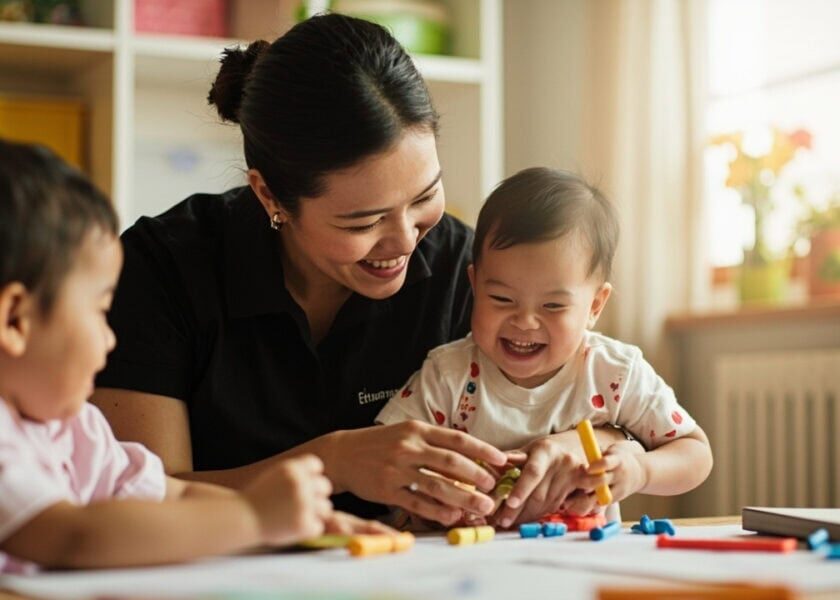
You know, in some deep place, what quality looks like. You know it when your child genuinely laughs, not just makes a polite noise. You know it when a person responds to your child’s cry rather than waiting for it to stop. You know it when an environment feels calm and purposeful, not just clean and colorful.
Translating that knowing into a set of questions, into a way of reading a room, into a framework you can actually use during a visit or a tour—that is where most parents feel lost. This article is meant to bridge that gap.
The Art of Patient Observation
The parents who make the best childcare decisions are rarely the ones who ask the most questions. They are the ones who know how to observe.
Not just look, but observe. There is a difference. Looking tells you what a place shows you. Observing tells you what a place is actually like when no one is paying attention.
Watch the Caregivers
Not when they are talking to you, but when they are with the children.
Watch how they hold themselves. Watch where their eyes go. A caregiver who is genuinely present will have a quality of attention that is difficult to fake. Their body will be oriented toward the children, not toward the visitors. Their faces will register what is happening in the room, not just what is happening in the conversation.
You are looking for evidence of a mind that is actually with the children, not a mind that is performing care.
Watch the Children Themselves
Not as a collective, but as individuals.
- Are they moving with ease through the space, or are they largely stationary, waiting for direction?
- Are there moments of spontaneous play, the kind where a child’s whole body is engaged and their face shows genuine absorption?
- Are there moments of genuine interaction between two children, or between a child and a caregiver, that has the quality of a real exchange rather than a task being completed?
The children will tell you a great deal about a place if you learn to read them. Give yourself permission to be quiet. To watch. To notice. The best questions in the world will not help you if you do not first develop the habit of seeing what is actually there.
Questions That Reveal Authentic Quality
There is a common mistake that parents make, and it is an understandable one. They ask questions that have answers the provider has already prepared.
What is your curriculum? What are your safety protocols? What training have your staff received?
These are good questions, important questions. But they are questions that any competent childcare provider can answer well, because they have been answered many times before. The answers tell you about what a place thinks it should be, not necessarily what it is.
Ask for Specific Moments, Not General Principles
Not what you do when a child is upset, but what did you do last Tuesday when a child in your care was having a genuinely difficult morning.
Not what does your environment support, but what does your day actually look like when something unexpected happens.
Listen to how the answer is given. Is it specific or general? Is it told as a story with a real child in it, or is it a description of a principle?
Specificity is a sign of genuine engagement. When a caregiver can tell you about a real moment, when their eyes change as they describe it, when they remember the texture of the experience—that tells you something important. It tells you that they were actually there. That this was not a protocol they followed but a situation they navigated, with all the complexity that implies.
Ask About Turnover and Transitions
There is another kind of question that matters, and it is the kind most parents do not think to ask. Ask about turnover. Not just whether caregivers leave, but what happens when they do.
- How are transitions handled?
- How is continuity maintained?
- How are the remaining children supported when a familiar face is gone?
The answer will tell you how a place thinks about attachment, about routine, about the real disruption that caregiver changes create for young children.
A place that treats this seriously will have thought carefully about it. A place that has not will give you a vague answer about hiring practices.
This matters in Singapore more than some parents initially realize, because the early childhood sector here does experience staffing challenges. What is not always transparent is how individual centres or home-based operators manage that reality. The question is not whether you will ever encounter imperfection. You will. Every childcare setting has imperfection. The question is whether the people running the setting have the awareness and the systems to manage imperfection without it becoming negligence.
Listen for the Difference Between Confidence and Certainty
When you ask a provider a question, you are not looking for the answer to be perfect. You are looking for the answer to be honest. You are looking for evidence that this person or this place thinks carefully about the real complexities of caring for young children, not just the presentation of those complexities.
The best answers are often the ones that acknowledge difficulty, that admit limitation, that show they have actually thought about what happens when things do not go smoothly.
So ask the hard questions. Ask about what happens when a child is sick, or when a caregiver is absent, or when there is a conflict between two children that cannot easily be resolved.
- Confidence says: we have thought about this, we have systems, we will work with you.
- Certainty says: we have nothing to worry about, this never happens here.
One of those is more trustworthy than the other.
Red Flags, Trade-Offs, and Caregiver Ratios
Let me talk about something that is often misunderstood in the childcare search: the difference between a red flag and a trade-off.
What Is a Red Flag?
A red flag is something that reveals a fundamental gap in values or practice. It is not a matter of degree, it is a matter of kind.
- If a caregiver dismisses your questions with impatience or condescension, that is a red flag.
- If a provider cannot clearly explain how they handle medical emergencies, that is a red flag.
- If you observe rough handling of a child, even once, that is a red flag.
- If a space smells persistently of urine or if the children appear consistently distressed in ways that are not acknowledged or explained, those are red flags.
Trust these. Do not talk yourself out of them. Do not rationalize them as the exception.
You are looking for a place that will be your partner in caring for your child, and a partnership requires that your concerns be taken seriously. If they are not, that is information. Act on it.
What Is a Trade-Off?
A trade-off is something that is not ideal but is within the range of acceptable compromise. Every childcare setting will have trade-offs.
- Perhaps the hours are not exactly what you hoped for.
- Perhaps the environment, while safe and clean, is not as richly resourced as you would choose if money were no object.
- Perhaps the location is convenient but the space is smaller than you imagined.
- Perhaps the caregiver your child will have is experienced but not a native English speaker.
These are not questions of right and wrong. They are questions of fit.
Learning to distinguish your red flags from your trade-offs is one of the most important skills in this process. Parents often get stuck either by dismissing everything as unacceptable or by compromising on things that actually matter deeply to them because they feel pressure to be reasonable.
The way through this is to be honest with yourself before you begin visiting. What actually matters to you? Not what you think should matter, not what other parents seem to value, but what matters to you and your family.
For some families, it is language environment. For others, it is outdoor access. For others, it is the specific philosophy of care. For others, it is proximity to home or work. For others, it is the ratio of caregivers to children.
None of these is wrong. But you cannot evaluate trade-offs honestly if you have not first named your priorities clearly.
Why Caregiver Ratios Matter
In Singapore, ratios are often a central part of the conversation. And they should be.
The number of caregivers to children, especially in infant care, matters enormously. It determines:
- How much individual attention your child can receive
- How quickly a caregiver can respond to a need
- Whether your child is known or just supervised
When there are fewer infants for each caregiver, there is time to notice. There is time to respond. There is time to comfort, to engage, to simply be present with a child who is having a hard morning or a wonderful afternoon.
But I want to be careful here. I have seen conversations about ratios become a kind of arms race where the only thing that matters is the lowest number possible. That is not entirely fair either.
A one-to-one ratio in a poorly resourced environment with an unengaged caregiver is not better than a one-to-three ratio with a responsive and intentional one. The ratio is an enabler of quality, not a guarantee of it.
What ratios do is create the conditions in which quality becomes possible. Within those conditions, you still need to evaluate whether the quality is actually there through observation and conversation.
What Quality Childminding Actually Looks Like
There is a tendency, especially in Singapore with our cultural emphasis on excellence and achievement, to approach the childcare search as if the wrong choice will ruin your child’s future. I understand that fear. It is real.
But I also want to tell you that it is largely unfounded.
What children need in their early years is not a perfect environment. It is a good environment with responsive, loving adults who see them and respond to them consistently over time.
That is not a high bar in the sense of requiring perfection, but it is a high bar in the sense of requiring genuine presence. The search is really about finding that presence, learning to recognize it when you see it, and having the confidence to choose it when you find it.
Home-Based Versus Centre-Based: A Matter of Fit
The environment in home-based settings tends to be, by nature, different from centre-based settings. It is smaller. It is in a residential space. It has the qualities of a home rather than an institution.
For some children, particularly infants and very young toddlers, this can be a significant advantage. A home environment at a manageable scale with consistent caregivers can offer a kind of warmth and predictability that large centres cannot easily replicate.
But I want to be honest that this is also a matter of fit. Some families prefer the structure and resources of a centre. Neither is inherently better. Both can offer quality. What matters is what works for your child and your family.
What to Expect After Enrollment
Most parents approach the search as a one-time decision: research, visit, decide, done. But choosing a childcare setting is actually the beginning of an ongoing relationship, not the end of a process.
The best parents treat it that way.
Questions to Ask About Communication
When you are evaluating a childcare provider during the search, you should also be asking questions about communication.
- How will you know what happened in your child’s day?
- What does a typical update look like?
- How are concerns raised and addressed?
- What happens when there is a problem?
These questions reveal not just the communication practices of a provider but their philosophy of partnership with parents.
A place that sees itself as a partner will have thought carefully about transparency. They will have systems for keeping you informed, not just when there is a problem, but as a regular part of care.
Some providers offer CCTVs. Some use daily logs or photographs. Some have regular parent meetings or informal conversations built into pickup time. What matters is not the specific mechanism but the commitment to keeping you genuinely connected to your child’s day.
A Practical Framework for Your Search
Let me leave you with a clear way to organize what you have learned.
Before You Visit
- Name your non-negotiables: What actually matters to you and your family?
- Name your acceptable trade-offs: What can you live with even if it is not ideal?
- Prepare 2-3 specific questions you want answered, not just general ones
During the Visit
- Give yourself permission to observe quietly before asking anything
- Watch caregivers when they are not performing for visitors
- Watch children as individuals, not just as a group
- Listen for specificity in answers, not just polish
- Ask at least one question about what happens when things go wrong
After the Visit
- Notice how you felt in the space, not just what you were told about it
- Distinguish between what the provider said and what you observed
- Compare against your non-negotiables, not against an ideal checklist
- Trust recognition when it comes
What EduNanny Offers Singapore Families
For families exploring their options in Singapore, it is worth understanding the range of models available. EduNanny operates through the ECDA Childminding Pilot, a government-supported initiative designed to expand the range of childcare choices accessible to Singapore families.
This matters practically as well as symbolically. The pilot framework is structured to offer home-based childminding at accessible fee levels for many families, making this a genuinely viable option rather than an exclusive one.
When evaluating cost, look beyond the headline number. Consider what is included, what subsidies or schemes may apply, and whether CDA or Baby Bonus funds can be used. The full financial picture often looks different once these mechanisms are factored in.
Ratio Structure and What It Means
Through the ECDA Childminding Pilot, EduNanny offers home-based childminding with ratios of up to one to three infants. This has direct implications for what your child’s day actually looks like: more individual attention, faster response to needs, and a greater likelihood that your child is known rather than simply supervised.
The Relationship Model
EduNanny exists because there are families in Singapore who need flexible, responsive support—people who need to know that someone else can care for their child with the same seriousness and attentiveness they bring to it themselves.
When a family entrusts their child to a childminder through EduNanny, there is an understanding that this is not a transaction. It is a relationship. It is a continuation of the care the family provides, extended into the hours when they cannot be there, supported by systems and structures that make that extension safe and purposeful.
The childminder is not a stopgap. The childminder is a partner. And the way to know whether a provider takes that seriously is in the details: the ratios that allow for genuine attention, the training that prepares caregivers for real situations, the communication systems that keep parents connected, the philosophy that sees the child as a whole person deserving of respect and responsiveness.
You Already Have What You Need
Here is what I want you to carry with you after reading this article.
You do not need to master all of this before you can make a good decision. You need to approach the process with a few clear principles, with some practical tools, and with trust in your own capacity to notice.
The fact that you are here, that you are taking this seriously, that you are willing to do the work of evaluation rather than just hoping for the best—that already puts you ahead.
The parents who make the worst decisions are usually not the ones who lacked information. They are the ones who ignored what they already knew because they felt they were not allowed to trust it.
You are allowed to trust your instincts. You developed those instincts over months and years of caring for your child. They are not sophisticated enough for everything, but they are sophisticated enough for some things. Use them.
What You Bring That No One Else Does
You have spent more time with your child than anyone else. You know their rhythms, their preferences, their signals. You know what makes them light up and what makes them withdraw. You have been observing your child since birth, and you have become remarkably good at it, even if no one has ever told you so.
That knowledge is not irrelevant to evaluating childcare. It is actually central to it.
Because when you walk into a room and watch how a caregiver responds to a child, you are bringing the perspective of someone who has studied one particular child more deeply than anyone else.
Use that. Trust the recognition that comes when you see something real. You will know it the way you know your child’s cry, or their laugh, or the way they look at you when they need you.
That knowing is not a mystery. It is something you have earned through the act of being their parent.
If you are ready to explore what genuine, responsive childminding can look like for your family in Singapore, EduNanny is here to answer your questions and help you take the next step.
You have the attention. You have the instincts. You have earned the confidence to trust them.
Now go find the care your child deserves.