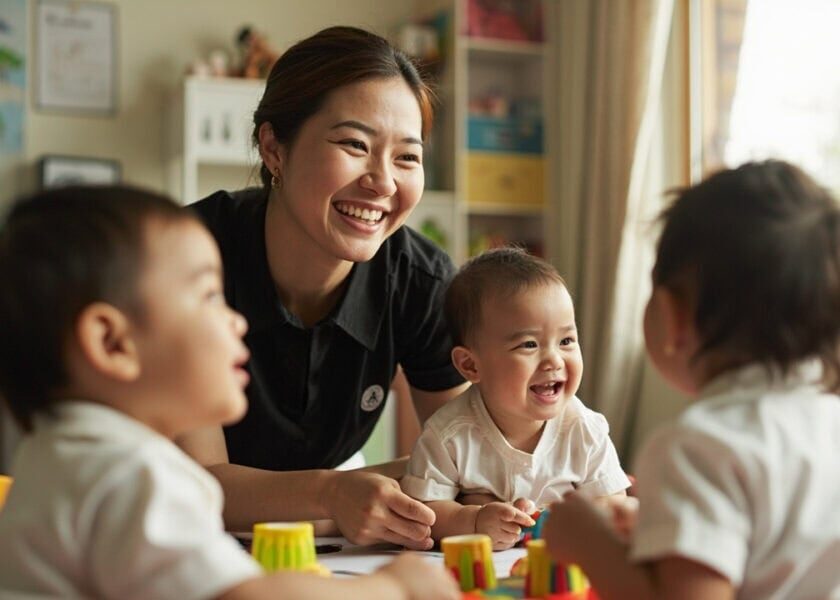
The Observation Skill Singapore Parents Are Quietly Learning
The Question Every Singapore Parent Carries
There is a question that most parents in Singapore carry quietly. Perhaps while driving home from work, or lying awake before sleep. It is not dramatic. It does not announce itself. But it is there, persistent and hard to silence:
Is this actually working?
You chose your childcare arrangement with care. You visited the space, asked the questions, watched how caregivers interacted with the children already there. You made the best decision you could with the information available.
And yet, on certain afternoons, that small quiet question surfaces again. Not because you doubt yourself, but because you genuinely do not know how to answer it with any real confidence.
This is not a failure of parenting. This is the gap that almost no one talks about.
Most parenting resources in Singapore do one of two things. They either reassure you that you are doing fine, which does not actually teach you anything, or they hand you a checklist of standards and benchmarks, which can feel clinical and does not account for the real texture of daily life.
What these approaches miss is the space in between: the actual skill of observation. The ability to look at your child, the person caring for them, and the environment they spend their days in, and to read what you see with clarity and confidence.
This guide offers a framework for doing exactly that.
Observation Is a Learnable Skill
Here is what many parents do not realize: observation is not an innate talent. It is a skill. And it is one that you already possess more of than you think.
Every parent observes. You notice when your child is fussier than usual at pickup. You register the tone a caregiver uses when speaking to you. You feel something shift when your child reacts differently to the same person than they did a month ago. These are observations.
What you may not have is a framework for organizing them, trusting them, and acting on them effectively.
When your child runs to their caregiver at the end of the day, what does that look like? Is it the same energy every day, or does it fluctuate? When your child hesitates at the door, what is in their face, their posture, the way they hold their body? These are not questions meant to manufacture anxiety. They are questions meant to help you notice what is already there.
One critical principle: a single observation means very little. A pattern of observations made over weeks and months begins to tell a story you can trust.
The Four Layers of Observation
Effective observation is not about watching constantly or second-guessing every moment. It is about developing a consistent practice across four distinct areas. Each layer adds something essential to the picture. Together, they give you something more valuable than any single checklist: genuine understanding.
Layer 1: Reading Your Child
At pickup, look at your child’s physical state first. Are they tired, hungry, overstimulated? This is baseline information. Then look at their emotional state. Are they calm, clingy, withdrawn, overexcited? These are not judgments. They are data points.
What matters is not whether your child is perfect at every pickup, but whether the pattern of their behavior makes sense in context. A tired child at the end of a long day is expected. A child who has been crying and is still visibly upset twenty minutes after you arrive is worth noting. A child who consistently seems flat when they were previously bright and alert is worth investigating.
One of the clearest signals a parent can read is the quality of the reunion. When a child sees their parent after time apart, there is typically a release of some kind. The form of that release tells you something:
- A child who runs into your arms and then settles quickly is one whose day likely had enough warmth and consistency.
- A child who collapses into tears and cannot be soothed, or who pushes you away, or who seems almost blank, may be showing you something about how their day felt.
Not every difficult reunion means something is wrong. But repeated difficult reunions, especially without a clear explanation, are worth taking seriously.
Watch also for shifts in your child’s behavior that persist beyond a day or two:
- Regression in skills they previously mastered
- Increased clinginess or anxiety at separation
- Changes in appetite or sleep patterns
- A reluctance to go to childcare that intensifies rather than fades
These are not signs of weakness or bad adjustment. They are signals, and signals are meant to be read.
Layer 2: Reading the Caregiver
Pay attention not just to what the caregiver says, but how they say it, and what they choose to share. A caregiver who offers only pleasantries at pickup is giving you pleasantries. A caregiver who tells you that your child had a good day and leaves it at that is giving you very little to work with.
This does not automatically mean something is wrong, but it does mean you have limited information.
A caregiver who tells you about the morning activities, mentions a small moment of frustration your child had and how they handled it, and observes that your child seemed particularly engaged during outdoor time is giving you something entirely different. They are giving you a window.
Ask questions, and notice the quality of the answers. Specific answers indicate a caregiver who pays close attention. Vague answers, deflections, or reassurances that do not address your actual question indicate something else.
There is a meaningful difference between a caregiver who answers your question and a caregiver who volunteers information. The latter often suggests a higher level of engagement and investment in the relationship with your family.
Notice how the caregiver speaks about your child when they do not know you are listening. The tone of voice used, the words chosen, the amount of warmth and genuine attention you observe. These are things you can notice.
When something warrants attention during the day, a fall, a conflict with another child, a moment when your child was upset, notice whether the caregiver tells you about it proactively, explains what happened clearly, and shares how they responded.
A caregiver who minimizes or deflects, who says everything is fine when something clearly was not, is showing you something important. A caregiver who takes the time to explain, to invite your questions, to take joint responsibility for your child’s wellbeing, is showing you something equally important.
One thing to be clear about here: asking questions does not make you a difficult parent. It makes you an attentive one. And attentive parents are not something good caregivers resist. They are something good caregivers welcome.
Layer 3: Reading the Environment
This does not mean scrutinizing every corner for safety hazards, though safety matters. What it means is developing a sense for whether the space serves the children who are in it.
Ask yourself:
- Is there enough room for the children to move?
- Is the noise level appropriate for the activities happening?
- Is there natural light, or is it artificially bright in a way that feels harsh?
- Are the children able to access materials on their own, or are they constantly waiting for adult assistance?
Notice the temperature, the smell, the general atmosphere. A space that smells of damp or closed air, that feels chaotic in a way that seems to overwhelm rather than energize the children, is worth registering. A space that feels calm and organized, where children seem engaged and not merely supervised, is worth registering too.
This is not about finding a perfect environment. It is about developing a baseline understanding of whether the environment suits your particular child. An active, adventurous toddler may thrive in a space with lots of open-ended materials and room to move. A more sensitive child may need a quieter, more structured setting to feel secure.
What matters is not whether the environment matches some abstract ideal, but whether it seems to serve your child specifically.
Layer 4: Reading Your Own Instincts
This is the layer most parents neglect, and for understandable reasons.
Most parents have been told, sometimes explicitly and sometimes implicitly, to distrust their gut feelings. In moments of genuine uncertainty, the advice often offered is to calm down, not to overthink, to trust that everything is fine.
And while this advice sometimes serves a purpose, it can also teach parents to override the very instincts that are meant to protect their child.
Your instinct is your brain processing information too quickly for you to articulate consciously. You may have walked into a room and felt that something was off before you could name what it was. That feeling was based on something.
The question is not whether to trust it. The question is whether you can slow down enough to identify what triggered it.
When you have a gut feeling about a situation, ask yourself what you actually observed. Not what you imagined, but what you saw, heard, or felt.
Then ask whether that observation was accurate:
- Did your child actually seem happy, or were you hoping they seemed happy?
- Did the caregiver actually seem engaged, or were you reassured by their demeanor regardless of what you observed?
- Did the space actually feel comfortable, or did you want it to feel comfortable?
Checking your instincts against reality is not the same as dismissing them. It is the skill that transforms a vague feeling into useful information.
What This Looks Like in Singapore
Parents in Singapore face particular pressures that shape the childcare landscape in ways that are specific to this city-state. The pace of work, the demands of dual-career households, the cost of living, the expectations around academic achievement that begin earlier than in almost any other context. All of these things create a childcare environment that is under considerable strain and full of genuine complexity.
The ECDA Childminding Pilot exists in recognition of this reality. It is an acknowledgment that families need options beyond traditional centre-based care, and that home-based and community-based arrangements can offer something valuable when they are structured with the right support, the right ratios, and the right standards.
Up to one-to-three infant ratios in settings like this are not arbitrary numbers. They are the difference between a caregiver who can truly attend to your child and one who is spread too thin.
Understanding these standards helps you evaluate arrangements more clearly. Quality care in Singapore should include clear caregiver-to-child ratios, relevant training and certifications, communication that goes beyond pleasantries, transparency about daily routines and any incidents, and age-appropriate structure that balances activity with rest.
What the observation framework offers in this context is the ability to engage with these arrangements as an informed participant rather than a passive one.
From Observation to Partnership
When you put these layers together, when you begin to read your child, the caregiver, and the environment with intention and consistency, something shifts. The questions you carry quietly begin to have answers. Not perfect answers, not answers that eliminate all uncertainty, but answers that are grounded in something real.
You stop hoping that your childcare is working and you start knowing it, or you start seeing clearly that something needs to change.
This is not about becoming a suspicious parent. It is about becoming an informed one.
When you know what good care looks like, you can advocate for it. Not in an adversarial way, but in a constructive one. The caregiver who knows that you are paying attention, who knows that you notice the details, is often the caregiver who is most careful and most committed. This is not surveillance. This is mutual respect, and it produces better outcomes for everyone, most especially your child.
What the deepest layer of observation ultimately reveals is this: it deepens the partnership between you and your child’s caregiver in ways that are profoundly meaningful.
When you walk into pickup with questions that are specific and thoughtful, when you share observations from home that the caregiver may not have seen, when you both begin to understand your child as a complete person across multiple contexts, something shifts. The relationship stops being a transactional arrangement and starts becoming a collaboration.
Over time, this shared observation practice becomes a ritual of its own. Not a ritual of worry, but a ritual of knowing. You start to notice your child’s milestones not as dramatic revelations but as quiet confirmations of growth you have been tracking all along. You start to trust the caregiver’s reports because you have built a track record of accuracy together. You start to feel a kind of confidence that is not borrowed from external reassurances but grown from the inside, from genuine understanding.
Questions Parents Ask
“Am I overthinking this?”
Probably not. Most parents who worry about overthinking are actually underthinking with anxiety rather than thinking clearly with structure. The framework of four observation layers gives your natural attention a home. It does not multiply your concerns; it organizes them.
“What if I ask questions and they get defensive?”
A caregiver who gets defensive when asked thoughtful questions is showing you something about their practice. Quality caregivers welcome engaged parents. They understand that your attention makes their work better, not harder.
“What if I change arrangements and it turns out to be fine?”
Trust the pattern. A single difficult pickup means very little. A pattern of difficult reunions, escalating behavioral changes, vague communication, or a persistent feeling of unease deserves attention. You do not need certainty to act. You need enough signal to warrant investigation.
“I do not want to be seen as difficult.”
You are not looking for permission to be difficult. You are looking for a childcare partner who treats your attention as valuable. The two are not the same. Attentive parents and quality caregivers recognize each other.
How do I start observing more effectively?
Begin with these practical steps:
- Visit more than once. First impressions matter less than patterns. If possible, visit at different times of day.
- Ask specific questions. Instead of “How was my child’s day?”, try “What was the highlight of the morning?” or “Did anything frustrate my child today?”
- Notice the caregiver’s questions. A caregiver who asks you about your child’s preferences, sleep patterns, or recent milestones is investing in knowing your child.
- Observe the children present. Are they engaged, or merely supervised? Is there energy and warmth in the room?
- Pay attention to the handover. How does the caregiver greet your child? How do they describe your child’s day? Is the information specific and useful?
- Build observation over time. One pickup tells you very little. A month of pickups tells you something you can trust.
Ready to Find a Childcare Partner?
If you are a parent who has been carrying that quiet question, the one you do not quite know how to answer, we want to tell you something important.
You are not lacking instinct. You are not failing to trust properly. You may simply be missing a framework, and frameworks can be learned.
EduNanny operates within this philosophy. We are part of the ECDA Childminding Pilot because we believe in the model it represents: low ratios, trained caregivers, structured communication, and a genuine welcome for parents who want to be informed participants in their child’s care.
We maintain transparency not because we have something to prove, but because transparency is what makes partnership possible.
Our approach to communication reflects this philosophy. We expect our caregivers to share the texture of your child’s day, not just the headline moments. We expect them to ask you questions about what you observe at home and to take those observations seriously. We expect them to tell you when something did not go well, and to be honest about their own limitations and challenges.
This is not a performance of perfection. It is an honest relationship, and honest relationships are what allow children to thrive.
We also understand the practical realities that Singapore parents face. The Monday to Friday rhythm of working life. The ways childcare costs interact with CDA and Baby Bonus structures. The fact that quality care must be affordable if it is to be accessible.
What we want for every family we work with is not a smooth, frictionless experience. That kind of promise is dishonest. What we want is a relationship where both parties are committed to understanding your child as well as they possibly can. Where questions are welcomed. Where observations are shared. Where the aim is always to serve your child’s development and your family’s peace of mind.
EduNanny is not looking for parents who will hand over their trust and step back. We are looking for parents who want to engage, to observe, to ask, to understand. We are looking for partnerships, not transactions.
You have the eyes to see your child. What we are offering is a way to trust what you see.
That is not a small thing. That is everything.
If this approach resonates with you, we welcome a conversation. Reach out to learn more about what EduNanny offers and whether it aligns with what your family needs.
At EduNanny, we believe thoughtful observation and genuine partnership are at the heart of quality childcare. Learn more about our approach.