What Your Morning Drop-Off Reveals About Childcare
The Weight of the Morning Handoff
There is a particular weight to a gate in the morning. Not just the physical weight — though anyone who has carried a toddler on one hip, a diaper bag on the other shoulder, and a travel mug in their hand knows that weight intimately — but the other one. The invisible weight that settles in your chest the moment you lift the latch and step into someone else’s space with your child.
You know this weight. Every working parent in Singapore knows it.
It is the weight of the morning handoff. And it happens every single day.
What the Morning Drop-Off Actually Tells You
We spend weeks choosing childcare. We read the reviews, tour the facilities, ask the questions, fill out the forms. We agonize over ratios and curricula and whether the walls are painted with non-toxic paint and whether the outdoor space is sufficient. All of that matters.
But there is a moment that none of those preparations fully protect you from — and that is the moment you are living right now, perhaps on your commute, perhaps while your child is already settled somewhere across the island. Did the drop-off go well? Did she cry? Did he eat? Is the caregiver in a good mood today?
That wondering. That five-minute window of not-quite-knowing.
Here is what years of walking alongside Singapore families through some of their most vulnerable mornings has taught us: the drop-off ritual is not just a transition. It is a daily trust barometer. When it goes well, it sets the emotional tone not only for your child’s day but for yours. When it goes poorly — or with that lingering doubt you cannot quite name — it follows you onto the MRT, into your 9 a.m. meeting, through every moment with a low hum of unease.
What to Watch For
The morning drop-off is an unfiltered moment. You are seeing the caregiver at the beginning of their workday — not the polished version. In that unfiltered state, quality reveals itself in small, spontaneous moments:
- Eye contact. Not the quick glance that acknowledges your presence, but the kind that says: I see your child. I am glad they are here.
- The caregiver’s hands. Are they already moving toward your child in welcome, or are they still occupied — finishing something else — and your child must wait?
- Your child’s face. Children are exquisitely sensitive readers of adult emotional states. They do not need words to know whether the person welcoming them is genuinely present or performing a duty.
This is not about perfection. A caregiver who is juggling three children will not always give your child their full attention the instant you arrive. What matters is the trajectory — the direction of their attention, the visible effort to make the connection, the warmth that is genuine rather than performed for your benefit.
You will know the difference. Your child already does.
Signs of Genuine Attunement
- The caregiver greets your child by name, even when the room is chaotic
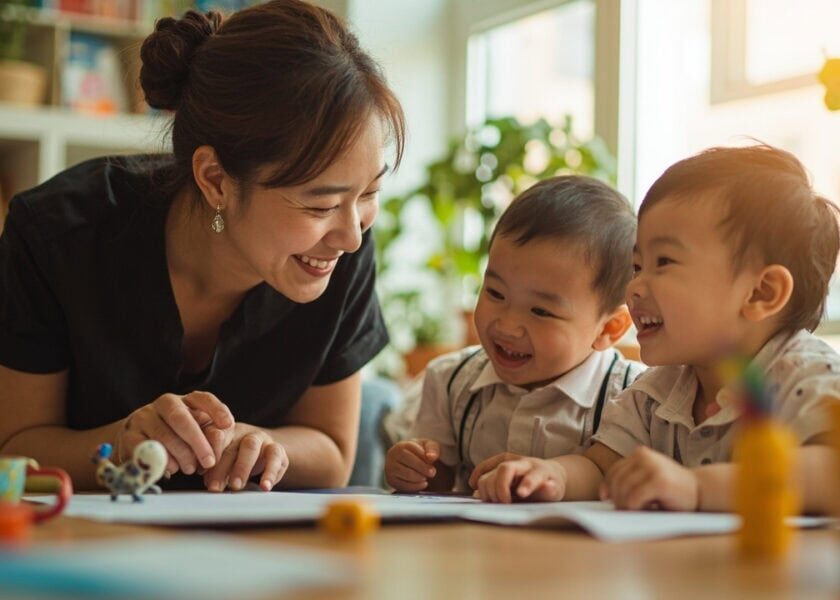
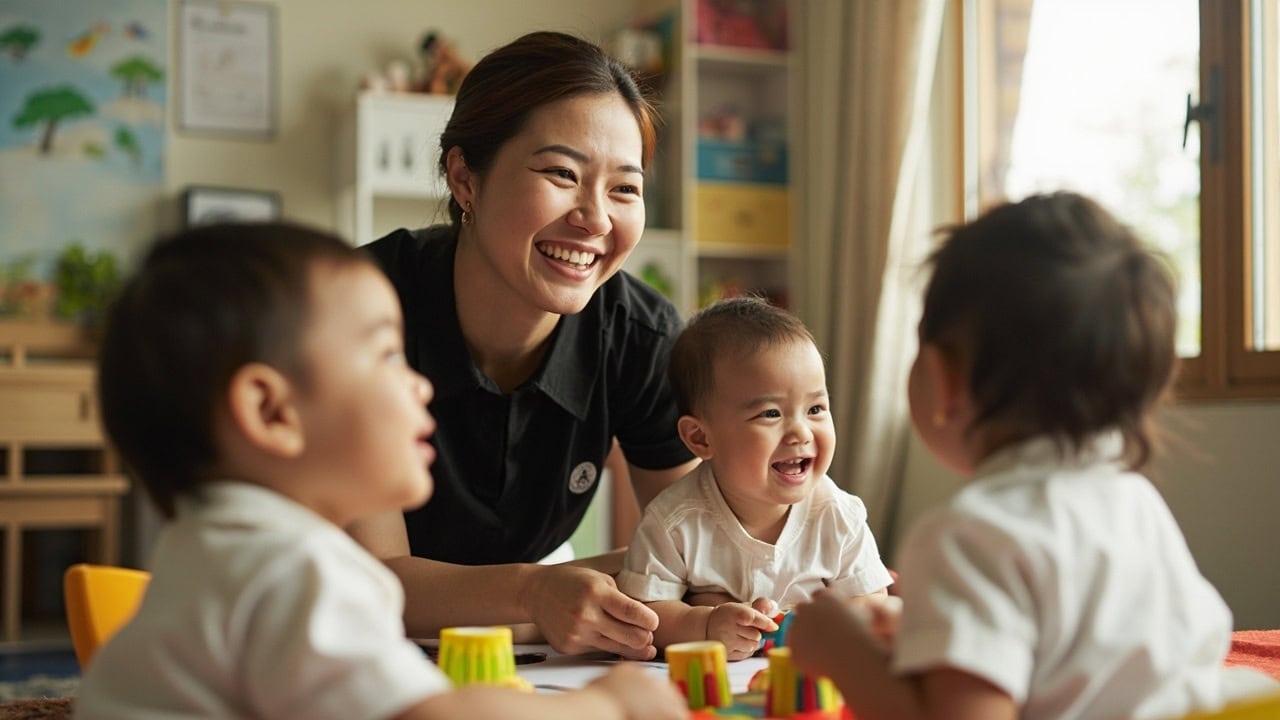
- They kneel to child level rather than speaking down from above
- They read your child’s mood and meet them where they are — adapting their approach morning by morning
- They take a moment to hear how the morning went from you, without making you feel rushed
- Your child moves toward the caregiver — even hesitantly — rather than clinging harder to you
There is a skill to reading these moments, and like any skill, it improves with attention. As the weeks pass and the routine becomes familiar, you start to notice patterns. The caregiver who always kneels down. The one who seems to have a sixth sense for when a child is about to melt down and intervenes before the spiral begins.
When a drop-off feels right — when you leave the gate and realize, with some surprise, that you are not worried — that feeling is data. It is your nervous system telling you that the handoff was sound, that your child is in a place where they will be okay.
Why the Right Match Matters for Your Whole Family
We live in a culture that frames parental guilt as something to overcome, something to manage, something to push through. But guilt — in its most honest form — is not the enemy. It is information. It tells you that you care.
The question is not whether you feel the weight of leaving your child in someone else’s care; of course you do. The question is whether the care you are leaving them in is worthy of that trust.
When it is, something remarkable happens. The guilt does not disappear — it softens. It becomes a smaller, quieter thing. And in its place, you find something more sustainable: confidence.
- The confidence to walk through your office door knowing that your child is not merely supervised but cherished
- The confidence to focus on your work because the morning handoff was solid
- The confidence to come home at the end of the day and be fully present with your family, because you were not draining your emotional reserves all day with low-grade worry
This is what we mean when we talk about the emotional sustainability of a good drop-off ritual. It is not a luxury. It is the foundation on which your ability to work, to parent, to be a whole person is built.
You are doing something extraordinarily difficult. You are building a life for your family, which requires your absence during the hours when your child is most awake and alive. You did not choose this because you wanted to leave them. You chose this because the mathematics of modern life in Singapore require it — because you believe in the future you are working toward.
That choice deserves support. It deserves a childcare model that understands what you are carrying and does not add to your burden unnecessarily. It deserves a morning drop-off that leaves you with peace, not doubt.
What Quality Childcare Looks Like at the Gate
After years of serving Singapore families, these are the markers we have seen consistently in childcare arrangements that sustain trust over time.
1. Consistency
The single most important factor in a child’s sense of security is the predictability of their caregivers. When your child walks through the door and sees a familiar face — the same face, morning after morning — something in their nervous system settles. They know this place. They know this person.
The relationship is the care.
2. Attunement in the Transition
The first moments of the drop-off set the emotional temperature for the entire day. A caregiver who is attuned will read your child’s mood, meet them where they are, and offer the specific kind of comfort they need on that particular morning.
Some mornings, that means distraction and play. Some mornings, it means holding and quiet. The attuned caregiver adapts, because they have taken the time to know your child as an individual, not just as a checklist item.
3. Genuine Communication
Not the formal, logged kind — though documentation has its place — but the kind that happens in that five-minute window. How does the caregiver receive your child from you? Do they take a moment to hear how the morning went, what your child might need extra support with today? Or do they receive the handoff cursorily, already looking past you toward the next task?
These micro-interactions are not trivial. They are the texture of trust.
4. Accessibility Without Compromise
For Singapore families, affordability should not require you to compromise on quality. EduNanny participates in the ECDA Childminding Pilot, with fee structures designed to be within reach for families navigating the real costs of quality care. CDA and Baby Bonus funds can be used, which eases the financial reality of early years childcare. Care is offered in Monday-to-Friday blocks because your work schedule is not negotiable, and your child’s care should not have to be either.
How EduNanny Approaches the Morning Transition
At EduNanny, we have built our approach around a conviction: the quality of the morning handoff predicts the quality of everything that follows.
We train our caregivers to understand this. We design our environments to make genuine attunement possible — small ratios, because when you are caring for fewer infants, you can actually see them, know them, respond to them. One to three in our infant rooms. Not because regulations require it in every configuration, but because we believe it is the standard that dignity demands.
We welcome the cameras, the transparency, the open communication. We do not think of these as impositions on our practice but as extensions of it. When you close the gate behind you, you should not have to wonder. We want your wondering to become trust, and your trust to become the freedom to do your work well, and come home to be the parent you want to be.
There is one more thing that often goes unspoken in conversations about childcare quality. The caregivers who do this work — who stand at the gate each morning, who receive your child with open arms, who kneel to child level and say good morning in a voice that means it — they are not interchangeable. They are human beings who have chosen to devote their professional lives to the care of other people’s most precious people.
That is a sacred calling. And when the system around that caregiver is designed to support them — manageable ratios, fair compensation, thorough training, professional respect — that quality becomes sustainable. It becomes repeatable. It becomes the norm rather than the exception.
Practical Steps for Choosing Infant Care in Singapore
If you are currently researching childcare options, here is how to put the drop-off ritual to work for you.
- Visit during drop-off time. Ask to observe a morning transition. The unfiltered quality of this window will tell you more than any tour or orientation.
- Notice your child’s response. Not just in the first visit, but over the first few weeks. Does your child show increasing familiarity, or increasing resistance? Both can be normal early on, but the trajectory matters.
- Pay attention to the caregiver’s hands and eyes. Are they reaching toward your child before they reach for the clipboard? Do they kneel down?
- Ask about continuity of care. Who will be the primary caregiver? How often does the team change? The answers will tell you about the system’s commitment to your child’s sense of security.
- Ask yourself how you feel leaving. Not during the first visit when everything is new, but after a few weeks. Does the feeling shift toward trust, or does the doubt persist?
Finding Your Breath
The gate closes behind you. You hear the click of the latch. You take a breath.
That breath can be different. It can be a breath of peace instead of doubt. It can be a breath that says: I made the right choice. This place is good. My child is known here. And I can go to work and do my work well.
That breath is not a luxury. It is your right as a parent who has made a loving, necessary, difficult choice to entrust your child’s early hours to someone else.
The ritual you are part of every morning — the one that feels so ordinary, so rushed, so heavy with emotion — is one of the most important things you do as a parent. It is the hinge on which so much else turns.
Walk toward your commute. Take the MRT. Check your phone for the morning update. And know this: on the other side of that gate, someone is there with your child.
Welcome to EduNanny.
At EduNanny, we believe that every family deserves a morning handoff they can trust. Learn more about our approach to thoughtful, development-oriented childcare, or reach out to speak with our team.