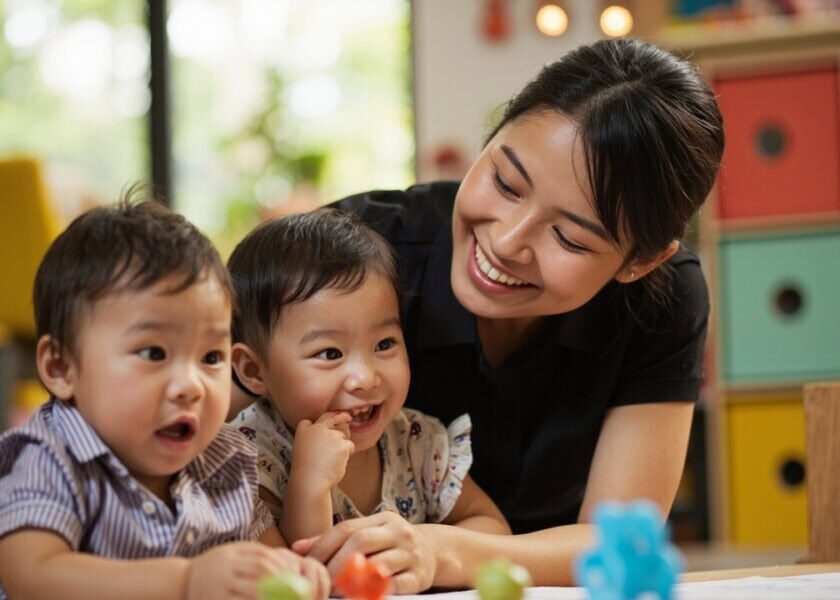
How Quality Childcare Builds the Emotional Foundation Your Child Needs
What Your Child Learns About Feelings Before They Can Say Them
There is a moment that happens every day in quality childcare that most parents never see.
A child—perhaps two years old, perhaps eighteen months—becomes suddenly furious. The trigger might be small. A block that won’t stack. A peer who stepped on their drawing. The banana they wanted broken in half but it isn’t breaking the way they imagined it should.
The fury rises. The face contorts. The sound that comes out is not quite a scream and not quite a cry but something entirely its own—a sound that communicates I am being undone by this moment and I do not have the words for what is happening inside me.
In that moment, a skilled caregiver does not rush to fix it. Does not immediately offer a screen or a snack or a distraction that will make the feeling disappear. They kneel down. They wait. And then, quietly, they name what is happening.
“I see you. You worked so hard on that tower and it fell and that made you feel so, so angry.”
The child, mid-sob, looks up. Something shifts. The feeling was real. It was seen. And now it has a name—anger—that makes it something outside of themselves, something that can be held, something that can be survived.
That moment—ordinary, unscripted, unrepeatable—is one of the most important things your child learns in the hours you are not with them.
When you leave your child in quality childcare, something is happening that is far more active than most parents realize. Your child is not simply being watched. They are being taught—not through lessons or instructions, but through the hundreds of small interactions that happen throughout each day.
These are not soft skills. These are the hardest skills a human being ever learns: emotional vocabulary, self-soothing strategies, frustration tolerance, empathy, and resilience. They are learned in precisely this way—through repetition, through safe failure, through the patient presence of someone who knows what they are doing.
Why the First Years Shape Everything
You live in a city that runs on ambition, on achievement, on the quiet understanding that the decisions made in early childhood ripple outward for decades. Singapore parents understand this better than almost anyone. You have researched preschools. You have debated timelines. You have felt the weight of knowing that what happens in these early years matters in ways that are hard to quantify but impossible to ignore.
And yet, when you choose childcare, you are often making that choice in the dark—knowing you want more than supervision, hoping your child is safe and happy, but lacking the language to ask the question that actually matters: Is my child learning to manage big feelings? Is someone actively teaching them that?
In the first thousand days of life—and the years that immediately follow—a child’s brain is building itself at a speed it will never again achieve. Neural connections are forming at a rate of more than one million per second during peak periods of development.
And the architecture being built in those early years is not merely cognitive. It is emotional. It is social. It is the foundation upon which every future relationship, every future challenge, every future moment of frustration or disappointment or joy will rest.
The research here is not ambiguous. Children who develop strong social-emotional skills in their early years show better academic performance years later. They have stronger friendships. They are more resilient when life inevitably becomes difficult. They can regulate their own emotions rather than being regulated by them.
The place where these skills are most powerfully developed is not a classroom or a worksheet or a screen. It is in relationship—with adults who are trained to respond with intention, and with peers who are navigating the same overwhelming feelings in their own small bodies.
The Emotional Milestones Your Child Is Building
When a child is in a quality childcare environment, they are building a sequence of emotional milestones that layer upon each other like the foundations of a building.
1. Identifying Emotions
First, children learn to identify emotions—not just their own, but the emotions of others. They learn that when another child is crying, that child is feeling something, and that they themselves are not the center of every feeling in the room.
A caregiver might point gently: “Look, Aarav is sad. His face is showing us he needs some space right now.” This simple observation plants a seed of emotional literacy that grows quietly over months.
2. Learning to Self-Soothe
Then, children begin to learn self-soothing—not because they are abandoned to figure it out alone, but because a caregiver teaches them strategies. Breathing. Clamping their hands over their mouth to feel the exhale. Asking for a hug. Finding a quiet corner with soft toys.
These are skills that feel simple when we do them as adults, but they had to be learned somewhere, by someone, in the early years when everything felt enormous.
3. Building Frustration Tolerance
Beyond self-soothing, children in quality care develop what we call frustration tolerance—the capacity to wait, to not have what they want immediately, to understand that another person’s needs matter as much as their own.
This is not a natural skill. Children are inherently egocentric in their early years; this is developmentally appropriate and not a character flaw. But it can be gently, consistently reshaped through the structure of group care, where sharing is required, where turn-taking is non-negotiable, where a child learns that the world does not end when someone else gets the red cup first.
4. Developing Empathy
And then there is empathy itself—the capacity to look at another person and understand that they have an inner life, that they might be feeling something different from what you are feeling. This is perhaps the most remarkable thing young children learn in quality childcare, because it represents a fundamental shift in consciousness, a movement from total self-absorption to genuine connection with another human being.
A child who pushes another child in frustration and then stops, looks, and says “sorry” is not just performing a social nicety. They are demonstrating a capacity for empathy that did not exist a year or two earlier and that had to be built, brick by brick, through countless experiences of being seen themselves.
Why Group Care Creates Unique Opportunities
You might wonder whether these skills could be learned just as well at home. The answer is nuanced: children can and do learn emotional regulation in home environments, especially when caregivers are attuned and responsive. But quality group care offers something unique—peers who are also learning, also struggling, also needing to navigate the same overwhelming feelings.
In group care, your child encounters other children who are also learning to share, to wait, to manage disappointment. This is not a negative—it is a classroom of equals, all figuring it out together, all practicing on each other in safe, supported ways.
The child who learns to comfort a crying peer is practicing a skill they will use for the rest of their lives. The child who learns to wait for a swing because another child is on it is building tolerance that no worksheet could teach.
What Quality Childminding Actually Looks Like
Let us be specific about what you should be looking for, because specificity matters here. When you ask a caregiver about how they handle a child who is upset, listen to the words they use.
Do they talk about managing behavior or about understanding feelings? Do they have language for the emotional milestones described above? Do they speak about your child as an individual whose inner life matters?
These are not trivial questions. They are the questions that distinguish supervision from education, caretaking from teaching.
Signs That the Invisible Curriculum Is Working
When you pick up your child at the end of the day, notice what you see. Not perfectly calm—children are supposed to be expressive and sometimes chaotic—but fundamentally okay.
Can they move from activity to activity without total collapse? Can they name how they feel? Can they show concern when another child is hurt?
These are the signs that the invisible curriculum is working, that in the hours you were away, your child was not merely supervised but was being shaped by intentional, knowledgeable hands.
The EduNanny Difference
We want to be honest about how EduNanny by BUTLER approaches this work, because we believe you deserve to understand not just our philosophy but our practice.
We are part of the ECDA Childminding Pilot, which means we operate within a framework designed to provide quality care that is also accessible to families across Singapore. We offer both home-based and community-based pathways, recognizing that every family has different needs and different circumstances.
Our infant ratios are structured to ensure that no child is overlooked, that each small person receives the attention their development requires. We believe that the ratio of caregivers to infants is not an administrative detail but a fundamental condition of quality—that when there are too many children and not enough trained eyes, the subtle moments described in this article simply do not happen.
Our caregivers are trained observers. They understand the difference between a child who is crying because they are hungry and a child who is crying because they are overwhelmed. They know how to respond to aggression without shaming and how to comfort without creating dependency. This is not accidental. It is the result of careful selection, ongoing training, and a culture that treats emotional development as the serious, foundational work that it is.
We also believe that you, as a parent, should never feel excluded from your child’s day. We have implemented communication and transparency measures, including CCTV where deployed, because we know that trust is built through visibility. You should never have to wonder what is happening when your child is with us.
Because we know that the cost of quality care can feel daunting for families, we have structured our pilot program to be accessible, and we have made it simple to use the tools you already have. Your Child Development Account can be used. Your Baby Bonus can be applied. These are not gimmicks. They are practical supports that make it easier for you to choose quality without adding financial strain to the many other strains you are already carrying.
What to Look For and Observe
You are raising children in one of the most dynamic, demanding cities in the world. The expectations on families here are extraordinary. Children are enrolled in enrichment programs before they can walk steadily. Parents compare developmental milestones in whispers and worry in silence. There is a quiet intensity to parenting here that can feel isolating, even when you are surrounded by other parents doing the same thing.
You are not wrong to feel the weight of it. You are not wrong to want your child to thrive. And you are not wrong to wonder whether the childcare you have chosen is truly giving your child what they need.
What we want to offer you is a framework for understanding what you should be looking for—not as a checklist, but as a way of seeing.
Questions to Ask Your Childcare Provider
- How do you respond when a child has a big feeling like anger or frustration?
- What words do you use to help children identify what they are feeling?
- How do you teach children to calm down when they are upset?
- What does a typical day look like when children need to share or take turns?
- How do you help children who are struggling to connect with peers?
- What would I see if I observed a classroom during a moment of conflict?
If the answers you receive focus on understanding feelings rather than just managing behavior, if caregivers can articulate the emotional milestones children are building, if they speak about your child as a person with an inner life worth attending to—these are good signs.
What to Watch for at Home
You can also observe signs that learning is transferring to your home environment:
- Does your child use feeling words to describe their state (“I feel mad”)?
- Can they wait for something they want without total collapse?
- Do they show concern when someone else is upset?
- Can they recover more quickly from frustration than they did months ago?
- Do they seem to trust that big feelings can be survived?
These observations tell you that the invisible curriculum is taking hold.
The Work We Are Invited Into Together
What we are offering through EduNanny is not just childcare. It is partnership in the most important work there is—the work of raising a human being who can feel deeply and still function, who can love strongly and still be independent, who can experience the inevitable disappointments and frustrations of life without being undone by them.
We are offering your child the chance to have big feelings in a safe place, with people who know exactly what to do with them.
Not reading. Not arithmetic. These things will come. But the ability to be a person in the world—to feel big feelings without being destroyed by them, to care about others even when it is inconvenient, to return to equilibrium after disruption—this is the curriculum that matters most, and it is happening in the hours you are working, driving, meeting, building the life your family needs.
We want to close by inviting you to notice something the next time you watch your child. Watch them when they are frustrated by a toy that won’t work. Watch them when they are reunited with you after a separation. Watch them when they see another child stumble and turn to look, rather than ignore.
In these small moments, you are seeing the results of everything that has happened in their young life—the sum of every response they have received, every feeling that has been named, every time someone has sat with them in their distress and helped them find their way back.
That is what we are building together. Not just in childcare hours, but across the whole arc of childhood. Not just academic readiness, but life readiness. Not just a child who is safe, but a child who knows how to be in the world—how to feel, how to connect, how to recover, how to grow.
That is the work. And it begins long before children can tell us what they are learning. It begins with us—with the choices we make, the people we trust, the questions we dare to ask.
You are asking the right questions. And your child is in exactly the right place to grow.
If you would like to learn more about how EduNanny by BUTLER supports your child’s social-emotional development, we invite you to schedule a conversation with our team.
At EduNanny by BUTLER, we believe that every child deserves to be seen, heard, and supported as they learn to navigate the world of big feelings. Learn more about our approach to thoughtful, development-oriented childcare, or read about our team and the standards we hold ourselves to. We are proud to be part of the ECDA Childminding Pilot, serving families across Singapore.