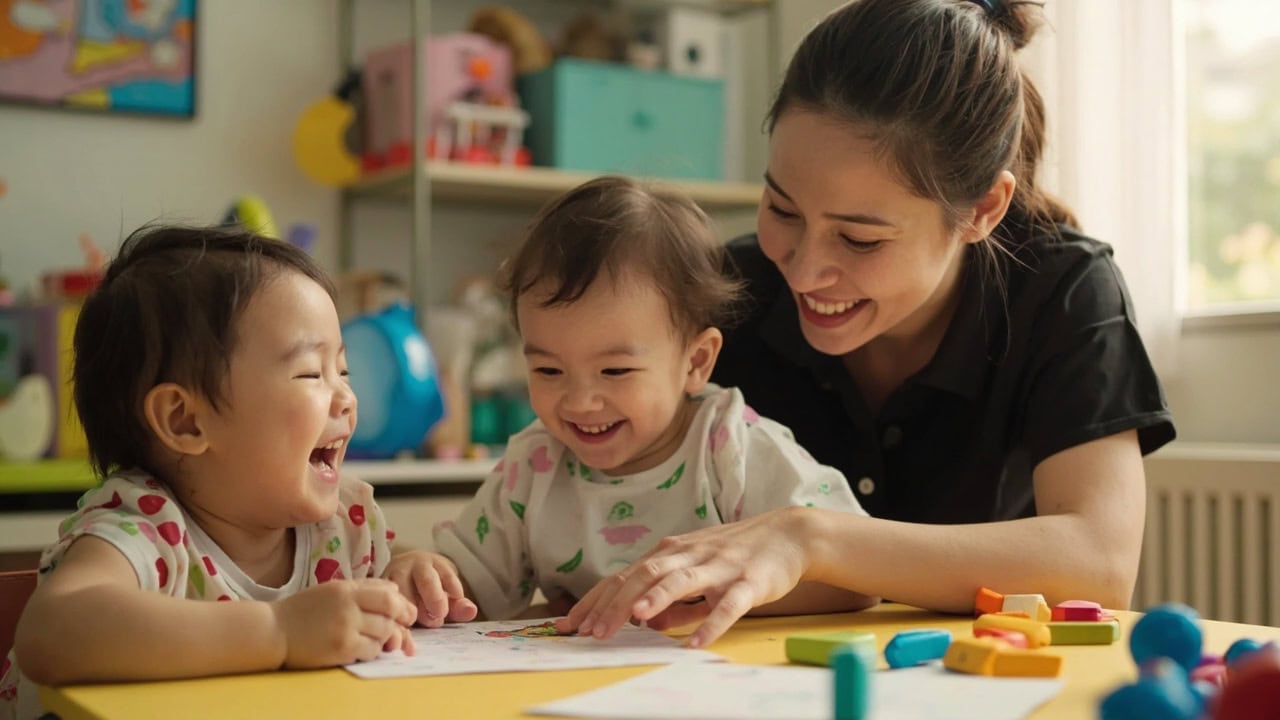
What Your Child’s Behaviour Is Telling You During Childcare Hours
Quick Summary
If you’re short on time, here’s what every Singapore parent should know about the hours between drop-off and pick-up:
- Your child is having a rich, complex internal experience during childcare hours—not just “being looked after”
- The behavioral shifts you notice after enrollment are not random—they are your child communicating
- Quality childcare environments are designed with intentional sensory and relational architecture
- The communication between caregiver and parent creates a shared language for understanding your child
- Your growing ability to read your child is evidence that the childcare environment is doing its work
The Weeks After: What You Begin to Notice
There is a particular kind of attention that settles over a parent in the weeks after their child begins childcare. It arrives quietly. You might notice it at dinner, when your child reaches for a utensil in a new way—or when they pause at a sound they would have ignored three months ago.
You are collecting data without meaning to. Small data. The kind that accumulates in ordinary days until one evening you realize you have been mapping something you did not know you were mapping: your child’s internal world, rendered visible through shifts that only become visible when you are watching for them.
In those early weeks, you will notice things. Perhaps your child comes home hungry in a way that seems different—or unusually calm, settled into a different rhythm than the one they keep at home. You might notice new interest in textures, or responses to sounds with a different kind of awareness.
These observations accumulate without pattern at first. And then, somewhere around the sixth or eighth week, something shifts. The data begins to cohere. You start to see that what you have been noticing is not random—it is a language. Your child is speaking to you in a grammar you are only now learning to parse.
Inside Your Child’s Day: The Sensory World of Quality Care
To understand why this happens, step inside the world your child inhabits during those hours. Consider what a quality childcare environment feels like from inside a young body. Singapore is a sensory-rich city—humid air, the hum of air conditioning, the smell of food being prepared, the texture of learning materials designed for small hands.
For an infant or toddler, these sensory inputs are not background. They are the architecture of experience. In a thoughtfully designed environment, every element has been considered:
- The visual calm of the space—is it overstimulating or does it invite focus?
- The acoustic environment—can a child’s voice be heard without strain?
- The materials—do they invite touch and exploration without overwhelming?
- The spatial arrangement—does it allow for both connection and quiet retreat?
This is not aesthetic indulgence. It is developmental intentionality. Children build their understanding of the world through their senses, and the sensory landscape of their days shapes the neural pathways that will support learning, language, and emotional regulation for years to come.
Routine as Security
Now add the layer of routine. Young children are not passive recipients of time—they are active builders of predictability. When the morning begins with the same greeting, when snack follows circle time in an anticipated sequence, when the rhythm of the day follows a logic a small person can learn to read—something profound happens. The child’s internal sense of safety expands. They begin to trust not just the caregiver’s presence but the shape of the day itself.
This is not about rigidity. It is about the deep comfort that comes from being able to predict what happens next, and thereby to invest energy in exploration rather than vigilance.
The First Laboratory of Human Connection
And then there are the peers. The first friendships of childhood are experiments in proximity, in sharing space and attention, and eventually, toys. When your child encounters another child in a quality childcare environment, they are engaging in one of the most sophisticated learning exercises available to a young human being:
- Learning to read intention in another’s actions
- Registering emotion in faces they are still learning to interpret
- Practicing the earliest forms of negotiation and turn-taking
- Navigating the complex emotions of wanting, sharing, and waiting
These are not skills that can be taught through instruction. They must be lived, again and again, in the company of other small beings who are equally clumsy and earnest in their social attempts.
The Caregiver as Observer: What Makes Reading Possible
But perhaps the most significant relationship your child forms during these hours is with their caregiver. And this is where the story becomes, for many parents, genuinely transformative.
In the best childcare settings, the caregiver does not simply watch over children. They observe. Watching is passive. Observation is intentional—it requires training, attention, and a genuine curiosity about the individual child in front of you.
When a caregiver is trained in developmental observation, they begin to notice patterns that would otherwise remain invisible:
- That a particular child becomes fussy before hunger, but only after a certain kind of morning activity
- That another child reaches for comfort in a specific way when processing a new social experience
- The micro-expressions that flicker across a small face in the moments before a meltdown
- The particular quality of engagement that signals genuine curiosity rather than mere activity
The Shared Language
This observational practice is meant to be shared. You arrive at pick-up, and the caregiver tells you not just what your child ate or how long they slept, but how they approached the morning’s sensory play, what captured their attention, how they interacted with another child during free play, what their face looked like when the music started.
This is not a status report. It is a window. And when you begin to receive these windows regularly, something begins to happen on your end, too. You start to connect what you see at home with what you are hearing from care. You begin to see the thread.
This is the beginning of the shared language—and it changes everything.
What This Means for You as a Parent
What happens to a parent who begins to receive this kind of information consistently? Something changes in your relationship with uncertainty. The hours you are apart no longer feel like a void. They feel like a story—a story you are beginning to learn how to read.
- When your child comes home exhausted, you understand it may be the exhaustion of genuine cognitive engagement, of building new neural pathways through play and exploration
- When they come home hungry in a different way, you understand it as a sign of active participation, of a child who has been fully present in an environment that invited their presence
- When they seem irritable or clingy, you have a context—developmental, relational, sensory—that allows you to hold their behavior with patience rather than frustration
This is fluency. You are becoming fluent in your child’s language.
And the remarkable thing is that this fluency does not stay contained within the childcare relationship. You find yourself noticing things at the playground that you would have missed before—subtle social choices, moments of emerging self-regulation, the way your child’s face moves through emotions with a complexity you are only now beginning to appreciate.
You find yourself more patient with the hard moments because you understand them as part of a longer developmental narrative. More present for the beautiful moments because you understand their significance.
Your child has always been this complex, this fascinating, this worthy of deep attention. But perhaps you did not have the framework to see it fully. Perhaps you did not have the mirrors that quality childcare provides.
Pick-up becomes translation. You arrive, and your child looks up. There is recognition, of course—joy at your return. But there is the beginning of a conversation that will continue through the evening. You learn that your child spent the morning building a tower with another child, that they were fascinated by the sound of rain on the window, that they asked, in their still-limited way, when you would return.
You carry this information home like a gift. And over dinner, you find yourself asking about the tower, and your child’s face lights up, and you realize you have opened a door into their day that was not open before.
What Quality Childminding Looks Like in Practice
This kind of reading is not possible in every childcare environment. It requires intentionality, training, and structural conditions that make observation feasible. So what does it look like in practice?
- Observation over supervision: Caregivers are trained to notice patterns, not just manage activities
- Communication as partnership: Pick-up conversations go beyond food and sleep to include emotional texture and developmental moments
- Small ratios: With fewer children per caregiver, there is space to truly see each child
- Intentional environments: Sensory-rich spaces designed for developmental engagement, not just safety
- Consistent routines: Predictable rhythms that build internal security and invite exploration
Addressing Your Real Concerns
How will you really know what happened during the day? Quality childcare providers offer windows through photos, narrative notes, and digital platforms that allow you to see not just what happened but how it happened. In some settings, transparency measures offer additional reassurance—not because parents do not trust, but because trust and transparency are companions, not opposites.
Can you actually afford this level of care? With CDA and Baby Bonus subsidies, quality childminding is accessible in Singapore in a way it has not been before. Every child deserves to be known this well.
How do you know the caregiver is truly observant and not just going through motions? A caregiver who is truly observing will be able to tell you something about your child’s inner experience that you did not already know. Ask questions. Notice whether pick-up conversations go beyond the basics. Notice whether the caregiver seems to know your child as an individual—their preferences, their patterns, their moments of struggle and breakthrough.
Choosing Well: Questions Worth Asking
If you are beginning to research childcare options, here are some questions worth asking:
- How does the caregiver describe your child’s day? Does it go beyond meals and sleep?
- What does observation look like in practice? Is there a documented approach?
- What is the child-to-caregiver ratio? Is there space for genuine attention?
- How is pick-up communication handled? Is there time for a real exchange?
- How does the environment feel? Is it designed for sensory engagement or just safety?
- Are subsidies like CDA and Baby Bonus accepted? Is quality care accessible?
The Invitation
Parenting is an act of translation. Your child speaks in behavior, in expression, in the quality of their attention and the texture of their play. You spend your early years together learning to read them, and in doing so, you learn to love them in ways you could not have anticipated.
But you do not have to do this alone. You can choose a partner in this work—someone who will sit with your child in the hours you are apart, who will observe with care, who will tell you what they see, who will hand you the window you need.
EduNanny was built around this conviction: that what happens between drop-off and pick-up matters—that it is not merely a service interval but a significant chapter in your child’s development, and in yours. The caregivers are trained not just in safety and logistics but in the art of observation. The environments are designed not just for efficiency but for the richness of sensory experience. The communication practices are built not just for reassurance but for genuine insight.
With small ratios that allow caregivers to observe rather than merely manage, and with consistent routines that give young children the predictability they need to feel safe enough to show you who they really are—this is the kind of care that takes seriously the profound responsibility of being the environment in which your child spends their most formative hours.
When you choose an environment that understands this, that takes it seriously, that reflects it back to you in the language of observation and insight—you are not just choosing childcare. You are choosing to become a more attentive parent. You are choosing to read your child with a depth and accuracy that will serve you both for years to come.
And your child, who cannot yet articulate what they need in words, is waiting to be understood.
Not eventually. Not approximately.
Fully.