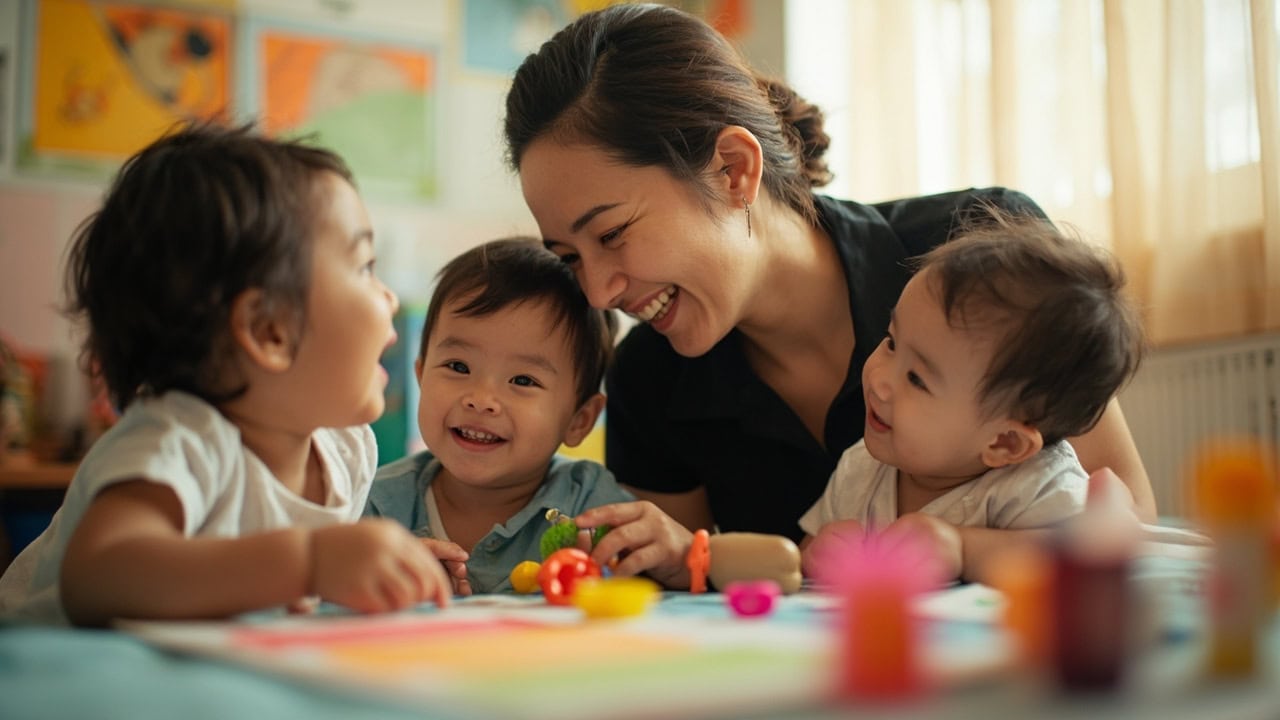
What Your Child Experiences in a Quality Childcare Environment
What Your Child Actually Experiences
For busy parents who want the key points before diving deeper, here is what quality childcare looks like from your child’s perspective:
- Rhythm creates safety – Predictable routines help your child’s nervous system stay calm and free their attention for learning
- The space teaches – Low shelves, warm colours, and thoughtful design communicate with your child all day long
- Consistency builds trust – The same caregiver, over time, learns your child’s signals and responds before distress arrives
- Peers accelerate development – Structured peer interaction builds social intelligence that cannot be replicated at home
- Choices build confidence – Even small decisions like choosing a cup or a book fuel developing autonomy
- Emotions are met, not dismissed – A caregiver who names and acknowledges feelings helps your child learn to regulate them
- Language fills the day – Warm, continuous narration builds vocabulary and the sense of being known
- You remain connected – Open communication means the hours apart become a shared story, not a gap
The Six Pillars of a Quality Day
The first thing that happens when a child arrives at a place that truly understands their needs is not instruction. It is not activity. It is rhythm. Within minutes, the child begins to absorb the architecture of the day—not because anyone explains it, but because rhythm is something the body understands before the mind can name it.
The lights are the same. The smell is the same. The way the caregiver’s voice sounds in the morning carries a particular warmth, a particular pitch. There is a song sung before breakfast. There is handwashing at the sink at the same point in the sequence, every single day.
This is not ritual for its own sake. It is emotional architecture. When a child knows what comes next, they do not need to waste energy bracing for the unknown. Their nervous system remains regulated. Their attention is free to explore, to engage, to learn. You are in a place where things are ordered. You are held.
Environment as Teacher
The room a child inhabits for eight or nine hours is not simply a room. It is a sensory environment, and every detail in it sends a message.
The colours on the wall are chosen deliberately—calming, warm, not overstimulating. The materials on the shelves are within reach, because a child who must ask for everything learns dependency. A child who can walk to a shelf and select a puzzle or a set of wooden blocks learns agency.
Low shelves invite autonomy. A reading nook with soft lighting signals this is a place for stillness. The outdoor area is not an afterthought—it is where lungs fill with fresh air, where gross motor development accelerates, where the sky becomes a reference point for a child learning to understand scale and distance and their own place within it.
The Caregiver Who Knows Your Child
There is one moment in a childcare day that reveals more about its quality than any tour or checklist could: the moment a child approaches a caregiver with a need they cannot yet articulate.
Perhaps they are hungry. Perhaps they are frustrated. Perhaps they have fallen and are not yet crying but are close—the kind of close that requires someone to read the body before the sound comes.
In a quality environment, that caregiver moves before the crisis. They know that child’s face when fatigue is approaching. They know the gesture that means I need help opening this. They know it because they have been present, consistently, over days and weeks and months.
This is what consistency means, spoken in human terms. It means the caregiver who was there yesterday is there today. It means the child learns that this adult responds—not sometimes, not occasionally, but reliably. The ratio matters here. When there are three infants for every one caregiver, as is the case within the EduNanny model, that caregiver has the time to be present in this way.
The Small Society of Peers
Within this space, alongside responsive adults, your child encounters other children. And this is where development accelerates in ways that are difficult to replicate at home.
Peer interaction in the first years of life is not about competition or cooperation in the adult sense. It is about mirroring, about the early grammar of social life. One child takes a toy. Another watches. The second child then takes a toy. This is not misbehaviour. This is the brain building its first maps of social exchange.
A quality childcare environment provides these interactions in a structured, supported way. Caregivers narrate what they see: I see that Jianhao is building with the blocks and Mingxi wants to join. How can we all play? They model words like please and thank you and my turn until these words become part of the child’s own vocabulary—absorbed, not drilled.
Autonomy and the Power of Choice
Your child, even as an infant, is a person with preferences, with opinions about the world, with a growing sense of I am someone who can act on my surroundings. A quality childcare environment does not suppress this. It amplifies it, carefully, respectfully.
There are choices offered throughout the day. Which book shall we read? Which song shall we sing? Do you want the red cup or the blue cup? These are not trivial. They are the fuel of developing autonomy.
A child who is given small choices learns that their preferences matter, that their voice has weight, that they are not merely a passive recipient of care but an active participant in their own life. This is the foundation of confidence—not bravado, but the quiet inner knowledge that I can affect my world.
Emotional Attunement
Young children do not yet have the words for their feelings. They have sounds, movements, expressions, and eventually, as language develops, the beginning of vocabulary. But in the moments before words arrive, emotions live in the body. A clenched fist. A furrowed brow. A stillness that is not calm but frozen.
In a quality childcare environment, caregivers are trained to read this language. They distinguish frustration from fatigue, hunger from overstimulation, loneliness from boredom. And when they read it correctly, they respond—not with distraction or dismissal, but with acknowledgment.
I see you are feeling big feelings right now. It is okay to feel this way. I am here.
When a child is consistently met with this kind of response, something profound happens. The child begins to internalize it. They begin to develop the capacity to name their own feelings, to understand that emotions are not overwhelming forces but experiences that can be understood and managed.
Language as the Architecture of Thought
Caregivers in quality environments are not quiet. They narrate the day, describe what the child is seeing, name the objects and actions and emotions around them. The ball is rolling under the table. You are pointing at the bird outside the window. You seem proud of yourself for finishing that puzzle.
This constant, warm verbal stream does two things at once: it builds language acquisition at a pace that astonishes researchers, and it builds the sense of being known. The child hears their own experience reflected back through words, and learns that their inner life is visible, interesting, valued.
For Singapore children growing up in multilingual environments, this rich language exposure is particularly valuable. They are absorbing vocabulary, syntax, and the rhythms of communication from attentive adults who have time to speak with them—not just to manage them.
When You Return: The Communication Loop
You have been away all day. Your child has been in this world—the world I have been describing. And now it is time to pick up.
The child sees you before you see them. There is that moment—sometimes joyful, sometimes ambivalent, sometimes almost startled—as recognition dawns. You are here. The day is over. And the child comes to you carrying something.
They carry the rhythm of the day, which has become, imperceptibly, part of their internal clock. They carry the memory of the caregiver who knew their tired signal, their hungry signal, their I need extra holding signal. They carry the songs and the stories, the games played with other children, the moment when they chose the blue cup and it was honored.
You look at your child. You ask the caregiver how the day was. You hear about the morning activity, the nap, the afternoon walk, the small interaction that mattered. This loop of communication—honest, specific, warm—is not administrative. It is the thread that connects your world to your child’s world, so that the hours apart do not become a gap but a shared story.
This is what transparency means, spoken in human terms. It means you are not left guessing. It means the people caring for your child are willing to be seen, to be accountable, to invite you into the day even when you are not in it.
A Practical Guide for Singapore Parents
None of what I have described is automatic. It is not guaranteed by a centre’s reputation, its location, its facilities, or its price point. Quality is a choice made repeatedly, every day, by every adult in that environment. It is a commitment to seeing the child clearly—not as a task to be managed, not as a unit in a ratio, but as a full human being with an inner life that deserves to be honored.
Signs of Quality You Can Observe
- Caregivers who narrate – Listen for how caregivers speak to children. Do they describe what is happening? Name objects and feelings? Or is it mostly directives and corrections?
- Children who move freely – In quality environments, children can access materials independently. They are not always asking permission or waiting for help.
- Transitions that feel unhurried – Watch how children move from one activity to another. Are there warnings? Songs? Predictable cues?
- Caregiver consistency – Ask how often primary caregivers change. The relationship your child builds depends on continuity.
- Outdoor time is protected – Fresh air and physical movement are not optional. They are essential to development.
- Communication that flows both ways – You should hear about your child’s day without having to pry. Notes, photos, verbal updates—whatever the format, it should feel genuine, not performative.
Questions to Ask on a Tour
- What is the caregiver-to-child ratio, especially for infants?
- How stable is the team? How often do primary caregivers change?
- How is the daily routine structured? Is it flexible or rigid?
- How do you communicate with parents about the child’s day?
- What does a typical morning and afternoon look like?
- How do you handle a child who is distressed?
- What is your approach to supporting emotional regulation?
- How much time do children spend outdoors?
What Singapore Parents Actually Worry About
“Will my child feel abandoned?”
This is perhaps the most common and most honest fear. The answer lies in how quickly your child learns that you always come back. In a quality environment with consistent caregivers, separation anxiety actually decreases over time—not because the child forgets you, but because they develop the security to trust that parting is temporary.
“Can anyone really know my child as well as I do?”
No—and that is not the goal. What quality childcare offers is supplement, not replacement. A caregiver who spends full days with your child will learn things you cannot see: how they behave with peers, how they respond to frustration, which activities light them up. This knowledge, shared honestly with you, makes you a more informed parent, not a less important one.
“Is home-based care or centre-based care better?”
There is no universal answer. Home-based care offers a cosier, more homelike environment and often smaller ratios. Centre-based care offers richer peer interaction and more structured programming. What matters most is not the setting but the quality within it.
“How do I know if the caregivers genuinely care?”
Ask to watch an interaction between a caregiver and a child you have not met. Do you see warmth? Eye level? Do the children seem at ease with this adult? Do the caregivers look engaged, or are they counting down to break time? You cannot manufacture genuine care, but you can recognize it when it is there.
How EduNanny by BUTLER Builds This World
This is the conviction that has shaped EduNanny by BUTLER: that every child deserves to live in a world that knows them, and every parent deserves to trust that world.
EduNanny is part of the ECDA Childminding Pilot, operating across home-based and community pathways alongside centre-based options. This is not simply a care arrangement—it is a recognition that every family in Singapore deserves access to childcare that is not just supervision but genuine developmental support.
With infant ratios kept deliberately low, with caregivers trained and supported, with fee structures designed to be accessible within the pilot framework, EduNanny is building something that answers the real question parents are asking: not just who will watch my child, but who will truly be with my child?
For families navigating the choice between home-based care in a familiar environment and centre-based settings with their richer peer ecosystems, EduNanny offers both pathways, recognizing that every child, every family, has distinct needs. What remains constant across both is the philosophy—the insistence that the child must be seen, known, and nurtured as a complete person.
How EduNanny Addresses Key Quality Indicators
| Quality Indicator | How EduNanny Approaches It |
|---|---|
| Caregiver consistency | Stable caregiver teams with dedicated primary caregivers for each child |
| Low infant ratios | 3 infants per caregiver maximum in infant care settings |
| Emotional attunement | Caregivers trained to read and respond to pre-verbal signals |
| Rhythm and routine | Predictable daily structure that creates safety and reduces anxiety |
| Language-rich environment | Narrative interaction woven throughout the day by attentive caregivers |
| Parent communication | Open, honest communication practices that keep parents informed |
The World Your Child Carries Home
We began with a quiet morning scene. A child steps through a door. The parent turns and walks away, carrying all the ordinary anxieties that parents carry—the wondering, the hoping, the leap of faith.
We have tried to show you what happens after. Not to remove the mystery entirely—because raising a child, in the end, is always an act of trust—but to replace a vague hope with something more specific.
A world built on rhythm, where predictability creates safety. A space designed for a child, where every detail communicates care. A caregiver who knows your child’s face well enough to respond before distress arrives. Peers who teach the earliest lessons of human relationship. Choices that build autonomy. Attunement that builds emotional capacity. Language that builds the mind and mirrors the self.
Your child lives in this world, or something like it, for the hours you are apart. And if that world is built well, you will see it—not in detailed reports or photographs alone, but in the quiet evidence your child carries home.
The way they are becoming more confident. The way they are learning to navigate the feelings that once overwhelmed them. The way they speak about their caregiver with the easy trust of someone who has been loved consistently.
This is what quality childcare makes possible. Not perfection—perfection does not exist in the raising of children. But a foundation. A world that knows your child and helps them know themselves.
That is the world EduNanny is building, one child, one day, one moment of responsive care at a time.
That is the world your child deserves.
Ready to See This World for Yourself?
If you are ready to learn how that world might become your child’s world, EduNanny is here to walk that path with you—openly, honestly, and with genuine care for the small person at the centre of everything.
We invite you to visit us, to ask questions, to watch a morning unfold, and to see for yourself what it looks like when a child is truly known.
Your child is waiting to be seen. Let us show you how we see them.
Learn more about who we are and what drives the EduNanny approach to childcare.