Why Siblings in Childcare Help Each Other Thrive
The Sibling Effect: Why Siblings in Childcare Accelerate Each Other’s Development
For a long time, conversations about childcare in Singapore have focused, quite understandably, on the individual child. How is your child settling in? Is the caregiver a good fit? Are milestones being met?
These are important questions, and they deserve careful answers. But they tend to treat each child as an island—as if the sibling asleep in the next room, or the one who left for school an hour ago, has no bearing on what is happening in this moment.
In reality, siblings are not just sharing your home. They are sharing a developmental journey. And when you find the right childcare arrangement, something remarkable happens: the presence of a sibling stops feeling like a complication and starts feeling like what it actually is—a gift that keeps giving.
The Developmental Multiplier in Action
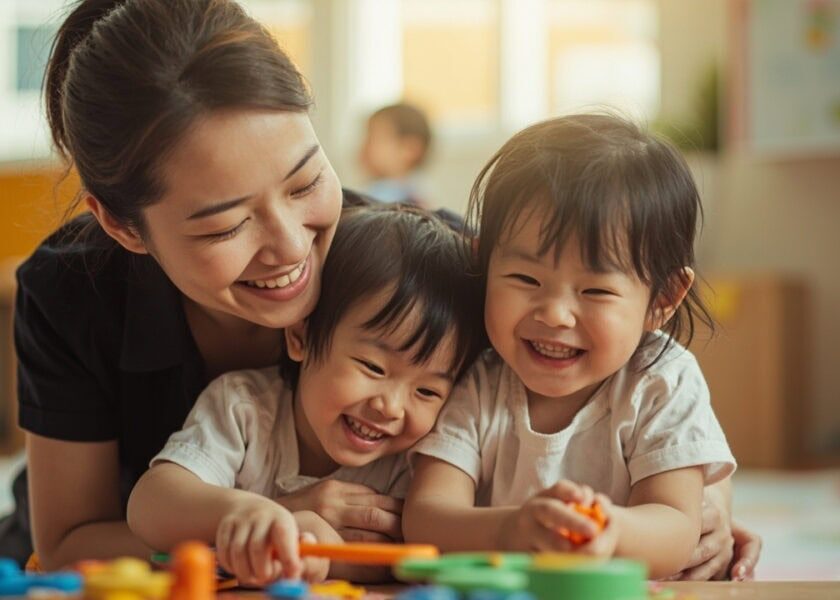
Walk into any childcare environment where siblings are enrolled together and you will see it. A three-year-old who clings to his mother’s leg during drop-off is redirected—not told to stop crying, but redirected—by the sight of his four-year-old sister arranging blocks nearby. He takes a breath. He looks at her. He walks toward the corner where she is sitting, and within minutes, he is playing.
The sister has not done anything extraordinary. She has simply been there.
This is what research on sibling relationships in early childhood consistently shows: siblings buffer each other’s anxiety in ways that adult caregivers cannot replicate. When a younger child walks into a childcare environment and sees an older sibling already present, already comfortable, already moving through the space with ease, something shifts. The sense of strangeness that would otherwise require an adult’s steady reassurance is met by something simpler and more powerful: familiarity.
The younger child does not need to be told that this place is safe. They can see it. Their brother or sister is here. Their brother or sister is not afraid. And so, by some logic that operates below the level of language, neither are they.
Now consider the inverse. An older child who has been the only one in childcare suddenly has a younger sibling join the same environment. The older child’s response often surprises parents: pride, protectiveness, a new sense of herself as someone who belongs to a place, not just as someone who goes there.
For the first time, she has something to teach.
This is where the sibling effect becomes genuinely developmental. Because children do not just learn from adults. They learn from other children—especially children who are slightly ahead of them, slightly more fluent in the social codes they are trying to decode.
Siblings accelerate each other’s development not through instruction but through imitation, and imitation at this age is one of the most powerful learning mechanisms available.
The Identity Paradox: How Familiarity Creates Difference
There is another dimension of the sibling dynamic that catches parents most off guard: the way siblings in the same childcare environment begin to develop distinct personal identities.
You might expect the opposite. You might worry that if siblings are always together, always in proximity, they would begin to blur into each other. That the younger one would model herself so completely on the older one that her own self would become a copy of a copy.
What actually happens, in environments where individuality is properly held, is the opposite. The older child provides a kind of developmental scaffolding—a framework within which the younger child can safely experiment with difference. “My brother does it this way, but I prefer to do it this way.” That sentence, or its pre-verbal equivalent, is one of the earliest acts of identity formation. And it requires a familiar peer to be truly possible.
The child who is always alone among strangers has no safe ground from which to assert preference. Everything is borrowed from adults. But the child who shares a world with a sibling has someone to differ from. And difference, when it is noticed and valued, is the beginning of identity.
The Unspoken Worry: Will My Second Child Be Seen?
Consider the parent who has already navigated one child’s transition to childcare. That first child adjusted, eventually, after some difficult weeks. There were tears. There were mornings when the drop-off felt like a small act of surgery, performed without anesthetic. But they got through it.
Then came the second child, and with them, a new and unexpected fear. Not the fear of the unknown—that had already been survived once. Something more specific. A fear of inequity.
The unspoken worry went something like this: when you drop off your second child, you are also dropping off your first child. But the first child is already there, already settled, already part of the routine. The second child is the newcomer. The second child is the one who has to find their place in an existing world.
And if you are honest, you do not know how to make sure that both of them feel like the most important child in the room. You do not know how to be fair to two children at once when you are only ever present for one of them.
This is the internal equity problem that haunts parents with multiple children. It is not dramatic. It does not announce itself at parenting workshops. But it is real, and it shapes the decisions that Singapore parents make about childcare in ways that are rarely acknowledged.
The question behind the question is always this: will my second child be seen?
Why Siblings in Quality Care Deepen Individual Attention
The parent described above is not worried about whether her children are safe. She has done her research. She has visited the centre, spoken with the caregivers, looked at the ratios. She trusts that her children are physically secure and emotionally held.
What she cannot shake is a subtler anxiety: will each of my children be known?
The word “known” is doing a lot of work here. It is not the same as “cared for.” A child can be cared for in a general way, attended to according to schedule and need, without ever quite feeling that the specific texture of who they are has been registered. It is the difference between being fed and being fed your favourite food. Both are care. One of them is recognition.
And the parent is asking: when two children are in the same childcare environment, does the caregiver have the bandwidth to know them both? Does the second child become, in some quiet and unintentional way, a footnote to the first?
This is not a trivial concern. It is one of the most sophisticated questions a parent can ask about childcare quality. And the answer that most parents arrive at, when they find the right arrangement, is counterintuitive: the presence of siblings in a quality childcare environment does not dilute individual attention. When the structure is right, it actually intensifies it.
When a caregiver is responsible for one child in isolation, that child’s every mood and milestone becomes a project. The noticing can sometimes feel evaluative—Is this normal? Is this on track?
When siblings are present, the caregiver is forced to see each child in relation to others. And in that relational seeing, something unexpected emerges: each child’s individuality becomes more visible, not less.
You cannot watch two children play together without noticing that one leads and one follows, that one is bold and one is cautious, that one processes disappointment through words and the other through movement. The siblings are not just being cared for. They are being known through the lens of who they are in the world.
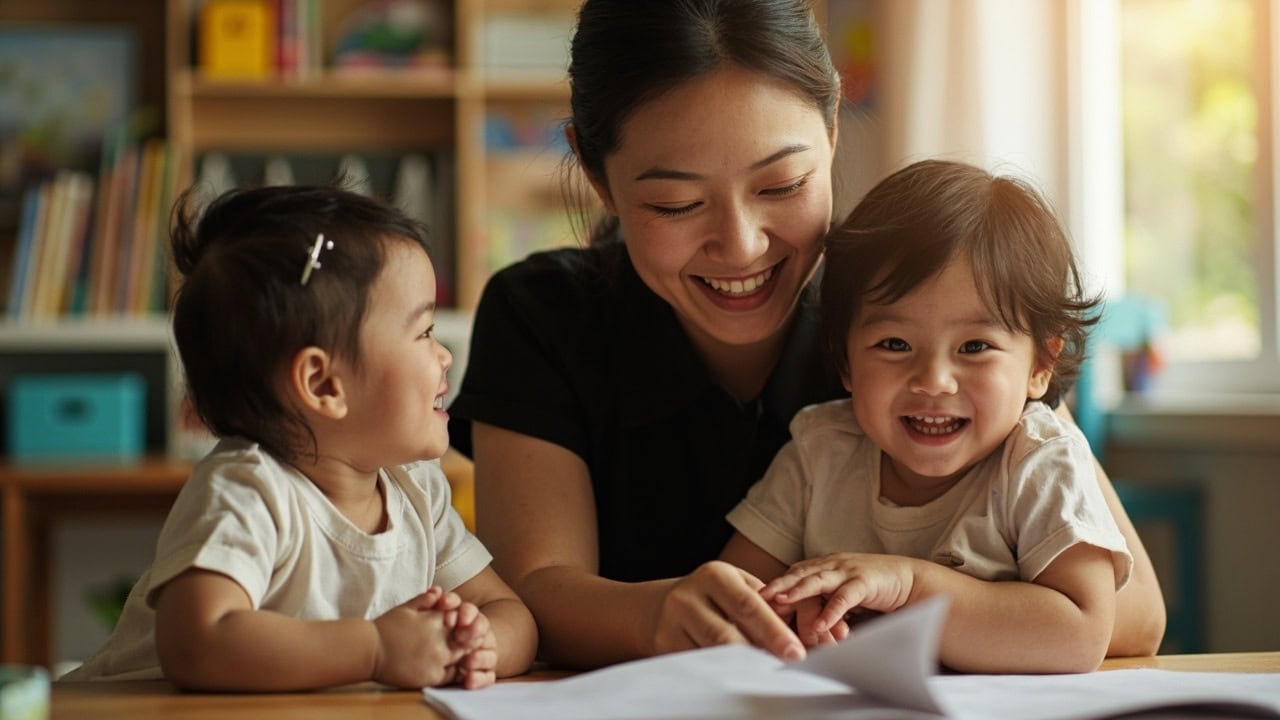
A caregiver in a high-quality, appropriately-staffed environment sees the older sibling’s careful instructions to her younger brother, and understands something about that child’s need for order and responsibility. She sees the younger sibling’s fearless improvisation and understands something about a different kind of courage. She is not comparing them. She is appreciating them.
What Quality Childcare Looks Like in Singapore
Understanding the sibling dynamic is what separates childcare as logistics from childcare as development. Logistics asks: Is everyone accounted for? Development asks: Who is everyone becoming?
In quality care environments, ratio matters—not because numbers are the point, but because numbers create the conditions for noticing. When a caregiver has time to watch two siblings play, there is space to see not just what they are doing but who they are becoming.
What Singapore parents need to look for is not just physical safety and scheduled activities, but:
- Observation over evaluation: Caregivers who notice patterns in how each child approaches the world, not just whether they meet milestones.
- Relationship-informed care: Caregivers who understand that your children are siblings, not strangers, and who leverage that relationship rather than managing it away.
- Communication that goes beyond reports: Updates that tell you not just what happened but who your child was being that day.
- Flexibility within structure: The ability to support siblings at different developmental stages within the same environment.
When your children arrive together in the morning, and when they leave together in the afternoon, carrying the residue of shared discoveries and small conflicts and the particular language of children who have spent a day in the same world—they are not just siblings by blood. They are siblings by experience. And that shared experience is one of the most durable foundations of the sibling bond that will carry them through their entire lives.
Common Concerns: Addressing What Parents Actually Worry About
“Will my second child feel like a footnote?”
No—not in an environment where caregivers are trained to see children relationally. The presence of an older sibling gives caregivers additional data points, not fewer. Your second child’s responses, preferences, and growth become visible in contrast and connection to the first.
“What if one child always gets picked up last because of scheduling?”
This is a real logistical concern, and it deserves real answers. Quality childcare arrangements account for the reality that siblings may be in different stages and may need different rhythms. The goal is not to treat every child identically but to ensure every child feels consistently valued—which means communication about these realities matters.
“What if sibling rivalry transfers to childcare?”
Sibling dynamics are complex, and they exist whether children are in care together or not. The difference in a quality environment is that caregivers are present to help children navigate those dynamics constructively. The same conflicts that might escalate at home become opportunities for social learning when a skilled caregiver is there to guide resolution.
“My children are so different. Can one environment serve them both?”
Different children need different things—and a good childcare arrangement accounts for this. It is not about treating siblings identically but about creating conditions where each child can be supported according to their own tempo, while also benefiting from the presence of a familiar companion.
The EduNanny Approach: Built for the Family System
EduNanny understands that the family is a system, that siblings are not competing for limited resources but enriching a shared developmental environment, and that the right childcare does not just manage that system—it optimizes it.
This understanding shapes their model in concrete ways. The ECDA Childminding Pilot that EduNanny participates in exists because Singapore recognized that its families needed more than one pathway to quality care. Home-based care. Community settings. Centre-based environments. Different families have different needs, and a system that offers only one shape of care is a system that will fail some of the families it is meant to serve.
EduNanny offers multiple pathways because children come to them in different configurations: an infant and a toddler, two children close in age, siblings who need to be in the same place, or siblings whose developmental stages require different kinds of attention within the same day.
The practical mechanisms matter too. Fee structures, the usability of CDA and Baby Bonus—these are not peripheral benefits. They are the mechanisms by which affordability becomes real for families who are making genuine sacrifices to give their children quality care.
Singapore parents are not asking for charity. They are asking for a system that respects what they are willing to invest and ensures that investment goes somewhere meaningful.
And the communication measures—the transparency, the regular updates, the deployment of monitoring tools where appropriate—these exist because trust is not given. It is built, brick by brick, through the accumulation of small and consistent acts of openness.
Finding Care That Sees Your Whole Family
There is something that sits just beneath the surface of all this, something that parents often feel but rarely articulate. It is not whether their children will be safe. It is whether they will be loved. Not by the caregivers—though that matters—but by life itself.
Whether there is enough love to go around. Whether having a second or third child means diluting the first. Whether every child can truly be someone’s favourite, or whether some children are always going to feel like they come second.
This is the unspoken wound of the multi-child family in a society that celebrates children individually but often organizes its systems around the idea of the singular child. We have birthday traditions that privilege the individual. We have parenting philosophies that assume a one-to-one ratio of attention. We have childcare models designed for the only child, which then get retrofitted for siblings as though the presence of a second child were simply a logistical variation.
The truth is simpler and more hopeful: your children are not the same child twice. Every parent knows this, and every parent is sometimes baffled by how differently two children can emerge from the same household, the same love, the same bedtime stories.
They are not the same child. And in the right childcare environment, they will not be treated as though they are. They will be treated as who they are: two people, distinct and irreplaceable, who happen to be building a relationship that will outlast yours.
There is a phrase parents use when they finally find the right childcare arrangement. They say, “I stop worrying.” Not because the worry disappears entirely—parents always worry, and that worry is an expression of love—but because it stops being the kind of worry that keeps you awake at night.
The anxiety about whether your child is okay transforms into the simpler, quieter curiosity of wondering what they did today. What they learned. Who they played with. What surprised them.
For parents with multiple children, that shift often comes not from resolving the equity problem but from realizing that the problem, in the right environment, was never quite what they feared.
Your second child is not receiving less attention. Your second child is receiving something you could not give them at home: a world that includes a sibling, and a caregiver who sees them both.
The best childcare does not just care for children. It cares for the relationships between them. It creates the conditions in which siblings can be both safe and stimulated, both supported and challenged, both known as individuals and recognized as a pair.
That is what quality care offers. Not a service, exactly, though it is that too. An understanding. An understanding that your family is not a collection of individuals who happen to share an address, but a system with its own rhythms and dynamics and potential.
Your children are not the same child twice. They will not be treated as though they are. They will be treated as who they are: two people, distinct and irreplaceable, who happen to be building a relationship that will outlast yours.
And that relationship—the sibling bond—begins not in the nursery they share but in the world they discover together.
Ready to Explore Childcare That Sees Your Whole Family?
If you are navigating childcare decisions for multiple children in Singapore—or if you are expecting your second and wondering how to manage the transition—EduNanny offers consultations designed to understand your family’s specific configuration.
Because the right care is not the same for every family. It is the care that fits yours.
Book a family consultation with EduNanny