Why Your Child Reaching for Their Caregiver Is a Developmental Milestone
What Is Actually Happening When Your Child Reaches for Their Caregiver
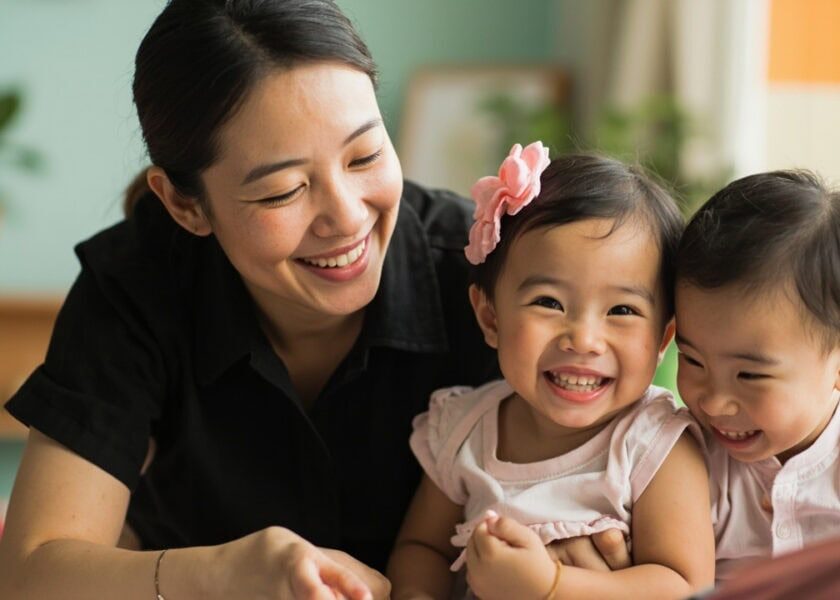
When your child reaches for their caregiver instead of you at drop-off, here is what is actually occurring:
- Your child is doing exactly what they are supposed to do. This is not a sign that something is wrong. It is a sign that something is working.
- Your child has formed what developmental science calls a “secure base” with their caregiver. This means they trust their caregiver enough to explore the world from them—just as they do with you.
- This does not replace or threaten your bond with your child. In fact, your bond is what made this possible. Your child is not turning away from you. They are reaching toward something new, carrying the security you gave them first.
- Multiple healthy attachments benefit children. Research increasingly shows that children who form secure bonds with caregivers beyond their parents are not dividing their emotional resources—they are multiplying them.
- You are not on the sidelines. You are the architect of the ecosystem that makes this expansion possible. The bond your child forms with their caregiver is your achievement as much as theirs.
The Science of Secure Attachment: Understanding Your Child’s Relational World
Developmental science has given us a name for the capacity your child is demonstrating in that moment. It is called the secure base.
The concept was first articulated by psychologist John Bowlby and later expanded by Mary Ainsworth. It describes the most fundamental organizing principle of early human development: a child uses their attachment figure—not just for comfort, but for courage. A secure base is a person who is so reliably present, so consistently responsive, that a child can lean on that relationship as a launching pad for the world.
When a child feels secure, they do not just sit still. They explore. They engage. They take in everything around them because they know, deep in their body, that there is a place to return to if they need to.
What you witnessed at drop-off was your child using their caregiver as a secure base.
For that to happen, something has already been put in place. A foundation has already been laid. Your child has not just been supervised for the past few days or weeks—they have been in relationship. And in that relationship, they have experienced enough consistency, enough attunement, enough predictable care, that they now feel safe enough to look outward. To look past you, and into the room, and into the arms of someone else, because they trust that those arms will hold them the way yours do.
Why Your Bond and Their Bond Work Together, Not Against Each Other
Here is something that most parents are never told: children are not built to have only one secure base. They are built to form multiple attachments.
Not equally, and not interchangeably—your bond with your child is singular and irreplaceable. But it is also not the only bond they need.
Research on early childhood development increasingly suggests that multiple healthy attachments in the first years of life are not just tolerable for children—they are beneficial. A child who has one secure base and then forms a second is not dividing their emotional resources. They are multiplying them.
The Feeling No One Talks About
There is a version of this conversation that could make parents feel unnecessary. As if, by forming a bond with their caregiver, your child is proving that they do not need you as much as you thought they did. As if the whole edifice of parental devotion has been quietly undermined by the competence of a good childcare provider.
That version is wrong, and we want to be clear about why.
Your bond with your child is not diminished by the fact that they have formed another bond. Your bond with your child is what made this other bond possible.
A child who does not have a secure base at home cannot form a secure base elsewhere. The primary attachment you have established with your child is the template. It is the model. It is the internal working map that your child uses to understand what it means to trust someone.
Every warm, responsive, attuned interaction you have had with your child since they were born has been preparing them to be the kind of child who can form healthy relationships with other caring adults.
You are not the fallback. You are the foundation.
What Quality Attachment-Based Care Actually Looks Like
Not every non-parental caregiving relationship becomes a secure base. Some do, and some do not. The difference is not accidental. It is not luck. It is the result of specific, intentional relational practices that the best childcare providers understand and cultivate deliberately.
The Three Ingredients of a True Attachment Bond
Consistency: A child does not form an attachment to a rotating cast of strangers. Attachment is built through repetition, through familiarity, through the accumulation of thousands of small, predictable interactions.
When a child knows that the same person will be there in the morning, and in the afternoon, and next Tuesday, and next month, their nervous system begins to settle. They stop scanning for threat. They start engaging with curiosity.
Primary caregiver continuity is not just a nice-to-have in quality infant care—it is the foundation upon which everything else is built.
Attunement: Attunement is the caregiver’s ability to read the child’s internal state and respond to it—not just physically, but emotionally.
It is noticing that a child’s fussiness is not ordinary tiredness but a signal of something deeper. It is adjusting the pace of the day when a child needs stillness rather than stimulation. It is meeting a child’s frustration with calm steadiness rather than impatience.
It is the caregiver functioning as an external regulator for the child’s still-maturing nervous system.
When a caregiver is attuned to a child, the child experiences being known. They experience their internal world being reflected back to them by someone who is paying close enough attention to understand it. Attunement shapes the architecture of the developing brain. It teaches the child, through lived experience, what it feels like to be in sync with another person.
Predictability: Young children do not have the cognitive capacity to understand time the way adults do. They do not know that a parent who leaves will return later in the day.
What they do understand is routine. They understand the sequence of events that makes up their day—the morning greeting, the feeding, the nap, the story, the homecoming.
Predictability is not a limitation on a child’s development. It is the scaffolding upon which their sense of security is built.
Signs Your Child’s Attachment Bond Is Healthy
How do you know that the bond your child is forming with their caregiver is a healthy one? How do you know that what is happening in the hours when you are not there is actually good for your child? Here is what to look for.
A child who has formed a healthy attachment bond with their caregiver will show signs of that bond at home—not dramatic or theatrical displays of affection, but subtle, consistent indicators that their relational world is expanding in a healthy way.
- Increased confidence in exploration. Your child seems more willing to move away from you to investigate something new, knowing that you are there. More secure in unfamiliar situations.
- Stronger emotional regulation. Their ability to recover from frustration, to settle after distress, is stronger than it was before they began care.
- A sense of ease around the caregiver. When the caregiver’s name is mentioned or when they are approaching the childcare space, there is no anxiety, no resistance, no fear.
- An expanding social world. Your child is more interested in other children. More willing to engage with new adults. Curious in a way that suggests general security.
A child with a healthy caregiver attachment does not contract into a smaller world. They expand into a larger one.
What to Look for When Choosing Quality Infant Care
Understanding the difference between quality attachment-based care and mere supervision is essential. Here is what to look for:
- Primary caregiver continuity: Your child should have one main caregiver who is consistently present, not a rotating team of different faces.
- Small ratios: In infant care, the number of children per caregiver directly affects the quality of attunement possible.
- Intentional relational practices: Quality care is not accidental. Providers should articulate how they build secure attachment through daily practices.
- Predictable routines: Consistent daily rhythms help children feel safe and understand their world.
- Transparent communication: You should have regular insight into your child’s day—not as surveillance, but as partnership.
Questions to Ask Any Infant Care Provider
If you are evaluating childcare options in Singapore, these questions will tell you whether a provider understands what we have been discussing:
- Who will be my child’s primary caregiver? How often does this person change?
- What is the ratio of caregivers to infants? How does this change as children grow?
- How do you support attachment and emotional security? Look for answers that go beyond safety and curriculum to talk about relationships and responsiveness.
- How do you handle drop-off and transitions? Quality providers understand that these moments matter and have thoughtful approaches.
- How will I know what is happening during the day? What communication systems are in place?
- How do you support families? Is there partnership, or is the relationship purely transactional?
The answers to these questions will tell you whether a provider has genuinely thought about attachment, or whether they are simply offering supervision with a caring face.
For parents navigating the practical realities of childcare in Singapore, accessible care arrangements are available. Care blocks run Monday to Friday, and eligible families can access support through CDA and Baby Bonus schemes—making quality infant care a realistic option rather than a privilege reserved for the few.
The EduNanny Approach: Built on Attachment Science
EduNanny by BUTLER is part of the ECDA Childminding Pilot, which means their model is built around these very principles: small ratios, consistent caregivers, intentional relationship-building.
In their home-based and community or centre-based settings, your child is not one face in a crowd. They are one child, known by name, seen for who they are.
The up to one-to-three infant ratio in the pilot model is not a regulatory accommodation. It is a recognition that quality attachment cannot happen at scale. It requires intimacy. It requires attention. It requires a caregiver who has the time and the capacity to attune to your child as an individual.
EduNanny’s approach also reflects a commitment to transparency and partnership with parents that goes beyond what most childcare arrangements offer. Communication systems, regular updates, and where deployed, measures that give parents a window into their child’s day—all of this serves a single purpose. It helps you trust what you cannot fully witness.
Every consistent caregiver assignment, every attunement practice, every predictable routine is a deliberate act of relational security-building. Supervision keeps children safe. But attachment-based care keeps children safe and helps them grow into the kind of people who trust the world, who can form healthy bonds, who can explore without fear.
Your Child Is Learning How to Love—and You Made It Possible
Your child is in the business of learning how to love. Not the love of dependency, which is fragile and fear-based, but the love of connection, which is secure and expanding.
Every day your child spends in the care of someone who meets them with consistency, with attunement, with warmth, they are learning something that will shape their capacity for relationship for the rest of their lives. They are learning that the world has more than one safe place. They are learning that they are worthy of care from people beyond their immediate family. They are learning that love is not a finite resource that diminishes when it is shared.
You, the parent, are not on the sidelines of this process. You are its source.
So when you walk out of that door tomorrow morning, or next week, or next month, and your child reaches for someone else, remember what that moment actually means.
It means your child trusts you enough to trust someone else.
It means the bond you built is strong enough to bear the weight of expansion.
It means your child’s heart is growing, and you are the reason.
That is not a loss. That is the whole point.
That is what healthy development looks like. That is what you chose. And that is what EduNanny is here to honor.
If you are a parent in Singapore considering quality infant care or childminding, we invite you to connect with us to learn more about how EduNanny by BUTLER puts attachment science at the center of everything they do. Every consistent caregiver, every attunement practice, every predictable routine is designed with one purpose: to give your child the security they need to flourish, and you the peace of mind you deserve.
Your child’s expanding emotional world begins with a choice you make today. We would be honored to be part of that story.