Why the Right Caregiver Matters More Than the Right School
The First Door Is a Person, Not a School
We live in a world that is extraordinarily attentive to children’s futures. Singapore parents are among the most thoughtful, most invested, most forward-thinking parents in the world. You plan for education years in advance. You consider enrichment, development, school trajectories. You want your child to have every advantage, every opportunity, every door opened that can be opened.
But here is what is rarely said aloud, and what deserves to be said clearly: the first door is not a school. The first door is a person.
The first experience your child has with care beyond your own arms is not preparation for the future. It is the foundation of the present. It is where your child first learns, in the only language they know before words, what it means to be safe, to be seen, to be valued.
Think about this for a moment. Not as an abstract idea, but as a living truth. When a child is in the care of someone who truly knows them—who notices not just their physical needs but their rhythms, their preferences, the way their face changes when they are about to cry versus when they are about to laugh—something profound is happening. The child is not simply being minded. The child is being taught. They are learning, with their whole being, that they are worthy of attention. That their needs matter. That someone is paying attention, not because they have to, but because the child is worth paying attention to.
This is not sentiment. This is psychology. The research is clear: these early experiences shape what researchers call internal working models—the templates that form in early childhood and influence how we relate to others for the rest of our lives.
The child who learns, in those earliest months and years, that their presence commands care, that their cry will be answered with presence rather than frustration, that they are known rather than merely managed, carries that template forward. They approach the world differently. They trust differently. They love differently.
The question is not simply, who will watch my child? The question is deeper and more consequential than that. The question is: what am I teaching my child about themselves through the choice I make?
What Singapore Parents Are Really Navigating
Here is what makes this moment so significant for parents in Singapore specifically. You are navigating something that parents in few other places face in quite the same way.
You are balancing extraordinary professional commitments with high costs of living. Your family structures may not offer the intergenerational support that previous generations relied upon. And at the same time, you carry a deep cultural commitment to doing right by your children. You are doing this with your eyes open, with your hearts fully invested, and often with very little slack in the system.
That is why the quality of the childcare you choose is not a luxury. It is not a nice-to-have if you can afford it. It is an expression of the same love and foresight that drives every other choice you make for your child. It is your first opportunity, after your own arms, to show your child what they deserve.
What Quality Care Actually Looks Like
Let us speak plainly about this, because it matters enormously and is so often lost in the conversation. We talk about childcare as though it is a monolith—as though all care is roughly equivalent, differing only in price and convenience.
But any parent who has watched their child with a caregiver who truly loves their work knows that this is not true. Any parent who has felt the difference between a caregiver who sees their child as one of many tasks to be managed and a caregiver who sees their child as a specific, unrepeatable person knows that this difference is not small. It is everything.
Quality care is not supervision. Supervision is watching to ensure safety. Quality care is attunement.
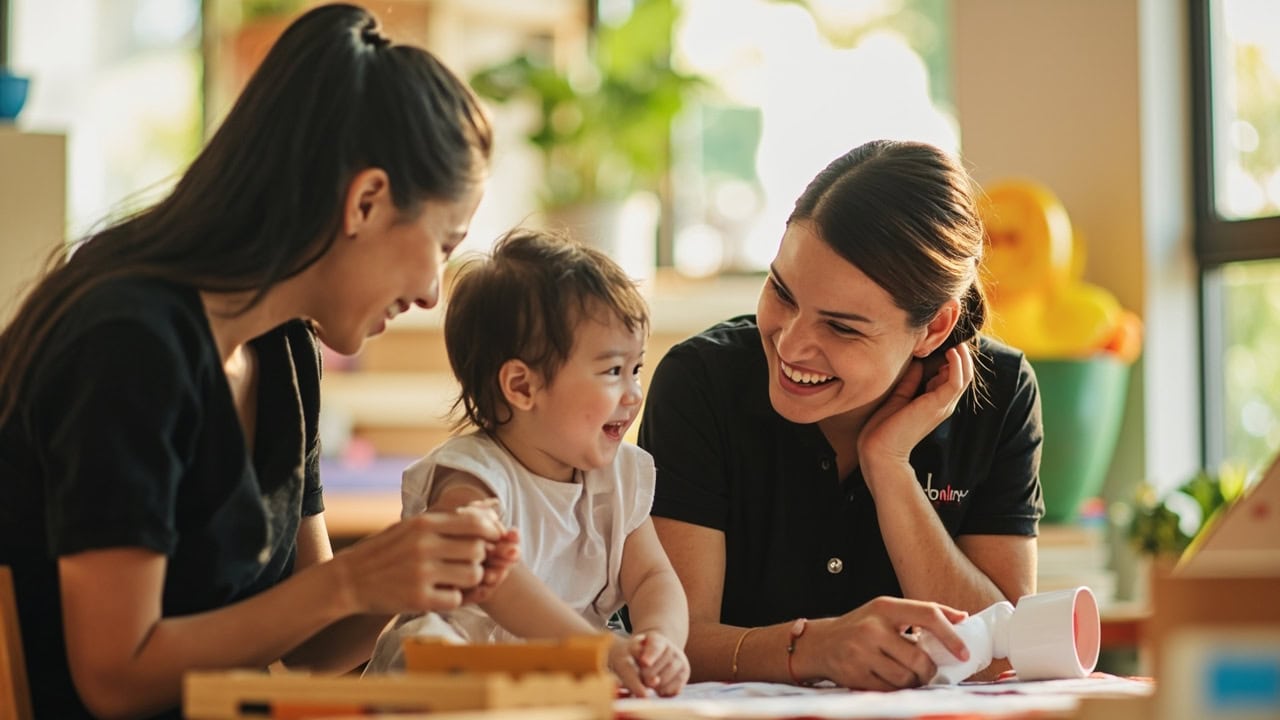
It is the caregiver who learns that your child likes to be sung to in a lower voice in the morning but needs the higher register in the afternoon. It is the caregiver who notices when your child is on the verge of a developmental leap and creates space for it. It is the caregiver who sends you a photo not because the app prompts them to, but because they genuinely thought you would want to see your child’s face in that moment of discovery.
This is what the first caregiver you choose is actually doing. They are not a placeholder until school begins. They are the beginning of everything your child will understand about their own worth.
The mathematics of attention are unforgiving. When a caregiver is responsible for fewer children, they can attune more deeply. They can notice the small things that reveal the big things. They can respond with presence rather than procedure. And your child feels that. Even before they have language, even before they can articulate what is happening, your child feels whether they are in the presence of someone who is truly with them or someone who is merely present.
EduNanny: Built to a Standard, Not Just Delivered as a Service
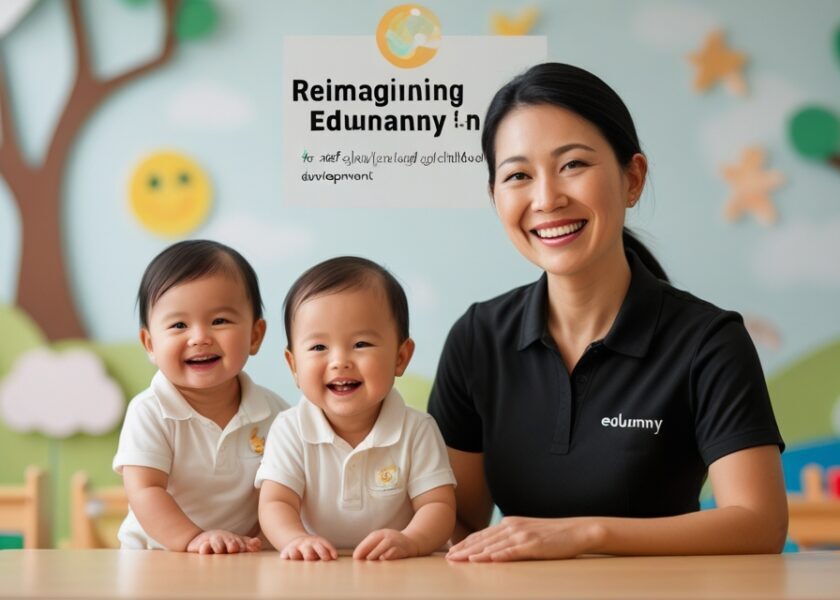
EduNanny by BUTLER was created to provide quality care that matches the intentionality you bring to every other choice for your child. Not just a solution to a logistical problem. A commitment to what your child deserves.
EduNanny operates within the ECDA Childminding Pilot, a government-supported framework designed to give Singapore families access to quality care that was previously difficult to find or difficult to afford.
Through the pilot, families access care with ratios of up to one caregiver to three infants. Your child is not one of ten or twelve in a room. They are known. They are seen. They are not statistics in a system; they are individuals in a relationship.
EduNanny offers two pathways, because families are not monolithic:
- Home-based care: Your child remains in their familiar environment with a dedicated caregiver who becomes part of your household’s rhythm.
- Community-based care: Your child builds social awareness in a carefully designed, ratioed space alongside other children.
Both pathways share the same commitment to quality, the same standards of caregiver selection and training, the same philosophy: that your child deserves to be known, not just watched.
For questions outside of care hours—because modern parenting is complex and the questions do not stop at office hours—EduNanny offers the Thomas AI Chatbot. Not as a gimmick, but as a point of connection that makes the system feel human rather than bureaucratic.
Questions to Ask Before You Choose
When you are ready to approach this decision with the same intentionality you bring to every other choice for your child, here are questions worth sitting with:
- When I imagine my child in care, do I see them being managed or being known? Look for environments and caregivers who speak about your child as an individual, not a task on a list.
- What does the caregiver-to-child ratio look like? Fewer children means deeper attention. Ask specifically about this.
- How does this caregiver or service talk about my child’s development? Quality care is attentive to where a child is, not just where they should be.
- What does communication look like? You deserve to know what is happening in your child’s day. Ask about how they share this with parents.
- Does this feel like a partnership? The words “I trust you with my child” are among the most profound words one human can speak to another. You should feel that your trust will be honored.
What Your Child Will Carry Forward
Here is a question I hope will stay with you, not as anxiety but as clarity:
When your child looks back, years from now, on the first care they received beyond your own arms, what do you want them to remember?
Not the logistics. Not the cost analysis. Not the decision tree you navigated to arrive at your choice. Those things matter, but they are not what your child will carry.
What your child will carry is a feeling. A felt sense of whether they were cherished or merely managed. A template, formed in those earliest months and years, of what they deserve, of what their presence commands, of what love looks like when it is expressed through presence and attention and attunement.
You have already given your child the best possible start. The fact that you are reading this, the fact that you are willing to examine this decision with the seriousness it deserves, tells me that you already understand something most parents take far longer to learn.
You understand that parenting is not a series of isolated choices. It is an architecture. Every decision is a brick. And the first brick, the one that sits at the foundation of everything that follows, is the choice of who will care for your child when you cannot.
That is not a logistical decision. That is a love decision. That is the first time you step back from your child and ask, not who can take this on, but who will love this the way my child deserves to be loved.
EduNanny was created to answer that question. Not to replace your role, never that, but to stand beside you in it. To be the standard you set for your child before your child can speak. To be the partner who makes your intention into a reality, your love into a lived experience for your child, your foresight into your child’s first memory of being valued.
You are already giving your child everything they deserve. Now go forward with that same intentionality into this decision. Not with doubt. Not with guilt. But with the clear-eyed, wholehearted commitment that has already made you the parent your child needs.
Explore infant care and childminding options for your family.
Discover how EduNanny supports Singapore families with quality, development-focused childcare. Learn more about our approach or connect with our team to begin the conversation.