How Singapore Parents Learn to Notice Quality Childcare Over Time
Quick Summary: What Quality Childcare Actually Looks Like
For parents who need the key ideas before diving in:
- Quality childcare is felt more than evaluated. The real signs reveal themselves over weeks and months, not during a tour.
- Attunement is the foundation. Caregivers who truly know your child can read subtle signals—distinguishing a tired cry from a hungry one, a frustrated moment from an overstimulated one.
- Small ratios make deep attention possible. When one caregiver is responsible for three infants instead of twelve, something fundamentally different becomes possible.
- Consistency builds trust. Children need the same faces over time to feel secure enough to explore and grow.
- You will notice the difference in your child. Greater emotional vocabulary, more confidence, clearer emerging identity—these are the marks of quality care.
The Moment You Stop Searching and Start Noticing
After the tours and the research, after the conversations with other parents and the endless scrolling through reviews, something shifts. You stop asking “How do I know if this is the right centre?” and start asking something different: “What am I actually looking at? What am I seeing when I watch my child here?”
This shift—from evaluating to noticing—is where the real understanding begins. And it is the shift that most parenting content never guides you toward. Most articles tell you what to look for before you choose. Very few help you understand what you will discover after you have chosen.
The evidence of quality childcare comes with time. It is not visible on a tour, not fully captured in photographs, not fully conveyed in promotional materials. It accumulates in the small moments of your child’s daily life. And when you learn to see those moments, you gain something invaluable: the knowledge that you are exactly where you are supposed to be.
What a Day Looks Like in Quality Care
Consider what a morning actually looks like when a child has been in the right place long enough to feel at home.
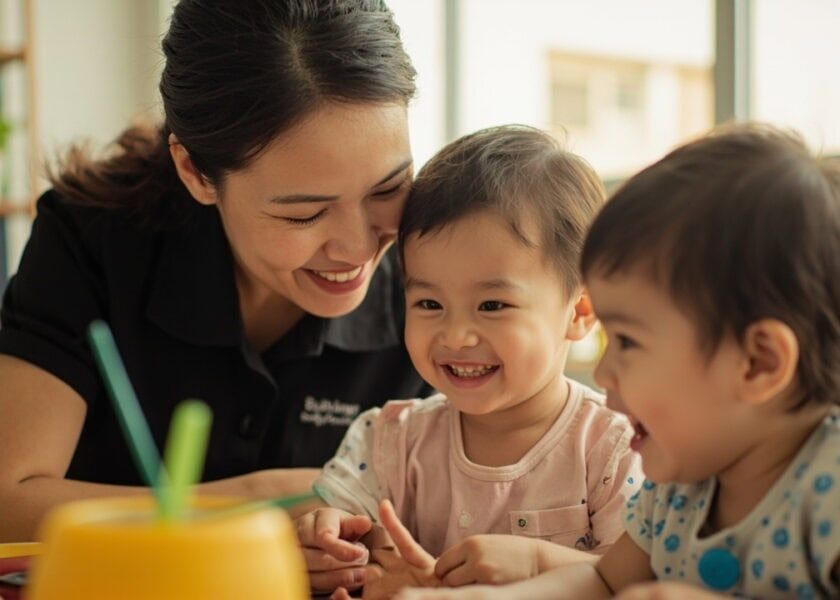
Arrival is not a small thing. For a toddler or infant, the childcare door can feel like a border crossing. In adequate care, the child is received and processed—checked in, shoes removed, hands washed, moved into the programme. In quality care, the child is received by a specific person, one who has learned the small signals that indicate how this particular morning is going.
Perhaps the child is clingy today, needing an extra moment of held contact before she can turn away. Perhaps she is already lifting her arms to be picked up by her caregiver—a gesture that tells you everything about what has been built between them over weeks of consistent presence.
The best childcare does not move children through its rhythms. It meets them where they are and gently, patiently, helps them join the rhythm that is already in motion.
Through the morning, there is structure—but structure is not the point. The point is what structure makes possible. When a child knows what comes next—when she has internalised the reliable sequence of morning snack, then play, then story time, then lunch, then nap—she can stop investing her energy in prediction and start investing it in discovery. She can move from the lobby of her brain, where anxiety lives, into the open rooms where curiosity and imagination take up residence.
The Ordinary Miracles Within Those Hours
In quality care, you will find the most ordinary miracles:
- A toddler who discovers that blocks can be balanced, then stacked, then knocked down with enormous satisfaction.
- An infant who learns that when she drops a toy over the edge of the highchair, someone will retrieve it—every single time, without impatience, without exasperation—and in doing so, learns something foundational about the reliability of human connection.
- A small group of children who, over weeks and months, begin to notice each other. Who develop the earliest stirrings of social recognition, of shared attention, of the pleasure of being near someone who is engaged in the same activity.
These are not marketed moments. They are not Instagram-worthy scenes. They are the slow, invisible construction of a person who knows how to be in relationship with the world.
Attunement: Why Attention Changes Everything
Attunement is a word that appears in many parenting articles, but its meaning is often stated rather than shown. In quality infant care, attunement is the quality of attention that notices the difference between:
- A child who is tired and a child who is hungry
- A child who is frustrated and a child who is simply overstimulated
- A child who needs physical comfort and a child who needs verbal acknowledgment of her feelings
The caregiver has spent enough time with each child to read these signals accurately, and enough confidence in her role to respond to them without rushing to fix or redirect.
She does not silence the child who is crying. She wonders what the crying is saying. She does not impose adult logic on a toddler’s meltdown. She meets it with the calm certainty that this too is part of growing up, and that she is here for all of it.
This kind of attunement does not happen in a week. It cannot be manufactured for a tour. It requires something very specific: small ratios, consistent faces, and time.
Time for the child to learn that this person will still be here tomorrow. Time for the caregiver to learn what makes this child laugh, what frightens her, what she needs when she is teething, what she reaches for when she wants comfort.
What You Begin to Notice as a Parent
Somewhere between the anxious first drop-off and the routine of an ordinary Tuesday morning, something shifts. The anxiety of choosing finally gives way to the quieter knowledge of experiencing. And what you begin to notice surprises you.
It is not a milestone, not a skill, not a measurable gain. It is a quality of presence. Your child seems more settled—not in the way that suggests she has been subdued or homogenised, but in the way that suggests she has found her footing. There is a comfort in her body, a relaxation in the way she moves through the world, that was not there before.
She brings something of that environment back with her. Not learned behaviour, not performed compliance. Something deeper. A confidence that says: I know how to be taken care of. I know what it feels like when someone is paying attention to me.
You may also notice language development that surprises you. Your child begins to name things she could not name before—not just objects but emotions. She says she is “mad” or “sad” or “too excited.” This is the product of a caregiver who narrates the emotional experience throughout the day, naturally voicing what the child seems to be feeling and modelling what one does with that feeling.
“I see you are frustrated because the puzzle piece won’t fit. Let’s try turning it around.”
Over time, the child internalises this vocabulary. She learns that feelings are manageable, that they have names, that someone has always already seen them.
You may also notice a new kind of separateness—not distance, but healthy differentiation. Your child is becoming more clearly herself. She has opinions, preferences, a sense of her own direction. The more time she spends in quality care, the more clearly you see who she is. This is the product of an environment that respects the child’s emerging agency, that offers choices rather than directives, that allows her to discover what she likes rather than prescribing it for her.
What Good Structure Actually Looks Like
You have likely encountered terms like “holistic,” “child-centred,” and “nurturing” applied to childcare settings that do not always reflect what unfolds in practice. You are right to look beyond the language.
What matters is the structure behind the words.
The Structural Requirements for Attunement
| Structural Element | Why It Matters |
|---|---|
| Small caregiver-to-child ratios | A caregiver responsible for three infants can notice what a caregiver responsible for ten cannot. The attention can be deep rather than broad. |
| Consistent staffing | When your child cries at drop-off and is comforted by a familiar face, something is being built that cannot be built in a setting with high turnover. |
| Honest, detailed communication | When you receive specific observations about your child’s day—not generic “had a great day” messages—you gain the ability to read your child more accurately. |
| Time | Attunement cannot be manufactured. It accumulates through weeks and months of consistent presence. |
These are not luxuries. They are the necessary conditions for the quality we have been describing.
EduNanny’s Approach: Where Structure Meets Relationship
Through the ECDA Childminding Pilot, EduNanny by BUTLER builds its model around these structural realities. We know that attunement is not an add-on or a philosophy on a brochure. It is a structural commitment.
When the ratio is one caregiver to three infants, something becomes possible that is not possible at higher ratios. The relationship can be specific rather than general. The child can be known as a whole person, not managed as a slot in a schedule.
Families in the pilot have access to home-based and community-based pathways that offer the small ratios and consistent faces we have been describing. Fee structures are designed to make this level of care accessible, with CDA and Baby Bonus funds available for financial planning.
In settings where it is deployed, CCTV provides an additional layer of accountability—not as surveillance, but as transparency. The message is simple: we have nothing to hide because we are proud of what happens here.
Parents in Singapore should not have to choose between quality care and affordable care. The two should travel together.
Practical Guidance for Singapore Parents
Common concerns addressed
“How do I know if I’m making the right choice?”
The right choice is not a perfect choice. No centre is perfect. The right choice is one where the structural elements are in place—small ratios, consistent faces, honest communication—and where you can observe, over time, that your child is growing in confidence, curiosity, and emotional vocabulary.
“What if my child cries at drop-off every day?”
Separation anxiety is developmentally normal. What matters is not whether your child cries at drop-off, but how she is received when she does. In quality care, your child is greeted by someone who knows her, who has built trust with her over time, and who can read what she needs in that particular moment. The crying may continue for a period—but the caregiver’s consistent, attuned response teaches your child something important: this person comes back. This place is safe.
“Can I really trust a caregiver more than I can evaluate a centre?”
This is not about trusting a caregiver over a centre. It is about understanding that the relationship between caregiver and child is the foundation of everything else. A beautiful environment with high ratios and high turnover will not produce what we have been describing. A modest environment with small ratios, consistent faces, and time can produce extraordinary results. Look at the structure. Trust the relationship.
What to look for—and look at
- Ask about ratios. How many children is each caregiver responsible for? For infants, you want ratios that allow for deep attention—typically no more than three infants per caregiver.
- Ask about consistency. How long have the caregivers been in their roles? How frequently does staffing change? Ask specifically how the centre handles transitions.
- Ask about communication. What will you receive each day? Will it be specific observations or generic summaries? Will you feel informed enough to notice patterns in your child’s experience?
- Visit at different times. If possible, observe the centre during arrival time, during a transition, and during free play. These different moments will reveal different things about the quality of care.
- Shift your question. Instead of asking “How do I choose the right childcare?”, begin to ask: “What will I look for when I am experiencing it?” The evidence of quality care comes with time. Prepare yourself to notice it.
The Journey Begins With Trust
There is something profound about standing at the childcare door with your child. You, holding her hand or watching her run ahead to the familiar caregiver who is already smiling. You got here through research, through visits, through questions and concerns and late-night searches. But you also got here through something less articulable: a decision to step forward despite the uncertainty.
That decision is the beginning. It is not the end. The search for the perfect childcare, the relentless evaluation, the fear of making the wrong choice—these are all understandable, but they are not where the answer lives.
The answer lives in the noticing.
In the weeks and months ahead, you will have the extraordinary privilege of watching your child grow in a place you chose, tended by people you trusted enough to hand her to. And what you observe, if you slow down enough to observe it, will tell you everything.
You will notice when your child runs to her caregiver with the uncomplicated joy of recognition. You will notice when she begins to use words she learned somewhere other than home. You will notice when she handles a frustration with more patience than she had last month, or when she plays alongside another child with a new kind of awareness, or when she falls asleep in the stroller with the deep, total relaxation of a child who has spent the day feeling safe.
These are not small things. These are the building blocks of a human being. And they are being built, right now, in the place you chose. Not because the place is perfect. No place is perfect. But because it is attuned. Because the ratios are right. Because the faces are consistent. Because the people who work there understand that the small things are not small at all.
EduNanny by BUTLER exists because we believe that Singapore families deserve more than adequate. They deserve to experience the kind of childcare that reveals itself over time—not through marketing, not through tours, but through the daily, quiet, accumulating evidence of a child who is thriving in every sense of that word.
We are not here to make promises. We are here to build something that can be seen, experienced, and verified over time. A framework that works. A pilot that makes quality care accessible. A communication structure that keeps parents informed and involved. A model that prioritises the relationship between caregiver and child as the foundation of everything else.
If you are still searching, we understand. We want to invite you to shift the question. Instead of asking how to choose the right childcare, begin to ask what you will look for when you are experiencing it. Instead of hoping you chose well, commit to noticing whether you did.
The evidence will come. If the structure is right—if the ratios are small, the caregivers are consistent, the communication is honest, the environment is one where a child can feel safe enough to explore—then you will know.
Not because you read it somewhere. Because you watched your child become more herself than she was before.
That is what quality childcare does. It does not just keep your child safe. It does not just occupy her hours. It gives her a place where she can grow. And it gives you, as a parent, something rarer and more valuable than confidence in a decision: it gives you the experience of watching your child flourish, and the knowledge—earned through patience and attention—that you are exactly where you are supposed to be.
That is the journey we are inviting you to begin. Not the journey of evaluation. The journey of discovery. And it starts not with a tour, but with a decision to trust. Everything else follows from there.
Curious about what quality infant care looks like in practice? Connect with EduNanny by BUTLER to learn more about our approach and discover what attentive, development-focused childcare can look like for your family.