What Your Child Needs to Be Ready to Learn
The Story You Have Been Told About School Readiness
Walk into any preschool tour in Singapore and you will hear certain words. Letters. Numbers. Assessments. Phonics. You may see a classroom where three-year-olds are seated at tables with workbooks. You will be shown a curriculum map that outlines what children will learn before they turn five.
If you are a first-time parent, all of this can feel reassuring. It can feel like rigour. Like seriousness. Like your child will not be left behind.
But I want to offer you a different lens.
Because after years of working alongside children in their earliest years, after watching thousands of little ones walk into classrooms for the very first time, I have come to believe something that the most honest early childhood educators will quietly confirm:
The children who thrive in school are not the children who arrived knowing the most. They are the children who arrived ready to learn.
And those are not the same thing. Not even close.
Why Early Academics Can Backfire
The child who walks into Primary One able to recite the alphabet and write their name may struggle by the end of Primary Two, when the curriculum shifts from recall to reasoning, from following instructions to thinking independently.
Meanwhile, the child who entered school knowing fewer letters but able to regulate their emotions when frustrated, to wait their turn, to ask for help, to stay curious when something is hard—that child is building something that will compound over years. That child is building the architecture of a learner.
There is a difference between performative early academics and genuine developmental readiness. And as a Singapore parent, you are being sold the first one while your child actually needs the second.
What Genuine School Readiness Actually Looks Like
Real school readiness has a shape. It has components you can recognise, even if they are not the ones most often discussed on preschool tours.
Emotional Regulation: The Invisible Foundation
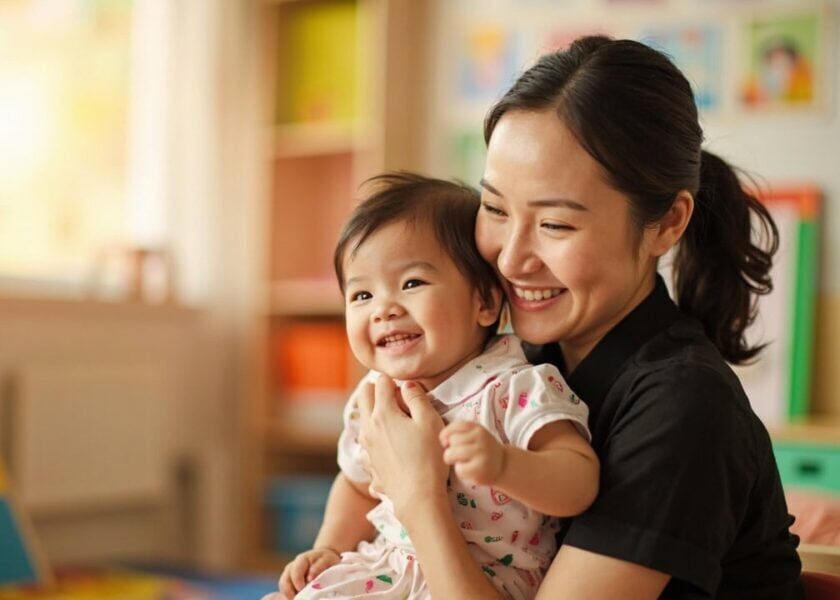
It looks like a child who can separate from you in the morning without falling apart. Not because they have been trained to, but because they have learned, over time, in consistent and loving care, that you always come back.
That is emotional regulation. That is the invisible foundation that allows a child to sit in a classroom, manage their own big feelings, and focus on what the teacher is saying. No workbook teaches that. That is grown through relationship, through routine, through the slow and patient work of a caregiver who responds to a child’s distress with calm presence.
Social Confidence: The Ability to Be With Others
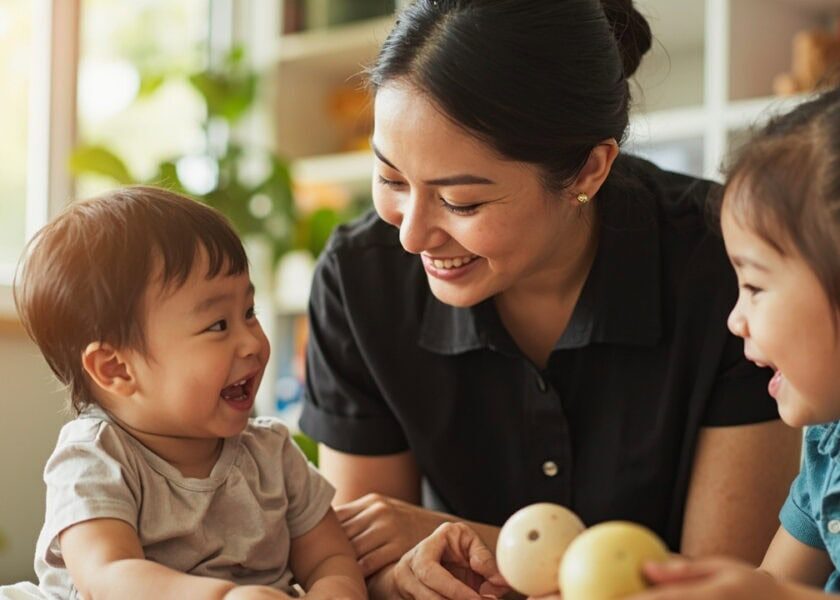
It looks like a child who can collaborate. Who can share a toy, negotiate a turn, express disagreement without aggression, and find joy in playing alongside others.
These are not soft skills. These are the skills that determine whether a child sees school as a hostile environment or a community of learners. Social confidence is not something that arrives on the first day of school. It is built across years of rich peer interaction in environments that are small enough, safe enough, and thoughtfully structured enough to teach children how to be with others.
Curiosity: The Engine of All Learning
It looks like a child who is curious. Who asks why. Who wants to know what happens if. Who picks up a stick and wonders if it will float or sink, and then throws it into the drain to find out.
That curiosity is the engine of all learning. And it is extraordinarily fragile. It can be nurtured or extinguished. It thrives in environments where questions are welcomed more than answers, where the process of discovery is valued over the product of correct information.
When we drill children on facts too early, before they have the cognitive architecture to make meaning of those facts, we are not building knowledge. We are building compliance. And we may, without meaning to, be teaching them that learning is something that happens to you, not something you do.
Physical Readiness: The Body as Learning Partner
It looks like a child whose body is ready. Whose hands can hold a pencil with enough control to write, but who has also had years of running, climbing, jumping, balancing, and exploring through gross motor play that built the neural pathways for fine motor precision.
Whose sensory systems are regulated enough that sitting still in a chair is possible—not because they have been forced into it, but because their body has learned what stillness feels like and can access it when needed.
Physical readiness is not separate from cognitive readiness. They are deeply intertwined.
Persistence: Learning to Work Through Difficulty
And it looks like a child who has learned persistence. Who can try something, fail, and try again. Who has experienced the satisfaction of working through frustration to reach a goal.
This is not a personality trait that children are born with or without. It is a capacity that is built in environments that allow struggle, that resist the urge to fix things for children too quickly, that celebrate effort over outcome, that treat mistakes as information rather than failure.
The Common Thread
Every single one of these capacities—emotional regulation, social confidence, curiosity, physical readiness, persistence—is grown, not taught. It cannot be inserted into a curriculum map or assessed on a checklist. It emerges from:
- The quality of daily experience
- The consistency of relationships
- The ratio of adults to children
- The thoughtful design of play environments
- Caregivers who know child development deeply enough to understand what each child needs in each moment
This is why choosing your child’s early childhood care is not just a logistical decision. It is a developmental one. It is one of the most consequential choices you will make in the years before your child enters Primary One—not because of what will be on the assessment, but because of who your child will become as a learner and as a person.
What to Look For in Quality Childcare
Understanding what genuine school readiness means is only half the picture. The other half is knowing what quality childcare actually looks like in practice—because the difference between filling time and building foundations is visible, once you know what to look for.
The Ratio Matters More Than You Think
Every researcher who has studied early childhood development will tell you the same thing: the ratio of children to caregivers is not a logistical detail. It is the difference between a child being known and a child being managed. It is the difference between responsive care and custodial care.
When a caregiver has fewer children to attend to, they can observe, anticipate, attune. They can notice the child who is about to hit their limit before the limit is reached. They can read the cues that a child is ready for something new, and they can respond.
Notice How Caregivers Respond to Distress
When a child falls down and scrapes their knee, when two children conflict over a toy, when a child is crying because they miss their parent—these are not disruptions. These are opportunities.
Watch whether the caregivers meet these moments with patience and warmth. Watch whether they help the child name and move through their emotion rather than just stopping the behaviour. Watch whether the child recovers and returns to play, or whether they stay dysregulated.
The way a caregiver handles a child’s hard moments tells you everything about how your child will feel safe enough to learn.
Look for Evidence of Child-Initiated Play
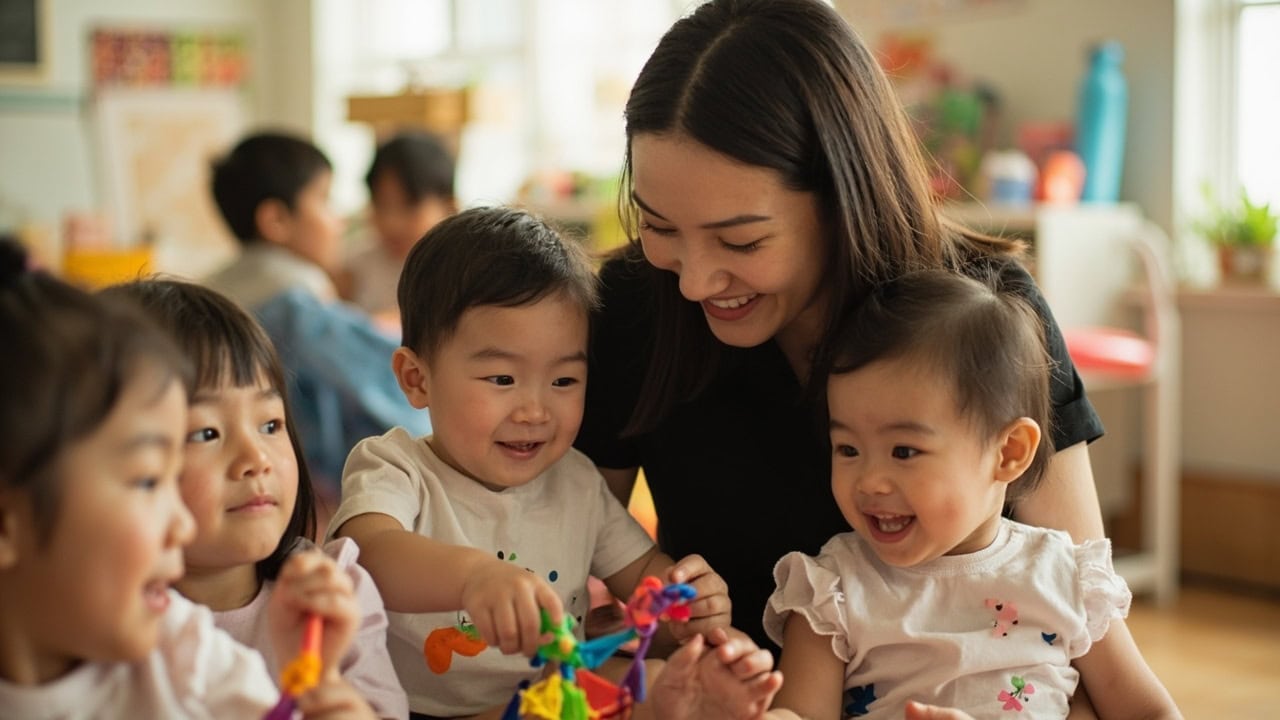
In genuine early childhood development, children learn most powerfully through self-directed play—their own questions, their own discoveries, their own social negotiations.
When children are only responding to adult-directed activities, they are not building the internal motivation and curiosity that will carry them through years of schooling.
Look for environments where children have access to open-ended materials, where they can choose what to explore, where play is valued not as a reward for finishing work but as the work itself.
Observe the Physical Environment
Is there space to move? Not just a classroom with chairs, but a space where children can run, climb, balance, and explore with their bodies?
Is the environment set up to support independence—can children reach materials, serve themselves, make choices?
A space that is overly restrictive, overly adult-directed, or overly focused on academic content is often a space that is not built around what children actually need to develop.
Consistency Builds Security
Children do not learn regulation and security from a rotating cast of caregivers. They learn it from the same faces, the same routines, the same rhythms that let them know what comes next.
When children know what to expect, when they know who will be there in the morning and who will be there when they are picked up, they can relax. And when children can relax, they can learn.
Communication You Can Count On
For parents, trust is not abstract. It is practical. It is wanting to know what is happening when you are not there.
Quality care means communication and transparency are woven into how the service operates. You deserve to feel connected to your child’s day, not anxious about it.
A Simple Checklist for Evaluating Any Childcare Option
- Start with ratio. Ask how many children are per caregiver, especially for infants. Smaller is better for developmental quality.
- Ask about consistency. Will your child have the same caregiver most days? Will routines be predictable?
- Visit unannounced if possible. How do the children seem? How do the caregivers interact with them during unscripted moments?
- Ask about their philosophy of school readiness. If they cannot articulate the difference between academic preparation and developmental readiness, that is information.
- Trust your observations over their marketing. A beautiful website means less than an engaged, responsive caregiver who knows your child’s name.
Addressing Your Real Concerns
You may have questions. You should have questions. Choosing childcare is one of the most important decisions you will make, and you deserve honest answers.
“Will my child fall behind if I don’t choose academics early?”
The children who are truly ready for school are not the ones who started enrichment at two. They are the ones who have been seen, and heard, and supported in becoming who they are.
The pressure you feel is real, but it is not always pointing you in the right direction. When you feel yourself being pulled toward programmes that promise to accelerate your child, pause. Ask: is this building curiosity or consuming it? Is this teaching my child to learn, or just teaching them to perform?
“How do I know if my child is on track?”
You are the expert on your child. No one knows them the way you do. But developmental milestones are not about comparison—they are about whether your child is building the capacities that will serve them over time: emotional regulation, social confidence, curiosity, physical coordination, and the belief that they can figure things out.
If you are concerned, ask your childcare provider specific questions about these areas. A quality caregiver will be able to tell you how your child is developing, not just what they have learned.
“Is home-based care as good as centre-based care?”
Quality matters more than setting. A warm, responsive home environment with small ratios can provide exceptional foundations. A large centre with impersonal routines may not. What your child needs is known, responsive care—not a specific building type.
Both pathways exist at EduNanny because we believe in matching families to what works for them, not pushing a one-size-fits-all model.
Why EduNanny Exists
EduNanny Singapore exists for exactly this reason. Because we believe that the years before school are not a waiting period. They are not a countdown to Primary One. They are a foundational period of human development that deserves to be taken seriously on its own terms.
EduNanny operates under the ECDA Childminding Pilot, and this matters because it means our approach is recognised, supported, and structured with the developmental needs of infants and young children at its centre.
We offer both home-based and centre-based pathways, because we understand that Singapore families are not all the same. Some children thrive in the intimacy of a home environment. Some families need the community feel of a centre. The point is not one model. The point is quality wherever it happens.
Small Ratios by Design
Our infant ratios are small by design—up to one to three infants per caregiver in our home-based pathway. This is intentional because the research is clear: when caregiver-to-child ratios are lower, children receive more responsive interaction, more language exposure, more emotional attunement, and more individual attention.
It is the difference between your child being a name on a list and being a person who is truly known.
Accessibility for Singapore Families
We also understand that for many Singapore families, affordability matters. The ECDA Childminding Pilot fee structures have been designed to make quality care accessible, and we are glad for that—because the children who need the best foundations are not only the children whose parents can pay premium prices.
Our centre-based pathway also accepts CDA and Baby Bonus funds, because we want financial considerations to be one less thing standing between your child and the care they deserve.
You Are Not Behind
If you leave here today with only one idea, let it be this: you are not behind.
Whatever stage your child is at, whatever decisions you have already made or not yet made, you are not behind.
The children who are truly ready for school are not the ones who started enrichment at two. They are the ones who have been seen, and heard, and supported in becoming who they are.
The work we do is not, at its core, about childcare logistics. It is about something more fundamental. We are helping to build the human being who will walk into a classroom one day and sit among peers and a teacher and be ready.
Not ready to perform. Ready to learn. Ready to be a person who can manage their own emotions, contribute to a community, stay curious when things are hard, move their body with confidence, and believe that they are capable of figuring things out.
That is what school readiness actually means. And that is what EduNanny is building, every single day, in every single interaction, for every single child in our care.
When you choose EduNanny, you are choosing caregivers who have been trained to see child development as their purpose, not just their job. You are choosing an organisation that has been vetted, supported, and structured by ECDA because our model is built on what children actually need.
Our role, our privilege, is to come alongside you in the work of raising them. To be the trusted hands you can leave them in. To be the partners you can call when you are not sure.
EduNanny is not just childcare. It is the beginning of your child’s story as a learner. And we take that responsibility with full seriousness and full warmth.
Thank you for trusting us with your children. It is the most important work we will ever do.
If you are ready to explore what quality early childhood care looks like for your family, we invite you to learn more about EduNanny Singapore and our ECDA-supported childminding pathways.
#SchoolReadinessSingapore #EarlyChildhoodSingapore #ChildcareSingapore #InfantCareSG #EduNannySingapore