The Most Overlooked Dimension of Multi-Child Family Life
The Weight of Divided Attention
There is no parent of multiple children who has not felt the particular weight of divided attention. You love your children individually. Each one carries a specific gravity in your heart that cannot be ranked or measured against the others. And yet you must care for them collectively. You must wake them, feed them, transport them, soothe them—and in the span of a single morning, be a comfort for a colicky toddler and a negotiator for a demanding preschooler.
This exhaustion is real. But within it is a deeper tension that experienced parents recognize even when they cannot name it: you are not just managing logistics. You are shaping two souls who will know each other longer than they will know anyone else in their lives.
Your children will be siblings for decades. The relationship they are building right now—in these early years when the gap between them feels vast and the dynamics feel fragile—is a thread that will survive your aging, your absence. It will connect two separate adult lives to a shared origin.
This is not a sentimental observation. It is a developmental fact. And it is the reason why childcare for multi-child families is not simply about who watches your kids while you work. It is about what kind of relational world you are constructing for your children when you are not in the room.
What Siblings Teach Each Other
Developmental science tells us something remarkable: siblings raised together are engaged in one of the most consequential developmental processes of their early lives. They are learning, from each other, things that no curriculum can teach and no adult can replicate.
Siblings teach each other emotional regulation. When a younger child watches an older sibling negotiate frustration, manage disappointment, or celebrate a small win, they are absorbing a template for their own emotional life. When an older child learns to adjust their energy for a younger sibling who is overwhelmed or tired, they are developing empathy and self-regulation in ways that sustained adult interaction alone cannot produce. These are not soft skills. These are foundational capacities that predict social competence and relational health across a lifetime.
Siblings teach each other the boundaries of relationship. They learn, through the natural friction of shared space and competing needs, that other people have interior lives that are not identical to their own. That desires can conflict and resolution is possible. That love does not mean getting everything you want, but means being witnessed, valued, and held even when you are frustrated.
Siblings are each other’s first and most enduring peer group. Before school, before structured activities, before the wider world enters their social field, siblings are the laboratory in which children learn to be with others who are not their parents. A child who learns in early childhood that siblings can be both rival and ally, that conflict does not end connection, that difference does not mean rejection—carries that capacity forward into every classroom, every team, every friendship, every partnership.
Research increasingly recognizes the sibling relationship as a protective factor against loneliness, anxiety, and the challenges of navigating an isolated adult world. Siblings who are partners grow into adults who know how to collaborate, how to forgive, how to show up for someone who is not obligated to be present but chooses to be anyway.
Here is what most childcare conversations miss: this sibling learning does not happen automatically. It does not simply occur because children share a home. It happens, or fails to happen, based on the environment in which siblings spend their time. And for most families in Singapore, that environment during working hours is childcare.
The Failure Mode of Standard Childcare
This is where we must speak honestly about what standard childcare does to the sibling relationship—not to alarm, but to illuminate.
Standard childcare is designed to manage groups of children efficiently. Centers operate on ratios, schedules, curriculum tracks, and group activities. The rhythm is designed for the group. For a single child, this is perfectly adequate. The group becomes their cohort, and the structure serves them.
But when you have two children who are not the same age, not the same temperament, not the same developmental stage, not the same needs—they enter that group environment as individuals who happen to share a surname. And the system, built for efficiency and scale, has a predictable failure mode: it manages them as a group unit rather than as individuals within a family system.
What does this look like in practice?
- The older child is expected to wait, to be patient, to understand that the younger one needs more attention.
- The younger child is expected to keep up—or is held back.
- The child who is more verbal is given more space to speak; the child who processes internally is given less.
- The child whose temperament fits the group rhythm thrives; the child whose temperament does not fit is managed rather than understood.
There is a subtler problem. In group care, siblings often become each other’s peer reference point in ways that undermine rather than support their bond. When a caregiver says, “Look how well your sister is sitting,” or “Your brother finished first, why haven’t you?”—whether explicitly or through the structural comparison that group environments inevitably create—siblings begin to understand themselves in relation to each other as competitors, not partners.
The sibling relationship, which should be a source of unconditional belonging, becomes another arena for performance and comparison. This is not intentional. It is structural. And it is one of the reasons that multi-child families often report feeling that their children are closer at home than at school—that the childcare environment is somehow depleting the sibling bond rather than building it.
What Quality Childcare Actually Looks Like
The alternative is not simply a matter of better ratios or nicer facilities. It is a different understanding of what siblings need and a different approach to creating the conditions for that need to be met.
Quality childcare for multi-child families requires two things simultaneously, and they are not in tension:
- Individual attunement: Each child is seen as irreducibly individual—their temperament understood, their needs recognized, their pace respected.
- Intentional sibling support: The environment is designed to support the sibling relationship as a distinct developmental project, not just accommodate siblings as an afterthought.
When children are not competing for individualized attention, when they are not comparing themselves to each other for limited caregiver resources, they are freed to relate to each other as partners rather than rivals. They learn that each of them is fully seen, fully valued—and that this does not diminish the other’s place. This is the foundation of a sibling bond that lasts.
Smaller Environments, Different Dynamics
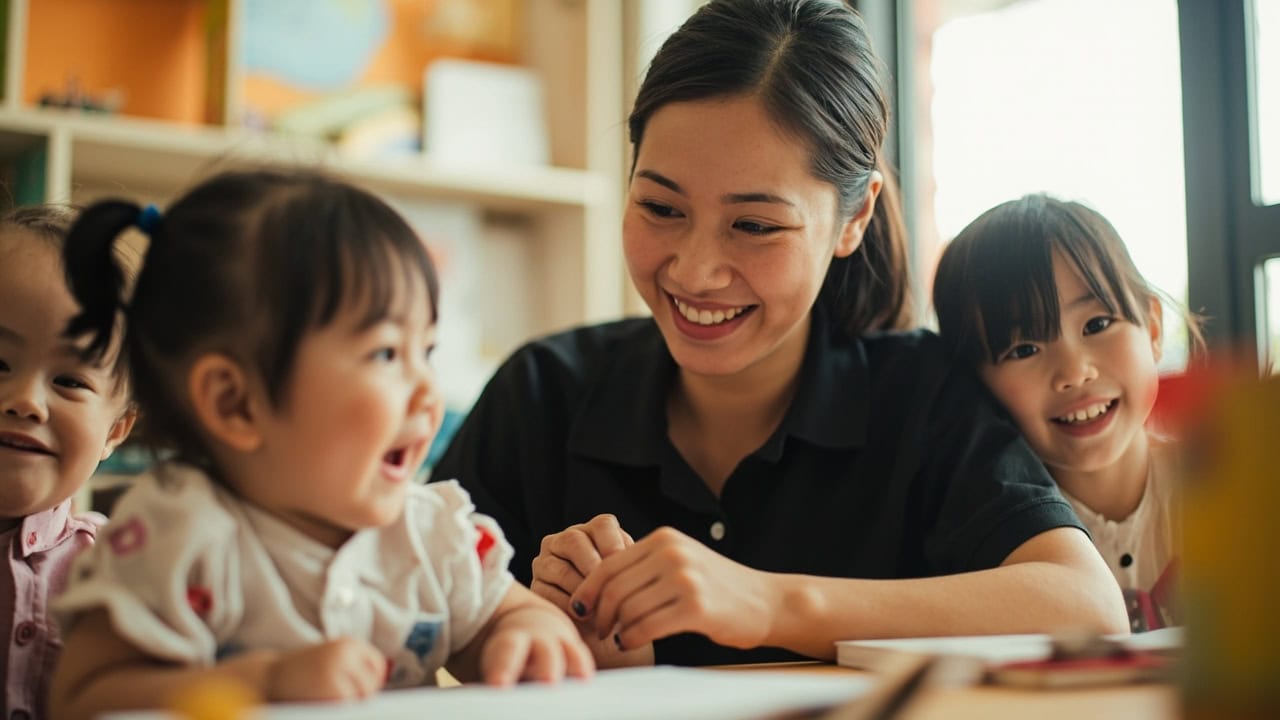
In a home-based environment, there is no cohort. There is no group rhythm that subordinates individual needs to collective efficiency. There is a smaller space, a more intimate ratio, a caregiver who is present with one, two, or three children—because quality childminding operates within frameworks that allow for ratios honoring the reality that every child under three needs more than group management. They need attunement. They need response. They need to be known.
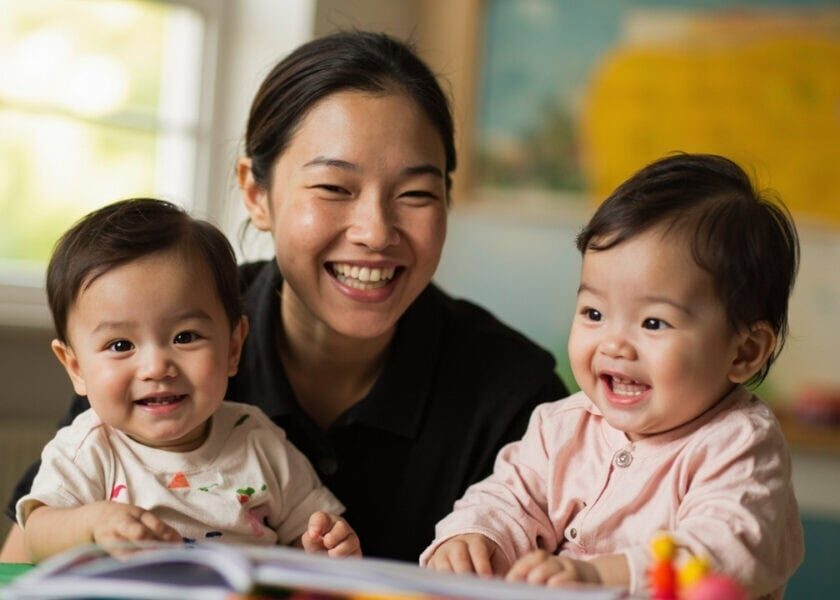
In this environment, siblings are not placed in a group with other children who happen to be the same age. They are in their own home, or in a carefully selected caregiver’s home, where the space is scaled for connection rather than efficiency. They are not competing for a caregiver’s attention against strangers. They are sharing a caregiver who knows them individually, who tracks each child’s emotional weather, who understands that your eldest needs patient encouragement before attempting something new while your middle child needs gentle challenge to stay engaged, while your youngest needs physical closeness to feel secure.
Real Sibling Dynamics, Real Support
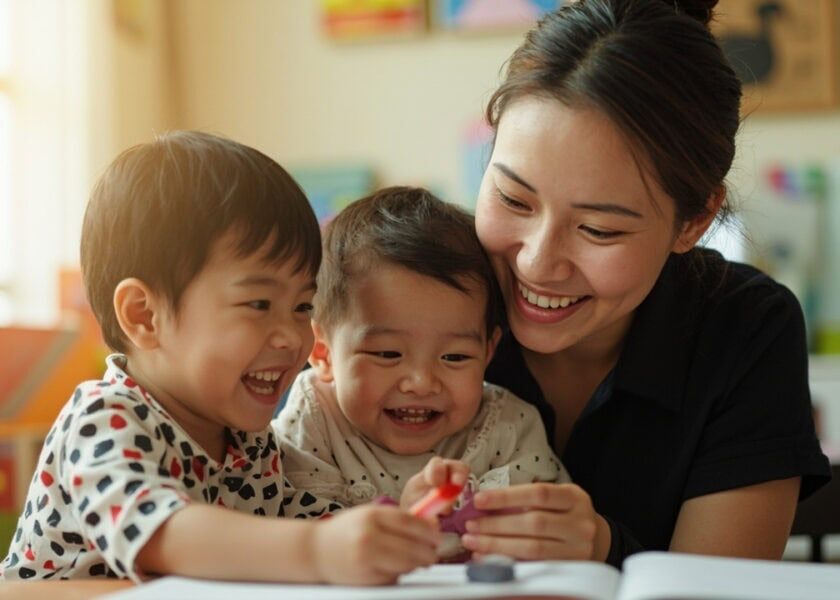
Because the environment is scaled for intimacy, siblings have the space to develop their own dynamic rather than having it managed by group structure. They negotiate. They collaborate. They frustrate each other and reconcile. They discover each other’s rhythms and learn to adjust.
Consider two siblings, three years apart, in quality home-based care. The older child, verbal and confident, tends to narrate their play, to take the lead, to propose scenarios. The younger child, more reserved, tends to observe before engaging, to express preference through action rather than words, to need reassurance before venturing into unfamiliar territory.
In a group center environment, these temperamental differences might create friction—the older child dominates, the younger child withdraws, the caregiver manages conflict rather than facilitates connection.
In a home-based environment, the caregiver notices these patterns. They understand that the older child needs to learn to make space, to invite rather than assign, to check in with their sibling’s inner life. They understand that the younger child needs to feel safe in their tentativeness—that their quiet observation is a strength, not a deficit. And they help both children understand each other: “I notice that your sister is watching us. She might want to join when she is ready. Let’s make sure there is space for her.”
This is emotional intelligence in formation. It is happening because the environment has the capacity to see each child individually and the bandwidth to support the sibling relationship as a distinct developmental project.
The EduNanny Model
EduNanny was built around a simple but often missed insight: multi-child families deserve childcare that is as sophisticated as the challenge they are navigating.
Our model is home-based, which is not simply a logistics choice. It is a developmental choice. In this environment, siblings have the space to develop their own dynamic. The caregiver is present, but not intrusive—facilitating, modeling, supporting much as a parent would in the home environment. The difference is that the caregiver’s sole focus during those hours is this family. These children. This specific sibling pair and their specific way of being together.
We operate within the ECDA Childminding Pilot framework, which maintains standards around safety, development, communication, and caregiver wellbeing. Our caregivers are trained, supported, and equipped—not random individuals offering babysitting, but part of a structured program designed to deliver quality care. We offer Monday to Friday care blocks aligned with the realities of working parents, and we have built our fee structures to be accessible, with CDA and Baby Bonus funds usable to support families in managing costs.
But beyond these structural assurances, what we offer is the conditions for genuine sibling connection. Because structure without relational intelligence produces well-managed children, not emotionally whole siblings. And for families with multiple children, emotional wholeness—the kind that comes from being known individually and related to intentionally—is not a luxury. It is the work.
Addressing Real Parent Concerns
Thoughtful parents often wonder whether home-based care can deliver the structure and quality that center-based care is presumed to offer. This is a fair question, and it deserves an honest answer.
Will my children receive enough stimulation?
Quality home-based care is not unstructured. It is structured differently—around the developmental needs and rhythms of the specific children in care, rather than around a group cohort. Activities are tailored to individual developmental stages while creating opportunities for siblings to learn from and with each other. The caregiver has the bandwidth to observe, respond, and adapt in ways that larger group settings cannot match.
How do I know my children are safe?
We maintain transparency measures including communication protocols and, where deployed, CCTV arrangements that give parents visibility into daily care without creating surveillance pressure on caregivers or children. Safety standards are maintained within the ECDA Childminding Pilot framework.
What if my children have different needs?
This is precisely what home-based care is designed to address. In a smaller environment, your children can have different experiences of the same space. Your eldest can be working on a more challenging activity while your younger child engages in something suited to their developmental stage. They come together as siblings from a place of wholeness rather than merger. Each one knows who they are. And that is why what they share becomes precious rather than consuming.
Questions to Ask When Evaluating Childcare
When you evaluate any childcare arrangement for multi-child families, ask these questions not because they are on a checklist, but because the answers will tell you whether this environment understands what siblings need.
- How does the caregiver handle situations where one child needs more attention than the other? You want to know that they see this reality, understand it, and have a relational approach to it rather than a logistical one.
- How are siblings supported in their play together? Are they encouraged to negotiate, collaborate, work through disagreement? Is the caregiver present as a facilitator, or do they simply intervene to manage conflict? Are siblings positioned as partners or as competitors for adult attention?
- How is individual difference honored? Can your children be in the same environment but have different experiences of it? Does the caregiver understand that your children are not interchangeable—that they have different temperaments, different needs, different ways of being in the world? Or do they tend to speak of your children as a unit rather than as individuals?
- What is the ratio and environment like? Smaller is not always better, but for sibling development, it almost always is. Because sibling connection requires bandwidth. It requires a caregiver who can track not just what is happening but what is unfolding between two children—the subtext, the dynamic, the shift.
- How do you feel when you observe the environment? Do your children seem more themselves or less? Do you feel that the caregiver understands what you are trying to build as a family?
The right childcare will not feel like a service you are purchasing. It will feel like a partnership you are joining. Because that is what it is.
Siblings for Life
Your children will be siblings for the rest of their lives. This is one of the most profound and underappreciated facts of human development. They will carry this relationship through childhood, adolescence, young adulthood, middle age, old age. They will be there for each other’s weddings, the birth of their children, the loss of parents, the milestones and losses that no friend can quite witness in the same way.
The sibling bond is one of the few relationships in adult life that is not chosen. You choose your friends, your partner, your community. Your sibling is given. And this is precisely why it can become either one of the deepest sources of support in adult life or one of the most painful unfulfilled potentials.
The sibling who was never truly seen as an individual, who always felt secondary, who learned that love was comparative and limited—carries that wound into adult sibling relationships that cannot quite heal. The sibling who was seen, who felt their unique worth recognized even in the presence of another equally-valued child, who learned that being fully themselves did not threaten the relationship but enriched it—carries that strength forward.
The early years of sibling life are not just a childcare logistics problem. They are the foundation of a lifelong relational architecture. And the hours that your children spend in childcare—those hours when you are not present, when the sibling dynamic is operating without you—are not peripheral to this architecture. They are central to it.
A Partnership in Raising Your Children
For those of you who are carrying this complexity, who understand that raising siblings is not the same as raising children sequentially, who feel the weight of wanting each child to be seen and wanting your children to be partners—EduNanny was created with you in mind.
We believe that every sibling pair deserves to be known as individuals and cherished as a bond. We believe that the hours you are not present with your children should be hours that strengthen the relationship they are building with each other. We believe that multi-child families deserve childcare that is as sophisticated as the challenge they are navigating.
Childcare is not a logistical problem to be solved. It is a relational opportunity to be honored. For families with multiple children, that opportunity includes the sibling bond—the most enduring relationship most of us will ever have, and one that is shaped in the early years through the quality of the environments we create for our children when we are not in the room.
If you are considering childcare options, or if you have been searching and not finding anything that speaks to the complexity you actually live, we invite you to start a conversation with us. Tell us about your children—each of them, as individuals. Tell us what you are hoping to build. Let us show you what that looks like in practice.
The right childcare does not just care for your children. It builds the sibling bond they will carry into adulthood.
That is what EduNanny offers. That is why we exist.
And we would be honored to walk this path with you.
Ready to explore childcare that understands what your children need? Connect with EduNanny Singapore to learn more about our home-based childminding services for multi-child families.