How Quality Childcare Builds Independence, Not Dependency
Does Childcare Build Dependency—or Independence?
Let me say something that might surprise you, because it goes against a worry that many of us carry without examining it closely.
There is a widespread, deep-seated belief that time spent in childcare makes children less independent. That the more hours a child spends away from home, the more she relies on caregivers, adapts to routines that are not her own, and loses the thread of her natural self-direction.
Parents in Singapore feel this acutely. We are a culture that takes education seriously, that pours immense thought and resources into our children. The idea that formal care might stunt rather than strengthen independence is genuinely frightening.
But here is the truth: this belief is built on a misunderstanding of what independence actually requires.
Independence Is Not Isolation
Independence does not develop in isolation. It does not flourish when a child is left alone to figure everything out. It grows when a child is in a relationship—with a responsive, attuned caregiver—where she feels safe enough to venture out, fail, try again, and ultimately discover that she can navigate the world on her own terms.
Think about it this way. When your infant reaches for a toy just out of her grasp, she is not developing independence because you step back and let her struggle indefinitely. She is developing independence because you are there—present, warm, steady—and when she finally grasps that toy, your smile tells her something profound. It tells her that her effort mattered. That she did something real. That she has power in this world.
This is not opinion. Decades of developmental science have confirmed it.
- Secure attachment is the foundation of independence. A child who trusts that her caregiver will respond when she needs help is a child who can eventually walk away from that caregiver and explore, knowing she can always return.
- The prefrontal cortex—the brain’s decision-making centre—develops most rapidly in the first three years of life. What wires this cortex most powerfully is not worksheets or formal instruction. It is responsive interaction: a caregiver who notices frustration, names it, and helps a child find words and strategies.
- Maternal employment does not harm children when care quality is adequate. The research on this is remarkably consistent. Quality is the variable that matters. Whether you work outside the home matters far less than what is happening in the hours your child spends in care.
- Compliance is not confidence. A child who follows rules because an adult is watching is not the same as a child who has an inner sense of her own capability. True independence is quiet. It is internal. It is the knowledge that “I can handle what comes.”
How Quality Childcare Nurtures Self-Direction
In the best childcare environments, independence is not a slogan on a wall. It is a set of deliberate choices made dozens of times each day. Here is what this looks like in practice.
At Mealtimes: The Architecture of Self-Trust
In infant feeding, a truly developmental caregiver does not simply hold the bottle and feed until the baby finishes. She watches for cues. She pauses when the baby turns away, honoring the baby’s growing sense of “I am full, I know my body.” She speaks softly about what is happening: “You are telling me you are done. That is your choice.”
This sounds small. It is not. This is the earliest architecture of self-trust. The child is learning that her signals matter, that her body is a reliable source of information, that she has agency even in the most basic physical experience.
For toddlers, it looks like this: a twenty-two-month-old wants to pour his own water from a small pitcher. The caregiver could do it faster, more neatly, with less spillage. But she steps back. She places a towel nearby. She says, “You want to do it yourself. I will be right here.”
She does not hover anxiously. She does not correct every wobble. She trusts that the child is capable of learning through doing, and she is present not to prevent failure but to normalize it. When water spills—and it will—the caregiver says, “Oh, there is water on the table. What should we do?” She is teaching problem-solving, not compliance.
Autonomy Support: What It Looks Like
There is a concept in child development called autonomy support, and it is different from what most of us imagine when we think of caregiving. Autonomy support does not mean leaving children alone. It means structuring the environment and the relationship so that the child feels that her actions and choices matter, that her internal experience is valid, and that she is an agent in her own life.
It looks like offering a choice: “Would you like to read the red book or the blue book?” when a child is restless before nap time. She is helping the child practice self-direction in a low-stakes moment.
It looks like naming a frustration without rushing to fix it: “I see you are frustrated that the tower keeps falling. It is hard when your building topples. Do you want to try again, or would you like help?” She is teaching the child that frustration is not dangerous, that she can tolerate difficult feelings, and that she has options.
It looks like reflecting a child’s emotion back with precision: “You are really angry that it is time to clean up. You were not finished playing. I understand.” The child is learning that her anger is seen and that it is okay to feel big feelings. This is emotional literacy—the foundation of emotional regulation, one of the most powerful predictors of long-term well-being we know of.
The Contrast That Matters
| The Child Who Feels Capable | The Child Who Waits for Direction |
|---|---|
| Builds an inner voice | Looks outside herself for answers |
| Learns that her desires and capabilities matter | Learns that others know better |
| Understands that effort leads to mastery | Believes competence comes from outside |
| Can say “I don’t know yet, but I will figure it out” | Looks to an adult to fill the silence |
The difference between these two approaches may not be visible in a single hour or even a single day. But over months and years, it becomes visible. It becomes visible in the child who enters preschool and knows how to negotiate rather than hit. In the child who can wait for her turn without falling apart. In the child who can say, “I do not like that,” without screaming. In the child who tries new things even when she might fail, because she has learned that failure is information, not catastrophe.
What This Means for School Readiness
Parents in Singapore often worry about school readiness. We live in a society that takes academic achievement seriously, and we want our children to succeed. We want them to be curious learners who can sit and listen and focus.
There is nothing wrong with wanting this. The question is how to get there.
Here is what the research tells us, and it may not be what you expect: the single best predictor of school readiness is not whether a child knows her letters or can count to twenty. It is whether she has a sense of herself as a competent learner. It is whether she can manage her emotions when something is hard. It is whether she can persist in the face of difficulty, ask for help when she needs it, and believe that effort leads to improvement.
These are not things you can teach through drilling. They are things you cultivate through relationship, through experience, through an environment that gives a child room to try and fail and try again.
The children who thrive in Primary One are not necessarily the children who had the most early enrichment. They are the children who trust themselves. Who believe, in their quiet, private inner selves, that they can figure things out.
This is what quality childcare gives your child. Not a head start on curriculum, but something deeper and more durable: the self-belief that will carry her through every stage of schooling and beyond.
What You Can Do at Home
The habits of independence that your child is building at quality childcare can be reinforced at home—not by doing something dramatic or elaborate, but by small, consistent choices.
Give Real Choices Throughout the Day
Not every choice—parents are still the adults, and children need boundaries. But real choices with real consequences: “Do you want to wear the blue shirt or the yellow shirt?” “Do you want to brush your teeth before or after we read?” “Do you want to carry your plate to the kitchen, or shall I help you?” When children practice making small decisions throughout the day, they are building the neural pathways for making larger ones.
Name What You See
When your child does something independently—when she puts on her own shoes, when she apologizes to her sibling, when she asks for help instead of just crying—tell her what you noticed. “I saw that you put on your shoes all by yourself. That took effort. You must feel proud.” This sounds simple. It is deceptively powerful. Your child is building an internal narrative about herself as capable, and your words are part of that narrative.
Allow Frustration Without Rushing to Fix It
I know this is hard. When your child is struggling with a puzzle, every instinct is to help. But resist. Wait a beat longer than you think you should. Ask, “Do you want to keep trying, or do you need a clue?” You are teaching her that she can tolerate the discomfort of not-yet-knowing, and that she has resources within herself.
Trust Her in the World
Let her walk a few steps ahead of you at the playground. Let her order her own food at a restaurant. Let her tell the hawker centre auntie what she wants. These are not grand gestures. They are tiny, daily acts of faith in your child’s growing competence. And they add up.
Talk to Your Child’s Caregiver
Not just a casual “how was her day,” but a real conversation. Ask what she was reaching for today. Ask what frustrated her. Ask what she did that surprised the caregiver. The more you understand about what is happening at childcare, the better you can support it at home—and the more your child benefits from continuity rather than dissonance.
The EduNanny Difference
EduNanny was built on a simple but profound understanding: the hours your child spends in care are not a gap to be filled. They are hours in which your child’s sense of self is being shaped, hour by hour, in the years when it is most malleable and most important.
Designed for Attunement
EduNanny operates as part of the ECDA Childminding Pilot, and this matters. The pilot reflects a deliberate government commitment to raising the standard of home-based and community-based childcare in Singapore. It is a recognition that the early years are foundational, and that the environment in which they unfold must be held to the highest developmental standards.
One of the most significant features is the ratio. For infants—children under eighteen months—EduNanny maintains a ratio of up to one to three. That means one caregiver for every three infants. This is not a regulatory minimum. This is a developmental necessity.
In the first year of life, a child is building the most fundamental trust: that the world is responsive, that someone will notice when I am upset, that my cries bring comfort. With a ratio of three infants to one caregiver, that caregiver can truly attune. She can notice the subtle cues of distress before they escalate. She can respond to each child’s individual rhythm of feeding, sleeping, and playing. She is not running from crisis to crisis. She is present.
Transparency You Can Trust
When you entrust your child to someone else’s care, you want to know what is happening. Not because you do not trust the caregiver, but because you love your child and the hours apart feel like a void you cannot see into.
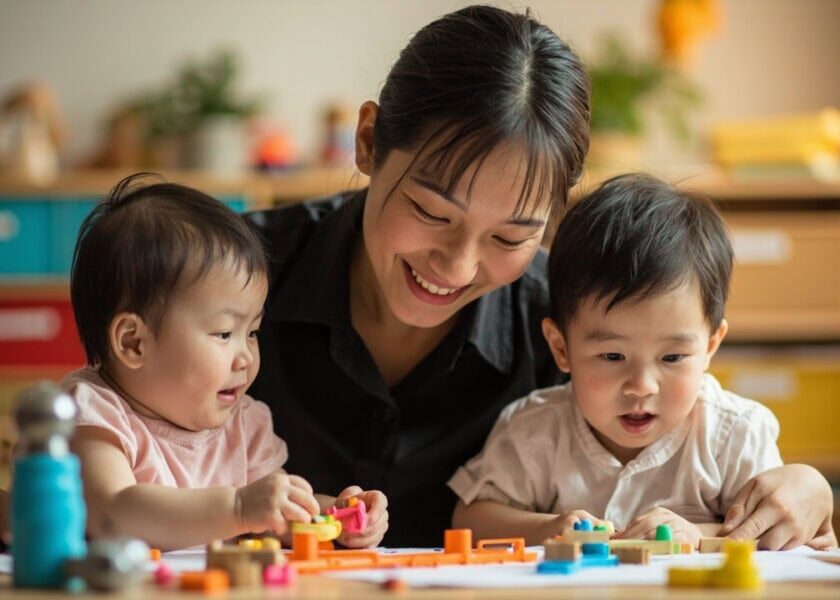
EduNanny addresses this through open communication and, where deployed, CCTV measures. This does not mean surveillance or distrust. It means that parents have a window—not just a metaphorical one—into their child’s day. You can see your daughter laughing at circle time. You can see your son concentrating on a shape-sorting activity with his brow furrowed in concentration. You can see the caregiver kneel down to his level and speak softly to him, and you can feel, even from a distance, that this is a person who genuinely cares for your child.
This kind of transparency does something important for parents too. It allows you to participate in your child’s day without being physically present. You can ask meaningful questions at pickup: “I saw that Maya was working on the puzzle today—how did she do?” You can follow up at home on what happened in the morning. You can reinforce at dinner what she learned at childcare.
Caregivers Who Understand Their Role
EduNanny caregivers are not babysitters. They are developmental partners in your child’s life. They are people who have been trained to notice, to respond, to nurture, and to step back at exactly the right moments.
They understand that their job is not to do things for children but to help children do things for themselves. They wake up every morning and come to work not just for a paycheck but because they believe in what they are doing. They will hold your child when she is sad, celebrate with her when she masters something new, and gently challenge her when she is capable of more than she knows.
Accessibility for Singapore Families
EduNanny operates within the ECDA Childminding Pilot, which was designed to make quality childminding more accessible to Singapore families. The pilot fee structures are designed to be affordable, and there are mechanisms in place that many families can use.
- Child Development Account: If your child has a CDA, those funds can be applied to EduNanny fees.
- Baby Bonus Cash Gift: This can also be directed toward childcare expenses.
- Care blocks: Structured around the working week—Monday to Friday—with both home-based and community or centre-based options available.
Every family is different, every child is different, and flexibility matters. The goal is to meet you where you are and to provide care that fits your life, not to make your life fit the care.
Growing Into Herself
There is a kind of confidence that cannot be taught. It is not bravado or performance or the confidence of a child who has been told she is special. It is quieter than that. It is the confidence of a child who knows, deep in her bones, that she can handle what comes. That she has resources within herself. That she is not helpless and she is not alone.
That moment—your daughter getting her own plate, your son putting on his shoes, that small, quiet, ordinary moment that feels anything but ordinary to you—is not an accident. It is not luck. It is not something that happens despite you, as though your love and attention and daily presence are somehow beside the point.
That moment happens because of you.
It happens because you held your baby in those first weeks and months, and your heartbeat taught her that the world is steady. It happens because you responded when she cried, and she learned that her voice matters. It happens because you have been, in a thousand small ways, teaching her that she is capable—and then stepping back just enough to let her prove it to herself.
And it happens because of environments like EduNanny. Because of caregivers who understand that their job is not to do things for children but to help children do things for themselves. Because of a model built on ratios that allow for attunement, on communication that allows for partnership, on a philosophy that treats every child as a person in the process of becoming.
The person who holds your infant when she is crying and helps her calm down is doing the most important work there is. She is not just feeding and diapering. She is showing a tiny human being that the world is safe, that she matters, that someone is paying attention. She is building the architecture of trust in a brain that will carry that architecture for the rest of that person’s life.
This is the gift you are giving your child. And it is the most important gift there is.
If you are considering childcare options for your infant or toddler in Singapore, EduNanny by BUTLER invites you to learn more about how our approach to childminding nurtures the quiet confidence that will carry your child through school and life.
Ready to learn more? Visit our website or speak with our team to understand how EduNanny can be the environment where your child grows capable, confident, and fully herself.
You can also learn more about EduNanny’s approach and our commitment to raising the standard of childcare in Singapore.