Reading Readiness: What Your Child Is Reaching For
Understanding Developmental Readiness: Why It Matters More Than Age
There is a moment — quiet, easily missed — when a child begins to outgrow the space you have made for them. It does not announce itself. There is no dramatic gesture, no milestone marker on the wall to tell you it has arrived. But if you are watching — and parents are always watching, even when they do not realize it — you will notice something shifting.
A child who once turned away from other children at the playground now watches them with something that looks almost like longing. A toddler who spent months mastering the art of throwing things begins instead to stack them, carefully, deliberately, as if to say: I want to see how high this can go. A baby who has never been particularly interested in your face suddenly stops what they are doing to study you, to study the sound of your voice, to try to understand what you mean.
These are not random behaviors. They are signals. And if you have ever found yourself standing in the kitchen after a moment like this, wondering whether your child is ready for something more — whether they are ready for the kind of care that will help them grow rather than simply keep them safe — then you already know something important.
You are right to notice. And you are right to ask the question.
The Problem With the Question You Are Actually Asking
Most of the conversation around childcare does not answer the question you are actually asking. It tells you about safety, and safety matters. It tells you about trust, and trust matters too. But neither of these addresses the quiet, persistent wondering that drives so many parents in Singapore to delay a decision, to second-guess themselves, to wonder whether the time is right.
Readiness is one of the most misunderstood concepts in early childhood development. It is not a number on a calendar. It is not the age at which a child reaches a certain month or year. Readiness is a window — a brief, specific moment when a child is primed neurologically, emotionally, socially, and physically to absorb something new. And not just to absorb it, but to take it and make it their own, to build upon it, to grow from it.
The Science Behind Sensitive Periods
Children’s brains are not simply smaller versions of adult brains waiting to be filled with information. They are dynamic, rapidly forming structures that are extraordinarily sensitive to the environment around them.
Certain skills, certain connections, certain ways of understanding the world — they have optimal periods for development. Researchers call these sensitive periods. Language has its window. Social connection has its window. Motor coordination, emotional regulation, even the ability to think symbolically — each has a moment when the child’s brain is most receptive, most hungry for exactly the right kind of input.
Here is what makes this so important: these windows do not wait for the school year to start. They do not align with convenient schedules or the end of parental leave. They open according to the child’s own internal timeline, and they stay open only for a while.
When a parent observes a child showing signs of readiness — when that parent notices their child beginning to reach for something just beyond what they currently have — they are looking at a developmental opportunity that is time-sensitive. It cannot be postponed indefinitely without cost.
Signs of Readiness: What to Look For
The signs are real, but they are not always dramatic. They do not always announce themselves clearly. In a city like Singapore, where children are surrounded by stimulation from a very young age, it can be hard to distinguish between true readiness and simple exposure. Let us be specific, because specificity is what transforms an observation into something actionable.
Cognitive Readiness
Readiness often shows up as a new kind of curiosity. A child who has been content with familiar objects begins to seek novelty. They point at things they have not seen before. They ask questions — or, in younger children, they demonstrate questioning behavior: the reaching, the intense gaze that says I want to know what that is.
They begin to engage in symbolic play, using one object to represent another. A wooden block becomes a phone. A pillow becomes a mountain. This is a foundational cognitive skill that researchers have linked to later language development and abstract thinking.
Social Readiness
Readiness manifests as what specialists call social reference and social interest. The child begins to look at other children, not just at the toys they are holding. They watch how others respond to situations and adjust their own behavior accordingly.
They may reach out — tentatively, clumsily, in ways that do not always result in smooth social interaction — but the reaching is there. The interest in connection beyond the primary caregiver is present, and it is growing.
Emotional Readiness
Readiness appears as a developing capacity for separation without catastrophic distress. This is not the absence of separation anxiety — which, by the way, is a normal and healthy response that proper care can help children navigate.
Readiness here is different. It is the emergence of a base level of security from which a child can venture out, explore, and return. It is the internal working model of attachment becoming stable enough that the child can trust: my caregiver will come back, this place is safe, I can engage with what is here.
Motor Readiness
Readiness shows up in the refinement of gross and fine motor skills. The child who has mastered walking begins to run, to climb, to navigate space with increasing confidence. The child who has been using a palmar grip begins to develop a pincer grasp, reaching for smaller objects with precision.
These are not just physical achievements. Motor development and brain development are deeply intertwined in these early years.
What You Are Actually Looking For
It is not all of these at once. It is not a checklist that must be completed before a child is ready. It is a pattern — a cluster of emerging signals, different in each child, that together suggest: this child is beginning to reach for something more.
When you see that pattern clearly enough that it stays with you, that it influences how you think about your child’s days — that is the moment to act. Not with anxiety, not with guilt, but with the confidence that comes from recognizing what your child actually needs.
Why Attuned Care Matters More in Singapore
Recognizing readiness is one thing. What happens next is everything.
A child who shows signs of cognitive readiness needs more than a safe environment where they happen to be present. They need an environment that will actively respond to that readiness — that will recognize what they are reaching for and provide exactly the right kind of scaffolding to help them get there.
What Scaffolding Actually Means
Scaffolding is a term from educational psychology, and it is one of the most powerful concepts in early childhood development. It refers to the process by which a more skilled person provides support that matches the child’s current level of ability, then gradually withdraws that support as the child develops the capacity to manage on their own.
It is not doing things for the child. It is doing things with the child, at precisely the right level, for precisely as long as they need it.
The Difference Between Richness and Responsiveness
Singapore is, by any measure, a high-stimulation environment. Children here are introduced to technology earlier. They are enrolled in structured activities younger. They are surrounded by other children, by caregivers, by grandparents, by the constant social density of a city-state that never quite rests.
But richness is not the same as responsiveness. Exposure is not the same as development. A child who watches hours of educational television may develop some language awareness, but it is not the same as a child who is spoken to by an attuned caregiver who pauses, who waits, who responds to their attempts at communication with warmth and precision.
In fact, the high-stimulation environment of Singapore makes the role of attuned caregiving more important, not less. Because when a child is surrounded by so much input, it becomes harder to distinguish what is truly engaging them from what is simply occupying their attention.
A caregiver who understands readiness can cut through the noise. They can see past the entertainment to the learning. They can notice when a child is truly developing versus when they are simply being diverted.
The Real Difference in Quality
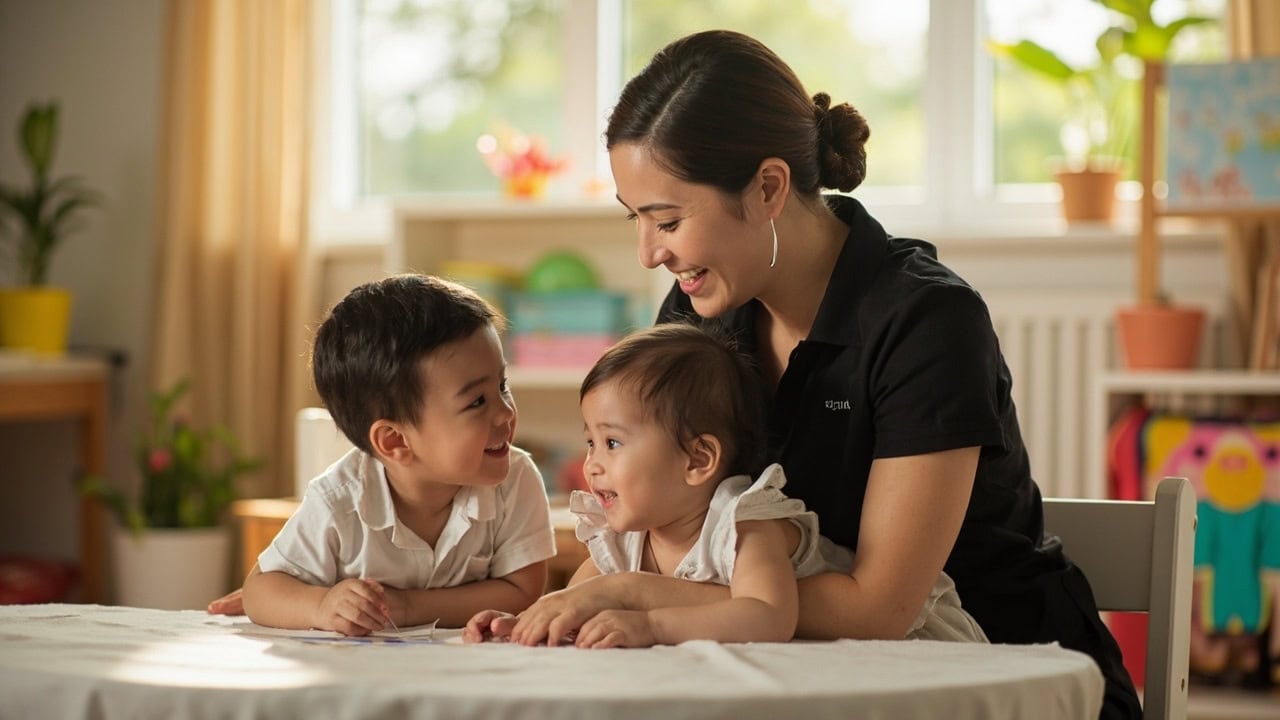
Think about it this way. If a child is showing early signs of language readiness — beginning to babble with intention, to imitate sounds, to point at objects and look to you for their names — a caregiver who understands readiness will engage with that. They will name things. They will narrate. They will pause and wait for the child to try, and when the child tries, they will respond with encouragement and more language.
If that same child is placed in an environment where language is not actively engaged — where they are fed, changed, kept safe, but not responded to with intentional language interaction — they will still learn to speak. But the learning may happen later, with more effort, with less of the natural fluidity that comes from being in the right environment at the right moment.
This is why the caregiver matters so profoundly.
EduNanny’s Enrichment-Oriented Model
EduNanny Singapore does not describe its model as childcare in the conventional sense. It describes it as enrichment-oriented care — care that is oriented not just toward keeping children safe, but toward actively supporting their development by recognizing and responding to their readiness windows.
The caregivers at EduNanny are trained to observe. To notice. To document the subtle shifts that indicate a child is moving from one readiness window to the next. They are trained to respond with intentionality — to structure interactions, activities, and environments that meet the child exactly where they are and invite them forward.
This is not guesswork. It is not luck. It is the result of careful preparation, ongoing training, and an organizational culture that treats each child’s development as the core purpose of every single day.
What EduNanny Actually Offers
EduNanny is part of the ECDA Childminding Pilot, which means it operates within a framework that prioritizes quality, oversight, and accessibility.
- Home-based pathway: Care in an intimate, familiar setting — a caregiver’s home structured around the rhythms and needs of young children
- Centre-based pathway: Community-based environments where children benefit from peer interaction and a broader range of resources
- Low infant ratios: Up to one to three in infant care settings, so that every child receives the attention their readiness signals deserve
- Monday to Friday care: Aligns with the working realities of most Singapore families
- Accessible fee structures: Quality developmental care is a realistic option, not a privilege reserved for those who can afford premium private arrangements
Financial Support in Singapore
For families using childcare, the CDA and Baby Bonus schemes are applicable. The financial architecture of Singapore’s family support system can be brought to bear on this decision. The money is there. The support structures are there. The question is whether the care itself is worthy of that investment — and that is where EduNanny’s developmental model makes the answer a clear yes.
Your Questions Answered: Making the Decision With Confidence
Before you make any decision, you deserve honest answers to the questions you may be carrying.
“Am I giving up something by choosing formal care?”
You, as the parent, are the primary reader of your child’s readiness. Not the only reader — the caregivers at EduNanny will observe your child, will document their development, will share what they see with you. But you have a window into your child’s readiness that no one else has.
You have watched them since before they were born. You know the patterns of their sleep, their hunger, their curiosity, their fears. You know how they respond to new people and new environments. You know what makes them light up.
This knowledge is not inferior to professional knowledge. It is different. And the best childcare relationship is one that honors both — where professionals bring their training and experience with hundreds of children, and where parents bring their intimate, irreplaceable knowledge of this particular child.
EduNanny is designed to be a partner with you, not a replacement for you.
“How will I know what is happening during the day?”
The communication structures — regular updates, documentation, open lines of dialogue between caregivers and families — are there to make sure that your observations and the caregivers’ observations inform each other. Transparency strengthens trust.
You deserve to know what your child’s days look like, because when you can see what is happening, you can integrate it with what you know about who they are and who they are becoming.
“Is my child too young? Too old?”
Readiness is not about age. It is about the pattern of signals you observe. A 10-month-old can show strong social readiness. An 18-month-old may still be developing emotional readiness. Every child follows their own timeline. Your role is to observe that timeline, not to compare it against an arbitrary schedule.
“Will this actually make a difference?”
Children who receive responsive, developmentally attuned care show stronger language outcomes. They show better social-emotional regulation. They show higher cognitive scores on early assessments. Not because they are smarter or more gifted, but because their readiness windows were recognized and met. Because the care they received was not passive supervision but active amplification of everything they were already trying to become.
A Framework for Observing Readiness
This is what makes the readiness framework work — not a system that decides for you, but a system that equips you. It helps you observe more clearly, gives you language for what you are seeing, and supports your confidence in timing and choosing.
Before Care Begins
Over the next two weeks, observe your child with these questions in mind:
- Cognitively: Is my child showing increased interest in novel objects or experiences? Are they engaging in symbolic play or pretend behaviors?
- Socially: Is my child showing interest in other children, not just parallel play? Are they watching how others respond and adjusting their own behavior?
- Emotionally: Can my child tolerate brief separations without total distress? Do they have moments of security from which they can venture out and return?
- Motorically: Is my child refining their gross or fine motor skills? Are they attempting new physical challenges with growing confidence?
If you are seeing signals across two or more of these domains, you are likely observing readiness in action.
During Care
Once care begins, ask the caregiver:
- What did my child seem most interested in today?
- Were there moments when you saw them trying something new?
- How did they respond to other children?
- What did engagement look like — were they curious, responsive, reaching for interaction?
These conversations are where your observations and the caregiver’s observations become a shared picture of your child’s development.
Trust What You Have Already Seen
Readiness is not something that happens to a child. It is something a child does. It is an active, internal process of reaching, of curiosity, of growing toward the next thing.
And when that process is met with attunement — when the environment is structured not just to keep the child safe but to actively support their emerging skills — the results are not marginal. They are transformative.
This is what EduNanny offers. It is not a place where children go to be kept. It is a place where children go to grow.
Let us return to where we began — with that quiet moment you may have noticed, the moment when something in your child shifted and you found yourself wondering what it meant.
You were right to wonder. That wondering is not anxiety to be managed or guilt to be forgiven. It is a form of wisdom. It is your understanding, at a level deeper than logic, that your child is not static — that they are moving, developing, reaching for something that requires more than you alone can provide in every waking moment.
That does not mean you have failed. It means your child is growing. And growth, by its nature, requires new environments, new relationships, new challenges.
The question is not whether to step into that reality. The question is how to do it with confidence — the confidence that comes from knowing your child’s readiness signals, understanding what quality care actually does with those signals, and choosing a care model that is designed around development rather than around convenience.
You have been watching your child. You have been noticing the signals.
Trust that noticing. Trust your child. And trust that there are places, there are caregivers, there are programmes designed specifically to amplify exactly what you have seen emerging.
That is what readiness is for. Not to be missed, but to be met.
And when your child is ready, they deserve to be met.
If what you have read resonates with what you have been observing in your child, we invite you to take the next step. Speak with our team about your child’s development, your family’s needs, and how EduNanny’s enrichment-oriented model might be the right fit.
Because you have been watching. You have been noticing.
Let us help you figure out what comes next.
Learn more about who we are and how we work.