The Sibling Bond Matters More Than Your Childcare Choice
The Wish Every Parent Makes
There is a moment, if you are a parent of more than one child, when you catch yourself watching them together. Perhaps the older one is showing the younger how to stack blocks. Perhaps they are arguing over a crayon. Perhaps one is crying and the other is trying, awkwardly and with limited success, to offer comfort.
In that moment, something inside you makes a wish so fierce it almost hurts. You think: I need you two to have each other. Not someday. Not when you are grown. I need you to know, right now, that the person sitting next to you will matter more to you than almost anyone you will ever meet.
That wish is one of the most honest things you will ever feel as a parent. And it is also, if we are being gentle and truthful, one of the things that keeps you up at night.
Because you cannot control whether your children will love each other. You can create the conditions. You can model kindness, enforce sharing, intervene in squabbles with varying degrees of wisdom. But at the end of the day, the sibling bond is something they build between themselves, and all you can do is hope you have given them the right foundation.
Here is what we have come to understand through years of working alongside families in Singapore: that foundation matters more than most parents realize, and the care setting you choose can either support it or unintentionally undermine it.
Most childcare settings are simply not designed to think about sibling bonds. They are designed to manage groups of children, keep them safe, and introduce them to early learning. The sibling relationship—the most important peer relationship your children will have for the first two decades of their lives—is often treated as a logistical detail rather than a developmental priority.
We think that is a profound oversight. And we think it is time to talk about why.
Why This Matters: Key Points for Parents
- Siblings are each other’s first social-emotional teachers — before preschool, before structured peer groups, brothers and sisters are the primary laboratory for learning how to relate to another person
- Early sibling dynamics predict adult relationship quality — research shows the sibling relationship in childhood is one of the most reliable predictors of how children will relate to others throughout their lives
- Quality caregivers notice the difference between sibling squabbles that carry developmental value and sibling distance that signals a need for attention
- Near-home care offers something larger centres often cannot — space for siblings to discover each other as people, not just as siblings defined by birth order
- Your childcare choice is a statement of values — choosing care that takes sibling bonds seriously is one of the most forward-thinking decisions a parent can make
The Science Behind the Sibling Bond
Siblings are not simply a family configuration. They are, in the earliest years of life, the most influential social-emotional teachers your children will ever have.
Before preschool. Before structured peer groups. Before the broader world starts to shape them. Brothers and sisters are each other’s laboratory for learning how to relate to another person.
In the zero-to-three window, the brain is building its social architecture at a speed it will never match again. Every interaction with a sibling teaches the child something fundamental: how to read another person’s signals, how to negotiate competing desires, how to experience frustration without the world ending, how to feel genuine joy in someone else’s happiness.
Psychologists who study sibling relationships have found something remarkable: the quality of sibling interaction in early childhood predicts the quality of adult relationships more reliably than almost any other childhood variable.
Not because siblings are magic, but because the sibling relationship is where children first learn that another person can be both a source of competition and a source of comfort. That duality—that someone can frustrate you and delight you in the same afternoon—is the fundamental truth of human intimacy. And siblings learn it, for better or worse, before anyone else.
This is why the question of how your childcare setting handles sibling dynamics is not a secondary concern. It is a primary one.
When Siblings Are Together in a Care Setting
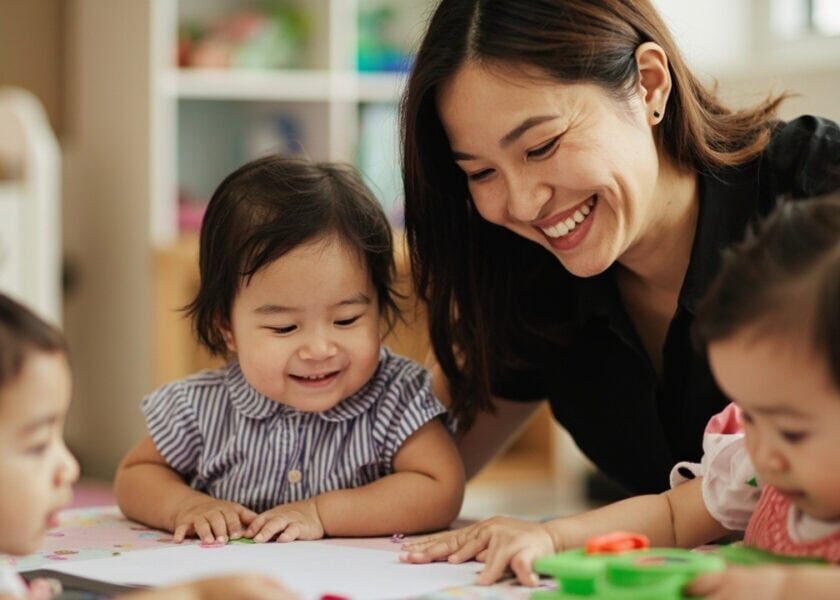
When you bring your children to a quality near-home care environment, something happens that is easy to underestimate. The children are together, but they are also in a space that is not home.
At home, siblings operate within the full gravity of parental presence. The older child is always someone’s big brother. The younger child is always someone’s little sister. There are histories, hierarchies, roles that have calcified over time.
But in a near-home care setting—a space that carries some of the warmth and familiarity of home without its full weight—siblings have room to relate to each other differently. They have room to discover each other as people, not just as siblings defined by birth order and parental expectation.
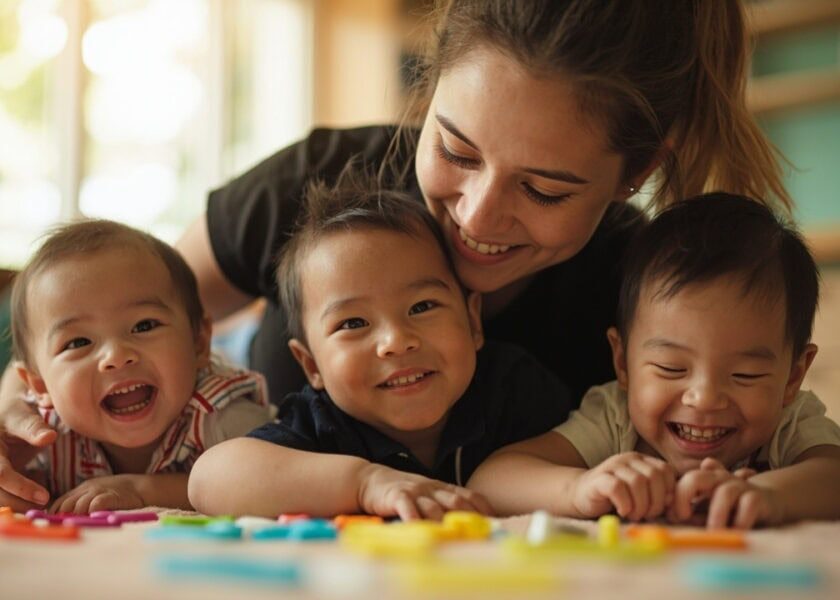
Siblings who might be slotted into age-appropriate rooms and separated in a larger centre can instead move through their day together, or in deliberate proximity, with caregivers who are paying attention to what is happening between them.
What Quality Caregivers Actually Notice
In a quality near-home care setting, the caregiver is not simply watching two children in the same room. They are reading the sibling relationship the way a thoughtful teacher reads a classroom—observing patterns, noting shifts, understanding that certain behaviors are signals and others are simply noise.
There is a distinction that parents find enormously clarifying: not all sibling conflict is the same.
When Fighting Is Learning
Some squabbles are the sound of children learning. The block tower that gets knocked over in anger, the toy that gets grabbed and the subsequent wailing—this is not a failure. This is a child discovering that other people have wants that conflict with their own.
When siblings fight over resources, negotiate turns, experience the frustration of being treated unfairly by someone their own size, they are building what psychologists call social competence. They are learning that relationships require effort, that conflict is not destruction, and that repair is always possible.
When Distance Is a Signal
But there is another kind of sibling dynamic that carries a very different signal. When siblings are in the same space but barely acknowledge each other—when one child consistently moves away from the other, when affection is met with flatness or indifference—this is not peaceful coexistence. This is isolation.
And isolation in a sibling relationship, at this age, is a signal that something needs attention.
A quality caregiver notices the difference. They notice when the fighting carries energy and engagement—the push and pull that means children are invested in each other—and when it carries a flatness that suggests one child has retreated. They notice when a younger child seeks out an older one for comfort and when that seeking has stopped.
- By sitting near both children and narrating gently what they observe
- By offering an activity that invites parallel play that can turn collaborative
- By stepping back when siblings are working something out
- By stepping in when the emotional temperature suggests that a child needs rescue
This is what we mean when we talk about quality care that takes sibling bonds seriously. It is not a program or a curriculum. It is a posture. It is an orientation toward the sibling relationship as something worth protecting and cultivating, not merely managing.
What Near-Home Care Makes Possible
All of this—the observation, the intentional response, the daily cultivation—requires something that many childcare settings cannot provide: the capacity to actually see each child and the relationships between them.
Consider the transition from parallel play to collaborative play. In parallel play, children play side by side, occasionally glancing at each other but not yet truly engaging. In collaborative play, they are building together, creating together, negotiating roles and sharing ideas. A quality caregiver notices when siblings are ready for that transition and creates moments that invite it—an activity that requires two sets of hands, a story that needs two voices, a game that only works if you have a partner.
Consider power imbalances. In every sibling pair, there is a difference in size, in verbal ability, in confidence. When that imbalance becomes too pronounced—when the older child consistently dominates and the younger child consistently retreats—a skilled caregiver intervenes not to separate them but to restructure the interaction.
Consider the older child who is struggling with sharing a caregiver’s attention with a younger sibling. This is one of the most common dynamics in families with multiple children, and it is often invisible in larger care settings where individual attention is scarce.
When an infant care setting maintains a ratio of up to one to three—as is possible within the ECDA Childminding Pilot framework—each child is seen. Really seen. The caregiver is not managing a group; they are attending to individuals, and to the relationships between them.
The skilled caregiver holds the sibling relationship the way a gardener holds a young plant: with patience, with attention, and with the understanding that some growth happens in silence.
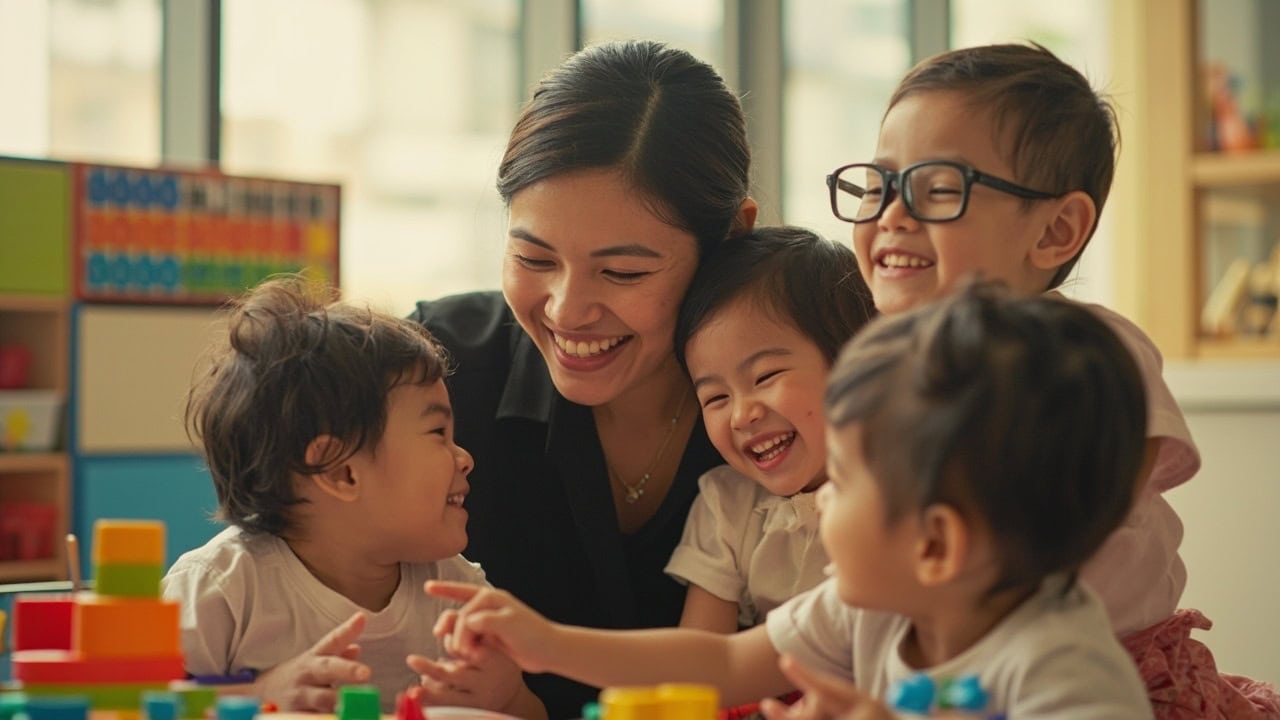
When you choose near-home care that maintains a familial warmth rather than an institutional feel, you are giving your children something precious: a second environment that still feels like life, not like an institution. You are choosing care that sees your children not as individuals to be managed but as people who are learning, together, how to be in relationship with another person.
What Singapore Parents Should Know
We understand that for many parents in Singapore, this level of care feels almost too good to be true. You have heard about childcare challenges: the cost, the rigidity, the difficulty of finding someone you trust with your children, let alone with the relationship between your children.
On Affordability
The ECDA Childminding Pilot was designed with the recognition that not every family needs or wants centre-based care, and that home-based and community-based pathways can offer something different and valuable. Within this framework, near-home care through EduNanny by BUTLER provides an option built around affordability, with fee structures designed to be accessible within the pilot parameters.
You can use your Child Development Account and your Baby Bonus to support the cost. Care is available across Monday to Friday blocks, with the flexibility and personalization that home-based care allows.
On Trust
We know that trust is not built on promises alone. We build it on transparency. When your children are in our care, you know what is happening—not through vague reassurances, but through real, ongoing connection.
Where deployed, our CCTV measures are not about surveillance; they are about accountability and peace of mind, yours and ours. We want you to feel that you know what is happening in the space where your children are learning to love each other.
On Support
We also know that modern parenting comes with a particular kind of exhaustion: the exhaustion of having questions at eleven at night, of needing reassurance on a Sunday, of wanting information that is specific to your situation and your children.
This is why we have developed Thomas, our AI chatbot, designed to answer your questions about parenting and childminding whenever they arise. Thomas does not replace the human connection that defines quality care, but it does something important: it makes sure that support is always available, that you never have to navigate uncertainty alone.
How to Choose Childcare If Your Children Are Siblings
If you are a parent of multiple children and you are researching childcare options in Singapore, here is a practical framework for thinking about what matters most:
Questions to Ask Any Caregiver or Centre
- How do you handle sibling dynamics? Are siblings kept together or separated? Is there intentional attention paid to how siblings relate to each other?
- What is the caregiver-to-child ratio? Can the caregiver actually observe and respond to what’s happening between your children, or are they managing too many children to notice?
- How do you distinguish between different types of sibling conflict? Do they understand that not all fighting is the same? Can they articulate the difference between developmental squabbling and concerning distance?
- How do you communicate about sibling dynamics? Will you hear about the small moments—the incidental touch, the shared glance, the way your children positioned themselves near each other? Or only about major incidents?
- What happens when one child consistently retreats from the other? Do they have a framework for understanding and responding to sibling isolation?
What to Look For
- A home-like environment rather than an institutional one—children relate differently in spaces that feel like life
- Caregivers who observe actively—who can describe what’s happening between your children, not just what each child is doing individually
- Flexibility in grouping—siblings who can be together, or in deliberate proximity, rather than slotted into age-appropriate rooms
- Communication that goes beyond updates—genuine sharing of what the sibling relationship looks like in their care
- Transparency about challenges—caregivers who will tell you when something concerns them, not just when everything is fine
The Choice That Reflects What You Already Believe
The sibling bond is not something that happens in spite of everything else you are doing as a parent. It is something that is happening right now, in every moment your children are together, in every interaction they have in the spaces you have entrusted with their care.
It is being shaped by the environments you choose, by the caregivers who hold those environments, by the small daily acts of attention or neglect that accumulate into something your children will carry into every friendship, every partnership, every relationship of their adult lives.
You cannot manufacture a sibling bond. But you can create the conditions for one. You can choose care that sees your children not as individuals to be managed but as people who are learning, together, how to be in relationship with another person. You can choose care that understands the difference between productive conflict and concerning distance, and that has the attention, the ratios, and the warmth to respond appropriately to each.
In a world that is increasingly oriented around individual achievement, individual happiness, individual optimization, choosing to think about your children as people who need each other is almost countercultural. It is a statement of values.
It says: I believe that the capacity to love another person who is not like me, who frustrates me and delights me and shares my history in a way no one else ever will, is one of the most important things I can give my children.
And it is a statement of hope. It says: I believe my children will need each other. Not someday, when they are older and the world has tested them, but now. In the small, daily, imperfect, beautiful work of being siblings.
We believe that too. And we believe that the care you choose can be a partner in that work—not a substitute for your love, but an extension of it. A place where your children are seen together, not just as individuals. A place where the sibling relationship is treated as the developmental gift that it is. A place where the quiet wish you make when you watch your children together has the chance to take root and grow.
If you are considering near-home care for your children and would like to understand how EduNanny supports sibling bonds within the ECDA Childminding Pilot framework, we invite you to explore your options and start a conversation with us.
Your children are learning to love each other right now. Let us help them do it well.
Learn more about who we are and the values that guide the care we provide for Singapore families.