The Childcare Choice That Shapes How Your Child Learns
The First and Most Important Educational Decision You Will Make
There is a moment—and if you are a parent in Singapore, you probably remember it vividly—when you realized that your child’s future relationship with learning would be shaped by a choice you had not yet made.
Perhaps it was during maternity leave, in the quiet hours before dawn, when you found yourself scrolling through childcare options with a sleeping infant curled against your chest. Perhaps it was when a colleague mentioned that her daughter had started tuition at four, or when you noticed another child at the playground who seemed to approach every new experience with a kind of quiet confidence that you hoped your own child would one day possess.
Somewhere in the accumulation of those moments, a question formed that would not let you go: What kind of care will my child need? And does it matter as much as I think it does?
The answer is that it matters more than you think. Not in the way that parenting advice usually matters, with its gentle reassurances and qualified maybe-this-will-helps. It matters in the way that architecture matters. The first structure your child enters after your home will shape how they understand themselves as learners. It will teach them, in ways that cannot be untaught, whether the world is a place where their natural way of engaging with it is met with patience or impatience, curiosity or correction, accommodation or conformity.
This is not a metaphor. It is the most practical truth in early childhood development: the childcare you choose is not a pause between your influence and school. It is the beginning of your child’s education, and it is one of the few educational decisions you will make for them before they are old enough to make it for themselves.
Why Singapore’s Academic Intensity Makes Fit More Consequential
Nowhere is this more consequential than in Singapore, where the pace of academic expectation begins earlier and moves faster than in almost any other context. I say this not to alarm you, but to reframe the conversation that Singapore parents are already having with themselves at 2 a.m., lying awake wondering if they are doing enough, if they are doing the right thing, if choosing this childcare or that childcare will mean that their child starts Primary One already behind, already struggling, already convinced that learning is a competition they are destined to lose.
The anxiety is understandable—and it is also pointing you toward something important. Singapore parents feel the weight of educational stakes more acutely because the stakes are genuinely high. But here is what the anxiety often misses: the answer to academic pressure is not earlier acceleration. It is stronger foundations.
Foundations are built not by exposing children to more content sooner, but by ensuring that the child who is learning has the disposition, the confidence, the security, the interest in learning that makes all subsequent learning possible.
A child who has spent their earliest years in an environment that understood their temperament, that scaffolded their approach to challenge, that celebrated their process rather than merely their outcomes, does not enter Primary School as a passive recipient of academic demands. They enter as a learner. They have a relationship with learning itself. They know how to notice when they are confused, how to ask for help, how to sit with not-knowing, how to try again.
Here is the paradox that experience in early childhood education reveals again and again: the children who are most prepared for the intensity of Singapore’s academic environment are not the ones who were pushed hardest in the early years. They are the ones who were understood best.
What Quality Childcare Really Looks Like
When a child enters a new care environment, they carry with them something no checklist can capture and no centre tour will reveal in advance: their temperament.
Temperament is the set of inborn tendencies that shape how a child experiences and responds to the world. Some children are highly reactive, sensitive to every sound and texture, slow to warm to new people but deeply observant once they feel safe. Some are bold and persistent, drawn to novelty, undeterred by setbacks. Some are quieter, their needs obvious, their moods predictable. And some are a beautiful, bewildering mix of all these, depending on the day, the hour, the company, the context.
None of these temperaments is better than another. But some care environments are better for certain temperaments than others, and this is where quality begins.
Consider two children in the same room: a sensitive child will either develop resilience in an environment that gently exposes them to variety, or they will spend their days in a low-grade state of overwhelm that teaches them, quietly, that learning is exhausting. A bold, persistent child will either be channelled into constructive problem-solving by caregivers who understand their need for challenge, or they will be repeatedly told to slow down, wait, be careful—which teaches them, quietly, that their natural approach to the world is not welcome.
This is what we mean when we say childcare is educational architecture. It is not merely where your child goes while you work. It is where they begin to form beliefs about themselves as learners.
Those beliefs, laid down in the first years of life, are remarkably persistent. A child who learns that their questions are interesting will keep asking questions. A child who learns that their restlessness is a problem will learn to hide it. A child who experiences their caregiver as a secure base—someone who notices their distress and responds reliably—will carry that experience of security into every new challenge, knowing that they can explore and return, fail and try again, encounter the unknown and trust that someone will be there.
Supervision vs. Cultivation
Quality childcare observes. Not just to report back to you in a daily app message—though that communication matters. It observes to understand.
A skilled caregiver notices that one child approaches every puzzle by spreading the pieces across the floor before attempting to assemble them, methodically and independently. Another immediately asks for help and seems genuinely surprised when the answer is not given. A skilled caregiver notices that a child who seems quiet and withdrawn in large groups becomes animated and verbal in one-on-one interactions. They notice that a child’s frustration at a block tower that keeps falling is not about the blocks at all, but about something that happened earlier that morning—and they respond to the feeling rather than the behavior.
This kind of observation is disciplined, sustained, and rooted in genuine curiosity about the individual child. It is the work of understanding who this particular learner is, what they need, and how the environment can be adjusted to meet them where they are.
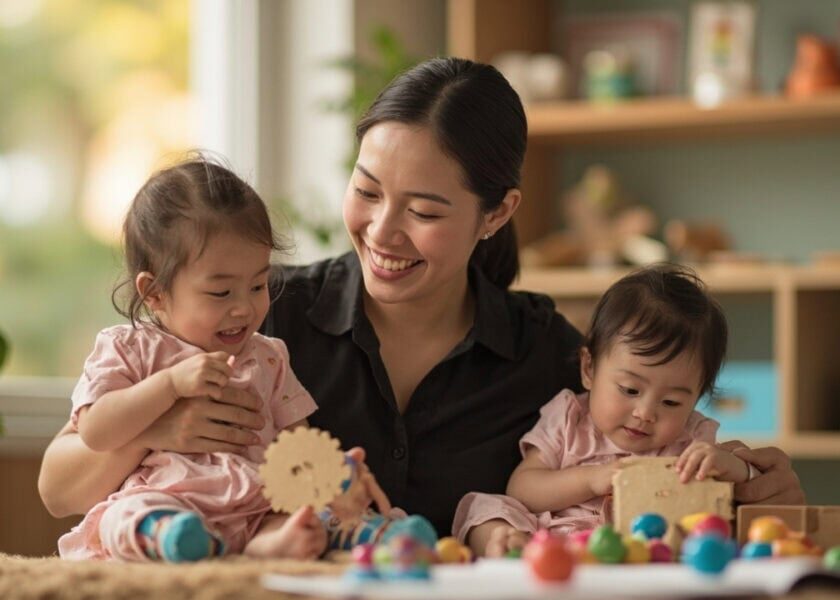
This is why caregiver-to-child ratio matters so much. When a caregiver is responsible for one or two, or at most three, infants, that caregiver has the bandwidth to notice. They are not managing a classroom. They are building a relationship.
There is childcare that supervises. And there is childcare that cultivates. Supervision keeps children safe and entertained. Cultivation keeps children safe, entertained, and engaged in the slow, profound work of becoming a learner.
Both may look similar on a tour. The toys are clean, the staff are friendly, the ratios are compliant. But the quality that determines whether your child thrives or merely survives is not visible on a checklist. It is the quality of attention your child will receive, day after day, in the most important developmental window they will ever have.
Understanding Your Child’s Learning Style
You are not simply choosing a service. You are choosing a partner in your child’s development. And the best way to choose well is to become, if you are not already, a student of your own child.
Before you evaluate any programme, before you ask about curriculum or qualifications or meal plans, spend time noticing your child:
- How do they respond to new situations?
- How do they handle frustration?
- What makes them light up? What makes them withdraw?
- Do they need time to observe before they participate, or do they need to dive in headfirst to feel truly engaged?
- Are they energized or drained by social interaction?
- Do they seek patterns and order, or do they prefer spontaneity and surprise?
These are not personality quirks. These are the early signatures of your child’s learning style, and they are more visible in the first three years than they will ever be again.
A child who is highly sensitive to sensory input at age one may become an artist or a scientist or a deeply empathetic human being, depending on whether that sensitivity is nurtured or pathologized. A child who is relentless in pursuing their own agenda at age two may become a leader or an innovator or a fierce advocate for justice, depending on whether that persistence is channelled or suppressed.
The childcare you choose will either honor these tendencies or try to correct them. This is why the question of fit is so important. There is no universally best childcare. There is only the childcare that is best for your child—which means the childcare whose philosophy and practice are aligned with your child’s nature.
How EduNanny Approaches Childcare
What we have been describing—temperament-aware, observation-driven, relationship-based care—is not abstract to us. It is the reason EduNanny by BUTLER exists.
EduNanny operates within the ECDA Childminding Pilot, and this framework reflects a recognition at the policy level that not all children thrive in centre-based settings. Home-based care, when it meets rigorous standards, offers something that institutional care cannot: the intimacy of a small environment, the consistency of a familiar space, and the ratio of one to three infants that allows for the kind of individual attention we have been discussing.
Our childminders are trained, supported, and held to standards that ensure quality. Our model is not a casual arrangement. It is a professional service that brings intentionality to every aspect of care.
For many parents, the cost of quality childcare feels like a barrier. Within the pilot framework, fees are structured to be accessible, and the use of CDA and Baby Bonus funds is supported. Monday to Friday care blocks accommodate the rhythm of working parents. Communication with families is a priority: transparency about the day, about what your child is experiencing, about the small moments that add up to development.
These details are not selling points. They are answers to questions you are already asking. You want to know that the people caring for your child are qualified. You want to know that the environment is safe. You want to know that you will be told what happened when you were not there. These are not unreasonable demands. They are the minimum requirements of trust.
Questions You Might Have
“How do I know if a caregiver will truly understand my child?”
You will not know for certain until you try—but you can look for signs during your interactions. Ask yourself: Does the caregiver seem genuinely curious about your child as an individual, or do they seem focused on routines and compliance? When you describe your child’s temperament, do they respond with recognition and practical strategies, or with reassurances that everything will be fine? Do they ask about your child’s preferences, fears, and patterns—or do they assume all children are basically the same? The best caregivers are students of the children in their care. They are not applying a formula. They are building relationships.
“Is home-based care safe?”
Safety is not about the type of arrangement but about the standards it meets. Within the Childminding Pilot, EduNanny childminders are held to clear safety requirements, including background checks, training, and home environment standards.
“What if I choose wrong?”
You may adjust. You may change arrangements. You may discover that what worked at six months does not work at eighteen months. The pressure to find the “perfect” arrangement is often the enemy of finding a good one. Your child is resilient. Your instincts are good. The fact that you are asking these questions means you are paying attention—and that attention is the most important thing you bring to this decision.
A Practical Path Forward
If you are ready to move from anxiety to clarity, here is where to begin:
- Observe your child. Spend a week simply noticing. How do they respond to new experiences? What calms them? What excites them? What exhausts them? You already know more than you think you do.
- Define what you most want for them. Not in abstract terms, but specifically. Is it resilience? Curiosity? Social confidence? Security? Let these priorities guide your search.
- Ask the right questions on visits. Instead of “What curriculum do you use?” try “How do you handle a child who is struggling with transitions?” or “Can you describe a time when you noticed something about a child that their parents had not mentioned?”
- Trust your intuition. There is a moment, when you visit a childcare environment, when you can feel whether this is the right fit. Watch the caregiver interact with children who are not yours. Notice whether they are truly present, truly curious, truly attuned. Then imagine your own child in that space—and notice what you feel.
- Know that you can adjust. The first choice is not the last. You are not locked in forever. What matters most is that you are paying attention, and that you remain willing to ask whether the arrangement is still working as your child grows.
Your Child’s Natural Way of Learning Is a Gift
Every child arrives in this world with a set of tendencies that are already, at eighteen months or two years, remarkably distinct. Your child is not a blank slate. They are not a project to be optimized. They are a person with preferences, strengths, sensitivities, and a style of engaging with the world that is entirely their own.
The childcare you choose will either be a mirror that reflects their nature back to them—affirming it, building on it, helping them feel seen and understood—or a correction, a refinement, a gentle and well-intentioned attempt to shape them into something that is easier to manage, easier to educate, easier to compare.
This is the damage that quality childcare can prevent. Not by shielding children from challenge, but by meeting them where they are—by believing that their approach to the world is worth understanding rather than correcting.
The right childcare for your child is not the most expensive, or the most prestigious, or the one with the most impressive facilities. It is the one that will see your child clearly. That will honor their temperament rather than strain against it. That will scaffold their emerging approach to the world with patience, curiosity, and genuine care. That will communicate with you, transparently and consistently, about what they observe, what they wonder, what they are learning about your child that you might not see as clearly from inside your own love.
This is what EduNanny is designed to offer. Not perfection—because no care arrangement is perfect, and the search for perfection is often the enemy of finding what is right. But alignment. Intentionality. A commitment to understanding each child as the individual learner they are, and building an environment that nurtures rather than merely supervises.
You are making this decision not for a stranger’s child but for your own, with love and anxiety and the best intentions you can bring to it. That is enough. That is more than enough.
The fact that you are taking it seriously is the evidence that you are ready to make it well.
If you are ready to explore whether EduNanny’s approach is the right fit for your family, we invite you to schedule a conversation with our team or learn more about our approach.
Childcare Singapore · Infant Care Singapore · Childminding Pilot