What Quality Near-Home Care Quietly Builds in Your Child
The Quiet Moment After Pick-Up: What Quality Near-Home Care Actually Builds
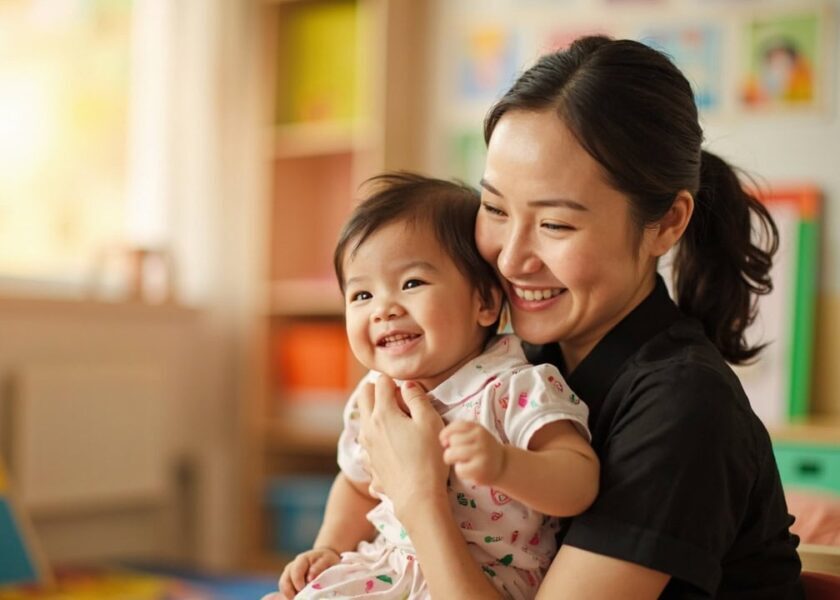
There is a moment that every parent who has chosen quality near-home care eventually recognizes. It does not announce itself. It is not dramatic. It arrives quietly, often in the ordinary minutes after you have collected your child and are walking home together, or settling into the car after a long day.
Your child says something. Makes a gesture. Responds to another child with an ease that surprises you. And you think, without quite articulating it: where did that come from?
That moment is not accidental. It is the visible edge of something that has been building for months, quietly and consistently, in the hours you were not there to witness it. It is the result of a decision you made perhaps when your child was still an infant, a decision that felt significant at the time but whose full shape you could not yet see.
You chose not just a childcare arrangement. You chose a developmental environment. And your child is now showing you what that environment has been building.
What happens in those early years does not stay in those early years. It accumulates. It shapes. It creates a trajectory.
What Quality Near-Home Care Builds Over Time
- Secure attachment that becomes the internal working model for all future relationships
- Emotional vocabulary built through months of consistent attunement and responsive caregiving
- Social confidence developed through small-group interaction in a warm, managed environment
- Language acceleration from language-rich environments where communication is a bridge, not a barrier
- Executive function foundations constructed through routine, warmth, and supported independence
- Preschool readiness that goes beyond academic content to include curiosity, persistence, and resilience
Why the Early Years Are Not a Waiting Room
The first thing to understand is that the early years are not a pause before real development begins. They are, in the most literal sense, the foundation. Not a metaphor for the foundation. The foundation itself.
The brain architecture that will support your child’s thinking, feeling, and relating for the rest of their life is being built right now, in these years that can feel so consuming and uncertain in the moment but are, in reality, extraordinarily generative.
Developmental science has been telling us this for decades. But what is less often discussed is this: the quality of care during these years does not merely influence outcomes. It compounds them.
A child who experiences consistent, attuned caregiving in the first two years of life does not simply feel secure in that moment. They build an internal working model of what relationships feel like, what the world is like, what they can expect when they venture out and explore. That model becomes the template. And templates, once established, tend to reproduce themselves.
How Compounding Works in Practice
In the early months, a child in quality near-home care is learning something profound: that their signals matter.
When they are hungry, someone responds. When they are distressed, someone comes. When they are curious, someone notices and names what they are looking at. This is attunement, and it is the scaffolding upon which emotional regulation will eventually be built.
The child is not learning to be quiet or to wait indefinitely. They are learning that they exist in relation to responsive others. That their needs register. That the world is, fundamentally, a place where they can make their presence known and expect to be met.
Secure children explore more. They take more informed risks. They approach new situations with curiosity rather than fear because they carry within them the quiet confidence that if things become difficult, there is a base to return to.
The Social Emergence: How Quality Care Fosters Peer Readiness
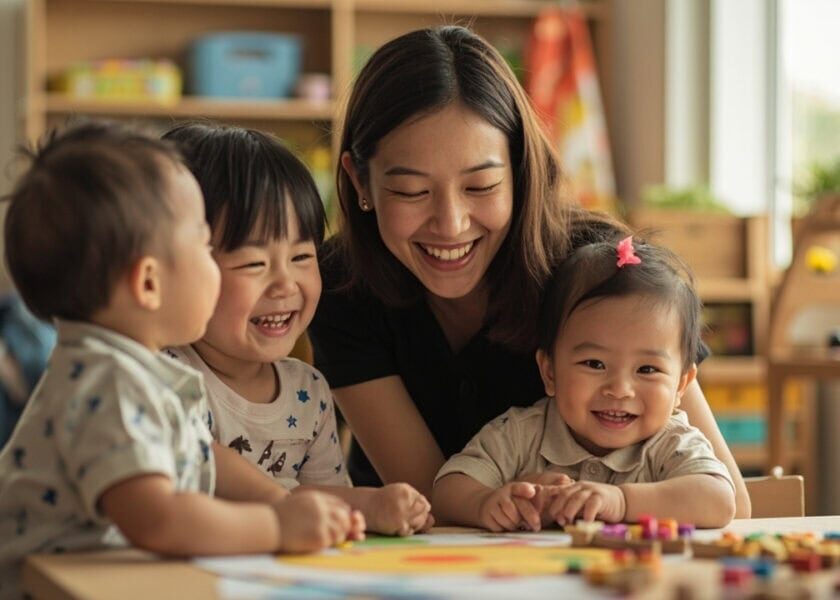
That same child, now a toddler, begins to play alongside others. In a near-home environment with a small group of children, they have opportunities to practice social interaction in a setting that is still managed, still warm, still attuned to their individual rhythms.
The toddler who has been securely attached is not necessarily a social natural, but they are more likely to attempt interaction. They are more likely to negotiate, to share, to recover from the inevitable social friction of early childhood. They have the emotional infrastructure to hold the frustration of a playmate not giving them the toy they want. They have the vocabulary, built through months of responsive caregiving, to say what they need.
In a small near-home setting, your child learns:
- How to notice and respond to other children’s emotional states
- How to wait, take turns, and navigate temporary disappointment
- How to use words instead of actions when frustrated
- How to approach a group of playing children and join in
- How to recover from a social setback and try again
These are not lessons delivered through instruction. They are absorbed through the daily texture of supported peer interaction.
Language and Executive Function: The Capacities That Make Learning Possible
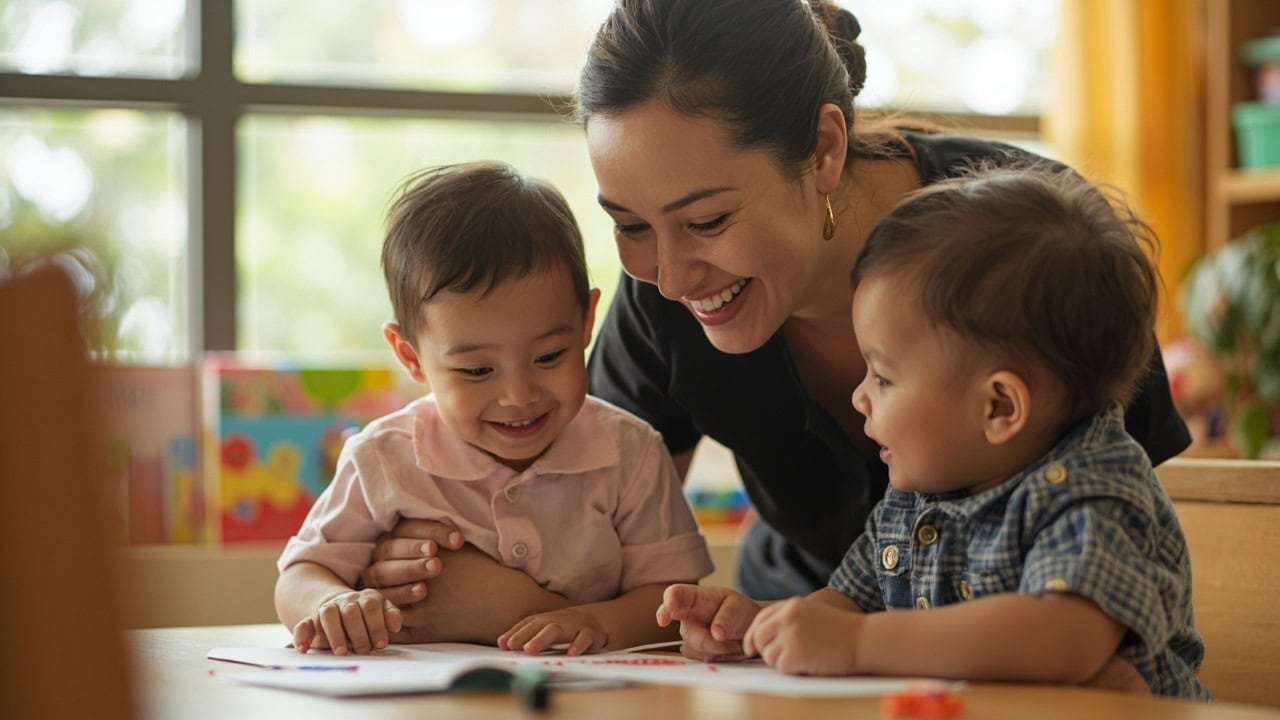
Language development follows a similar trajectory. Children in language-rich environments do not simply learn more words faster, though they do. They learn the rhythm of conversation, the back-and-forth of communication, the pleasure of being understood.
When a caregiver consistently narrates what a child is experiencing, names their emotions, and responds to their attempts at communication with genuine engagement, the child absorbs not just vocabulary but the architecture of communication itself.
A two-year-old who has experienced months of responsive caregiving enters preschool with something more valuable than a memorized vocabulary list. They enter with the understanding that communication is reciprocal—that when they speak, someone listens, and when someone else speaks, it is their turn to listen.
This is the foundation for everything that follows: classroom participation, teacher relationships, later literacy, the ability to advocate for themselves, the capacity to navigate conflict with words rather than escalation.
By the time this child approaches preschool age, these accumulated experiences begin to coalesce into school readiness—not the narrow, test-based readiness that the word sometimes implies, but a deeper readiness: the ability to be in a group, to follow a routine, to manage transitions, to persist at a task even when it is challenging, to regulate the emotions that arise when things do not go as hoped.
Executive function—the set of cognitive skills that allows us to plan, focus, manage impulses, and adapt to changing demands—is being built through the ordinary architecture of a well-structured day:
- The consistent routine that helps a child predict what comes next
- The warm but clear boundaries that help them understand the shape of acceptable behavior
- The supported peer interactions that require navigation of social complexity
- The caregiver who notices when a child is becoming dysregulated and helps them name and manage what they are feeling
What Quality Near-Home Care Looks Like in Singapore
Understanding what quality builds is one thing. Understanding what quality actually looks like in practice is another. For parents navigating options in Singapore, it helps to be specific about what to look for—not as a rigid checklist, but as a framework for discernment.
Signs of a Quality Near-Home Environment
Attunement in action: Watch for caregivers who notice what children are noticing. Who name what they see. Who respond to a child’s attempt at communication with genuine engagement rather than reflexive correction.
Emotional warmth without permissiveness: Children in quality care are not simply allowed to do what they want. They are held with warmth while being taught the shape of acceptable behavior. The boundary is clear; the relationship remains safe.
Small group dynamics: For children under three, smaller is genuinely better. In a group of one to three children, each child receives individual attention that is simply not possible in larger settings. This is not luxury—it is developmental necessity.
Consistent caregiver relationships: Your child should be building a real attachment to their caregiver over time. Frequent caregiver changes undermine the attachment security that is the foundation for everything else.
Transparent communication: You should feel informed about your child’s day—not just through formal reports, but through the kind of natural exchange that happens when a caregiver genuinely knows your child.
The EduNanny Model Within the ECDA Framework
Singapore has made significant investments in early childhood through ECDA, with regulatory standards, childcare options, and subsidy structures that recognize the economic reality of raising children here. Yet for all this infrastructure, the question of what constitutes quality care remains one that parents navigate with more uncertainty than they should have to.
For parents who want the warmth, consistency, and individualized attention of home-based care alongside the accountability, training, and transparency of a structured service, the options have been limited. The ECDA Childminding Pilot opened a pathway that honors both of these needs, and EduNanny has built its model within and around that framework.
Imagine a small, carefully prepared environment where your infant or young child is one of at most three children in the caregiver’s care. Not a room of fifteen infants managed by two overwhelmed educators. Not a home converted into a childcare facility without thought for the developmental needs of young children. But a true near-home environment: warm, predictable, attuned, and designed with the understanding that children under three need something qualitatively different from older children.
When you choose near-home care through EduNanny, you are not choosing between warmth and professionalism. You are choosing an environment where both are the baseline.
- Monday to Friday care blocks that align with working parents’ actual schedules
- Fee structures designed to be accessible within the Pilot framework
- The ability to use your Child Development Account and Baby Bonus funds, which means the financial architecture Singapore has put in place to support families actually works for you
- Transparency measures, including communication practices and, where deployed, CCTV systems that allow you to feel connected to your child’s day even when you are not physically present
This is not surveillance. It is partnership. The kind of partnership that allows you to go to work knowing that your child is not merely being watched but being cared for in the deepest sense of that word.
Addressing What Parents Actually Worry About
“How do I know quality care is actually happening when I’m not there?”
You cannot be there every moment, and no honest provider should pretend otherwise. What you can have is a system designed for transparency: regular communication about your child’s day, consistent caregivers who build real relationships with your family, and where appropriate, infrastructure that lets you see what is happening without intrusive surveillance.
“Is near-home care actually good for my child’s development, or is it just a compromise?”
The research on this is consistent: for children under three, smaller caregiver-to-child ratios are associated with better developmental outcomes across multiple domains—language, social-emotional development, attachment security. Near-home care, when delivered with quality, is not a compromise. For many children, it is genuinely optimal.
“What if my child doesn’t adjust well?”
Adjustment takes time, and it is normal. A secure, consistent caregiver who understands separation anxiety and can support your child through it without judgment or pressure makes an enormous difference. Ask potential providers how they handle transitions and adjustments. The answer reveals a great deal about their understanding of child development.
“Can I afford quality near-home care?”
Singapore has built a support structure around early childhood that you may not be fully utilizing. CDA and Baby Bonus funds can be applied through the Pilot framework, and subsidies are available depending on your circumstances. The cost conversation is worth having directly with EduNanny, because the full financial picture may be more favorable than you assume.
The Children Who Arrive Ready
Here is what we have observed, watching children move through quality near-home care over time: the children who have had this experience do not merely adapt to preschool. They arrive ready.
They have the social confidence to engage with new children and new adults. They have the emotional vocabulary to express what they need. They have the regulatory capacity to manage the inevitable transitions and frustrations of a school day.
This readiness is not about academic content. It is about the foundational capacities that make all subsequent learning possible:
- The capacity to be curious
- To persist
- To recover from setback
- To be in relationship with others
These are not soft skills. They are the hard currency of a successful life, and they are built in the early years, in the daily experiences of quality care.
What Quality Care Means for Your Child’s Future
The investment you are making is not in supervision. It is not in logistics. It is in the foundational architecture of a human life.
It is in the social confidence, the emotional regulation, the language and curiosity and executive function that will serve your child not just in preschool but in primary school, in secondary school, in their relationships, in their work, in their capacity to navigate the complexity of modern life with resilience and grace.
Caring for young children is demanding, often invisible work. The caregivers who show up day after day, who attune to children’s needs, who manage the beautiful chaos of early childhood with patience and warmth—EduNanny’s model invests in their training, creates career pathways that recognize expertise, and builds a culture that sees childminding as skilled, meaningful, and worthy of dignity.
Your Child Is Becoming Someone Extraordinary
None of this happens in a day. This is why the question of childcare is not merely a logistical question. It is a question about what environment you want to be the daily context of your child’s early development.
The child who enters preschool with social confidence, emotional vocabulary, and the beginnings of executive function did not arrive there by chance. They arrived there because for two or three years, they lived in an environment that was quietly and consistently building the capacities they now carry.
You are not merely making a logistical decision when you choose childcare. You are making a statement about what you believe your child deserves. You are investing in a trajectory that will unfold over years, in ways you can partly see and partly cannot.
The child who greets you with excitement when you collect them, who tells you about their day with new words and new stories, who plays imaginatively and negotiates conflicts with growing sophistication, who approaches new situations with curiosity rather than fear—that child is the visible evidence of accumulated experience.
When you notice something small but significant has shifted in them, know what you are seeing. You are seeing the result of months and years of consistent, warm, attuned care. You are seeing the visible edge of a developmental trajectory that began the day you made the choice to invest in quality. You are seeing who your child is becoming.
And who they are becoming is remarkable.
A Note for Parents at the Beginning of This Journey
If you are reading this while your child is still an infant, if you are in the early weeks of navigating childcare decisions, if you are feeling the weight of a choice whose full shape you cannot yet see—know this:
The decision matters. The environment you choose for your child in these early years is not interchangeable with any other environment. It is formative. It is shaping the person your child is becoming.
And you are capable of making this decision well. Not perfectly—no parent does. But well enough. With attention, with intention, with the willingness to look beneath the surface of logistics and ask what kind of developmental environment you are choosing.
Quality care is available in Singapore. It is possible to find it, to recognize it, to trust it. And when you do, something extraordinary begins to happen—not just for your child, but for your whole family.
EduNanny exists because we believe that Singapore families deserve care options that honor the significance of these early years. We have built our model around the understanding that what happens in the first thousand days of your child’s life does not stay in those first thousand days.
It compounds. It creates. It shapes who your child becomes.
Because this is the long game. And it is the most important game you will ever play.
Your child is becoming someone extraordinary. And the environment you choose is part of why.