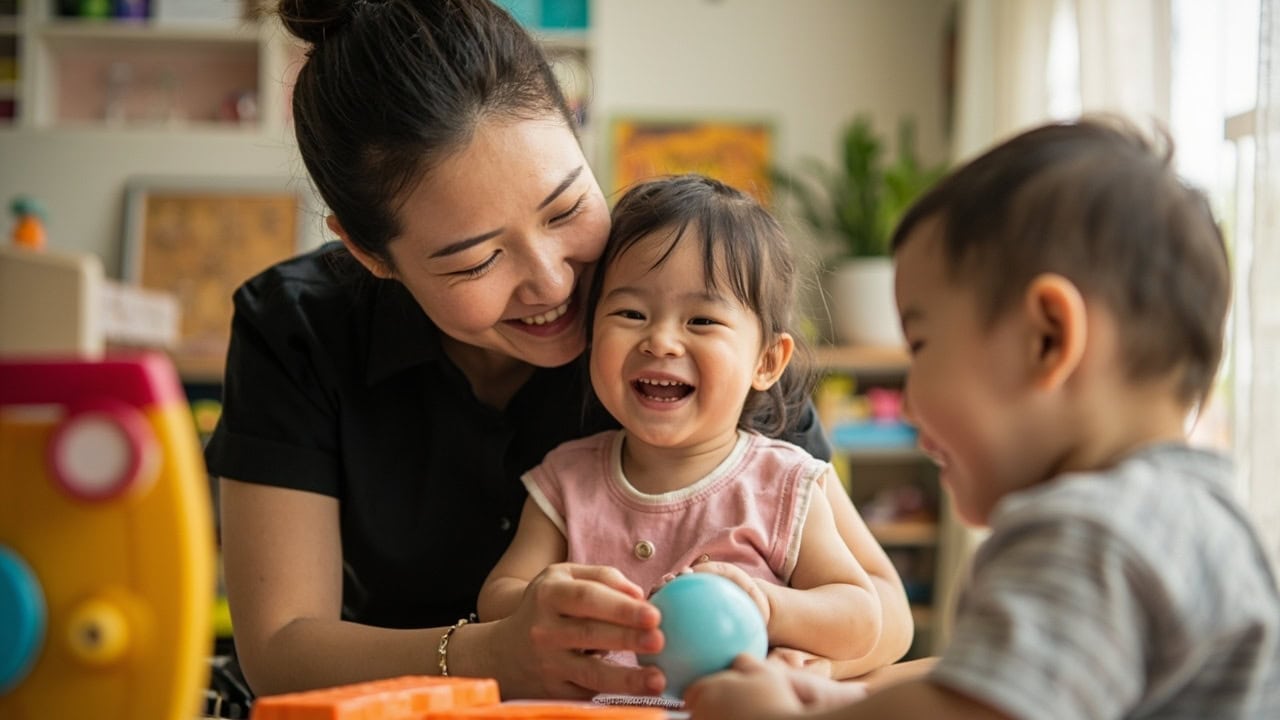
Why Singapore Parents Should Trust Their Parental Intuition
Quick Summary
- Your instincts are valid. Research in developmental psychology and infant neuroscience confirms that parents develop a genuine, measurable ability to read their child’s emotional and physical state.
- The gap you feel is not a failure. That uncomfortable space between what others advise and what you intuitively sense is a sign of attunement, not a parenting weakness.
- Science supports what you already know. When you notice your child’s fatigue signals, hunger cues, or readiness for new experiences, you are processing complex, real data — not guessing.
- Quality childcare extends your attention, not replaces it. The right caregiver becomes a trusted partner who respects and integrates with your understanding of your child.
The Science Behind What You Already Know
Studies in developmental psychology and infant neuroscience have shown, consistently and compellingly, that parents — particularly in those early years — develop a remarkably refined ability to read their child’s emotional and physical state.
This is not sentiment. It is not wishful thinking. It is attunement: the ongoing, dynamic process of learning to interpret a being who cannot yet use words to tell you what they need.
Researchers have long called this parental intuition, and the term carried a slightly dismissive air — as if it were a polite way of saying educated guess. But the data tells a different story.
When parents accurately read their infant’s hunger cues, fatigue signals, and threshold for stimulation, they are not guessing. They are processing complex, multi-channel information: facial expression, body tension, vocal quality, and pattern recognition built over months of close, daily contact. And arriving at a read that is often remarkably precise.
Real Examples of Attuned Parenting
- A parent who notices their toddler is about to unravel before the meltdown arrives.
- A mother who senses her infant is ready to transition to solids — not because of a chart but because of the way her child watches food, reaches for it, seems interested in a new kind of hunger.
- A father who knows that his child’s particular whine means I am overtired and need to be held differently tonight.
These are not superstitions. These are data points that the parent’s brain has been quietly collecting and analyzing since birth, building a model of this specific child that no checklist and no generic developmental guide can replicate.
The parent’s unique expertise — the intimate, accumulated knowledge of this particular child — is not a soft skill waiting for validation. It is a real form of expertise that science is now beginning to explain.
The Landscape of Modern Singapore Parenting
There is a particular kind of exhaustion that Singapore parents carry, and it is not only the physical tiredness of broken sleep or the logistical marathon of ferrying a child between activities. It is the cognitive and emotional weight of navigating a landscape where every decision seems to require a panel of experts to sanction it.
Grandparents say one thing. The internet says another. A friend who is also a mother says something completely different. The clinic offers a third perspective. And in the middle of all that noise sits a parent — often with very little sleep, often navigating work pressures, often managing the expectations of an extended family — trying to figure out what is actually right for their child.
We know this landscape. It is not unique to Singapore, but it has a particular texture here. Shaped by the extraordinary value we place on family, on education, on doing right by the next generation. Shaped by a society that moves fast, where the conversation about a child’s development can feel like it starts before the birth certificate is even printed.
The modern parent in Singapore is often caught between worlds:
- Between what the previous generation did and what current research recommends.
- Between what looks impressive and what actually works.
- Between the expert and the inner voice.
That gap — that persistent, uncomfortable space between what others say and what you instinctively feel — can start to feel like evidence that your own judgment is unreliable. We want to take that feeling seriously. Not to dismiss it, not to pile reassurance on top of it, but to sit with it honestly and ask a different question:
What if my ability to sense my child’s needs is not a soft instinct that needs to be validated by science — but a real form of expertise that science is now beginning to explain?
Where This Tension Becomes Real: The Childcare Decision
For many Singapore parents, the decision about who will care for their child is not simply a logistics decision. It is an emotional one. Wrapped up in guilt, in identity, in cultural expectations, in the very real question of what kind of care will honor the bond that parent has worked so hard to build.
And into this already tender space comes a flood of advice:
- What the child needs is consistency.
- What the child needs is social exposure.
- What the child needs is to learn independence.
- What the child needs is to stay close to primary attachment figures.
Here is what research actually tells us about what infants need: they need attunement. They need a caregiver who is responsive, who can read their signals, who can adjust.
And this is precisely where the modern Singapore parent is, perhaps without fully realizing it, already ahead of the curve. Because attuned parenting — the kind that responds to the child rather than the clock, that reads readiness rather than just applying a rule — is exactly what the research identifies as the foundational competency in early development.
What Quality Childminding Actually Looks Like
So if attunement is what children need, what does quality childminding look like in practice?
It begins with ratios. Research consistently shows that young children, especially in their first years, benefit enormously from smaller care environments where the adult-to-child ratio allows for genuine responsiveness. When one caregiver is responsible for fewer children, they can notice what a parent would notice — the subtle shift in mood, the early sign of tiredness, the moment when a child needs engagement versus when they need stillness.
It continues with communication. Parents consistently tell us they need:
- Transparency. To know what is happening during the day.
- Trust. In the person caring for their child.
- Alignment. To feel that care is an extension of their own values and attention, not a departure from them.
And it depends on partnership. The caregiver is not a substitute for the parent. The caregiver is a trusted extension of the parent’s attention — someone who has taken the parent’s understanding of the child seriously, who communicates about what they observe, who adjusts based on the parent’s insights.
The parent who chooses childcare carefully is not abandoning their role as the primary expert on their child. They are deepening it. They are saying: I know what my child needs, and I am building the right environment for those needs to be met.
EduNanny Singapore: Built Around Your Read of Your Child
This is the question that shaped EduNanny Singapore from the very beginning. Not as a platform that tells parents what their children need, but as one that asks: how do we become a partner to the attunement you already have?
EduNanny operates within the ECDA Childminding Pilot, and this matters not just as a regulatory detail but as a philosophy. The pilot framework recognizes something that has long been understood in developmental research but not always reflected in how childcare is structured: that young children benefit enormously from smaller care environments where responsiveness is possible.
EduNanny offers up to one-to-three infant ratios in its home-based pathways, creating the kind of setting where a caregiver can notice what a parent would notice. It is care built around the rhythms of the child, not the other way around.
For parents who need both — who find that centre-based programmes and home-based care serve different purposes in their family’s life — EduNanny provides access to both pathways, community-based and centre-based, across Singapore. Because families are not uniform. Children’s needs are not uniform. A service that respects that variety is one that respects the intelligence of the parent making those decisions.
How EduNanny Supports Your Attunement
EduNanny addresses the real needs parents have through concrete, transparent practices:
- Regular communication with families about how the day unfolds.
- Openness about how care is delivered and how observations are shared.
- Where deployed, CCTV measures that provide an additional layer of assurance without replacing the fundamental trust that must exist between parent and caregiver.
These are not gimmicks. They are the kind of practical considerations that let a parent breathe a little easier, that allow them to focus on their work or their own wellbeing knowing that their child is in a setting where their instincts are being respected and extended by the caregiver.
Addressing Common Concerns
Will childcare replace my bond with my child? The research on attachment tells us that what matters is not the number of hours a parent spends with a child, but the quality of attunement in those hours — and the consistency of a responsive caregiving environment overall. A childcare arrangement that extends your attunement does not compete with your bond. It supports it.
How do I know if a caregiver will really understand my child? Look for caregivers who ask about your child’s rhythms, preferences, and cues — not just schedules. Look for regular, substantive updates that go beyond “baby ate and slept well.” Look for communication that flows both ways — where your observations are welcomed and integrated.
What if I feel guilty about returning to work? The choice to engage childcare is not a failure of parenting. It is, in many cases, the most responsible and loving decision a parent can make — to build a team around their child, to ensure that the attention their child receives matches the quality of attention they would receive at home. That guilt is a signal of love, not a verdict on your choices.
Navigating Comparison Culture and Choosing With Confidence
There is another dimension to this that matters enormously in the context of modern Singapore parenting. We live in a comparison culture that is more intense than perhaps any generation before us has experienced.
Social media, parenting forums, WhatsApp groups — the relentless visibility of other people’s choices, other people’s children, other people’s outcomes — creates a background hum of evaluation that is difficult to escape.
- A parent who is nursing an older toddler hears that breastfeeding should have ended at twelve months.
- A parent who practices gentle parenting is told their child will lack resilience.
- A parent who sends their child to a centre is asked why they are not keeping the child home.
- A parent who keeps their child home is asked why they are not socialising the child.
The fire is coming from all directions, and the parent is expected to hold their ground with composure and quiet confidence.
But here is the thing about confidence that is worth stating plainly: it is not the absence of doubt. It is not a feeling of certainty that never wavers.
Real confidence in parenting is something quieter and more durable than that:
- The ability to hold your own observations alongside other information and make a considered judgment.
- The willingness to say, I have looked at the research, I have listened to what people I trust have to say, and based on what I know about this specific child in front of me, this is what I believe is right.
- The willingness to act on your read of your own child even when others disagree — not out of stubbornness, but out of deep respect for the relationship you have built.
Questions Worth Asking
If you are researching childcare options, here are the questions worth asking — not just of providers, but of yourself:
- Who will be caring for my child, and can I see them interact with children? Look for responsiveness, warmth, and the ability to adapt to a child’s signals rather than rigid adherence to routine.
- What are the ratios, and why do they matter? Fewer children per caregiver means more space for attunement. Ask specifically about how the setting allows for individualized attention.
- How will I know what happens during the day? Ongoing, substantive communication is not a luxury — it is how your attunement extends into the hours you are apart.
- How will my knowledge of my child be integrated? The best childcare arrangements treat you as the primary expert. Ask how your observations, preferences, and insights will shape the care your child receives.
- Does this feel right for my child? Trust the same attunement that brought you this far. If something feels off during a visit, take it seriously.
Science, at its best, does not undermine that kind of confidence. It reinforces it. It says: your attunement is real. Your observations have value. Your judgment, informed by knowledge and sharpened by daily attention to your child, is a legitimate form of expertise.
Trust It
Here is the truth that sits at the heart of everything we have talked about today: your child has been communicating with you since the moment they were born. Before words, before formal milestones, before any developmental chart existed to measure them, they were telling you who they are.
And you — with all the messiness and exhaustion and uncertainty that comes with it — have been listening.
That is not a small thing. That is the most important thing.
The science is catching up to what you already know. The question now is not whether your instincts are valid. They are. The question is simply: what kind of support do you need to trust them fully and act on them with clarity?
EduNanny Singapore is here as part of that answer. Not to tell you what your child needs. To listen alongside you. To extend the care you have already begun. To be the kind of partner that takes your read of your own child seriously, communicates with you honestly, and holds your confidence in the way it deserves to be held.
Because parenting in Singapore is complex, and it is demanding, and it asks a great deal of you. But it does not ask you to set aside the most important expertise you have — your knowledge of your own child.
That expertise is not a feeling to be managed. It is the foundation on which everything else rests.
Trust it. And let us build from there.
Ready to explore childcare arrangements that honor your attunement? Connect with EduNanny Singapore to learn how our childminding pathways can extend the care you have already begun.
Learn more about EduNanny’s ECDA-registered childminding programme or return to the EduNanny homepage.