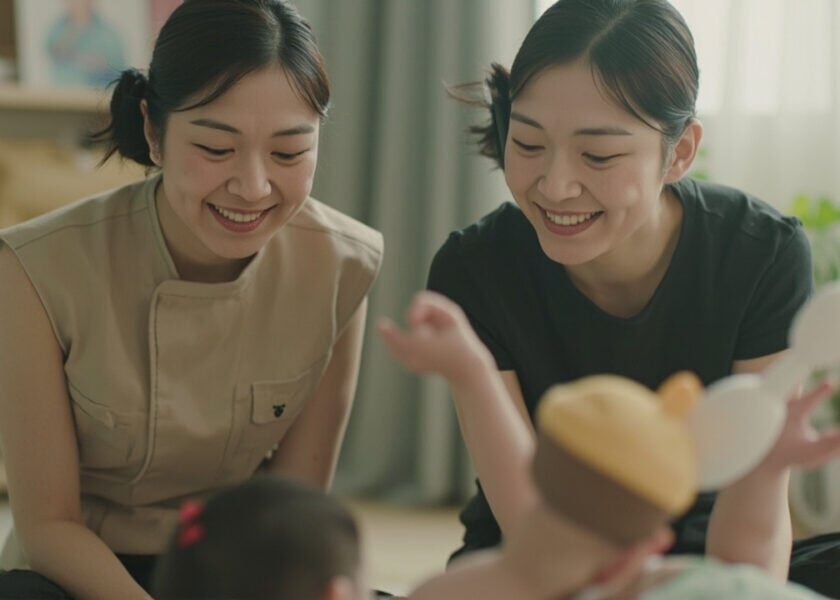
What Your Child Actually Needs: A Framework for Evaluating Quality Childcare in Singapore
Recognising Quality: Why Credentials Alone Are Not Enough
You walk into a childcare centre. The toys are neatly arranged. The walls are brightly painted. The caregiver smiles and greets your child by name. You take the tour. You ask the questions. You leave feeling cautiously optimistic.
And then, in the days that follow, a quiet question settles somewhere in your chest and refuses to leave.
Did I make the right choice? Is this person genuinely connecting with my child? Is my baby thriving in ways I cannot see?
That question is not weakness. It is the most important question a parent can ask. In a city as well-resourced and well-informed as Singapore, we have built an entire childcare infrastructure that asks parents to evaluate quality based on credentials, certifications, centre ratings, and tour impressions—while giving them almost no language for assessing what actually matters when a caregiver sits down on the floor with a one-year-old who has just dropped a toy for the fifteenth time and does not yet have words for frustration.
Here are the observable indicators that distinguish quality care. You do not need to be an expert to recognise them. You need a framework for trusting what you already sense.
- Caregiver responses that reflect understanding rather than scripted rule-enforcement
- Eye contact and tone that communicate genuine presence, not just attention
- Transitions handled with patience and language that acknowledges a child’s experience
- An environment that invites exploration, not merely contains it
- Communication that shows your child is seen as an individual, not a task to be managed
- Ratios that allow attunement—especially important in infant care
- Welcoming of parental observation beyond scheduled visits
Supervision and Care: The Difference That Shapes Development
Singapore parents are fortunate. The city-state has invested heavily in early childhood infrastructure, and most centres operate with genuine professionalism. But the standards we have built are designed for institutions and regulators, not for the parent standing in the hallway at 8 a.m., watching their child reach for a stranger’s hand.
When you evaluate a childcare centre, you are given metrics. Teacher qualifications. Centre ratings. Safety certifications. Curriculum frameworks. These matter. But they do not tell you what you most need to know.
They do not tell you whether the caregiver who will spend six or eight hours a day with your child understands that a toddler dropping a block repeatedly is not being naughty but is conducting an experiment. They do not tell you whether that same caregiver will notice the first signs of frustration before your child escalates into a full tantrum—or whether they will only intervene once the tears become screaming.
There is a difference between supervision and care that has consequences your child will carry. Not in dramatic ways. In quiet ways.
In the way a child learns to regulate emotion based on whether an adult nearby noticed the first signs of distress or only intervened once tears became screaming.
In the way a toddler begins to understand that their communication matters based on whether a caregiver paused what they were doing to listen to a half-formed sentence.
In the way a baby develops trust in the world based on whether the response that came felt warm, predictable, and attuned—or mechanical, hurried, and distracted.
This is what we mean when we talk about quality. And this quality is observable.
Understanding Attunement: What Quality Looks Like in Practice
Let me offer you a specific moment. One you can look for on your next visit.
A caregiver is sitting at a low table with three toddlers. One child pushes a block off the table deliberately.
Most adults in this situation will say “no” and pick up the block. A caregiver who understands attunement will do something different. They will look at the child—not just glance, but really look—and say, in a tone that matches the child’s evident interest rather than the caregiver’s own agenda: “You’re curious about what happens when it falls.”
The child did not push the block to cause trouble. The child pushed it to experiment. And the caregiver named that inner world.
That is the difference between managing behaviour and understanding development.
You might think this is a subtle distinction that only a specialist would catch. But pause and ask yourself: did you feel the difference when you read it? There was something in your body that recognised the second response as better. That recognition is what we want to sharpen.
How to Apply This When Visiting a Centre
When you visit a childcare setting, watch for this: does the caregiver’s response seem to come from an understanding of what the child is experiencing, or does it come from a script of rules?
- You will see it in the quality of their eye contact. Is it present and engaged, or distracted and performative?
- You will hear it in the tone of their voice—not the volume, but the warmth and presence carried in how they speak to children.
- You will notice whether they narrate the child’s experience back to them, because children learn language and self-understanding through this kind of reflection.
Phrases like these are what developmental partnership sounds like:
- “You’re working so hard on that puzzle.”
- “You look really tired today.”
- “I can see you’re proud of that tower.”
It is not elaborate or theatrical. It is quiet, consistent, and grounded in genuine attention.
What Attunement Actually Means
That word gets used a lot in parenting articles. Here is what it actually looks like in practice:
- Attunement is a caregiver who notices when a child’s play is becoming frustrated and adjusts the environment before the child escalates.
- Attunement is a caregiver who sees a child’s face light up and responds to that joy with their own genuine expression, not a polite acknowledgment.
- Attunement is a caregiver who can hold a crying baby and communicate through their body, their voice, and their stillness that the crying is okay, that they are not distressed by it, that they will stay close.
Attunement is the opposite of going through the motions. It is the presence of a person who has made a conscious decision to meet your child where they are, again and again, throughout every ordinary and difficult moment of the day.
This is not a personality trait that some people have and others do not. It is a skill, and like all skills, it can be learned, practiced, and strengthened. It is supported or undermined by the conditions around it—ratio, training, environment, culture. When those conditions are right, attunement becomes the norm rather than the exception.
What to Observe: The Environment and Transitions
The physical environment matters enormously and is almost never discussed in parent guides. A centre can have beautiful, expensive materials and still be developmentally impoverished. What you are looking for is not aesthetic quality but functional design.
Ask yourself:
- Is the space arranged so that children can reach things independently?
- Are there quiet corners and active spaces, or is everything uniform?
- Is there a mix of open-ended materials—blocks, fabrics, natural objects—that invite imagination rather than passive consumption?
- Is there evidence that children actually use the space, or does everything look too pristine, too protected, as if the room is designed to impress adults rather than serve children?
A room that genuinely supports child development will look slightly lived-in. There will be an art corner with work in progress. There will be a dramatic play area with props that have been used and arranged by children. There will be books left open on a low shelf, as if a child was just there.
The environment should feel like a place where children are invited to explore, not merely permitted to exist. A room designed for inspection is not the same as a room designed for children.
Transitions: The Moments That Reveal Most
Think about transitions—the moments that are hardest for young children and most revealing about caregiver quality. Moving from free play to circle time. Cleaning up and moving to a different activity. Walking from indoors to the outdoor play space.
In adequate care, transitions are managed. The caregiver says it is time to stop. Children are redirected. There may be gentle encouragement. There is nothing wrong with this. It is the baseline most centres achieve.
In genuinely attuned care, transitions are supported with language and patience. A caregiver does not simply announce the end of an activity. She approaches the child who is deeply absorbed and offers a bridge: “Two more minutes, and then we will clean up together. I will help you remember where you left off.”
She gives the child a role: “Can you help me carry the books?”
She acknowledges the child’s reluctance because she understands that strong focus is not stubbornness—it is the work of a developing mind that does not yet know how to switch easily between states.
Watch how children respond to transitions. Do they seem anxious or resigned, or do they move with a sense of security? The answer tells you something real about the quality of care being provided.
Evaluating Quality When You Are Not There
This is the anxiety beneath the anxiety for most parents in Singapore. You know that quality is not consistent across every hour of every day. You know that your child may behave differently when you are not watching. You worry about the moments you cannot see.
Here is the honest truth: no evaluation method is perfect. You cannot control what happens in your absence. But you can choose a setting where the conditions for quality are built into the system, not dependent on individual heroism.
What to Ask About Ratio
Ask about caregiver ratios. In infant care, a ratio of one caregiver to three infants is a significant indicator of capacity for attunement. One-to-one care is ideal, but when we talk about group settings, that one-to-three ratio means a caregiver can genuinely know each child—can notice when a child’s cry sounds different, can track individual rhythms of feeding and sleeping, can respond as a person rather than as a position on a roster.
This is not a minor detail. Ratio is the structural foundation that makes everything else possible.
What to Ask About Communication
Ask about communication. Not just whether you will receive daily reports, but how those reports are written. Compare these two approaches:
| Typical Report | Attuned Communication |
|---|---|
| “Wei Ling had a good day.” | “Wei Ling spent a long time watching the other children build with blocks today—she seemed really interested in what they were doing, and at one point she brought a block over to join them.” |
The first is a report. The second is communication. It tells you that someone is paying attention to patterns, interests, and social development. It tells you your child is seen as a whole person, not a set of tasks to be completed.
What to Observe About Parental Access
Ask whether the centre welcomes your observations—not just scheduled visits, but informal drop-ins. Settings that are confident in their quality do not create barriers to parental presence.
Notice how the caregiver speaks to you when you arrive and depart. A caregiver who is genuinely attuned will engage you in a brief, meaningful exchange about your child. They will not just report facts; they will share observations that show they know your child as an individual. They will ask questions. They will listen to what you say and incorporate it into the day.
This pattern of communication is one of the strongest indicators of a true developmental partnership between caregiver and family.
How EduNanny Approaches Quality Care
This is why we need to reframe what we mean when we talk about quality childcare in Singapore. We are not asking whether a centre meets a minimum standard. We are asking whether the model of care being offered makes attunement possible.
Because a model that makes attunement possible is one where your child is not just supervised but genuinely nurtured. Where the caregiver is not just present but attentive. Where the environment is not just safe but stimulating. Where you are not just kept informed but included as a true partner in your child’s care.
EduNanny by BUTLER was built around this understanding.
As part of the ECDA Childminding Pilot, EduNanny operates across both home-based and community or centre-based pathways. This means the model has been recognised as meeting the highest standards of quality care—not retrofitted to meet compliance requirements, but designed with developmental principles at its centre.
With ratios of up to one to three in infant care, EduNanny caregivers have the capacity to truly know each child in their care. This is not a marketing claim. It is a structural commitment to the conditions that make attunement possible.
Care runs Monday through Friday, in structured blocks that provide consistency for children and reliability for families. Fees are structured to be affordable, and CDA funds and Baby Bonus can be used where applicable—because quality care should not be accessible only to those with significant financial means.
EduNanny serves families across Singapore, because every child, in every neighbourhood, deserves the same standard of developmental support.
Transparency as a Standard
Parents deserve transparency, not as a concession but as a standard. Depending on the pathway you choose, EduNanny offers communication measures, daily updates, and in certain settings, CCTV access—so that the distance between you and your child’s day is as small as it can be.
You should not have to wonder what is happening. You should be able to know.
EduNanny has also developed the Thomas AI Chatbot to support families in navigating the realities of parenting and childcare—answering questions, offering guidance, and providing responsive support that mirrors the attunement brought to your child’s care. Because the partnership between EduNanny and your family begins before you walk through the doors and continues in every interaction.
Practical Steps for Choosing Infant Care in Singapore
Whether you choose EduNanny or another provider, here is a framework for making your decision with confidence:
During Your Visit
- Observe how caregivers respond to children—not just whether they are kind, but whether they seem to understand what the child is experiencing
- Watch a transition moment: how does the caregiver handle children who do not want to stop an activity?
- Look at the environment: does it feel lived-in, or does it feel staged for adult inspection?
- Notice the caregiver’s tone of voice—not the volume, but the presence and warmth
- Ask to see beyond the main play area: where do children go when they need quiet?
Questions to Ask
- What is the caregiver-to-child ratio, especially for infants?
- How are daily updates written? Can you see examples?
- Are informal drop-ins welcomed, or only scheduled visits?
- How do caregivers handle a child’s distress or frustration?
- What training do caregivers receive in child development, not just safety protocols?
Red Flags to Notice
- Responses that sound scripted or rule-focused rather than child-focused
- An environment that looks too pristine—as if children are not encouraged to use it fully
- Communication that reports activities but reveals no insight into your child’s experience
- Resistance or barriers to parental observation or informal visits
- Staff turnover that seems high—consistency matters for young children
Trusting What You Sense
The next time you walk into a childcare setting, you will notice the difference between a caregiver who is managing a room and one who is joining a child’s world. You will notice the quality of eye contact, the patience in transitions, the language that reflects a child’s inner experience back to them.
You will notice whether the environment invites exploration or merely contains it. You will notice whether communication feels like partnership or performance.
You will notice more because now you know what you are looking for.
And if, after looking, you see the signs described here—the quiet, consistent evidence of a caregiver who is genuinely present, genuinely responsive, genuinely invested in your child’s development—then you will know. Not because someone told you to trust your instincts, but because your instincts have been given language, structure, and something real to hold onto.
This is what EduNanny is here to provide. Not just care. But the kind of care that sees your child. That meets your child. That honours the trust you are placing in us every single day.
That is not a bonus. For us, it is the baseline. It is the starting point. It is the only standard we know how to uphold.
We would be honoured to walk this path alongside you.
Ready to learn more about EduNanny’s approach to quality infant care? Reach out to discuss how we can support your family.
#EduNannySingapore #QualityChildcare #InfantCareSG #ChildmindingSingapore #AttunementInCare