Your Child Remembers You and Loves You
Will My Child Still Know Me?
Not in the way we worry about whether they will recognize our faces or remember our names. We know children remember. We know they will run to us at the door, arms outstretched, the way they always have.
The fear goes deeper than that. It is the terror that something essential will change. That the bond you have built through nine months of pregnancy and countless sleepless nights and feeds at three in the morning will somehow be diluted. Diluted by time. Diluted by proximity to someone else. Diluted by the simple, unavoidable fact that you cannot be in two places at once.
This is the real question Singapore parents are asking at 2am. And it deserves a real answer.
- The genuine fear beneath the logistics of returning to work
- What attachment science actually tells us about young children and multiple caregivers
- What attachment-friendly care really means in practice
- How EduNanny’s childminding model supports secure attachment
- A simple daily ritual you can start tonight to protect your bond
The Science Behind Your Fear
We have been shaped, as parents, by a particular understanding of attachment that has been oversimplified—and in that simplification, has become a source of tremendous anxiety. The idea that a child has one primary attachment, and that this attachment must be protected at all costs from competition.
But the science does not support this fear. Not anymore.
What We Now Know About Attachment
The research on attachment, particularly the work that has emerged over the past two decades, tells us something that should bring enormous relief to every parent lying awake at two in the morning:
Young children are not limited in their capacity for connection. They do not have a fixed number of attachment slots that can be filled and then closed.
Instead, what we see is something far more beautiful and far more robust: a child’s heart is designed to hold multiple significant relationships. Not as replacements for the parental bond, but as extensions of it.
Your child is not a vessel with limited capacity. Your child is, in the language of developmental science, wired for multiple attachments. The primary attachment to you does not shrink when another trusted adult enters the picture. It provides the secure base from which your child can explore, connect, and form secondary attachments with confidence.
The Key Insight: Your Bond Is the Foundation
Children who form secure attachments to their parents tend to form secure attachments more easily with others. The parental bond is not threatened by additional care. It is, in a very real sense, the foundation that makes additional secure attachments possible.
The fear that your child will forget you or stop needing you is not supported by what we know about how attachment works in the early years. You are not being replaced. You are being supplemented. And your child knows the difference, even if they cannot yet articulate it.
What Quality Childminding Actually Looks Like
Not all childminding is created equal in this regard. The science is clear that it is not merely the presence of additional caregivers that matters, but the quality of those additional relationships.
A child can form multiple attachments, yes. But those attachments must be characterized by the same qualities that make your bond with your child secure:
- Attunement — the ability to read and respond to your child’s emotional cues
- Responsiveness — meeting your child’s needs promptly and consistently
- Emotional warmth — a genuine, caring presence
- Predictability — a reliable rhythm that helps your child feel safe
A Day in an Attachment-Friendly Setting
Imagine your child’s day in such a care environment. It begins before you even leave.
The handover: Not a rushed exchange of keys and medical forms, but a genuine sharing of information. What did your child eat this morning? How did they sleep? Is there anything in their mood or behavior that might signal something worth paying attention to? This conversation is not administrative. It is relational. It signals to you that your child’s story matters, that what happens in your home is connected to what happens in theirs.
The rhythm of the day: In an attachment-friendly environment, the day is not chaotic or overstimulating. It is predictable. Young children thrive on routine not because they are rigid, but because predictability allows them to feel safe enough to explore. They know that after snack time comes story time, that after story time the caregiver will sing the same song they always sing before nap time.
This predictability is not boring. It is a gift. It tells your child’s developing brain: You know what comes next. You can relax. You are held.
Why Ratio Matters: The 1-to-3 Difference
Here is where care models diverge significantly. In traditional infant care settings, ratios can be one caregiver to eight, ten, or even twelve infants. In EduNanny’s childminding pilot, the ratio is up to one caregiver to three infants.
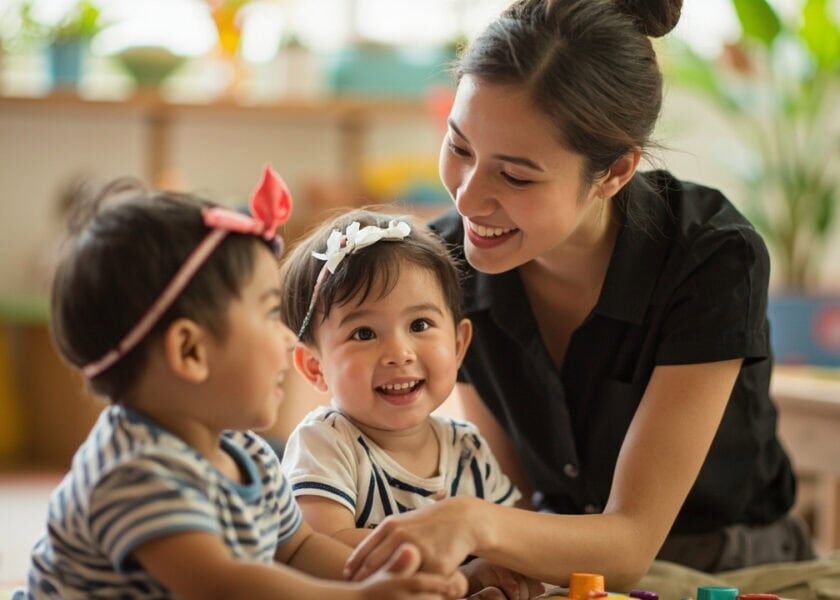
This matters enormously. This means your child is not lost in a group. Your child’s caregiver can notice when your little one is frustrated before the frustration becomes a meltdown. Can pick up on the subtle cues that signal hunger, or tiredness, or the need for comfort. Can respond in the way that you respond—with warmth, with attention, with the understanding that this small person’s emotional state is the most important thing in the room at this moment.
You cannot attune to six infants simultaneously. You cannot notice the early signs of distress in a room of twelve. But you can attune to three. You can be the kind of presence that a young child needs—not just a supervisor, but a responsive, emotionally available human being who has the time and the attention to truly see your child.
This ratio is not a luxury. It is the structural foundation that makes attunement possible.
How EduNanny Is Built Around Attachment
At EduNanny by BUTLER, the childminding model has been designed around what the science tells us about attachment. Not as an afterthought, but as the starting point.
The 1-to-3 ratio. The emphasis on consistent caregiver relationships. The daily communication that keeps you connected to your child’s experience even when you are apart. The handover practices that treat you as a partner in your child’s care, not a client passing through. The rhythms and routines that help children feel secure.
We understand that when you receive a photo of your child laughing at something, a note about how they said their first word today, a simple piece of evidence that they were happy and known and held with care—you are not just receiving information. You are receiving reassurance. You are receiving evidence that the choice you made is working. You are receiving permission to breathe.
I also want to address something that weighs on many Singapore parents: the expectations of grandparents and extended family. There is sometimes a quiet, deeply felt concern that placing your child in care somehow represents a failure. That it signals you could not or would not sacrifice enough.
Here is the truth: the village is beautiful. The problem is that many of us no longer live inside the village we grew up knowing. Our parents may be in Johor Bahru or Hong Kong or Melbourne. Our siblings may be on the other side of the island or the other side of the world. The village that raised us may not be available to raise our children in the way we imagined.
This is not a failure. This is the reality of modern Singapore, and it deserves a modern response.
When grandparents express concern, what they are often expressing is love. They want to know that their grandchild is safe, loved, and well cared for. The attachment-friendly model is actually well positioned to reassure them too. Because when they see your child returning home happy, secure, and deeply attached to you, their fears about care begin to quiet. Quality care does not diminish family. It complements it.
Your Daily Practice: The Reconnection Ritual
Here is something you can begin using tonight. Something that will not cost anything and does not require any special training.
When you pick up your child from care, your child has been away from you for hours. This is a significant experience for a young child. They have been safe, they have been cared for, they may have had a wonderful time—but they have also been apart from you. The reunion is not just a logistical moment. It is an emotional moment, and it deserves to be treated as such.
What a Reconnection Ritual Looks Like
- When you arrive, take a breath. Put down your bag. Give your child your full attention, even if just for two minutes.
- Crouch down to their level. Look into their eyes. Say hello as though you have been waiting to see them all day—because you have.
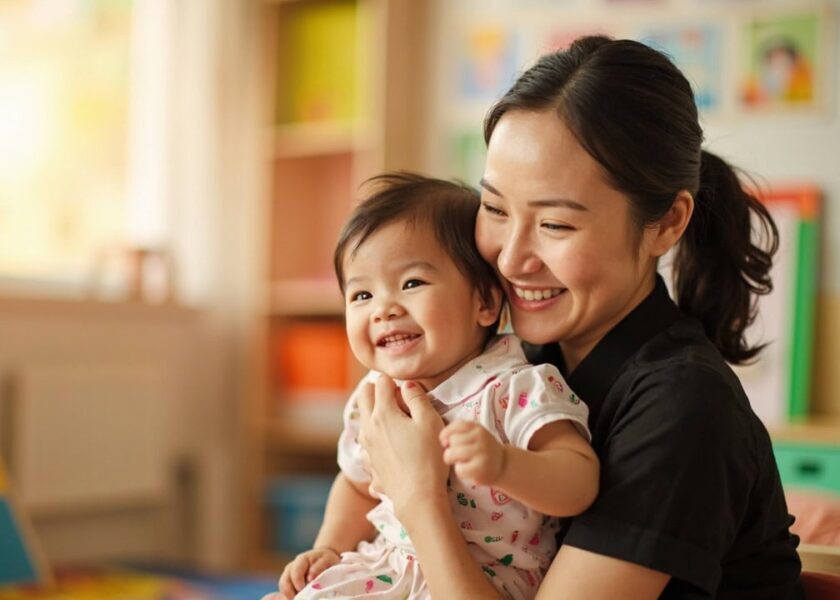
- Pick them up. Hold them. Let them feel your body, your smell, your warmth.
- Talk to them about what you see in their face, what you notice about their mood, how glad you are to be together again.
This is not indulgent. This is not excessive. This is the psychological practice of reunion—recognized in attachment research as a critical moment in the daily cycle of connection and separation.
What Happens When You Practice This
When a child experiences a consistent, warm reunion with their parent after a period apart, something remarkable happens. The child integrates the experience of the day. They process whatever happened while they were away. They refill their emotional cup. And they return to a state of security that allows them to explore, learn, and sleep well, knowing that their parent is still their parent, still loves them, still comes back every single time.
The reconnection ritual is your daily practice of demonstrating to your child that separation does not end connection. That love does not diminish with distance. That you are still the person they can count on, and you always will be.
In the rush of a Singapore evening—in the commute, the dinner, the bath, the bedtime routine—it is tempting to skip the ritual, to treat the pickup as just another task in a long list. But I want to encourage you to protect this moment. You will notice a difference if you do. You will notice it in your child’s ease, in their willingness to let you go at drop-off the next morning, in the quality of their sleep, in the warmth of their eyes when they look at you.
And you will notice it in yourself. The reconnection ritual is not just for your child. It is for you. It is your daily practice of returning to yourself as a parent, of being present, of affirming that whatever you did today, you are here now, and this is what matters.
The Two in the Morning Question Has an Answer
Look at your child. Notice whether they are thriving. Whether they are happy. Whether they run to you at the end of the day with joy. Notice whether the anxiety that used to wake you at two in the morning has begun, slowly, to quiet.
Because if the care is truly attachment-friendly—if the ratios are right, if the caregivers are attuned, if the environment is designed around security rather than just supervision—then you will see it in your child. You will feel it in your own heart.
You will see a child who is not diminished by additional caregivers but expanded by them. More curious. More socially confident. More secure in their knowledge that the world is a place where people can be trusted.
Not because you have failed as a parent. But because you have found a care arrangement that understands what your child needs—and what your child needs is not less of you. Your child needs you at the center, providing the secure base from which they can explore everything else the world has to offer.
You are not failing your child by returning to work. You are providing for your child. And you are doing so with a care arrangement that is designed—thoughtfully, carefully, with both warmth and evidence—to protect and strengthen the bond that matters most.
Your child has room in their heart for everyone. And right at the center, in the place that no one and nothing can ever take, is you.
That is the truth. That is what the science tells us. And that is what EduNanny is here to prove, one securely attached child at a time.
If you are a parent in Singapore exploring infant care options, we invite you to learn more about EduNanny’s childminding pilot—designed around attachment science, built for the reality of Singapore family life, and grounded in the belief that quality care and parental bonds work together, not against each other.
The 2am question has an answer. And the answer is yes: your child knows you. Your child loves you. And your child has space in their heart for all the people who love them too.