Beyond the Dinner Table: How Singapore Parents Are Solving the Childcare Dilemma
The Conversation No Singapore Parent Wants to Have
There is a particular silence that fills a Singapore living room when the subject of childcare comes up at the dinner table.
You know the one. Your mother sets down her tea. She looks at you with an expression that is not quite disappointment, not quite worry — something older, something heavier. And she says, in Mandarin or in Hokkien or in the particular English that means she has rehearsed this: “Your father and I raised four children. We never needed anyone else.”
And there it is. The sentence that sits in your chest like a stone.
You love your mother. You respect everything she did. But you also know that the Singapore she raised you in — where one salary could sustain a family, where grandmother lived three MRT stops away and collected the children at 3pm — that Singapore has quietly left the building.
What she is really asking is not about childcare arrangements. She is asking: Do you trust me? Do you trust what I know? Do you trust the way we did this?
Most childcare brochures will never have this conversation with you. They will tell you about ratios and curriculums. They will show you photos of clean, bright rooms. They will promise safety, development, peace of mind.
And none of it — none of it — will address the reason you have been putting off this decision for six months. The reason is not about the childcare. The reason is about your family.
The Crowded Family System
Singapore has one of the most complex family architectures in the world. Three generations, sometimes four, orbiting the same child — each with opinions, each with history, each carrying their own version of what a good family looks like.
The grandparents remember when children were raised by family, full stop. The parents — that is you — are navigating dual-income realities that no previous generation was asked to manage. And somewhere in the middle is a domestic helper, often the first responder in the home, holding together what would otherwise be impossible.
The family system is not broken. It is extraordinarily crowded.
When we talk about childcare in Singapore, we almost never talk about this crowdedness. We talk about logistics. We talk about costs. We talk about curriculum alignment with MOE’s framework. But we do not talk about the fact that your childcare decision is made at the family table, in the family group chat, in the WhatsApp thread where your mother-in-law sends articles about “what children really need.”
Your childcare choice is a family event. And that is precisely why it matters so much. And precisely why it is so hard.
What Generational Wisdom Gets Right
Here is what your parents and in-laws understand with a truth that should not be dismissed: children are not raised in isolation. The first five years of life are not merely a developmental checkpoint — they are the period when a child learns who they belong to.
Language is learned in laps. Rituals are learned at tables. Identity is learned in the smell of a grandmother’s kitchen and the sound of a grandfather’s voice reading the same story for the hundredth time.
The cultural weight of those early years is not sentimental. It is structural. The child who knows where they come from is the child who knows where they are going.
What Generational Wisdom Sometimes Misses
Here is what your parents may not have had to reckon with: proximity does not automatically guarantee transmission. It assumes that because grandmother was present, grandmother’s wisdom was absorbed. But we know — all of us know, if we are honest — that this is not always true.
Presence is not the same as presence of mind. Being in the same room is not the same as being truly seen. Many of us grew up with helpers who were more present in our daily lives than our own parents. Many of us grew up with grandparents who were physically there but emotionally distant.
The village exists. But a village is not automatically a home.
What matters now is not just who is present, but who is present with intention. Who is present with attention. Who is present with the resources to meet this child where they actually are.
The Anxiety Nobody Names Out Loud
There is a particular anxiety that Singapore parents carry, and it is worth naming it clearly because it rarely gets named at all.
It is the anxiety that by choosing professional care, you are choosing against your own parents. That by enrolling your child in a structured early childhood setting, you are telling your mother or your mother-in-law: You were not enough. What you know is not enough. Who you are is not enough.
This anxiety is not irrational. It is rooted in a very real cultural truth. In Singapore families, childcare is rarely just childcare. It is a statement about values. It is a referendum on who gets to shape this child.
Here is what needs to be said to that voice, directly.
You are not betraying your family. You are doing what every generation of parents has done: adapting the village to serve the child.
Your grandmother’s grandmother likely left her village to move to the city. Your grandparents moved from rural settlements to one-room flats in Queenstown and Toa Payoh. Your parents moved from those flats to private properties with mortgages. Every generation has updated the structure of the family to serve the needs of the child.
This is not a break from tradition. This is tradition. Tradition is not a static arrangement. Tradition is the practice of making the family work for the child who is actually here, in the world that is actually now.
Near-Home Care: The Village, Made Deliberate
Here is the question that EduNanny Singapore was built to answer: What if the childcare that works for modern parents could also be the childcare that makes grandparents proud?
Not by pretending to be family. Not by mimicking what grandmother would do. But by understanding that near-home care — care that keeps the child in their own neighbourhood, their own community, their own emotional ecosystem — is not a departure from family tradition. It is family tradition, updated for the world we actually live in now.
The Structure of Near-Home Care
Think about what this means, practically. Your child wakes in their own bed. They are driven or walked to a caregiver who lives in your estate, or to a home-based setting that is registered, vetted, and close enough that you can be there in ten minutes if you need to be.
The caregiver knows your neighbourhood. The caregiver knows your hawker centre. The caregiver is, in many cases, someone who has been recommended by a neighbour, vetted by the same community that vets school teachers and mosque committees and grassroots leaders.
Grandmother can visit. She is close enough. She can drop by on Wednesday afternoons with soup. She can take the child to the playground two blocks away, the one she has been going to for thirty years. She can be present in the way that her generation understands as presence — physical, daily, embedded in the rhythms of the neighbourhood.
The difference is that now she is present by choice, not by obligation. And that is not a lesser thing. That is often a better thing.
The Domestic Helper in Singapore’s Care Ecosystem
In Singapore, the domestic helper is often the invisible spine of early childcare. She is the one who wakes at 6am. She is the one who feeds, bathes, dresses, and brings the child to school. She is the one who knows what the child ate for lunch and whether they slept well and which shoe they insisted on wearing.
She is, in countless Singapore households, the primary caregiver for the first several years of a child’s life.
This is not a criticism. This is a fact. And it deserves to be named with honesty, because the domestic helper who enters a Singapore home to help care for a child is entering a role of profound significance. She is not merely an employee. She is, in the most literal sense, a co-parent in the early years.
Near-home care does not replace the domestic helper. It supplements her. It gives her support. It gives her a break. It gives her a network of trained, vetted caregivers who can step in when she is unwell, or when the family needs an extra pair of hands.
In the near-home model, the domestic helper becomes part of a broader care ecosystem rather than its sole pillar. That is not a demotion. It is a recognition that no one person — not even one who loves your child deeply — should carry the full weight of early childhood care alone.
Why This Is Still a Village
The near-home model takes the village that Singapore parents are nostalgic for — the village of multiple caring adults, the village of shared wisdom, the village of distributed love — and makes it deliberate.
It does not replace the village. It architecturally reconstructs it for an era when the village has been scattered by geography, by work schedules, by the particular demands of raising children in one of the most expensive cities on earth.
Near-home care does not remove grandparents from the equation. It repositions them. It says: you are not the backup system. You are not the last resort. You are the bonus. The blessing. The ones who visit not because they are obligated but because they are invited.
And that changes everything about the quality of the time spent together.
What EduNanny Singapore Actually Offers
EduNanny by BUTLER is part of the ECDA Childminding Pilot. This matters because it means the model is not an experiment dreamed up in a boardroom. It is a government-recognized approach, developed in response to the specific needs of Singapore families.
It is built on the understanding that not every family needs centre-based care, and not every family has access to grandparent support, and not every family can manage with a domestic helper alone. Somewhere between these three realities, there is a gap — and that gap is where EduNanny operates.
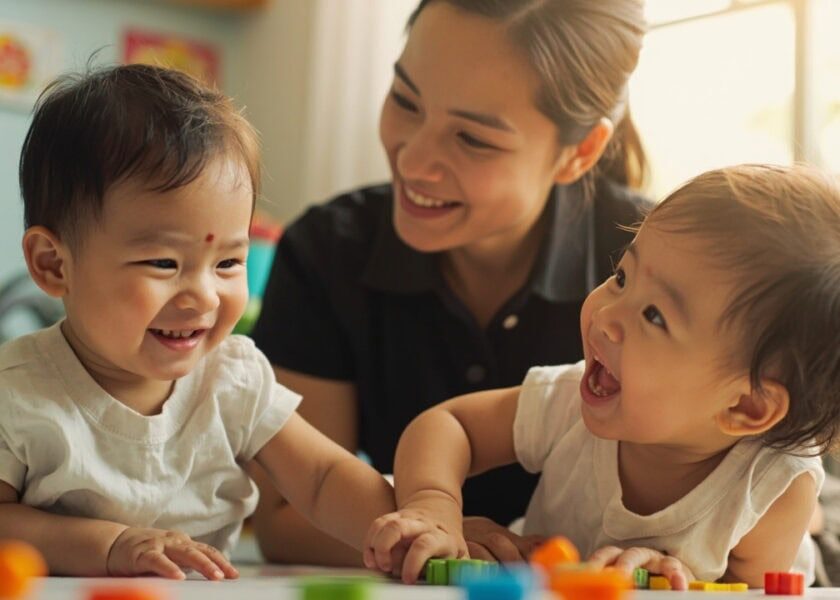
- Home-based care in small group settings — ratios of up to one caregiver to three infants. This is not a crowd. This is a family: small, intimate, well-staffed, where every child is known, seen, and responded to with consistency.
- Vetted, trained caregivers operating in registered settings close to where families live.
- Monday to Friday care blocks, because that is when most Singapore parents need it most.
- Affordable fee structures, with CDA and Baby Bonus usable where applicable — because Singapore parents should not have to choose between quality care and financial sustainability.
- Regular parent updates — you know what is happening in your child’s day.
- CCTV in settings where it is deployed — an additional layer of reassurance that is increasingly standard in how we think about trust in Singapore.
The Thomas AI Chatbot
There is also something new that reflects how seriously EduNanny takes the parent experience: the Thomas AI Chatbot. This is a tool designed to make the daily texture of parenting and childminding easier — to answer the questions that arise at 9pm when you are wondering about sleep patterns, or at 7am when you are unsure about feeding cues, or at any hour when you need a knowledgeable, calm presence in your pocket.
It is not a replacement for human guidance. It is a companion for the moments when you need an answer and need it now.
Making This Decision Without the Guilt
If you are somewhere in the middle of this decision, here is some honest, practical guidance for navigating it.
1. Separate the logistics from the emotion
Before you evaluate centres or caregivers, take a moment to name what you are actually feeling. If the anxiety underneath the logistics is about family judgment — about what your mother will think, about whether you are honoring your parents’ wisdom — acknowledge that openly. It is not a weakness. It is the real issue. And it deserves a real answer.
2. Ask yourself what you are actually afraid of
Most parents who feel stuck between modern care and family expectations are not afraid that professional care will harm their child. They are afraid that choosing it means they are bad children.
The reframing that helps: choosing care that works for your family is not a rejection of your parents. It is an update. Every generation has done this.
3. Look for care that keeps your neighbourhood close
Near-home care matters not because proximity is magical, but because it keeps the ecosystem intact. When your child’s caregiver is in your estate, grandparents can visit. Cultural routines can continue. Your child grows up in the community you grew up in — and that is not nothing.
4. Involve your parents in the process
One of the most powerful things you can do is bring your mother or your mother-in-law into the decision. Show them where the caregiver lives. Let them meet her. Let them see that this is not a replacement for them — it is a structure that leaves room for them.
When grandparents see that they are still needed, still invited, still central to the child’s life, the resistance often softens.
5. Trust that your child will know
Children are not confused by multiple loving adults. They are confused, and hurt, and disoriented when the people who love them are in conflict about who should care for them.
The best thing you can do for your child is make this decision with clarity and confidence — not with guilt.
The Village Made Deliberate
There is a moment, after you have made this decision, when something shifts.
You will drop your child off in the morning. The caregiver will greet you both by name. Your child will reach for a toy they recognize from last week. You will see the walls, the books, the small cohort of children who are known and loved in this space.
And then you will leave.
It will not feel like abandonment. It will feel like trust. It will feel like the deliberate act of entrusting your child to a structure that is built for them — close to home, grounded in community, informed by both modern pedagogy and the timeless truth that children need to know who loves them.
Your mother may, one day, visit. She may see the caregiver greeting your child with warmth and expertise. She may see the small group, the individualized attention, the record of what your child ate and how they slept and which song they asked to hear twice.
And she may say — quietly, almost to herself: “This is good. This is really good.”
That moment is not the goal. But it is not nothing, either.
Your child will grow up knowing who they are. They will speak your grandmother’s language, or they will speak your language, or they will speak all of the above. They will know the taste of your mother’s cooking, the sound of your father’s stories, the rhythm of your home.
And they will also know that they were loved by more than just family — they were loved by a community that was close enough to call home.
That is what EduNanny is building. Not just a care model. A village. One that recognises where Singapore families have been, and one that is honest enough to build for where they are going.
The village your parents recognise. The village your child deserves. The village, made deliberate, made intentional, made close enough to be whole.
Ready to Explore Your Options?
You do not have to choose between modern care and family wisdom. You do not have to choose between what is best for your child and what will make your parents proud. You do not have to choose between professional quality and cultural continuity.
These are not opposing forces. They are forces that, when structured correctly, reinforce each other.
EduNanny Singapore was built for the gap between what families need and what family tradition used to provide.
Explore EduNanny Singapore’s near-home childminding options and take the first step toward care that keeps your family close.