Why Singapore Parents Choose Connection Over Worry Every Morning
The Morning Drop-Off: Understanding the Invisible Weight Singapore Parents Carry
There is a particular silence that follows every morning drop-off. The car door closes. The childcare door opens. And for a moment, a parent stands in that space between leaving and being able to breathe again, wondering what the hours ahead will hold.
This is not distrust. This is love, made anxious by distance.
You are not a parent who doubts your child’s safety. You are not a parent who has chosen poorly. You are a parent who has done the math on modern life—calculated the cost of childcare against the cost of career, weighed the developmental benefits of early socialisation against the tenderness of private attention, made impossible choices with imperfect information—and still, every single morning, you feel that small fracture of uncertainty.
What are they doing right now? Are they engaged? Are they content? Are they growing in those hours when I am not there to witness it?
This is the invisible weight that Singapore parents carry. Not because they have been given reason to doubt, but because the distance itself creates the doubt. And this distance is not a failure of modern parenting. It is simply the reality of raising children in a society that demands so much of both parents and children simultaneously.
What we have come to understand, through years of listening to families, is that this anxiety is not a problem to be solved with reassurance alone. It is a gap to be bridged. And the bridge is made of something very specific: daily communication that tells you not just that your child is safe, but that your child is thriving.
Why This Anxiety Is Not Irrational
Singapore parents deserve to understand why the childcare experience they are receiving feels the way it does. The anxiety you feel is not irrational. It is a response to a genuine gap between what is possible and what is being provided.
Most childcare environments are operating under constraints that make it genuinely difficult to provide the kind of daily transparency parents need. Teacher-to-child ratios in large centres can make individual attention a challenge. Turnover in the sector means that relationships between caregivers and families are constantly disrupted before they can deepen. Administrative burden takes time away from direct engagement with children.
In some environments, the culture is one of protection rather than partnership—where communication is limited to the essentials because more would require resources that are not allocated. This is not a criticism of those environments. It is a description of structural reality.
The good news is that structural reality can change. When the conditions are right—the ratios, the training, the communication standards, the culture of partnership over secrecy—that gap transforms into a bridge.
From Supervision to Care: What Genuine Engagement Looks Like
The question every parent should be asking is not simply, “Is my child safe?” That question has been answered. Every licensed childcare environment in Singapore meets basic safety standards. CCTV measures are deployed. Ratios are maintained. Doors are locked.
The question that matters now—the question that separates supervision from care—is deeper: What is my child’s day actually like? What are they discovering? How are they being seen?
Because there is a profound difference between a child who is watched and a child who is engaged.
A child who is watched learns that the world is a place where adults stand at a distance and observe. A child who is engaged learns that the world is a place where curious minds are met with curious attention. One is passive. One is transformative.
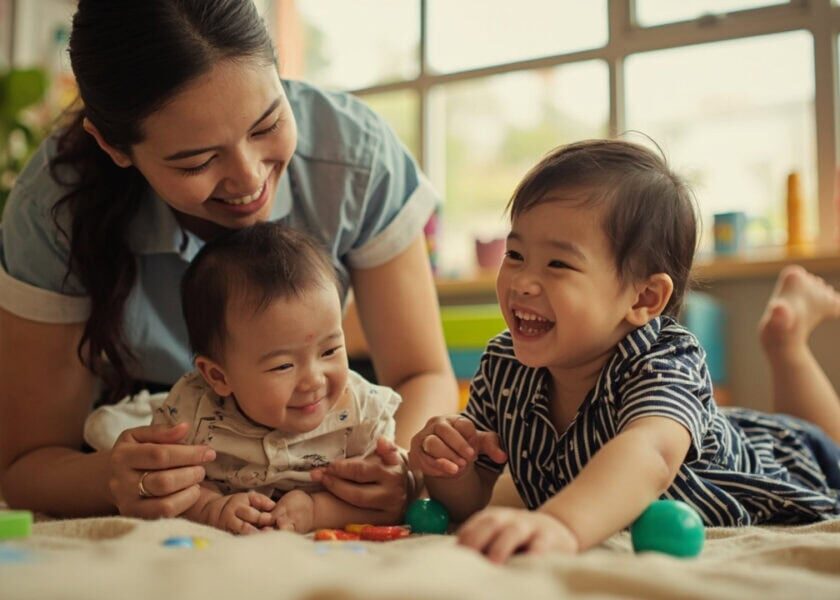
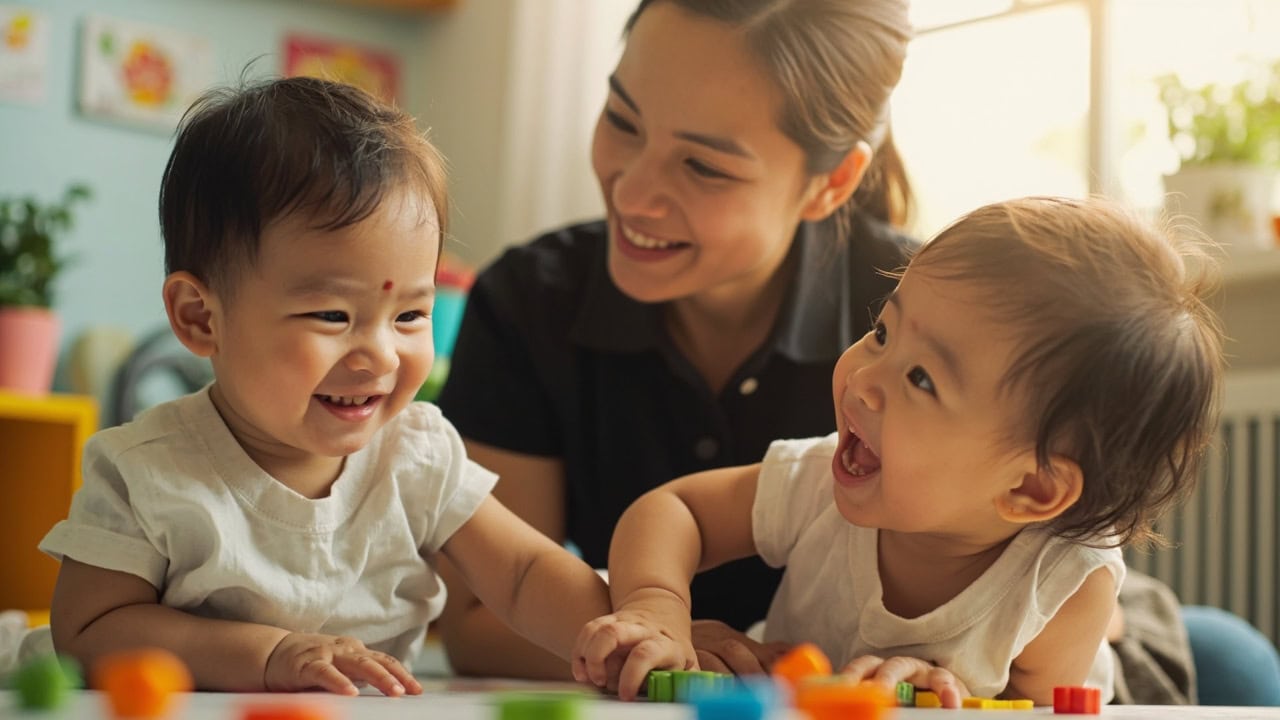
When you pick up your child and they reach for you with the particular openness of someone who has been well occupied, who has been interested and interesting, who has had their questions answered and their discoveries celebrated—that is not coincidence. That is the evidence of meaningful engagement.
What Meaningful Engagement Actually Looks Like
It happens when caregivers are trained not just to manage children but to understand them. When ratios allow for attention to be divided with generosity rather than necessity. When the curriculum is designed not around compliance but around wonder.
When a caregiver knows your child as an individual—because the ratio allows for that knowledge to develop—she notices things that matter:
- She notices that your child is approaching a developmental leap before you do at home, because she has been watching the specific ways your child experiments with language or physical challenge.
- She notices that your child is more tired than usual, and adjusts the day’s activities accordingly, rather than following a rigid schedule that ignores individual variation.
- She notices the small social dynamics that are invisible in larger groups—the child who is ready for more complex play, the child who needs a moment of quiet, the child whose appetite has shifted and whose lunch portions should be modified.
These are not extraordinary observations. They are the ordinary observations that become possible when a child is genuinely known rather than generally managed.
Daily Communication in Practice
Here is what daily transparency looks like—not as a promise but as a daily standard.
At arrival: Not the transactional handover of a child from parent to caregiver, but a genuine moment of sharing. What did your child have for breakfast? Did they sleep well? Is there anything happening today that we should know about? This is the first thread in the day’s connection between the people who love this child most and the people who are investing their professional attention in this child’s growth.
Throughout the day: At quality childcare environments, you do not wait until pick-up to learn what your child did today. You receive windows into their experience—not a formal report card, but the genuine texture of their hours:
- Photographs of a child deeply focused on a new sensory activity.
- A note about the way your toddler pronounced a new word for the first time.
- A quick message about how your baby settled for a nap, or did not, and what the caregivers tried in response.
This is not performance. This is partnership made visible.
At pick-up: Pick-up becomes something different when this communication has been consistent. Instead of the awkward exchange where a caregiver says “they had a good day” and you nod and leave not knowing what that means, you arrive to find your child eager to show you something they made, or tell you about a friend they played with, or simply radiating the particular calm of a day that was full.
You ask questions. The caregiver answers them with specificity. The story of your child’s day becomes a shared narrative between everyone who matters to that child.
When you know what your child is experiencing, the hours apart become hours of anticipation rather than hours of worry. You are not wondering. You are waiting to hear what they will tell you when you reunite.
Why Infant Care Demands Special Attention
Let us speak for a moment about what this looks like for infants specifically, because the stakes in those earliest years are different in kind, not just degree.
A six-month-old cannot tell you about their day. They cannot describe the textures they explored, the sounds that caught their attention, the faces that made them laugh. They are entirely dependent on the adults in their environment to witness their experience and translate it into language that those who love them can understand.
This is why infant care ratios matter so profoundly. A caregiver with three infants can observe each one with the attention that reveals meaning. She can notice that Baby A is on the verge of rolling, that Baby B has developed a new way of expressing preference, that Baby C is going through a sleep regression that parents at home might not yet understand.
She documents these moments through photographs, through notes, through the kind of daily communication that makes a parent’s evening reunion a continuation of a conversation rather than the beginning of an interrogation. When that communication is absent, when parents receive only the basics of feeding and sleeping schedules, the infant’s day becomes a black box. Parents are left to fill in the gaps with imagination, and imagination, under anxiety, tends toward worry.
Supervision vs. Engagement: A Quick Comparison
| Supervision-Focused Care | Engagement-Focused Care |
|---|---|
| Child is monitored for safety and basic needs | Child is actively observed for development and discovery |
| Updates limited to feeding, sleeping, diaper changes | Updates include activities, interactions, and developmental moments |
| Ratios may prioritise compliance over connection | Ratios allow caregivers to know each child individually |
| Communication is transactional and periodic | Communication is ongoing and partnership-oriented |
| Parents receive reassurance without evidence | Parents receive specific observations they can build on |
EduNanny by BUTLER: Bridging the Gap for Singapore Families
EduNanny by BUTLER was designed with the parent-childcare gap in mind. As part of the ECDA Childminding Pilot, EduNanny offers both home-based and community or centre-based pathways, giving families options that align with their circumstances and preferences.
The Home-Based Pathway
This brings qualified childminders into family environments or into carefully selected home settings, creating intimate care ratios—up to one to three for infants—that allow for truly individualised attention. In this setting, your child receives care in an environment where the caregiver can notice the small things that matter, where communication flows naturally throughout the day, and where your child’s routine and development are observed with the attention that only small ratios make possible.
The Community Pathway
This offers centre-based care with enhanced engagement standards, where the communication infrastructure described above is built into the daily operation rather than layered on top of it. From the moment of arrival through the day’s activities to the evening pick-up, communication is treated as a core function of care, not an add-on.
What matters is that this addresses a root cause rather than a symptom. Parent anxiety is not solved by telling parents to relax. It is solved by creating conditions where the communication parents need is actually possible.
What Parents Should Know About Access and Affordability
Childcare decisions should not be made impossible by cost. The ECDA Childminding Pilot offers fee structures designed to make quality childminding accessible to families across income levels. For families eligible for the Child Development Account and Baby Bonus schemes, these resources can be applied directly, reducing the financial burden that so often forces parents to compromise on the quality of care they want for their children.
Monday to Friday care blocks provide the consistency that families need without the premium pricing that sometimes accompanies full-schedule arrangements. Premium childcare should not be a luxury available only to those with significant disposable income. Every child in Singapore deserves to be seen. Every parent deserves to feel connected to their child’s day.
What to Look for When Choosing Infant Care in Singapore
Whether you are considering EduNanny or another provider, here are questions and signs to guide your evaluation:
Questions to Ask at Your Next Centre Visit:
- What is the caregiver-to-child ratio, especially for infants?
- How will you communicate my child’s day to me? Will I receive updates during the day or only at pick-up?
- What kind of information can I expect—basic care logs or observations about engagement and development?
- How long have the primary caregivers been in their roles? Is turnover a concern?
- Can I see examples of daily communication you provide to parents?
- What training do your caregivers receive in infant development and observation?
Signs of Quality Communication:
- Caregivers who ask about your child’s morning, preferences, and any changes at home during drop-off.
- Updates that include specific observations, not just checkboxes.
- Photographs that capture genuine engagement, not just posed shots.
- Caregivers who answer your pick-up questions with specificity and detail.
- A culture where asking questions is encouraged and welcomed.
Red Flags to Note:
- Vague responses like “they had a good day” without specifics.
- Difficulty getting clear answers about ratio or caregiver qualifications.
- Defensiveness when you ask about communication practices.
- No clear system for daily updates beyond basic care logs.
- High turnover that suggests relationships cannot develop.
Standing at the Door: Why Separation Can Be Growth
When these conditions are in place, something shifts in the parent experience. You stop being a parent who wonders what is happening and start being a parent who knows. You bring that knowledge home. You build on it in your evening routine. You notice what the caregiver noticed, and you see connections you would have missed without her perspective.
The communication becomes a feedback loop that serves your child’s development far beyond what any single caregiver or any single parent could achieve alone. Children are extraordinarily perceptive. They sense the difference between parents who are worried and parents who are confident.
When you pick up your child carrying the day’s knowledge—the photograph, the note, the conversation—you carry it in your body. Your child feels it. Your child knows that you know. And that knowledge becomes a shared foundation from which they can venture further, explore more, engage more deeply with the world, because they are not carrying your anxiety alone. They are carrying it with a parent who is informed, present, and connected.
The hours your child spends in childcare are not hours lost to your relationship. They are hours that, when the care is excellent and the communication is genuine, become hours that deepen your understanding of your child. Every activity your child explores in those hours is a thread that connects you to who they are becoming. Every interaction they have with a caregiver who truly sees them is an experience that shapes their sense of the world as a place where they are known.
EduNanny by BUTLER was founded on the belief that childcare is not a service transaction. It is a relationship—between caregiver and child, between caregiver and family, between your child’s weekday world and your family’s weekend world. And relationships require communication. They require transparency. They require the daily practice of showing up, paying attention, and sharing what you have observed.
The next time you stand at the childcare door, in that space between leaving and breathing, we want you to know something.
You are not abandoning your child. You are entrusting them to a system designed to keep you connected.
You are choosing to believe that the hours ahead will be filled with attention, discovery, and care. And you are right to believe that, when you have chosen a childcare partner who believes it too.
When you reunite at the end of the day, there will be a story to tell. Your child will show you something. Your caregiver will share something. And you will realise that the distance between morning and evening was not empty. It was full—full of moments that were witnessed, documented, and delivered back to you as evidence of a day well spent.
That is what quality childcare offers. Not the absence of anxiety, but the presence of answers. Not the removal of separation, but the bridging of it.
Built with attention. Maintained with communication. Walked together by everyone who loves them.
That is how we keep your family close, even when you are apart.
If you are ready to explore childcare options that prioritise communication, connection, and your child’s daily story, we invite you to connect with our team to learn more about EduNanny by BUTLER and the ECDA Childminding Pilot.
You can also learn more about who we are and the standards we hold ourselves to, or visit our homepage to discover how EduNanny is redefining what it means to care for children—and their families—in Singapore.