From Fear to Trust: How Singapore Parents Find Quality Near-Home Care
The Morning You Walk Away
There is a moment, most mornings, when the most important thing you will do that day is walk away.
For Lin, that moment came at 7:47 on the first Monday of September. She stood in the doorway of Mdm Tan’s HDB flat—a home much like her own, with similar tiles and similar morning light—and understood that she had arrived at the edge of something. Her fourteen weeks of maternity leave had ended. Her daughter, Xiao Le, was now fifteen months old.
“I’ll be back soon, my love,” she said, with a smile that cost her something. She felt Xiao Le’s hand open and release her blouse—the one that smelled like her—and then she was in the hallway, and the door was closing, and through the gap she saw her daughter’s face.
Both of them were crying.
This is the part of the story that every working parent in Singapore knows by heart. The part where you kneel, and you say something cheerful, and your child looks at you with an expression that is asking a question you cannot answer.
The part where the terror has a shape, a weight, a sound—and the sound is your child crying, not yet, not now, but soon, in advance, as though she already knows that the morning will end with you walking away.
Lin sat in her car for four minutes. She could not drive. But her hands would not move to the ignition. Her body knew something her mind was still arguing with.
She texted Mdm Tan. Three words: Please take care.
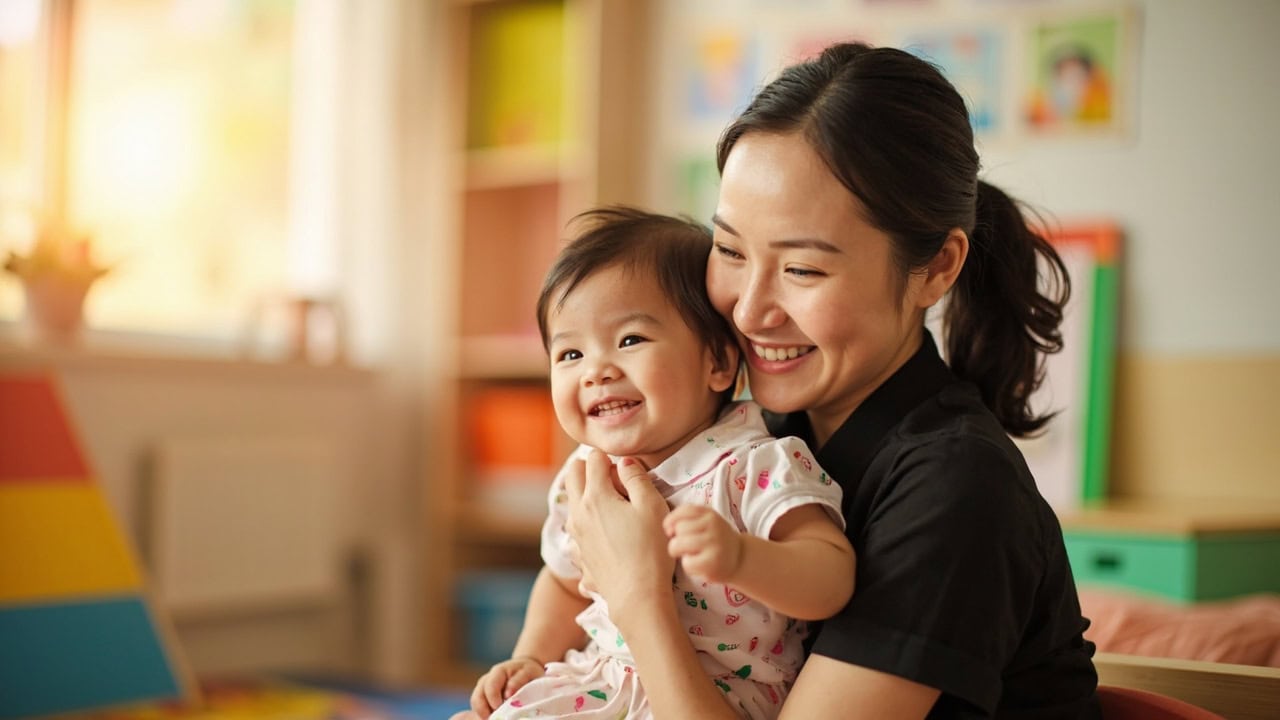
What the Research Actually Says About Attachment
There is a body of research on what psychologists call attachment. The foundational work was done in the 1950s and 1960s, by researchers who watched infants and their caregivers and mapped the patterns of connection that emerged.
What they found, and what subsequent research has confirmed across cultures, family structures, and childcare arrangements, is this: secure attachment—the kind that allows a child to explore the world with confidence because they trust that their caregiver will return—is not diminished by the presence of responsive secondary caregivers. It is, in fact, amplified.
This is the thing that every working parent suspects but is afraid to believe: that the bond you have with your child is not a finite resource that depletes when others hold her. That it is, instead, a capacity that grows when it is shared.
That when a child has two homes—both safe, both predictable, both attuned to her signals—she does not split her love between them like a diminishing bank account. She multiplies it.
What matters is not the hours. What matters is the quality of responsiveness. What matters is that when a child signals—a cry, a reach, a point, a word—the caregiver responds. Not perfectly. Not always. But reliably. With attention. With care.
The Communication Is Not a Feature. It Is the Work.
Quality communication from a caregiver is not a photo dump or a generic update. It is:
- Specific: Not “she had a good morning” but “she pointed at the mobile, then at the window, then at the mobile again—I think she’s telling us about her morning.”
- Observational: Noticing what the child notices. Taking seriously the small things that are, to the child, everything.
- Timely: Arriving in a rhythm that the child—and the parent—can anticipate. Morning, midday, evening. Predictability is itself a form of care.
- Reciprocal: Open to the parent’s own observations. “You mentioned she’s a grazer—she ate about half, which is normal.” The child’s history travels with her.
Children learn time before they learn clocks. They learn it through repetition, through the patterns of what happens next:
- Morning is when Mama leaves and Mdm Tan holds.
- Midday is when the porridge comes.
- Afternoon is when the playground opens.
- And then: evening. And then: home.
The parent who receives a photograph at 9:15 and a note at 12:30 is not being given information. She is being given time. She is being given the structure that allows her to hold the anxiety without being consumed by it.
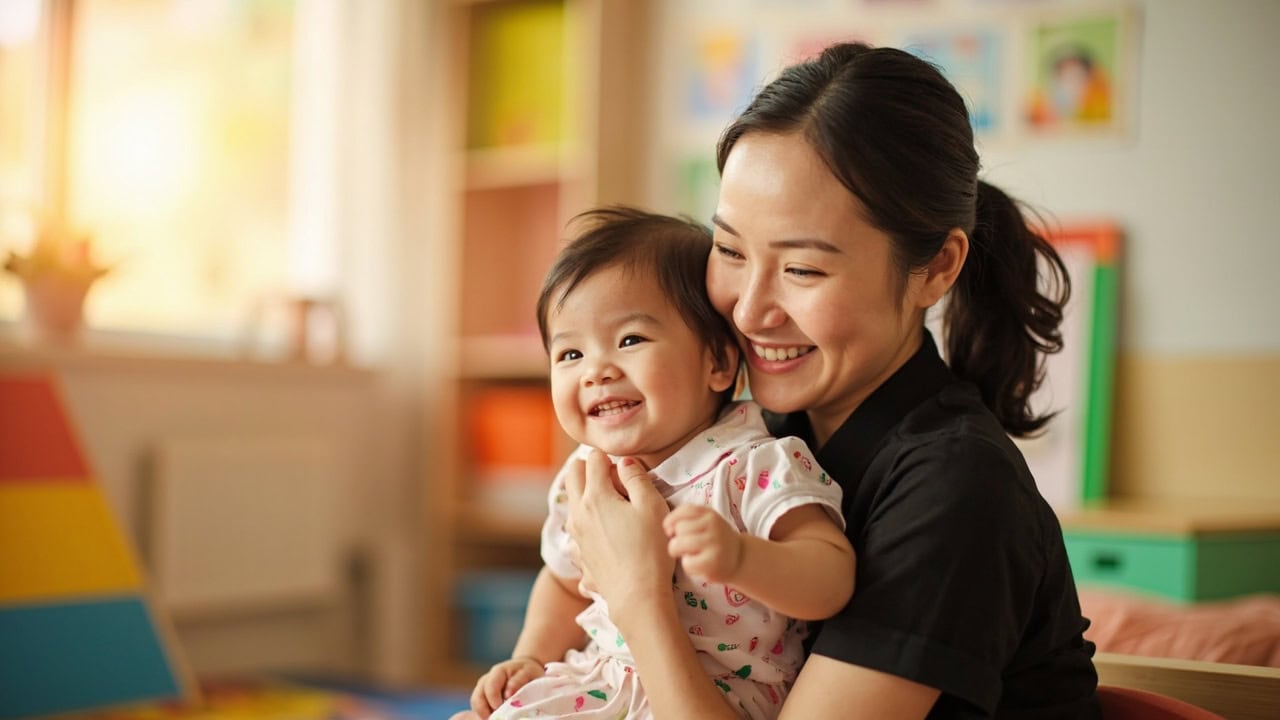
The First Week: A Parent’s Journey from Fear to Trust
Lin drove to the MRT station. She missed the 8:15 from Braddell. She caught the 8:25. She found a seat by the window, and she cried—not sobbing, not making sound, just tears, the kind that Singaporeans learn to do on public transport because there is nowhere else to be and the thing must come out somewhere.
She checked her phone at 8:43. No new messages. This was normal. This was fine. But there was the spike of anxiety anyway, the thought that perhaps something was wrong—
At 8:47, her phone buzzed. A message from Mdm Tan: “She’s having morning snack now. Will send photos when she’s settled.”
At 9:14, a photograph arrived.
Xiao Le, laughing, stacking blocks on a low table. The blocks were primary colors—red, yellow, blue—and they were unevenly stacked, and one was falling, and Xiao Le’s face was not just happy but delighted, the particular delight of a child who has discovered that she can do a thing, and now she can do it again.
Lin stared at the photograph for a long time. She was still on the MRT. A man across the aisle was reading The Straits Times. A woman was listening to a podcast. The train rocked gently, and the city passed by the window, and Lin felt something shift—not a resolution but a fissure, a crack in the certainty that she had made a terrible mistake.
The photograph was not proof of anything. But it was evidence that her daughter was not simply surviving the morning but inhabiting it. That she was not only waiting for Lin to return but living, now, in this moment, in this home, with this woman.
The Note at 12:31
Lin was in a meeting—an endless meeting about quarterly targets—when her phone buzzed under the table. She had been checking it every twelve minutes.
Mdm Tan had written: “Xiao Le had her porridge at 11:30. She ate about half, which is normal for her at lunch—she’s a grazer, I think, like her mama mentioned. After eating, she pointed at the mobile above her high chair, then at the window, then at the mobile again. I think she’s telling us about her morning. We’re going to the playground soon.”
Lin read the note three times. She did not cry. But her eyes blurred, and she had to look away.
The truth was stranger than tiredness. The truth was that a woman she had met twice, a woman whose last name she did not yet know, had just described her daughter’s inner life to her in a way that felt not just accurate but intimate. The grazing. The pointing. The particular way Xiao Le processed the world by naming it through gesture, through repetition, through the back-and-forth between the thing that moved and the thing that let in the light.
Mdm Tan had seen this. Had noticed it. Had recognized it as meaningful. And had taken the time—between the porridge and the playground—to write it down.
By Friday
Lin would later reflect that this was the week her relationship with her phone changed. It had been, before, a source of fragmentation—always too many tabs open, always too many notifications, always the half-attention that modern work demanded. But now, within the context of quality care communication, it became something else. A tether. A thread. A way of knowing, in real time, that her daughter was not just surviving but flourishing.
Each update arrived in a rhythm. Not constantly—because interruption is its own form of anxiety—but predictably, the way Xiao Le’s day itself was becoming predictable.
- Tuesday: Mdm Tan sent a video—Xiao Le dancing to a children’s song, holding a scarf, swaying in a way that was not yet coordinated but was already joyful.
- Wednesday: A photograph of a paint session—Xiao Le’s hand covered in non-toxic paint, pressing it to paper, leaving a mark.
- Thursday: A note: “She said ‘mama’ today when I was showing her photos. I think she’s thinking about you.”
On Friday morning, Lin pulled into the drop-off point at 7:44. She was not early anymore. She was not late. She had found the rhythm of it.
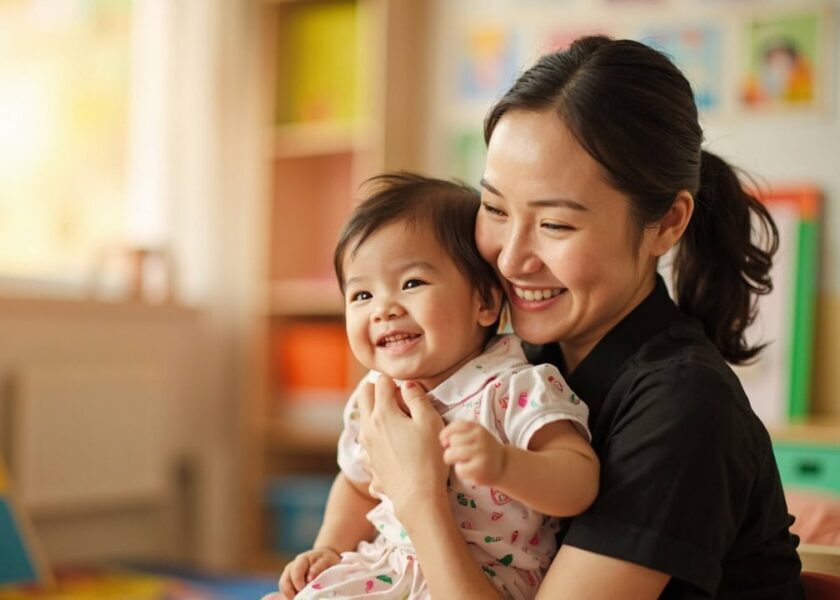
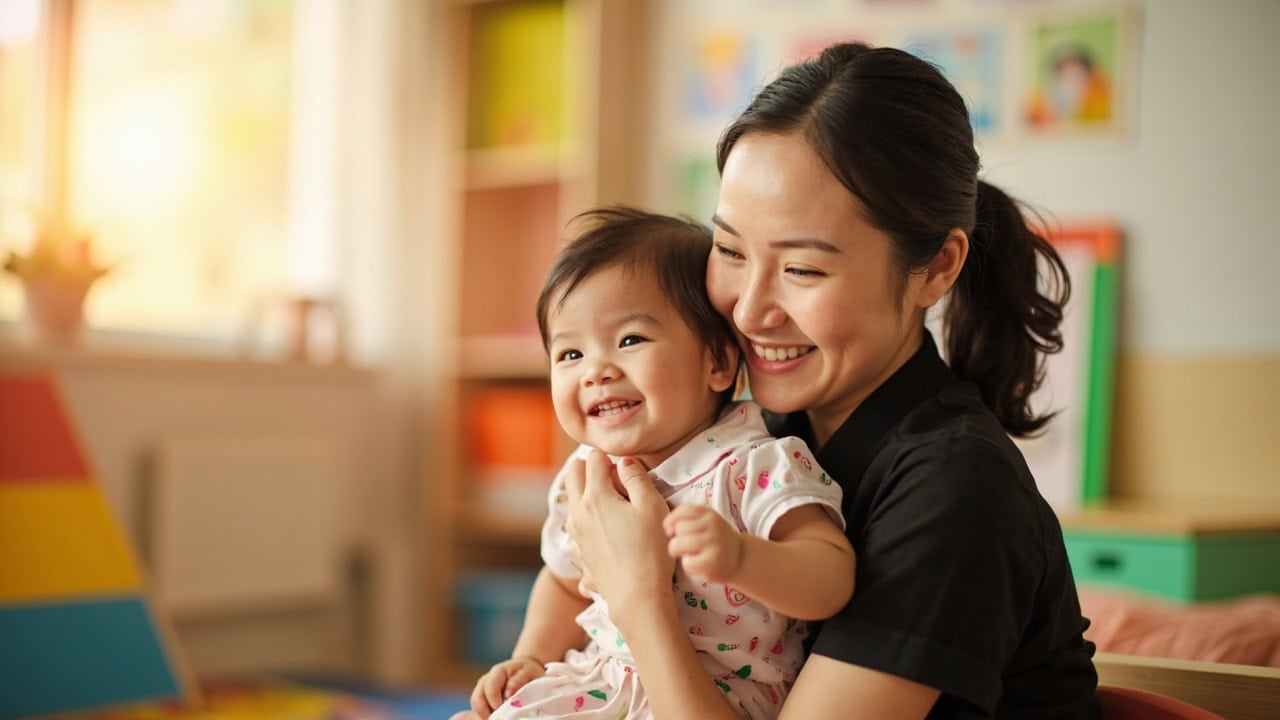
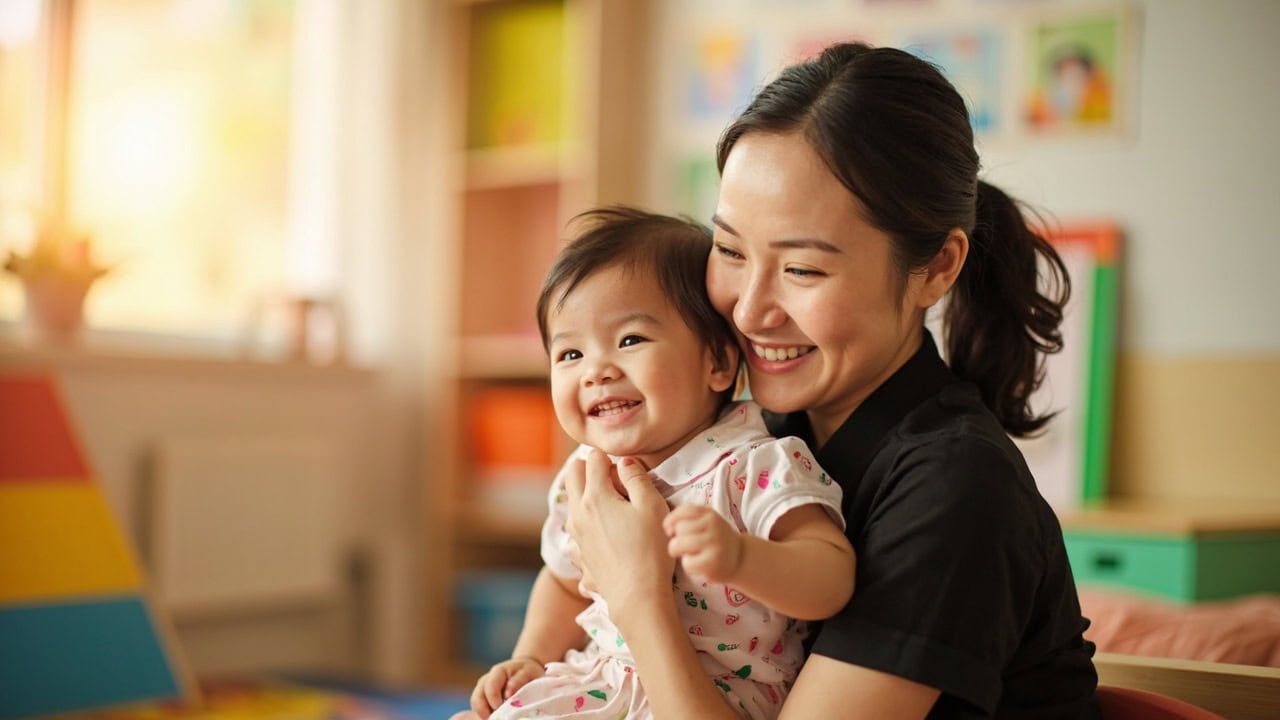
Her daughter still cried, some mornings. Some mornings she didn’t. But on this Friday, when Mdm Tan knelt at the doorway and opened her arms, Xiao Le did not cling. She turned. She looked at Lin. She reached for Mdm Tan’s hand.
And then she looked back at Lin. And she smiled.
This is the moment Lin would return to, in the weeks and months that followed. Not the first hand-off—that remained vivid, remained raw, but it was not the defining image. The defining image was this: her daughter, at the threshold of two homes, belonging to both.
She ran to her at 6pm. She always ran. The joy was not diminished by the day; it was concentrated by it.
And then, at the door, Mdm Tan waved. “See you Monday,” she said.
See you Monday. Not as a transaction. As a continuation.
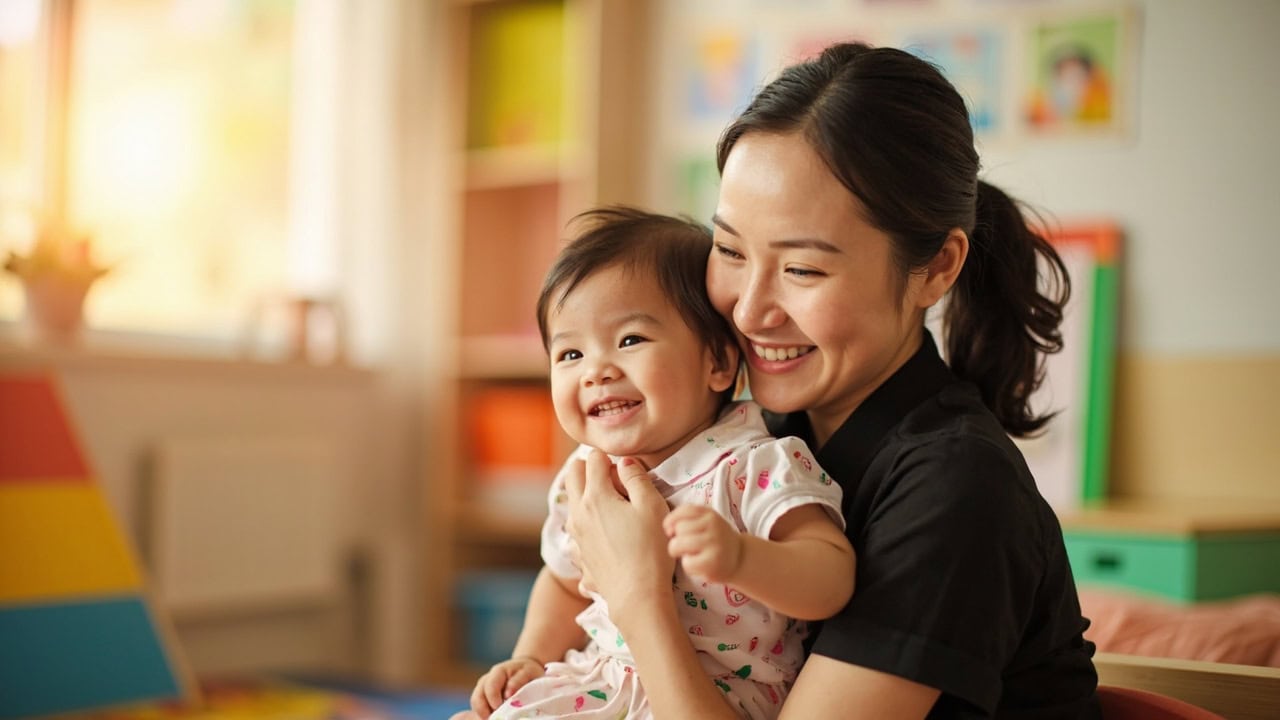
What Quality Near-Home Care Actually Looks Like
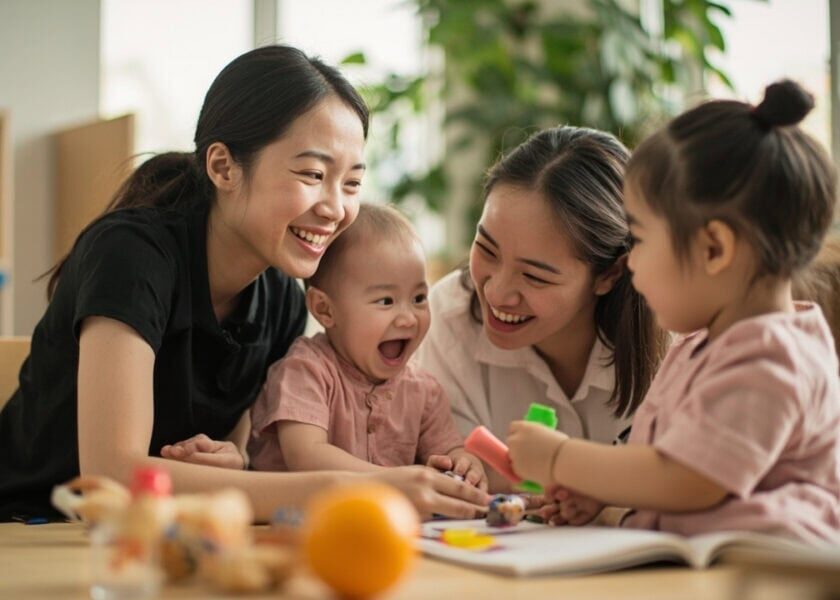
The EduNanny approach to childminding is built on a simple premise: the childminder becomes, over time, not a stranger and not a parent but something else—a trusted figure in a network of care. Someone who knows the child’s rhythms. Someone who notices the way she points at the window, the way she stacks the blocks, the way she says “mama” when looking at photographs.
What makes this possible is not just training—though training matters. It is the ratio. It is the environment. It is the communication.
The ECDA Childminding Pilot Context
In Singapore, the ECDA Childminding Pilot represents a deliberate choice to prioritize quality over scale. Childminders in the pilot maintain ratios of one to three infants. Their credentials are verified. Their homes are assessed. They operate in residential settings that feel familiar to children—HDB flats like their own, with the textures and light of the neighborhoods they already know.
This is not incidental. When a child walks into a home that feels like home—similar tiles, similar light, a different arrangement of furniture that nevertheless feels known—the transition is not an interruption. It is a continuation.
The CCTV Question
Where CCTV is deployed in childminding settings, it is deployed not as surveillance but as transparency: a way of saying to the parent, you can see. You can know. The door is open, even when it is closed.
Anxiety thrives in darkness. When a parent can see the drop-off point, can access a feed during the day, can know that the door is not a wall but a threshold—the anxiety does not disappear, but it changes shape. It becomes something she can hold rather than something that holds her.
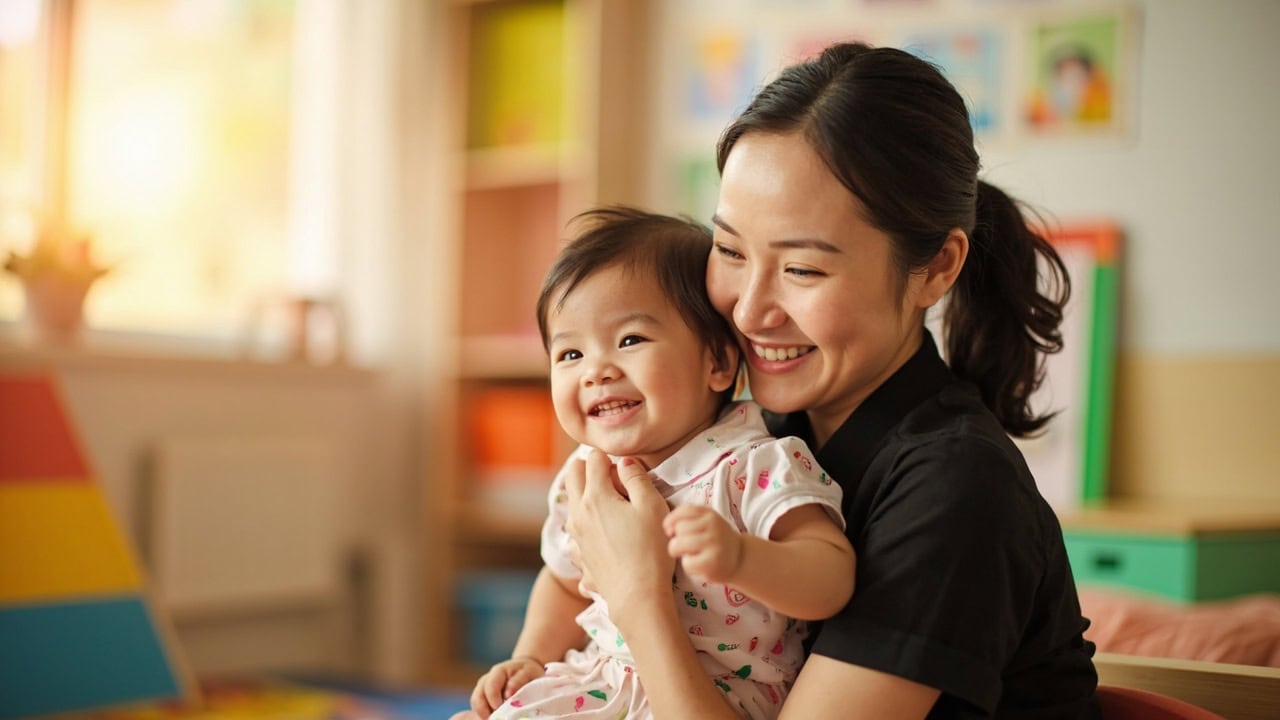
Addressing the Fear You Feel Right Now
If you are reading this, you are probably somewhere in the tension Lin felt on that first Monday. You want to return to work. You need to return to work—professionally, financially, for reasons that are real and valid and yours.
But you are afraid.
You are afraid that:
- Someone else will become your child’s primary emotional attachment.
- She will feel abandoned.
- The bond you built during maternity leave will erode.
- You will lose something you can never get back.
These fears are not irrational. They are reasonable. A mother leaving her infant with a stranger is a reasonable thing to fear.
But here is what Lin learned, and what the research confirms: what shifts is not the fear but its shape. It is not a wall anymore. It is something you can see through.
The Guilt Is Real. It Is Also Surmountable.
Guilt is not the problem. Guilt is a signal that you care. The question is whether the guilt becomes a weight you carry alone, or whether it becomes a shape you can examine, understand, and eventually set down.
What helps is evidence. Not proof—parenting does not offer proof—but evidence. Photographs. Notes. The specific, attentive communication that says: your daughter is not just being fed. She is being seen.
What helps is rhythm. When the day becomes predictable—when the morning hand-off is followed by a morning update, when the midday note arrives when you expect it, when the evening summary arrives before you check—your body begins to trust the pattern even when your mind still doubts.
What helps is watching your child belong to two places. Not divided between them. Belonging to both, fully, the way a child can belong to both parents and love both without loving either less.
How to Choose Infant Care That Gives You This
If you are researching infant care options in Singapore, here are the questions worth asking—not just of the service, but of yourself:
Questions to Ask Yourself
- What does my child need from a caregiver that I cannot provide in the hours I will be away?
- What do I need from a caregiver—communication, transparency, a specific philosophy of care?
- What are my non-negotiables? What can I compromise on?
- What does a successful first week look like? What would make me feel, by Friday, that I made the right choice?
Questions to Ask a Provider
- What is the caregiver-to-infant ratio?
- How are caregivers trained and assessed?
- What does communication look like in practice? How often? In what form?
- How do you handle the first hand-off? What support do you offer parents on Day One?
- What does a typical day look like for a child in your care?
Signs of Quality
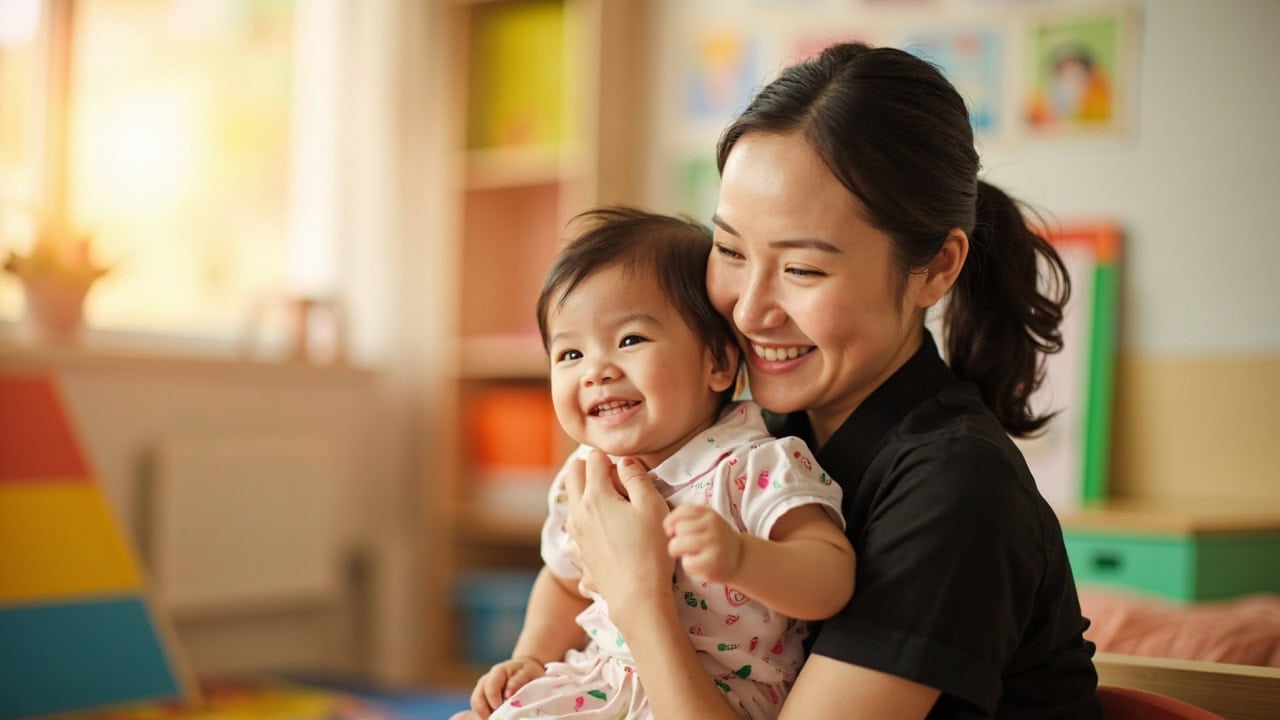
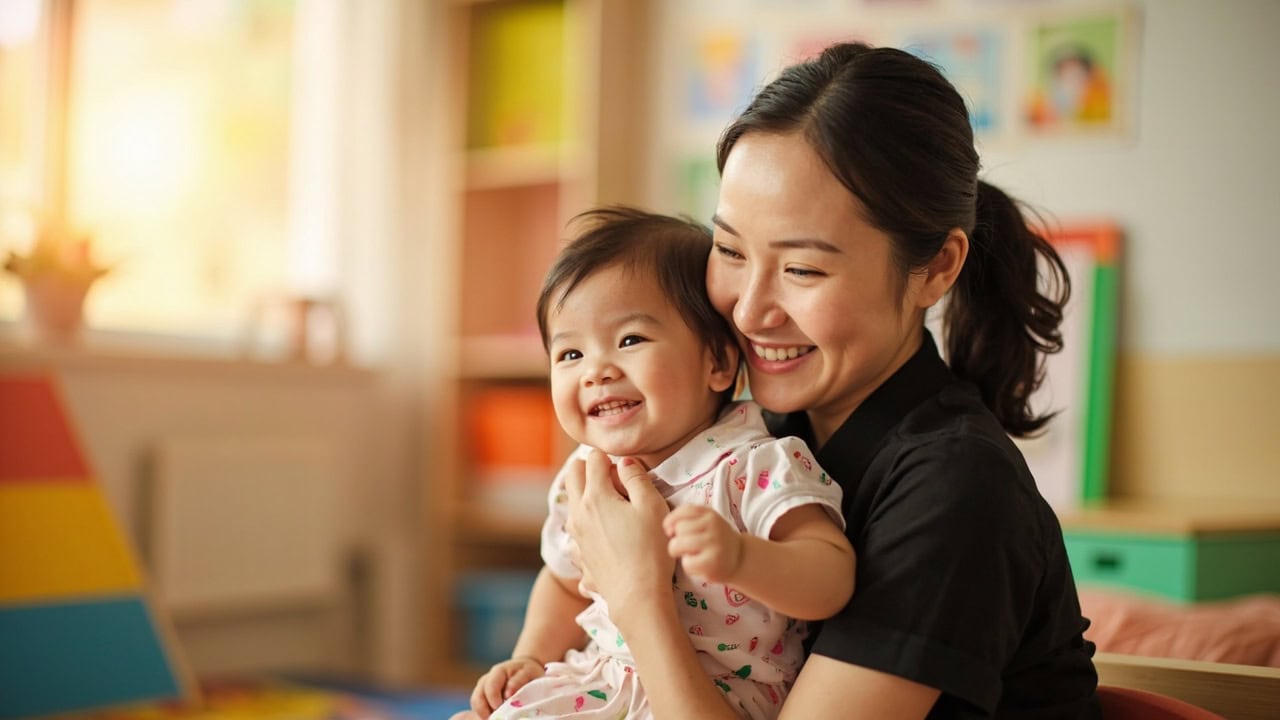
The childminder kneels at eye level. Not to seem smaller, but to meet the child where she is. The updates are specific, not generic. The rhythm of communication is predictable, not random. The environment feels known—not identical to home, but recognizable. Warm. Human. Small enough for every sound to be heard.
The ratio is not one-to-fifteen. It is one-to-one, or one-to-two, or one-to-three. It is small enough that your daughter is not a number in a room. She is a person, with a name, with a rhythm, with a way of pointing at the window that someone has noticed and written down.
Letting Go by Entrusting
When you leave your child with a caregiver, you are making a promise. The promise is not that you will never leave. The promise is that you will return. That the leaving is not an ending but a rhythm. That morning is when you go, and evening is when you come back, and the space in between is not a void but a day—a full day, with porridge and blocks and songs and naps and the particular delight of a child stacking primary colors that are falling, falling, but somehow staying up.
Lin made this promise every morning. “I’ll be back soon, my love.” She said it with a smile that cost her something. But she meant it. And every evening, she proved it—running to her daughter, feeling the weight of her in her arms, knowing that the joy of reunion was not diminished by the day but concentrated by it.
Lin texted Mdm Tan that afternoon. Not a request for an update—she knew one would come. Just a text. A simple: “Thank you.”
And Mdm Tan wrote back, three words: “We love her.”
We love her. Not as a platitude. Not as a marketing message. As a statement of fact, from a woman who had spent a day in a HDB flat with a fifteen-month-old child, stacking blocks and eating porridge and pointing at the window, and had found in that day something worth loving.
And now, every morning, at 7:44, Lin pulls into the drop-off point, and she walks her daughter to the door, and she kisses her forehead, and she says, “I’ll be back soon, my love.”
And every morning, something in her believes it.
That is not naivety. That is not the absence of fear. That is trust—earned, built, day by day, photograph by photograph, note by note, by a childminder who kneels at eye level and opens her arms and says, gently, “We’ll take good care of her, Mama.”
And means it. And proves it. And does it.
This is what it means to let go. Not by releasing. By entrusting.
And this is what EduNanny has learned, from every parent, every child, every first week and every Friday afternoon: that the most important thing a parent can do is not hold on. It is to trust that the holding can be shared.
And that the love, when shared, does not divide. It multiplies.
Ready to Find Your Village?
If you are considering near-home childminding for your infant in Singapore, EduNanny by BUTLER offers a free consultation to understand your family’s needs. Every child’s journey to finding the right care is individual—what matters is finding a fit that feels right for you, your child, and the life you are building together.
Book a free consultation with EduNanny