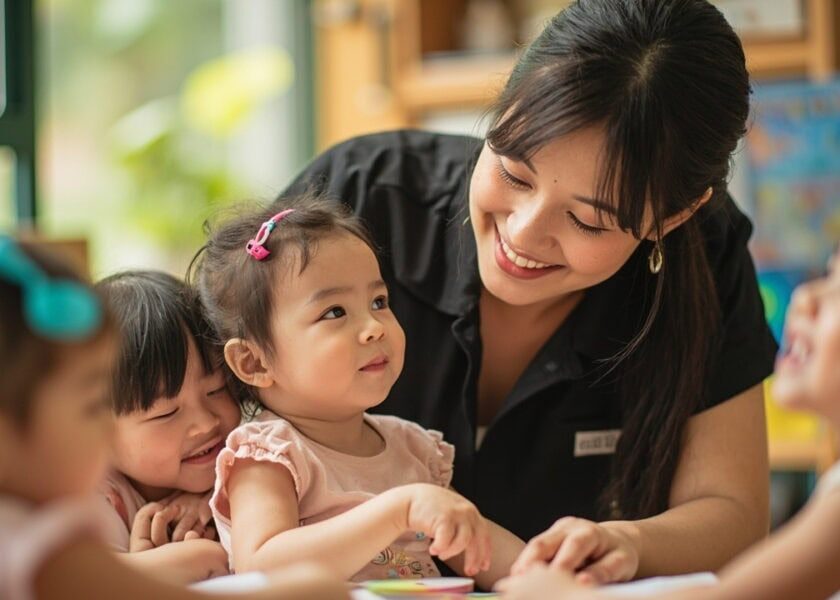
EduNanny Singapore How Near Home Care Nurtures Confident Happy Infants

” style=”width:100%;max-width:900px;display:block;margin:0 auto 16px auto;”/>
The Weight of That Question: “Am I Doing Enough?”
There is a moment familiar to every parent. The weight of a small body finally softens against yours. Breathing slows. The fist uncurls. In that stillness, a question surfaces—quiet, almost unbidden:
Am I doing enough?
You are not alone in that question. It lives in the pause before you leave for work. It lives in the guilt you carry on the commute, in the way you check your phone a little too often, in the particular silence of a home that used to be louder.
You are not failing. But you are navigating something genuinely hard, and that deserves more than a shrug. It deserves a real answer.
For parents in Singapore, that answer has historically been hard to find—until now.

Quick Summary: What Every Parent Needs to Know
- The first 1,000 days of your child’s life build the brain architecture that governs emotional regulation, language, and attachment for decades to come.
- Singapore parents face a real gap—traditional support systems (extended family, community) are often not available in the way they once were.
- Centre-based infant care and hired help are two common options, but neither is designed around the developmental needs of infants in their earliest months.
- The ECDA Childminding Pilot introduces a third option: structured, home-based infant care with proper ratios, training, and oversight.
- EduNanny operates within this pilot with a 1-to-3 caregiver-to-infant ratio, ongoing training, and genuine parent partnership.

Why the First Thousand Days Matter More Than You Might Think
You may have heard the phrase “first thousand days.” Coined by researchers studying early human development—not as marketing language, but as clinical shorthand—it describes the period from conception to roughly age three.
What decades of longitudinal research has found is striking in its consistency: the architecture of the brain is built most rapidly during these first three years. The neural pathways that will one day govern your child’s capacity for emotional regulation, language acquisition, and secure attachment are laid down not in school, but in the everyday rhythms of feeding, cooing, holding, playing, and being responded to.
This is not a suggestion. It is how development works.
A baby whose cries are met with consistent, warm response learns something profound—that the world is reliable, that they matter, that their voice has meaning. A child who experiences chaotic or unpredictable care in these early months carries that experience in their stress response systems long before they can speak a single word.
The implications are not abstract. They are neurological, emotional, and lasting.

The Singapore Reality: Why Parents Are Left to Improvise
Singapore is a nation that plans carefully. We build housing. We develop infrastructure. We invest in our workforce, planning for decades ahead.
But when it comes to the first thousand days of our youngest citizens, we have left too many parents to improvise alone.
Here is the reality on the ground:
- Singapore has one of the highest rates of dual-income households in the world. Both parents are working not by choice alone, but by economic necessity.
- Our housing model—practical, modern, well-designed—means extended family is often a bus ride away rather than a corridor apart.
- Grandparents, who were the informal childcare backbone of previous generations, are increasingly engaged in their own lives, their own health journeys, their own need for rest.
What this means simply is this: the village that parents are told to lean on does not always exist the way it once did.
Into that gap, parents have historically been offered two dominant options:
- Centre-based infant care—with ratios that can stretch a parent’s heart.
- Hired help—whose training, oversight, and suitability can vary widely.
Neither of these options is wrong. But neither was designed with the first thousand days as the priority. And for the infants who deserve more than a stranger’s hands and a checklist’s worth of attention, neither is enough.

A Third Option: The ECDA Childminding Pilot
Something is changing. The ECDA Childminding Pilot represents what the government has recognised and is working to address: that home-based infant care, when properly structured, supported, and monitored, offers something that large centres simply cannot replicate.
The benefits are specific and measurable:
- Intimacy of a smaller setting—your child is not one of many; they are known.
- Continuity of a consistent caregiver—no rotating staff, no faceless routines.
- Pace appropriate to development—no relentless group environment rushing a child forward before they are ready.
EduNanny by BUTLER operates within this pilot, and we take that responsibility seriously. We are not an experiment. We are a thoughtful, structured response to a genuine need—one that is backed by government recognition, not just private ambition.

How EduNanny Is Different: The Care Model
Intentional Ratios
Our care model is built around a ratio you will not find in most conventional settings: one caregiver for up to three infants.
This is not an accident. At one-to-three, a childminder can genuinely attune to each infant. They can read the difference between a hungry cry and a tired one. They can sit on the floor and play without divided attention. They can build the kind of responsive relationship that research tells us changes developmental outcomes.
This is not a luxury. It is a pedagogical choice, grounded in what we know about infant development, made available under a pilot framework designed to make it affordable and accessible to families across Singapore.
Professional Caregivers, Not Domestic Helpers
Caring for an infant in their first thousand days is not a domestic task. It is developmental work. It requires patience, knowledge, attunement, and a genuine love of the process.
A skilled childminder is not filling in for a parent. They are contributing to the most important period of human development in a way that deserves recognition, respect, and proper support.
When we speak about the EduNanny model, we are speaking about a vocation for caregivers—one that deserves dignity, fair compensation, structured training, and a framework that allows them to do this work well, consistently, and with pride.
Ongoing Training and Oversight
We do not place caregivers and disappear. Our team receives:
- Initial training aligned with ECDA Childminding Pilot requirements
- Regular oversight and development reviews
- Communication protocols designed to keep parents informed
- Support structures that ensure quality is sustained, not just achieved at launch

Addressing Your Concerns: Trust, Safety, and Partnership
We want to speak directly to something every parent feels: the fear of leaving your child.
It is not irrational. It is not weakness. It is the most fundamental expression of love and protection, and it is entirely reasonable to want to know—to genuinely know—that your child is safe, warm, fed, stimulated, and held with tenderness when you are not in the room.
We understand that. And we have built our practice around earning trust through transparency, not promises.
On CCTV and Communication
Where our service model includes CCTV measures, we do not present this as a surveillance tool but as a bridge of trust between parent and caregiver. You should be able to check in—not because we doubt our own staff, but because open communication is how real partnerships are built.
On Daily Connection
Our care operates Monday through Friday, in structured care blocks designed for working families who need reliability. Not a five-minute call in the morning. Not a message that goes unanswered. A genuine, daily line of communication between the people caring for your child and the people who love them most.
On Oversight and Accountability
Where our caregivers are supported by regular oversight, training, and communication protocols, we do this not to meet a compliance minimum but because the quality of care depends on the quality of support that caregiver receives. Good systems do not replace good people—they enable them.

Practical Information for Singapore Parents
We know parents deserve practical information alongside philosophical grounding. Here is what you need to know:
- EduNanny by BUTLER operates within the ECDA Childminding Pilot framework. This means our services are structured to align with existing government support where applicable.
- Fee arrangements are designed with affordability as a priority. Families may find that CDA and Baby Bonus funds can be used within our fee structures—confirm eligibility with us directly.
- We serve families across Singapore through home-based care arrangements or in connection with community pathways where available.
- Care blocks run Monday to Friday, matching the rhythm of working parents who need predictability.
- Open communication is a cornerstone of our service. A parent who is informed is a parent who can trust. A child who is calmly settled is a child who is learning.
Is EduNanny Right for Your Family?
We will not tell you that EduNanny is the only answer. It may not be the right fit for every family, and we would rather be honest about that than oversell a vision that does not match reality.
EduNanny is likely a strong fit if:
- You have an infant under 18 months and need structured, consistent care
- You value the developmental science behind the first thousand days
- You want a genuine partnership with your child’s caregiver, not just a transaction
- You are a dual-income household navigating Singapore’s childcare landscape

The Question Returns
Let us return to that first image—the weight of a sleeping child, the question that surfaces in the quiet.
Am I doing enough?
The honest answer is this: you are doing something extraordinarily difficult without the structural support that should have been there all along. And that is not your failure. It is a gap that institutions like ours, and frameworks like the ECDA Childminding Pilot, are slowly, carefully working to close.
But here is what we also know. The infants in our care—and in yours—are not waiting for perfect. They are building themselves from the inside out, and they need responsive, warm, consistent presence to do it.
That is what a one-to-three ratio makes possible. That is what a trained, supported childminder makes possible. That is what a service built on communication, trust, and developmental intentionality makes possible.
You are not outsourcing your parenting. You are sharing it with someone who takes it seriously.
And that sharing—that partnership—is not a compromise. It is a modern, thoughtful, Singapore-made solution to one of the oldest and most important questions any society can ask:
How do we raise our children well?

EduNanny Is Here, and We Are Listening
EduNanny Singapore is our answer. It is not the only answer, and it is still growing—because good care is not a product to be launched and forgotten. It is a practice that requires listening, learning, and refinement.
We built EduNanny for the parents who want to show up for their children, who understand that the early years are not a waiting room but a foundation, and who deserve a partner in that work that they can actually trust.
If you are ready to learn more about what EduNanny can offer your family, we invite you to reach out. Not because we have all the answers, but because we are committed to asking better questions—and building better systems to answer them.
Every infant in Singapore deserves the kind of start that makes a thousand days not just a statistic, but a gift—one small, safe, joyful moment at a time.
We are here. Let us walk this path together.
#EduNannySingapore #InfantCareSingapore #ChildmindingSG #FirstThousandDays #ECDAChildmindingPilot