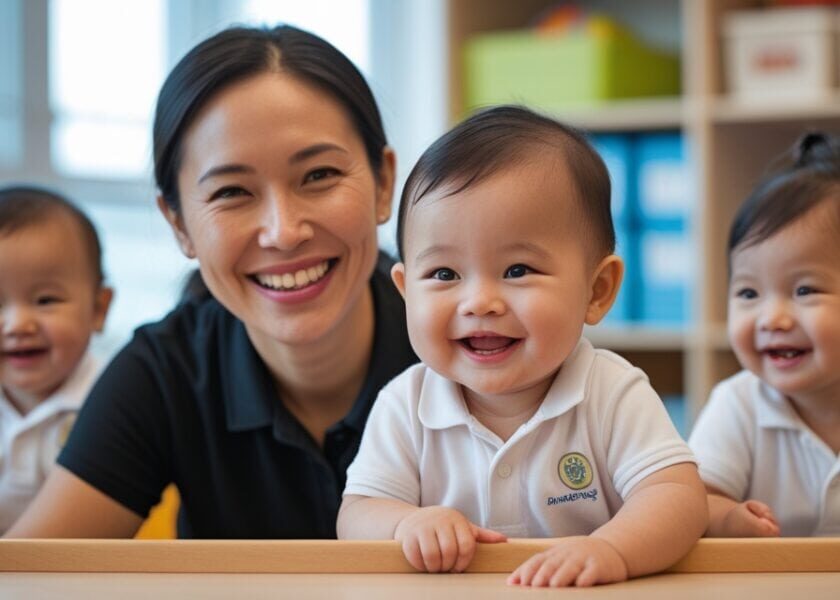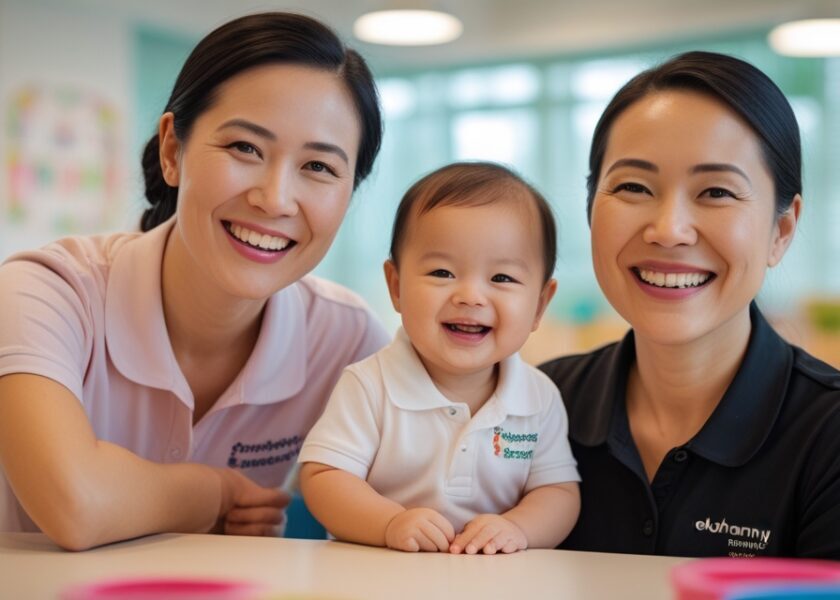
Where Singapore Infants Thrive With Safe Joyful Near Home Care

Quick Summary for Busy Parents
For parents who are researching infant care options right now, here is what matters most:
- EduNanny operates within the ECDA Childminding Pilot framework, offering home-based infant care across Singapore
- We maintain a 1-to-3 caregiver ratio — one trained caregiver for a maximum of three infants
- Our caregivers are trained in attunement-based care — responsive caregiving that supports your baby’s brain development
- Parents have direct visibility into the care environment through open communication and CCTV measures
- Our fee structures are designed to be accessible, with government subsidies and Baby Bonus schemes applicable
- Care is available Monday to Friday in established care blocks, with continuity as a foundation of our service

Why the First Thousand Days Matter More Than You Might Think
We believe something that deserves to be stated plainly: the earliest years of your child’s life are not a waiting period. They are not a gap to be filled until preschool begins. They are the foundation upon which everything else is constructed — neurologically, emotionally, socially.
In those first thousand days, a child’s brain forms more than one million new neural connections every second. The quality of care a child receives during this critical window does not simply influence development. It shapes it. It reaches forward into your child’s capacity to learn, to relate, to regulate emotion, and to trust the world around them.
This is not a comfortable truth for parents who must return to work before their child has even learned to walk. It is not meant to induce guilt. It is meant to reframe the conversation.
The question is not whether your infant will be in someone else’s care during these months. The question is what that care will look like, and whether it will serve your child’s development rather than merely supervise it.
What the Science Says
Studies in early childhood development consistently point to one finding above all others: the single greatest variable in the quality of early childhood care is not the curriculum, not the facility, not the materials. It is the person in the room with your child.
This means that when you are choosing infant care, you are ultimately choosing a person — someone whose daily decisions, responsiveness, and presence will shape your baby’s neural architecture in ways that matter for a lifetime.

The Singapore Reality: Why Infant Care Feels So Hard to Find
Singapore has made significant strides in expanding childcare options. The system has grown, options have multiplied, and subsidies have broadened. Yet for infants — children under eighteen months — the landscape remains genuinely constrained.
Centre-based infant care spots are limited. The demand consistently outpaces supply, particularly in the first year of a child’s life when the need is most acute and the stakes are highest.
For many families, the choice is not between excellent options. It is between available options.
Centre-Based vs. Home-Based Care
Understanding the difference matters for your decision:
| Aspect | Centre-Based Infant Care | Home-Based Childminding (EduNanny) |
|---|---|---|
| Typical caregiver-to-infant ratio | 1:5 to 1:8 | 1:3 (maximum) |
| Environment | Large group setting | Smaller, consistent setting |
| Location | Often centralised | Close to home, within neighbourhoods |
| Transitions | Longer commutes for infant | Shorter, gentler transitions |
| Individual attention | More distributed | More focused |
Neither model is inherently superior for every family. But for infants in their earliest months — when sensory processing is primary and attachment is being formed — research consistently supports smaller ratios and more individualised attention.

The ECDA Childminding Pilot: A Government-Recognised Framework
EduNanny operates within the ECDA Childminding Pilot, a government-recognised framework that opens pathways for home-based and community-based infant care in Singapore.
This matters for a reason worth understanding. The pilot acknowledges a truth that parents have long understood: infants thrive in environments that are small, consistent, and attuned.
A centre with forty children and a ratio of one caregiver to five or eight infants operates under a different logic than what a developing brain requires in its earliest months. The ECDA pilot creates space for a different model — one built around smaller numbers, deeper attention, and care that happens not across a centre but within a community.

What Makes EduNanny Different: The 1-to-3 Ratio
Every EduNanny placement is structured around a ratio of up to one to three. Let that ratio settle for a moment.
One caregiver. Three infants.
In a centre setting, this ratio is exceptional — available only at premium levels. In our model, it is the standard.
What does this mean in practice?
- The caregiver is not managing a group. They are attending to individuals.
- They notice when one child’s breathing shifts during a nap.
- They see the moment a second child reaches for interaction.
- They catch the early signals that a third child is becoming overstimulated, before the cry escalates.
This is not a luxury. This is what attentive care looks like when the numbers allow it.

Attunement: What Quality Infant Care Actually Looks Like
You may have heard the term attunement in discussions about parenting or child development. It sounds clinical, but it describes something profoundly simple and deeply human.
Attunement is the practice of reading a child’s cues and responding in ways that match the child’s emotional state and developmental need.
It is the caregiver getting on the floor, at eye level, and following the child’s lead. It is noticing that a twelve-month-old is fascinated by how a block feels when it is dropped, and using that moment to name the object, to model language, to allow the repetition that is central to early learning.
Care and Learning Are Not Separate in Infancy
We operate on a principle that may surprise some parents: care and learning are not separate activities in infancy.
A caregiver who responds promptly to a baby’s cry is not merely soothing distress. They are teaching the infant that the world is reliable, that communication works, that they are worthy of response.
This is not advanced pedagogy. It is attentive, responsive caregiving elevated by intention. And it becomes possible when the ratio is small, the training is thoughtful, and the culture of the organisation values this work.

Trust and Transparency: How We Partner with Parents
For parents, the question of who will care for your child is inseparable from the question of trust. How do you trust someone with the most vulnerable person in your life?
We do not pretend this is easy. We have built our practices around making that trust possible, starting with transparency.
What We Offer Parents
- Open communication — regular updates on your child’s day, development, and wellbeing
- Direct visibility into the care environment through CCTV measures where deployed
- Trust infrastructure — systems that allow you to check in during a lunch break, to see your child’s face, to feel connected to a daily life you are not present for
In a city where working parents often spend more waking hours apart from their infants than with them, this connection is not trivial. It is a lifeline.
Our Caregiver Standards
Our caregivers are selected not only for their qualifications and experience, but for their capacity for presence. We invest in ongoing development because we believe that the work of caring for an infant is skilled work — work that deserves respect, training, and continuous refinement.
We approach the childminder not as a service provider fulfilling a contract, but as a professional whose daily decisions ripple across a lifetime. The role carries a dignity that is not always recognised.

Affordability: Quality Care Should Not Be a Privilege
We understand that for many families, the question of affordability shapes what is even possible. Care should not be a privilege available only to those with means.
Within the ECDA Childminding Pilot framework, our fee structures are designed to be accessible.
How Singapore Families Can Offset Costs
- Child Development Account (CDA) — Government contributions and savings can be used to offset care costs
- Baby Bonus Scheme — Eligible families can utilise these funds for qualifying expenses
- Government subsidies — Applicable within the pilot parameters
We believe that the quality of care a child receives should not be determined by the neighbourhood they live in or the salary their parents earn. The first thousand days belong to every child in Singapore, not only to some.

Continuity and Reliability: Why Consistency Matters
Monday to Friday, during established care blocks, EduNanny provides continuity of care that many families tell us they struggled to find elsewhere.
The reliability matters. Infants need predictability.
Routines are not restrictions — for a young child, a reliable daily rhythm is a form of security. Knowing that Monday follows Sunday, that the caregiver’s face will be there, that the environment is consistent, reduces the cognitive and emotional load on a child who is already processing the enormous work of growing.
Care Near Home
EduNanny operates within Singapore’s neighbourhoods so that families do not have to choose between proximity and quality. A child should not have to travel across the island to receive care that will serve them well. The care should be close to home. Literally.
When care is near home, the transition for both parent and child is gentler. The environment is more familiar. The community connections — the neighbours, the routines, the neighbourhood sounds — remain accessible. For a young child whose world is defined by sensory experience and the presence of trusted faces, these details are not incidental. They are the texture of security.

Common Questions from Singapore Parents
How is home-based childminding different from hiring a domestic helper for childcare?
EduNanny caregivers are trained professionals within a structured framework. They receive ongoing development, operate under clear quality standards, and are part of a monitored pilot programme. The relationship is professional, with defined boundaries and accountability.
What if my baby has special needs or medical requirements?
We encourage parents to discuss their child’s specific needs during the matching process. Our caregivers are trained in responsive, individualised care, and we work to ensure that the placement is appropriate for your child’s requirements.
How do I know my baby is safe?
Safety is foundational. Our caregivers operate within ECDA pilot guidelines, and parents have direct visibility into the care environment. We believe transparency is not just policy — it is trust infrastructure that allows you to work with peace of mind.
What if my baby doesn’t adjust well?
Adjustment takes time, and every child is different. Our caregivers are trained to support gentle transitions, and we maintain open communication with parents throughout the settling period. If a placement is not the right fit, we work with families to find solutions.

A Letter to Singapore Parents
We also understand that the anxiety of leaving your infant, the guilt that many parents carry, the second-guessing and the worry — these are real experiences, and they deserve to be acknowledged without dismissal.
We are not here to tell you to stop feeling what you feel. We are here to offer you care you can trust, so that the moments of worry become fewer and the moments of confidence grow.
Singapore is a nation that understands investment. We invest in infrastructure, in education, in healthcare. We understand that the decisions made early — in the planning stages, before the building rises — determine what the structure becomes.
We are making the same argument about our youngest citizens. The investment we make in the first thousand days of a child’s life is not a sentimental choice. It is a strategic one.
Children who develop with secure attachment, with language-rich environments, with caregivers who are attuned to their needs — these children enter school ready to learn. They navigate social situations with greater ease. They carry less behavioural and emotional difficulty. The return on this investment compounds across a lifetime.

The EduNanny Commitment
We are not in the business of childcare provision in the conventional sense. We are in the business of building the conditions in which infants can develop well and parents can work with peace of mind.
Every policy we set, every ratio we maintain, every communication channel we open, every caregiver we train — all of it is in service of that dual commitment.
EduNanny is not a substitute for family. We are an extension of it — a trusted extension, built on rigorous standards, grounded in developmental science, and committed to the belief that every infant in Singapore deserves to be seen, heard, and tended to with care that is equal to the importance of the task.
The child in your arms today will be the person making decisions in this city twenty-five years from now. The quality of attention they receive now, in these earliest and most receptive months, will shape the kind of person they become.
This is not a small thing. It is the smallest and the largest thing at the same time.

Begin Your Search for Infant Care in Singapore
If you are researching infant care options for your child under 18 months, we invite you to learn more about what EduNanny offers.
We are grateful to the parents who trust us with this work. We do not take that trust lightly. And we are committed — day in, day out, one infant at a time — to proving that it is well placed.
Connect with EduNanny today to discuss your family’s infant care needs and discover whether our home-based childminding service is the right fit.
#EduNannySG #InfantCareSingapore #ChildmindingPilot #ECDAChildcare #FirstThousandDays