

EduNanny Singapore December 2024 to December 2027 A Living Attunement Approach Through Near Home Pods and Ultra Low Ratio Infant Care

EduNanny Singapore: A World-Class, Heart-Forward Approach to Infant Care
Good morning, Singapore. This long-form article expands on the core ideas behind EduNanny—our science-led, heart-forward childminding movement that brings premium infant care to families where they live and work. Built on the wisdom of Montessori, Pikler, Bowlby, Vygotsky, Piaget, Froebel, Erikson, and Spock, EduNanny translates theory into practical, everyday practice that is simple, safe, and deeply human. This piece provides actionable guidance for parents, caregivers, employers, and communities looking to raise capable, confident children through attentive proximity and carefully designed care environments.

Topic 1: The Pedagogy of Attentive Proximity
Great infant care is not a rigid schedule; it is a relationship rendered visible. At EduNanny, we practice the Four Quiet Moves—Sink, Scan, Signal, Support—because short, calm, attuned moments accumulate into lasting growth. Below are practical guidelines you can apply at home or in any EduNanny setting.
The Four Quiet Moves
- Sink: Lower yourself to the infant’s level. Knees bent, voice soft, pace slow. When you approach, your calm becomes contagious. Action begins with presence rather than rush.
- Scan: Read micro-cues in real time. Watch gaze shifts, facial expressions, breath rate, fidgeting, and posture. This is the live application of Vygotsky’s zone of proximal development—readiness and stress cues assessed moment by moment.
- Signal: Narrate the moment. Examples: “I see your hands reaching,” “I’m going to lift you now.” Language scaffolds safety and makes the world predictable; Piaget’s object permanence meets Bowlby’s secure base.
- Support: Offer just enough challenge within reach. Embrace Montessori’s “help me do it myself” and Pikler’s respect for self-initiated movement. The adult remains a steady lighthouse, not a tugboat.
In Practice: Everyday Implementation
- Floor-level learning: Create a calm, inviting space with low shelves, open baskets, and non-intrusive toys that invite independent exploration; keep pathways clear for safe movement.
- Flexible routines: Build routines around the infant’s cues—sleep, feeding, and play bend to the child’s rhythm, not the clock alone. This respects biological patterns and reduces stress for both baby and caregiver.
- Rich, responsive language: Practice serve-and-return conversations. Narrate actions, describe feelings, and name objects to grow vocabulary, regulation, and trust.
- Practical parenting tips: Use short, regular touchpoints—15–20 minute focused interactions followed by rest or independent play. Rotate activities to sustain curiosity and reduce overstimulation.
Our goal is simple: to cultivate a child who expects the world to be safe, people to be kind, and effort to be worthwhile. This is the foundation for lifelong learning and resilience.
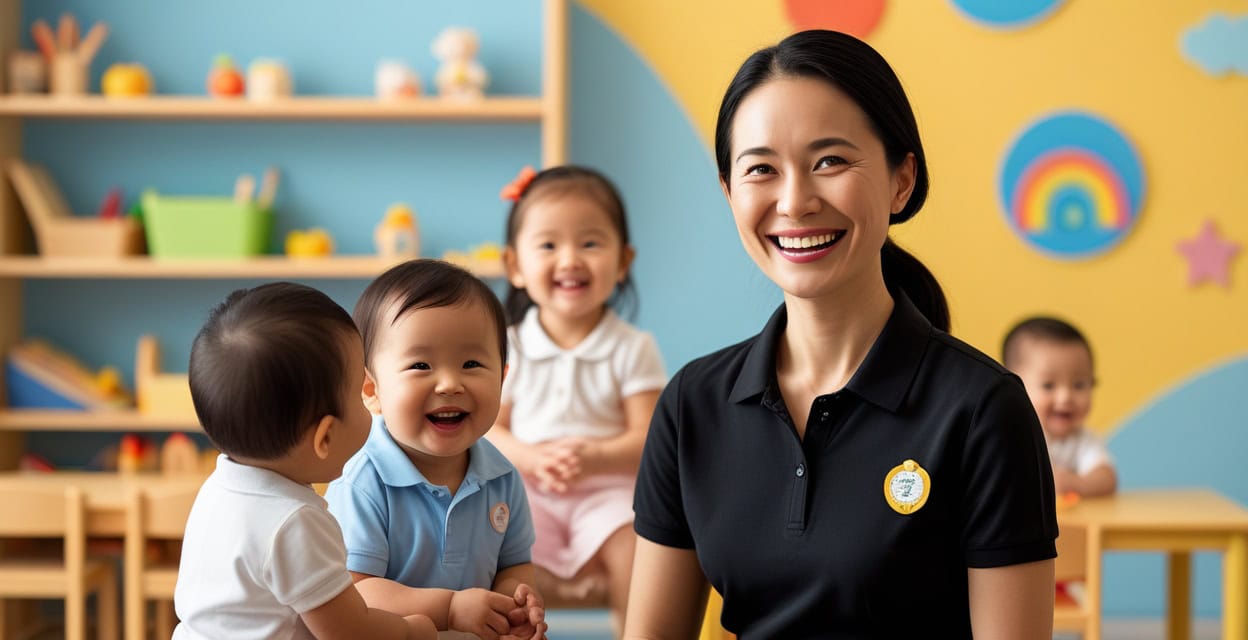
Topic 2: Safety by Design—Layers, Not Luck
Safety is a layered architecture that blends environment, procedure, people, and technology. This multi-layer approach ensures rapid response, ongoing learning, and transparent accountability.
Environment
- Modern layouts with rounded edges, anchored furniture, anti-slip surfaces, and clear sightlines to supervise without hovering.
- Sleep safety: firm, flat surface; back-sleeping; one infant per cot; no pillows, quilts, or soft toys; controlled temperature and lighting; frequent checks.
- Hygiene and conduct: medical-grade routines; handwashing choreography; proper sterilization and safe milk handling; diapering with strict zone separation.
Procedure
- 1:3 infant ratio for immediate response and attuned presence.
- Structured arrival and handover protocols that confirm identity, health status, feeding plan, and special notes.
- Clear allergy flags and controlled feeding lists; Epipen familiarity where indicated; safe weaning as guided by professionals and families.
- Transparent incident reporting that is timely, accurate, and archived for learning and audit.
People
- Childminders trained in infant CPR/first aid, safe sleep practices, developmental observation, and responsive caregiving.
- Continuous professional learning, reflective practice, and coaching to elevate skill and judgment.
- Character-first hiring: calm presence, precise hygiene, patient communication, and ethical conduct as non-negotiables.
Technology
- CCTV-enabled transparency in participating sites to support auditability and family confidence where allowed.
- Secure digital attendance, health logs, and developmental notes to strengthen family partnership.
- Emergency readiness with clear escalation pathways and drills to ensure calm, prompt response.
Safety is not an add-on; it is the soil from which curiosity and confident exploration grow.
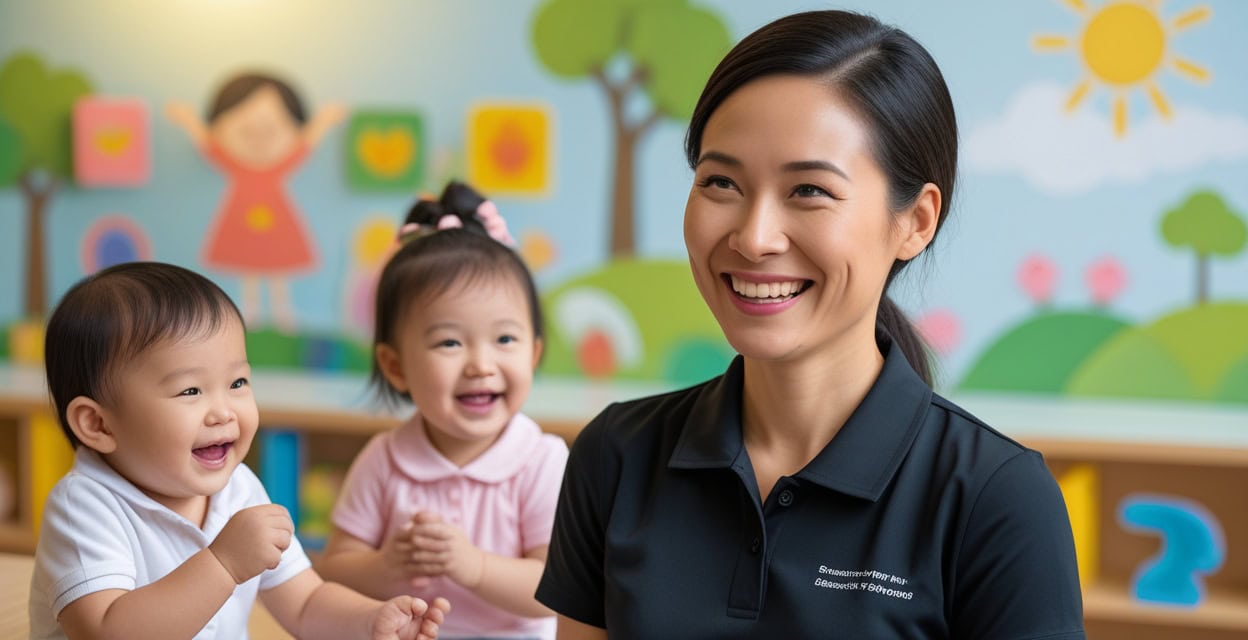
Topic 3: Development and Happiness—The Seven Everyday Nutrients
Infants thrive on consistent, loving care delivered through daily experiences that are meaningful and attainable. We identify seven everyday nutrients that form the backbone of early development and happiness. Each nutrient is a practical cue for caregivers and parents to cultivate in daily routines.
- 1) Touch: Warm, respectful handling; skin-to-skin contact when appropriate; secure holds that support the vestibular system and comfort.
- 2) Talk: Rich narration, singing, and storytelling; naming feelings and actions to build language and self-awareness.
- 3) Time on the floor: Supervised tummy time, side-lying play, and opportunities for free movement; strength before skill, gradually increasing capacity.
- 4) Tunes and rhythm: Simple songs, clapping games, and rhythmic activities that prime language and self-regulation.
- 5) Taste (developmentally appropriate): Parent-guided weaning with exposure to textures and flavours; safe feeding practices that align with medical guidance and family preferences.
- 6) Tiny challenges: Accessible ramps, wobble boards, and treasure baskets that introduce just-right challenges to foster persistence and problem-solving.
- 7) Tender endings: Unhurried transitions, predictable goodbyes, and consistent routines that instill security and trust.
Sample arc of the day with EduNanny-inspired pacing:
- Morning: Gentle arrival, check-in, sensory invitations, first nap cue.
- Midday: Feeding, storytelling, movement exploration, outdoor time where permitted, second nap.
- Afternoon: Music and rhythm, free play, diaper and hygiene, calm-down ritual, handover with parent briefing.
Happiness in infancy is not a constant smile; it is a steady rhythm of safety, delight, and recovery after small frustrations. This rhythm builds resilience that travels with the child into later years.

Topic 4: The Purpose of Childminders—A Public Craft, A Private Trust
The childminder’s work is quiet nation-building. It protects parental livelihoods, elevates women’s workforce participation, creates dignified employment, and strengthens neighbourhood bonds. EduNanny participates in the ECDA Childminding Pilot (December 2024–December 2027) to advance a maximum employment mandate—professionalising childminding with clear standards, transparent supervision, cooperative scheduling, and growth pathways.
EduNanny commitments under the ECDA pilot
- Centre-based and home-based options within communities—care close to family life.
- Distance support for remote days—virtual check-ins, coaching, and responsive routines.
- Employer partnerships—reliable 7am–7pm coverage, Monday to Friday, stabilising the workday for families.
- A culture of transparency—CCTV where enabled, open communication, and documented care.
- Professional development with upskilling pathways to elevate status and capabilities of childminders.
At-a-Glance: What Parents Can Expect with EduNanny
- Excellence and quality assurance in every setting.
- Centre-based, home-based, and distance-supported options islandwide.
- Convenient hours: Monday–Friday, 7am–7pm.
- Ultra-low 1:3 infant ratio for real attunement.
- Modern layouts designed for safety, calm, and curiosity.
- CCTV-enabled transparency in participating sites.
- Affordable from $33/day; CDA/Baby Bonus options where eligible.
- A national social initiative under the ECDA Childminding Pilot (Dec 2024–Dec 2027), operated by EduNanny by BUTLER.
- A maximum employment mandate—professionalising childminding and expanding quality jobs.
- Simple next steps at EduNanny.com and Childminding.EduNanny.com (note: this sentence appears in the source text; adapt as needed for your site).

EduNanny’s Philosophy and Purpose
We believe every infant deserves three gifts: time, tenderness, and thoughtful challenge. Time ensures development is not rushed; tenderness builds trust in joining the world; thoughtful challenge promotes joyful perseverance. Our purpose is to normalize these gifts everywhere, across Singapore, so that every block and building becomes a nurturing learning environment.
- Our public pledge:
- We will keep the ratio low and the listening high.
- We will let the floor be a classroom and the caregiver a calm guide.
- We will make safety visible and joy audible.
- We will stand with parents—Monday to Friday, 7 to 7—so that family life and working life can flourish.
- We will uphold affordability and transparency, from $33/day, with CDA/Baby Bonus options where eligible.
- We will grow a proud profession—childminders who are trained, trusted, and treasured.

Conclusion: Who, What, When, Where, and How Childminding Matters—and EduNanny’s Promise
EduNanny’s model blends science with tenderness to deliver a scalable, human-centric approach to infant care. Our focus on attentive proximity, safety-by-design, and a seven-nutrient approach ensures that infants receive consistent, high-quality care while families retain dignity and stability in work-life integration. The public infrastructure we’re building—transparent practices, trained professionals, and accessible hours—aims to ease parental anxiety, strengthen livelihoods, and foster kinder communities.
Next steps for parents and employers who share this vision: walk a site, meet a childminder, review safety layers, and experience the difference a 1:3 day can make. If EduNanny resonates with your hopes for your child and your neighbourhood, we invite you to engage with us through our education channels and consider how EduNanny can be part of your family’s everyday life.
In the end, the measure of our success is simple: calmer babies, steadier parents, and kinder communities. That is how small hands change a big world—and how Singapore grows resilient—one attentive minute at a time. Thank you.
Next steps:
- Visit EduNanny.com to learn more about our centre-based and home-based options.
- Request a site tour to observe the Four Quiet Moves in action.
- Discuss with your employer about reliable 7am–7pm coverage and flexible scheduling.
- Ask about safety features, transparency practices, and 1:3 infant ratios in prospective settings.