
Proximity Predictability Presence The EduNanny Model for Singapore Infants

EduNanny: Proximity, Predictability, Presence — A New Standard in Singapore Infant Care
Good evening, partners in care. Parents, caregivers, neighbors, and those who believe that the future of a nation is built in the smallest rooms of trust — this is EduNanny by BUTLER. Born in Singapore, our promise is to make everyday infant care both an art and a science: reliable, beautifully simple, and rigorously designed so that every family can begin well, not by chance, but by design.
What follows is an in-depth look at EduNanny’s integrated approach to infant care and childminding—how we work, why we measure what matters, and how families can partner with us to give babies the strongest possible start.

What is EduNanny?
Integrated care across settings
EduNanny is a cohesive system that blends centre-based care, home-based care, and near-home childminding into one unified model. We open Monday to Friday, 7am to 7pm, islandwide, so workdays and child days align with minimal friction. Our ultra-low infant ratio—1 caregiver for every 3 infants—honors focused attention and deep safety. Spaces are designed at baby scale, in modern, calm layouts that support exploration without overstimulation.
We embrace transparency with innovation CCTV, while keeping fees accessible from $33/day and enabling payments through the CDA/Baby Bonus. We operate in both community centers and home premises to ensure true proximity. EduNanny participates in the ECDA Childminding Pilot as a National Social Initiative with a Maximum Employment Mandate—creating meaningful, dignified jobs for trained childminders. Practical info: EduNanny.com and Childminding.EduNanny.com are your starting points for enrollment and updates.
Three core essentials: proximity, predictability, presence
- Proximity: Neighborhood micro-care that shortens drop-offs to minutes, not hours.
- Predictability: A consistent schedule—Monday to Friday, 7am–7pm—with dependable caregivers and routines you can anticipate.
- Presence: Eye-level attention at a 1:3 ratio, with daily updates and authentic, meaningful contact between baby, caregiver, and family.
These three essentials are the backbone of our practice. They transform ordinary routines—feeding, diapering, gazing—into a dependable, developmental framework that supports attachment, language growth, and self-regulation.

The Four Fresh Ideas That Power Our Practice
1) The Downshift Pedagogy: Adults go low so babies rise strong
Our posture is the first curriculum. We kneel, soften voices, and slow tempo. When adults enter a child’s frame—close, calm, observant—the infant nervous system organizes around safety, which primes learning.
- Three moves guide us:
- Downshift: Move to the child’s level, slow your pace, align breathing.
- Describe: Narrate the child’s actions: “You’re reaching. That block is heavy.”
- Delight: Mirror the child’s spark without overwhelming it.
Rooted in Montessori calm, Pikler respect, Vygotsky’s scaffolding, and Bowlby’s secure base, this approach makes every minute—whether feeding, diapering, or gazing—part of a meaningful curriculum.
2) Safety as Choreography: Calm rooms, practiced hands, clear sightlines
Safety isn’t a checklist we retrieve on a busy day; it’s choreography practiced until the room itself moves with safety.
- Space: Modern infant-height layouts, rounded edges, floor-level visibility, no blind spots.
- Ratios: 1:3 at all times—visible, measurable attention.
- Routines: A 60-second hourly safety scan: sleep position, airway, temperature, hydration, environment.
- Health: Handwashing before touch; allergens labeled; bottles timed and logged; sleep guidelines (backs, firm mattresses, no loose items).
- Training: Infant CPR/First Aid certification, rehearsed emergency drills, and practiced incident protocols.
- Transparency: Privacy-respecting, always-on CCTV that invites sunlight into care while protecting children.
- Communication: Real-time notes and photos that document progress and reassure parents, not merely for show.
We design “zero-rush rooms”—no fragile items, no sharp hazards, no frayed attention. Quiet spaces support loud learning in the right way.
3) Three Development Arcs in One Gentle Day
Infancy is rhythm, not race. Our micro-curriculum honors three arcs daily.
- Body: For the youngest, tummy time on soft mats, slow rolls, open-floor exploration; for early walkers, cruising along safe surfaces; for toddlers, structured movement—push, pull, climb, carry—to build strength and coordination.
- Language: Rich, concrete language; multilingual songs; mirror babble; gesture-rich reading with pauses. 0–12 months emphasizes sound-shapes; 12–24 months focuses on naming; 24–36 months builds short sequences like “First shoes, then door.”
- Regulation: Co-regulation as daily practice: “I can wait with you.” Predictable routines, soft transitions, and calm corners guide emotion regulation.
Milestones become conversations between temperament and environment, not numbers on a chart.
4) The Joy Index: How we know a room is truly good for babies
Joy is measured, not manufactured. Our indicators show the room’s vitality and security:
- Settling time at drop-off decreases over weeks.
- Sleep deepens; naps become restorative.
- Coos, gestures, and smiles rise, signaling social safety.
- Curiosity expands: infants reach, toddlers repeat, then vary.
- Transitions soften: fewer tears, more anticipation.
- Evenings feel calmer for families; feeding improves; the home feels lighter.
Joy is a steady hum of belonging. In EduNanny rooms, joy shows up as calm, engaged caretaking—a chorus of caregivers humbly moving with a child’s pace.

The Purpose of Childminders and the Maximum Employment Mandate
Childminders are not “extra help”; they are custodians of the bond that steadies a life. Their purpose is threefold:
- To provide a consistent anchor beyond the parent, building secure trust that the world holds.
- To enable parents’ working lives with reliable, dignified care rather than precarious patchwork.
- To knit neighborhoods into communities—where jobs are created near home and professional growth is supported with mentorship and respect.
That is why EduNanny’s Maximum Employment Mandate matters. We train and employ caregivers islandwide, offering clear progression and meaningful careers. When adults feel supported, children feel safe and confident.

What EduNanny Offers Busy Families: Practicality with Purpose
Setting choices that fit your life
Choose from Centre-Based care for robust resources, Home-Based care for intimate rhythms, near-home micro-care for near-immediate access, and Distance Support for coaching when baby stays at home. All options share the EduNanny standard of safety, routine, and developmental focus.
Hours, consistency, and accessibility
Monday–Friday, 7am–7pm, islandwide. Consistency means families can plan with confidence, knowing care is available during core work hours and aligned with baby schedules.
Safety, visibility, and trust
Safety is built-in, not bolted on. Ultra-low 1:3 ratios guarantee attentiveness; CCTV provides transparency while respecting privacy; caregivers are trained in infant CPR/First Aid and participate in ongoing drills and reviews.
Continuity and national alignment
Families see the same familiar faces and routines, creating familiar rhythms that support attachment. EduNanny operates within the ECDA Childminding Pilot as a National Social Initiative, contributing to a broader national infrastructure of care.
A day in an EduNanny room
Typical snapshots of a day:
- 7:45am: A caregiver kneels, a baby relaxes into a familiar touch; parent departs; room holds its calm.
- 9:20am: Infants explore texture boards; a toddler narrates a tower. The caregiver’s voice is soft, specific, and delighted.
- 11:30am: Sleep setup checked twice; lights dim; white noise low; ratios maintained.
- 2:15pm: Outdoor strolls or indoor movement arcs; hands washed; notes sent to parents.
- 5:45pm: Slow handover with a clear story: what your child tried, loved, and will revisit tomorrow.
It is quiet work that adds up—consistency that feels human, not showy.

Benefits at a Glance: What Families Experience with EduNanny
- Excellence you can see: Transparent care, well-designed spaces, and skilled caregivers.
- Flexible settings: Centre-Based, Home-Based, near-home, and distance coaching options.
- Safety and visibility: 1:3 ratio, real-time updates, and CCTV-enabled transparency.
- Time harmony: 7am–7pm coverage, Monday–Friday across Singapore, minimizing commute stress.
- Affordability: Fees from $33/day with CDA/Baby Bonus support.
- Continuity and development: Consistent caregivers and routines that support language, motor, and regulatory development.
- National alignment: ECDA Pilot participation and a national framework for quality care.

A Singapore Context Explainer: Why EduNanny Matters Now
Singapore moves fast, and families carry much. Great infant care must be two things at once: exquisitely personal and flawlessly practical. EduNanny bridges this paradox by pairing near-home access with national standards, balancing transparency with privacy, and keeping excellence affordable so it remains a baseline—not a privilege.
Key daily examples to consider as you evaluate care options:
- Proximity matters for parental peace of mind and child security during busy commutes.
- Predictable routines reduce household stress and improve sleep and feeding patterns.
- Presence through meaningful interaction supports attachment and early language growth.
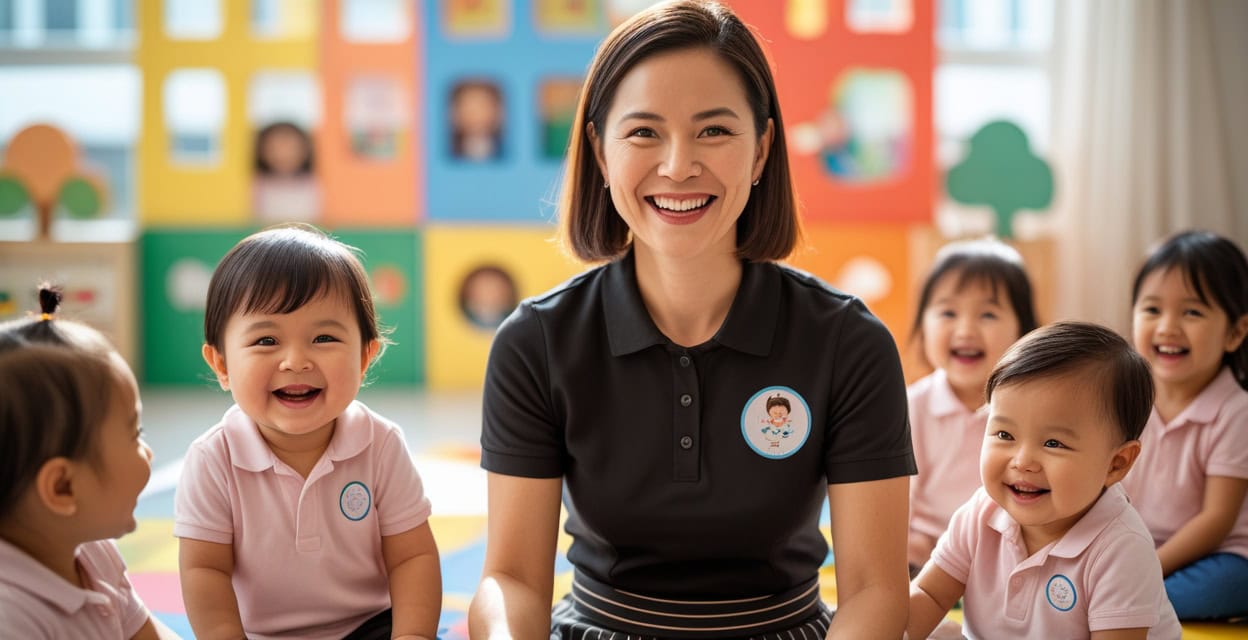
A Day in the Life: What to Expect in EduNanny
To give families a tangible feel, here is a concise, practical day diagram:
- 7:45am: Caregiver kneels, baby settles into familiar contact; parent departs; room maintains calm.
- 9:20am: Texture exploration and joint attention; caregiver uses calm narration to name discoveries.
- 11:30am: Sleep routines observed; safe sleep guidance followed; caregiver monitors for comfort.
- 2:15pm: Movement arcs and indoor/outdoor activity; hygiene protocols observed; progress notes shared.
- 5:45pm: Clear, simple handover story: achievements, attempts, and tomorrow’s focus.

Conclusion: A Call to See the Difference
Parents, your child’s first caregivers outside your arms carry a sacred trust. EduNanny holds that trust with practiced hands, listening eyes, and measurable standards. We promise proximity that shortens commutes, predictability that calms households, and presence that infants feel in their bones. Let the greeting in the morning be steady, gentle, and joyful—and watch the day open with potential.
Come see what a calm room and a careful ratio can do. Visit EduNanny.com or Childminding.EduNanny.com. Walk through our modern layouts, meet the childminders who will learn your baby’s rhythms by heart, and ask about CDA/Baby Bonus payments, 7am–7pm coverage, and our centre- and home-based options across Singapore.
Together, let’s turn ordinary minutes into lifelong confidence. Together, let’s build a future where every beginning is worthy of the potential it holds. Thank you.

Conclusion
Key takeaways for families and caregivers:
- EduNanny offers an integrated, proximity-first approach to infant care with strict safety and development standards.
- The three essentials—proximity, predictability, presence—shape every routine and space.
- The four ideas—Downshift Pedagogy, Safety as Choreography, Three Development Arcs, Joy Index—translate theory into daily practice.
- Caregivers are custodians of attachment, with a national mandate to expand meaningful, dignified work.
- EduNanny is designed to fit real family life: flexible settings, consistent hours, transparent care, and affordable rates supported by government schemes.
If you’re ready to take the next step, explore EduNanny’s offerings and begin a conversation about how we can tailor a plan for your family.
Visit: EduNanny.com and Childminding.EduNanny.com
Keywords for search visibility and context:
[#EduNannySingapore, #InfantCareSingapore, #LowRatioCare, #EarlyChildhoodDevelopment, #ECDApilot]Ready to Experience Excellence?
Transform Your Family’s Journey
Discover Singapore’s leading infant care and childminding services. Expert guidance for your little one’s first thousand days.