Cradling a Nation EduNanny Near Home Micro Pods Redefine the First Thousand Days in Singapore December 2024 to December 2027
Overview: The First Thousand Days and EduNanny’s Vision
Thank you for gathering to consider something both humble and profound: how we hold the first thousand days of a child’s life. Those days are small in number yet vast in consequence. They are the days in which the brain triples, bonds root, trust becomes a compass, and curiosity ignites. When we steward those days well, we do more than care for babies—we seed the character and confidence of a generation. EduNanny Singapore is designed to honour that gift by pairing near‑home care with professional, development‑minded practice. Our Near‑Home, 1-to‑3 micro‑pod model blends the intimacy of a trusted caregiver with the accountability of a well‑run public programme, within Singapore’s ECDA pilot from December 2024 to December 2027. This article expands on what that means in practice for families, caregivers, and communities.

EduNanny Infant Childminding Service: A National Pilot in Singapore
EduNanny by BUTLER is honoured to be one of the appointed operators in Singapore’s national childminding pilot led by ECDA. Our model emphasises proximity, low density, and high standards—designed to make saying “yes” easier for families while maintaining safety, dignity, and developmental richness. By delivering care that feels like home yet runs with the discipline of a public programme, we aim to support both infants and parents in the critical early years.

Five Convictions that Guide EduNanny
1) Proximity Matters
When care is near home, transitions are gentler, parents stay connected to their communities, and neighbourhood networks strengthen. Proximity reduces daily stress for families and supports continuity of routines. Practical steps you can take include:
- Seek pods located within walking distance of home or workplace to minimise travel time and preserve family routines.
- Choose spaces that feel safe, calm, and predictable in layout—low noise levels, natural light, and clean, organized materials.
- Coordinate pick‑ups with reliable handover rituals to reinforce trust between caregiver and family.
For EduNanny families, proximity is not just geography—it is a mechanism for consistent attachment, smooth everyday rhythms, and ongoing engagement with the local community.
2) Ratio Matters
A 1:3 infant‑to‑childminder ratio is more than a statistic; it is the scaffold for responsive, attachment‑first caregiving. In practical terms, this ratio enables caregivers to:
- Notice subtle cues and tailor responses quickly—soothing, feeding, and play become finely attuned to each child’s needs.
- Balance individual attention with gentle group experiences that support social development.
- Maintain sustainable energy for caregivers, reducing burnout and increasing reflective practice.
Our approach mirrors the wisdom of attachment theory and early‑years pedagogy: the caregiver’s sensitivity to a child’s cues shapes trustworthy relationships and healthy self‑regulation.
3) Dignity Matters
Every infant deserves trained professionals, clear standards, and transparent safety. We operate within ECDA’s framework, employing certified childminders, robust background checks (including regular adult residents in home settings when applicable), infant first‑aid training, and a culture of reflective practice grounded in Montessori, Piaget, Vygotsky, Froebel, Malaguzzi, Spock, and Erikson. Key practices include:
- Ongoing professional development and coaching for childminders.
- Clear safety protocols, including rigorous hygiene and safe sleep guidelines.
- Transparent incident reporting and responsive parent communication.
Dignity means treating caregivers with respect as professionals and recognizing families as partners in the child’s growth.
The Attachment Compact: A Secure Base, One Small Pod at a Time
Overview
Each infant is paired with a primary EduNanny Childminder who learns their cues, rhythms, and comforts. This primary relationship forms the core of attachment‑first care, offering consistency, warmth, and attuned response throughout the day. As part of the daily rhythm, a deliberate hello and goodbye routine is built into every transition, reinforcing security and trust.
Practical Implementation
- Handover practices: a short, human update at drop‑off and pick‑up—what the child tried, loved, and needed that day.
- Routines as curriculum: unhurried feeding, responsive naps, and play that respects the child’s pace.
- Sample handover script: “Hello, [Child]. Today we explored [material/activity]. [Caretaker] noticed [cue], and we tried [response]. We’ll continue with [next step] tomorrow.”
Safety by Design: Layers, Not Luck
People
All EduNanny childminders are certified, background‑checked (including regular adult residents in home settings where applicable), trained in infant first aid and food safety, and guided by ECDA’s industry standards. We assign a maximum of three infants per caregiver to ensure attentive, responsive care.
Places
Spaces include two models:
- Community pods: purpose‑built or adapted spaces with safety features and monitoring as required.
- Approved home‑based settings: carefully selected residences that offer a home‑like environment with monitoring in caregiving areas during care hours, with consent.
Practices
We uphold a No Sick Child Policy to protect infants and families. If fever or contagious symptoms arise, we coordinate prompt pick‑up and a clear return plan. Safety culture includes:
- Rigorous hygiene protocols and safe sleep practices.
- Incident reporting with transparent follow‑up.
- Continuous risk assessment and improvement cycles.
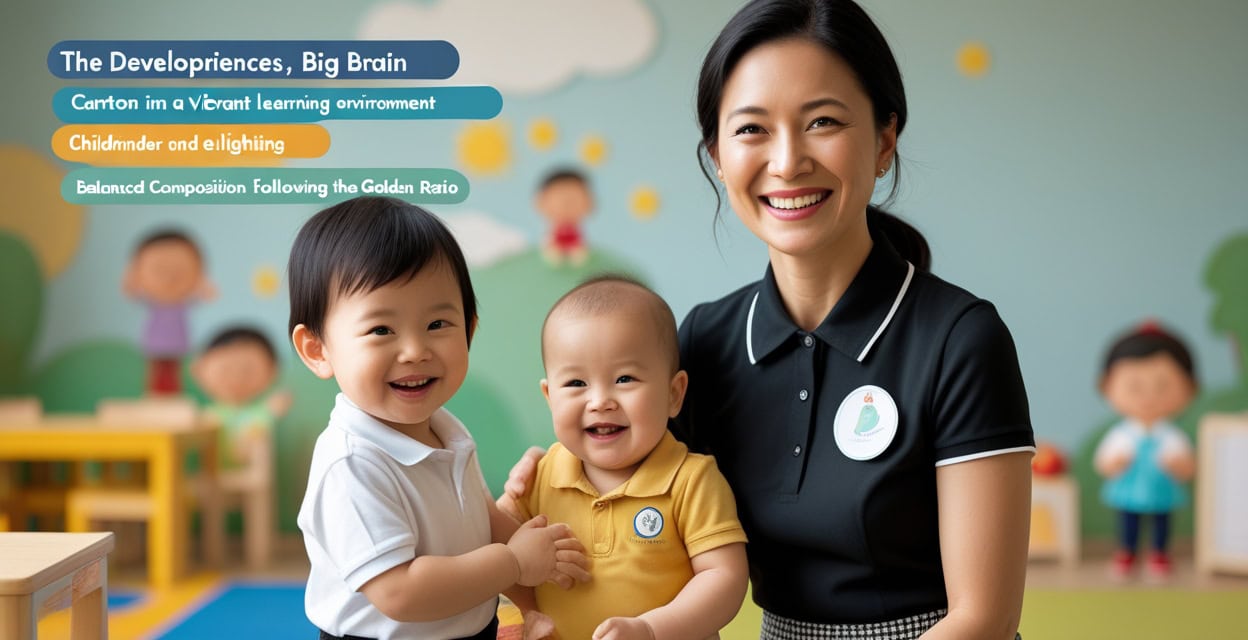
The Developmental Diet: Small Experiences, Big Brain
Intent and Approach
Drawing from Montessori and Piaget, our daily experiences are low‑stimulus, high‑purpose activities designed to support motor, cognitive, language, and social development. A typical day weaves together movement, exploration, and rest, with mindful attention to avoid overstimulation.
Key Activities by Developmental Domain
- Motor: reaching, grasping, rolling, scooting, cruising; tummy time with responsive prompts.
- Language: songs, rhymes, simple talking routines, responsive labeling of objects and actions.
- Cognition: cause‑and‑effect play with simple objects, problem‑solving through safe exploration, object permanence games.
- Social‑emotional: mirror play, turn‑taking during simple interactive games, warm, patient caregiver interactions.
Social Learning and the Power of Small Groups
Vygotsky reminds us that learning is social. The 1:3 pod forms a tiny community where infants observe, imitate, and gradually engage more fully under a sensitive guide. Regular reflective conversations among caregivers further enrich the learning environment.

Joy and Belonging as Outcomes: Because Happy Is Serious Work
What Joy Looks Like in Practice
Joyful outcomes are measurable and meaningful: calm arrivals, engaged play, relaxed feeding, settled naps, and cheerful reunions. We actively track these signals and respond with adjustments to routine, environment, or caregiver support as needed.
Visibility and Trust
Parents receive regular updates—logs, photos, and, where applicable, secure access to monitored caregiving zones under our policy. This transparency supports a sense of security and partnership in the child’s growth.
The Hundred Languages in Practice
Malaguzzi’s insight that children have a hundred languages translates into listening for gaze, gesture, cooing, and movement. We respond to each child’s unique mode of expression, validating their sense of belonging within the pod and broader community.

The Professional Purpose of Childminders: Carers as Nation‑Builders
Professional Development and Career Pathways
EduNanny Childminders are trained early‑years professionals with ongoing coaching, reflective circles, and growth opportunities. This structure supports dignified local employment and strengthens families by sustaining caregivers within local communities.
Public Value and Community Soothing
Keeping care near home stitches a net of trust across Singapore’s estates. The near‑home model respects family routines, supports parental employment, and contributes to a broader public good that endures beyond the pilot.
What You Can Expect with EduNanny (at a Glance)
- Ultra‑low ratio: 1 childminder to a maximum of 3 infants
- Ultra‑low density: small, calm pods designed for infants
- Certified EduNanny Childminders: infant first aid, basic infant care, food safety
- Background‑checked: including regular adult residents in home settings
- Safety and transparency: CCTV in community spaces; privacy‑conscious monitoring offered in participating homes during care hours with consent
- No Sick Child Policy: to minimise transmission and protect vulnerable infants
- Modern layouts: small‑scale, infant‑friendly community pods and curated home environments
- Centre‑based and home‑based options: choose what fits your family
- Near‑home convenience: islandwide across Monday–Friday, 7am–7pm
- Flexible blocks: half‑day (5 hours) or full‑day (10 hours) within subsidised hours
- Affordability under the ECDA Pilot: half‑day $16.50; full‑day $33.00 (before GST)
- Payable via CDA/Baby Bonus (for subsidised hours)
- National initiative: part of ECDA’s 3‑year Childminding Pilot (Dec 2024–Dec 2027)
- Excellence and accountability: incident protocols, parent agreements, and ongoing quality checks
- Innovation in visibility: thoughtful monitoring, daily updates, and parent‑childminder partnership
- Islandwide network: community and home premises selected for safety and access
- EduNanny by BUTLER: a public‑purpose, science‑guided operator you can reach and rely on
- More information: EduNanny.com and Childminding.EduNanny.com

Practical Details You Should Know
- Eligibility: Singapore Citizen infants aged 2 to 18 months, not concurrently enrolled in ECDA‑licensed infant care centres
- Hours: Monday to Friday, 7am–7pm (excluding public holidays)
- Blocks and fees (before GST): Half‑day (5 hours) $16.50; Full‑day (10 hours) $33.00
- Locations: childminders’ homes or community spaces near you; each childminder cares for up to 3 infants at a time
- Safety: background checks, mandatory training, child‑safe environments, clear incident management; CCTV in community spaces; privacy‑conscious monitoring offered in participating home settings during care hours with consent
- Health: No Sick Child Policy to protect community health; medicine administered per parent instructions and operator protocols
- Extended support: For care outside subsidised hours, speak to our Concierge; arrangements follow operator rates

How to Sign Up
To begin your EduNanny journey, follow these steps:
- Visit the information page: edunanny.com/edunanny-ecda-childminding-service/ and review details.
- Fill out the inquiry form and await a response from the EduNanny Concierge Team.
- Schedule a site visit—either a home‑based setting or a community pod—to assess fit for your infant.
- Enrol and begin a gentle transition plan tailored to your child’s rhythm, with a named primary childminder.

Why Childminding Matters Now—for Singapore, and for You
- Who: Our youngest cohort—2 to 18 months—where trust, attachment, and neural architecture are most malleable.
- What: Near‑home, ultra‑low‑ratio childminding in micro‑pods that honour the infant’s pace and the family’s needs.
- When: Weekdays, 7am–7pm, with half‑day or full‑day options that flex to work and life demands.
- Where: Carefully prepared home settings and community pods—small, safe, and close.
- How: Certified childminders, clear safety standards, transparent monitoring, and pedagogy that blends attachment, autonomy, and inquiry.
- Why: The first thousand days shape resilience, empathy, language, executive function, and confidence. When society invests here, everyone rises.
Our Philosophy and Purpose
- Attachment first: A secure base launches lifelong learning and curiosity.
- Safety without compromise: Rigorous training, clear protocols, and a culture of vigilance.
- Development in context: Purposeful play and guided exploration tailored to each infant’s pace.
- Joy as a north star: Happiness as a tangible, observable outcome at drop‑off and pick‑up.
- Public promise: A national initiative that keeps care affordable, dignifies caregivers, and strengthens families.
In Closing
If you remember one thing tonight, let it be this: small pods can carry big futures. In the arms of a steady childminder, within a calm and well‑prepared space, your baby learns not only to roll, babble, grasp, and giggle—but to trust. Trust in self, in others, and in the world. That trust is the quiet engine of a life well‑lived. We invite you to walk this path with EduNanny—near your home, within your community, and with the confidence that heart and science stand together. Enquire today, meet the person who will learn your child’s rhythm, arrange a site visit, and begin gently. Because the first thousand days do not repeat themselves. Let’s make them count, together.
SEO keywords: [#earlychildhood, #infantcare, #SingaporeECDA, #childmindingpilot, #EduNanny]