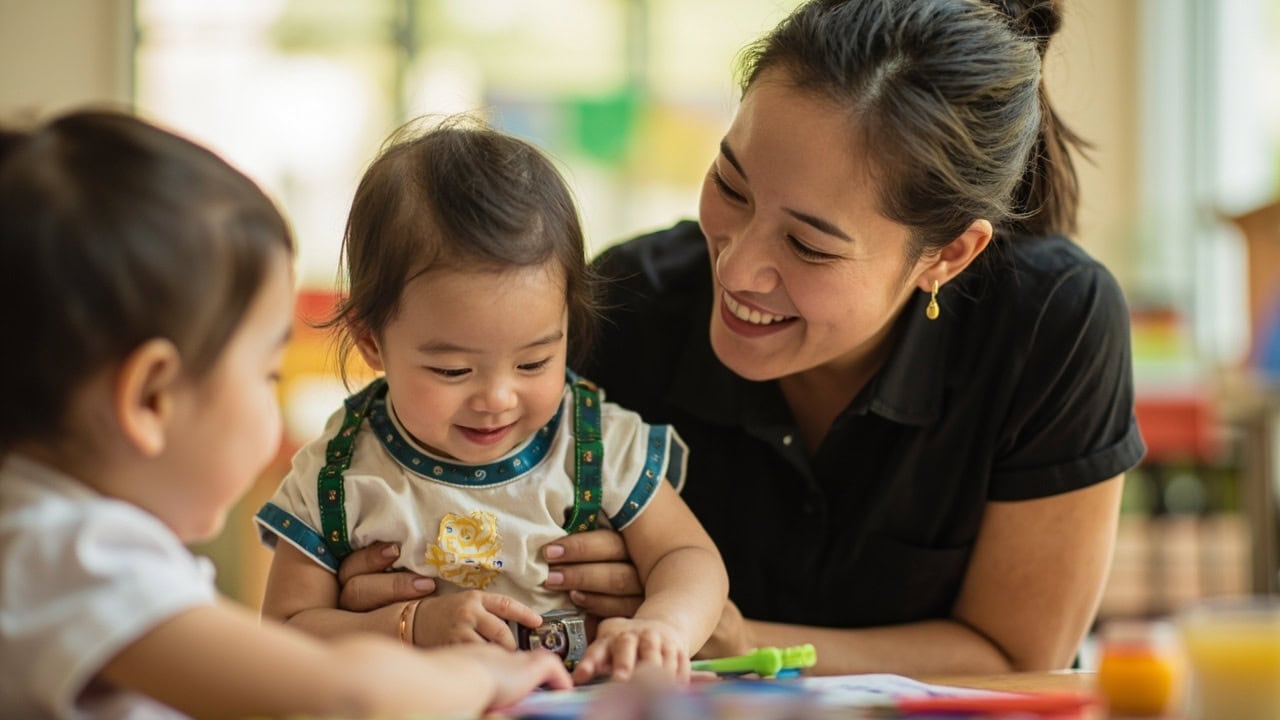
Your Child’s Five Seasons of Growth: A Singapore Parent’s Roadmap to Quality Childcare
What Your Child Is Learning Through the Seasons: An Overview
Before we go deeper, here is a concise overview of the developmental journey your child travels through quality childcare—and what you should notice at each stage:
| Season | What Your Child Is Learning | What Quality Care Looks Like | What to Notice and Ask |
|---|---|---|---|
| 0–6 Months The Season of Trust |
Foundational security; that the world meets their needs | Consistent, warm attunement; responsive caregiving | Does my child seem settled? Do they reach for comfort? |
| 6–12 Months The Sensorimotor Explosion |
Cause and effect; curiosity; intentional communication | Rich environment for exploration; caregiver narration | Is my child curious? What do they reach for? What makes them laugh? |
| 12–18 Months Purposeful Engagement |
Agency; separation with connection; emerging self | Initiated interactions; responsive daily rhythm | How does my child handle frustration? What does their play look like? |
| 18 Months–2 Years The Language Explosion |
Words; back-and-forth connection; social interest | Dialogue, not just narration; interactive storytime | Is my child using words to communicate? Are they showing me things? |
| 2–3 Years Identity and Autonomy |
Self as separate person; opinions; pretend play; empathy | Supports independence within structure; respects emerging will | How does my child handle limits? What does their pretend play reveal? |
The Five Seasons of Your Child’s Growth in Quality Care
The First Season: Trust, Not Learning (0–6 Months)
Let us begin with what may surprise you: the first season of your child’s time in quality childcare is not really about learning at all. It is about trust.
When an infant enters a new care environment, the most important thing happening is not cognitive stimulation or sensory enrichment. What is happening is foundational. The child is learning, on a cellular level, that the world is a place where their needs are met.
That when they cry, someone comes. That when they reach out, someone holds them. That when they are afraid, tired, or overwhelmed, there is a calm and consistent presence who sees them and responds.
This is not sentimental language. This is developmental science, and it is the bedrock upon which every subsequent season of growth is built. When a caregiver in a quality setting holds an infant with consistent warmth, responds to their cues with attunement, and creates an environment where the child’s communications are met with respect, the infant is not just being comforted. They are building their first and most fundamental model of the world. They are learning to trust.
For parents in Singapore, where infant care arrangements often involve formal childcare centres or home-based childminders, this season of trust-building may feel invisible. Your baby cannot tell you whether they felt safe. They cannot describe whether their caregiver noticed their hunger cues or responded to their fussy signals with patience.
All you have is your observation: Does my child seem settled when I arrive? Do they reach for comfort when they are upset? Do they show any signs of distress that feel new or persistent?
These are not small questions. They are the beginning of your framework for understanding whether your child’s care environment is supporting the most important work of infancy: the slow, profound construction of security.
The Sensorimotor Explosion (6–12 Months)
At around six months, you may begin to notice something paying dividends in ways that are both visible and meaningful. Your child, who may have been more reserved or watchful in their early weeks of care, is now beginning to explore.
They are rolling, reaching, grabbing, mouthing, investigating. They are fascinated by cause and effect—a ball that rolls, a rattle that shakes, a toy that lights up when pressed. They are beginning to babble with purpose, to laugh without reservation, to show preferences and displeasure with increasing clarity.
In quality care, this is the season of sensorimotor explosion. The environment has adapted to meet them. The caregivers are not just keeping them safe; they are offering opportunities to discover—tactile materials, objects that make sounds, faces to study, textures to explore.
They are narrating the child’s actions back to them, building language even before language arrives. They are watching for the moments when a child is challenged but not overwhelmed, and stepping in to support before frustration becomes distress.
What should you notice? Whether your child seems curious when you arrive, rather than depleted. Whether they are interested in the environment around them, whether they are reaching for things, exploring, engaging.
What should you ask? What does my child seem most interested in right now? What do they reach for? What makes them laugh?
These are windows into your child’s emerging sense of agency—the understanding that they are a person who acts upon the world and the world responds.
Purposeful Engagement (12–18 Months)
By twelve months, something profound has shifted. Your child is no longer an infant in the way they once were. They are a toddler in motion, in intention, in personality.
They are pulling to stand, perhaps taking first steps, exploring with their whole body. They are pointing. They are imitating. They are beginning to understand that objects have names, that people have roles, that routines have structure.
In quality care, this is the season of purposeful engagement. The environment has shifted again—shelves are within reach, materials are inviting investigation, the daily rhythm has become a source of comfort rather than confusion. Caregivers are now not just responding to needs but initiating interactions—singing songs with gestures, reading books with attention to the child’s focus, introducing simple games of anticipation and delight.
This is also when you may notice your child developing something remarkable: a sense of themselves as separate from you, but connected to you. They may cry more at separation, but they may also, paradoxically, run to greet their caregiver with recognition and even joy.
This is not a contradiction. It is a sign that your child has formed multiple attachments, and that these attachments are healthy and expansive. They are learning that love is not a finite resource. It is not your love or their caregiver’s love; it is love, abundant and distributed, and it is enough.
Notice whether your child is beginning to communicate intentionally—whether through words, gestures, or expressions. Notice whether they are interested in other children, even if play is parallel rather than cooperative. Notice whether they are beginning to show preferences, to assert will, to test limits with a sense of exploration rather than defiance.
These are not problems to solve. They are your child becoming a person.
The Language Explosion (18 Months to 2 Years)
By eighteen months, your child has entered what many developmental specialists call the “language explosion” phase. Words are coming rapidly now, though pronunciation may be creative and private to your family. Your child is understanding far more than they can say, following simple instructions, responding to their name, engaging in back-and-forth interaction with growing sophistication.
In quality care, this is the season of conversation and connection. Caregivers are no longer just narrating; they are dialoguing. They are waiting for responses. They are extending your child’s utterances, modeling fuller language, introducing new vocabulary in context.
They are reading stories not as background activity but as interactive experiences, stopping to ask questions, pointing to images, connecting the story to your child’s life.
You may also notice your child becoming more socially directed. They are interested in other children, not just as objects in the environment but as people to engage, imitate, and occasionally frustrate them. Sharing is not yet a stable skill—it may never be fully stable, even in adults—but the desire for connection is real and growing.
Notice whether your child is using words to communicate rather than just to label. Notice whether they are beginning to understand concepts like “in” and “out,” “up” and “down,” “more” and “all done.” Notice whether they are showing you things, bringing you objects, seeking you out for shared attention.
These are signs that your child’s language and social development are not just progressing but interconnecting, building the foundation for the more complex communication and relationship skills that will follow.
Identity and Autonomy (2 to 3 Years)
By two years, you have a person on your hands. A small, fierce, magnificent person with opinions, preferences, a sense of humor, and an increasingly sophisticated understanding of the world.
They are walking, probably running, certainly climbing. They are speaking in two- and three-word phrases, asking questions, expressing a range of emotions with intensity and clarity. They are beginning to engage in pretend play, to understand time concepts like “before” and “after,” to show empathy and concern for others.
In quality care, this is the season of identity and autonomy. The environment has adapted once more—dramatic play areas, pretend kitchens, blocks and building materials, art supplies that invite creation rather than consumption. Caregivers are supporting your child’s growing independence while maintaining the warmth and structure that prevents autonomy from becoming anxiety.
They are setting limits with respect, offering choices within boundaries, and treating your child’s emerging will with seriousness rather than dismissal.
This is also the age when behavioral challenges may emerge, and it is important to understand what you are seeing. When a two-year-old says “no” with vehemence, when they have meltdowns that seem disproportionate to the trigger, when they resist transitions or assert control with aggression—this is not a sign of bad parenting or poor care. This is your child learning that they are a separate person with their own desires, and that the world does not always bend to those desires.
This is developmental. It is uncomfortable. It is also profoundly important.
Ask your caregiver: How does my child handle frustration when things do not go their way? How do they interact with other children when there are conflicts? What does their pretend play look like?
These questions will reveal whether your child is being supported through this developmental stage with patience and understanding, or simply managed with rules and consequences that do not account for where they are in their growth.
Developmental Attunement: Why Quality Care Must Evolve
What I want you to hear in this journey through the seasons is something specific and important: quality childcare does not look the same at every age because children are not the same at every age.
A caregiver who is extraordinary with infants may be ill-equipped for the curiosity and challenge of a two-year-old. An environment that is perfect for a toddler may be stifling for a three-year-old who is ready for more. True developmental attunement means that the care itself evolves—that the ratios shift, that the environment changes, that the caregiver’s approach adapts.
This is not a feature or a selling point. It is a philosophy. And it is the difference between childcare that watches your child and childcare that understands your child.
When we talk about understanding your child’s growth trajectory, we mean something specific: caregivers who are trained to notice not just what your child is doing, but where they are in their developmental journey. Who can distinguish between a child who is typically developing and a child who may need additional support. Who can tell you not just what happened today, but what it means in the context of where your child has been and where they are going.
In Singapore’s childcare landscape, this kind of developmental understanding is not always standard. Many arrangements offer daily updates on meals and naps—useful information, but not the information that helps you understand your child’s growth.
What parents need, and what quality care should provide, is insight: Is my child developing appropriately? Are they being challenged at the right level? Are there any signs that warrant closer attention?
This is the kind of transparency that builds genuine trust between parents and caregivers—not surveillance, not checklists, but shared understanding of a small human being in motion.
What to Ask Your Childcare Provider—and What Their Answers Should Tell You
One of the most practical things a parent can do is learn to ask better questions. Not just “Did my child have a good day?” but questions that invite insight and reveal whether your child’s care environment is truly attuned to their development.
Here are the questions that matter, by season:
- For infants (0–6 months): Does my child seem settled and comfortable? How do your caregivers respond when my baby is upset? What does my child’s cry sound like when they are hungry versus tired versus needing comfort?
- For the sensorimotor stage (6–12 months): What does my child seem most interested in right now? What toys or materials do they reach for? What makes them laugh? How do you support their exploration when they are becoming mobile?
- For the purposeful engagement stage (12–18 months): How does my child respond when something is hard? How do they handle frustration? What does their play look like when they are fully engaged? How do they interact with other children in the group?
- For the language explosion stage (18 months–2 years): Is my child using words to communicate, or mostly to label things? What new words have you noticed recently? How do you support language development during the day? Is my child showing interest in other children?
- For the identity and autonomy stage (2–3 years): How does my child handle frustration when things do not go their way? What does their pretend play look like? How do they respond when limits are set? What are they most interested in right now?
These questions will tell you whether your childcare provider sees your child as a whole person—an emotional being, a social being, a thinking being—or simply keeps them safe and entertained. The answers matter more than any brochure or promotional material.
Addressing Common Parent Concerns
If you are researching infant care or childminding in Singapore, you likely have specific concerns that generic articles do not address. Let us be direct about some of them.
“How do I know if my child is actually thriving, not just being kept busy?”
Look for signs of genuine engagement: Is your child curious when they arrive? Do they seem interested in their environment? Are they building relationships with their caregivers and peers? Thriving children are not always happy—they also struggle, resist, and test limits—but they are engaged. They are growing in their sense of self and their connection to others.
“What if my child’s development looks different from other children their age?”
Children develop along their own timelines. What matters is not whether your child matches a chart exactly, but whether they are making progress—building on what they know, reaching for what comes next. A good caregiver will notice if your child’s trajectory seems atypical and communicate with you about it openly and supportively, not with alarm or dismissal.
“How do I evaluate whether my childcare arrangement still fits as my child grows?”
Ask yourself: Does the environment still challenge my child at the right level? Do the caregivers adapt their approach as my child’s needs change? Does my child seem genuinely happy and engaged, not just compliant? If the answer to any of these is unclear, it may be time for a conversation—or, if necessary, a change.
“What if I disagree with something my child’s caregiver is doing?”
Partnership means having honest conversations. A quality provider will welcome your questions and work with you to understand your concerns. If a caregiver is defensive or dismissive when you raise issues, that itself is a sign worth noticing.
EduNanny’s Approach: Partnership in Growth
At EduNanny, quality childcare means caregivers trained in developmental science, not just caregiving conventions. It means ratios that honor the vulnerability and complexity of infancy—up to one to three in our infant settings. It means environments that evolve as your child evolves, because the care that works for a newborn is not the care that serves a toddler.
It means communication that goes beyond daily updates to genuine transparency—the kind of transparency that helps you understand what your child is learning and becoming, not just what they ate and how they slept.
It means home-based and community pathways that offer families real choice in how and where their children are cared for. Because Singapore families are not monolithic, and neither are their needs.
And it means something harder to quantify but no less real: caregivers who truly see your child. Who notice when your normally gregarious eighteen-month-old is withdrawn, and flag it to you. Who recognize that your two-year-old’s “no” is not defiance but a developmental milestone being negotiated. Who know your child’s face well enough to know when something is different, and care enough to tell you.
No curriculum, no ratio, no technology can replace that kind of attention. But when these elements work together—with trained caregivers, thoughtful environments, transparent communication, and genuine partnership with families—they create the conditions for something precious. A place where your child is understood, not just watched. Where their growth is shared with you in language you can use.
That is what we are building at EduNanny. Not a service. A relationship.
You Are Already Paying Attention
Here is what I have learned, watching children grow across seasons and stages: parents know their children. They may not always have the developmental vocabulary, the milestone chart, the framework for interpretation. But they know their children. And when something is not quite right, when something has shifted, when something is not working—they feel it.
The question is not whether you can trust your instincts. The question is whether you have the support to act on those instincts with confidence.
This article is an invitation. An invitation to trust that you are already paying attention in ways that matter. To see the seasons of your child’s growth not as a checklist but as a journey—a journey that is predictable in its shapes and utterly unique in its particulars. To ask better questions, to expect more from your childcare arrangement, to understand that quality care is not a static achievement but an evolving response to your child as they grow.
Your child is not a project. They are not a performance. They are a person, becoming more themselves every single day, in every interaction, in every experience, in every season of care.
The question is not whether your child is growing. Children grow. It is the nature of being young.
The question is whether they are growing in an environment that understands them. Whether they are growing with people who see their emerging self and treat it with reverence. Whether they are growing in a place that adapts as they adapt, that meets them where they are, that celebrates their progress and supports their struggles with equal care.
If you are asking that question—and I believe you are, because you have read this far—then you are already the kind of parent your child needs. You are paying attention. You are curious. You are willing to learn.
And that is exactly where you need to be.
At EduNanny, we were built for parents like you—not because we have all the answers, but because we share your conviction that children deserve to be understood, not just watched. We believe that growth is a journey, and that the people who care for your child along the way should be partners in that journey, not bystanders.
If you are exploring childcare options in Singapore and would like to learn more about our approach, we invite you to connect with us or read more about who we are and the ECDA childminding framework that guides our work.
Welcome to the seasons of your child’s growth. We are honored to be part of the story.