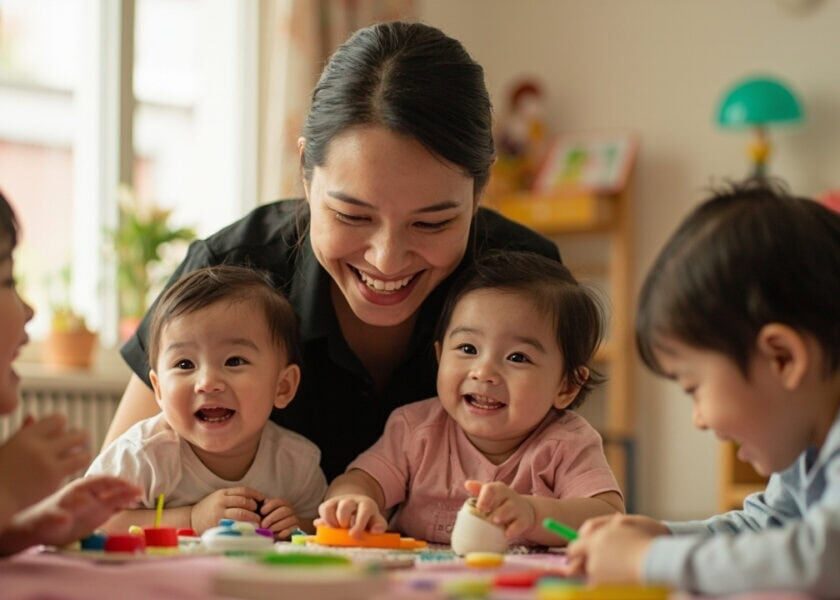
Your Child Will Change: Choose Childcare That Changes Too
“`html
The Question Singapore Parents Carry Quietly
There is a question that most Singapore parents carry in the hours between putting their child to bed and closing their own eyes for the night. It rarely surfaces at playdates or in parent group chats. It is not dramatic enough to be a confession, and too specific to be a general worry. But it is there, persistent and patient, like the hum of the air conditioner in a child’s room at 2 a.m.
The question sounds something like this: will the choice I am making for my child now still be the right choice three years from now? Will the place that feels right for my toddler feel right for my preschooler? Will what I am choosing today continue to serve my child when they are no longer the same child?
This article speaks directly to that question. Because it deserves more than reassurance. It deserves a real answer.
The Reality of Your Child’s Early Years
Here is what we know about the early years of a child’s life. It is a period of such extraordinary transformation that it almost defies description.
The infant who needed to be held at every moment becomes the toddler who needs to explore every corner of the room. The toddler who spoke in single words becomes the preschooler who asks, without stopping, why the sky is blue and why the rain falls down and why grown-ups go to work.
These are not gradual shifts. They are, for a parent watching closely, seismic ones.
What Changes Between 18 Months and 6 Years Old
From eighteen months to six years old, a child moves through more developmental stages than most of us will experience in an entire decade of adulthood. Consider what shifts during this window:
- Attachment evolves. Dependence gives way to social curiosity. The child who needed constant proximity begins to need peer connection.
- Play transforms. Parallel play—where children play beside each other but not yet together—evolves into collaborative imagination, shared stories, and the first friendships that actually matter.
- Cognition deepens. Motor exploration becomes cognitive questioning. Sensory comfort remains important, but so do fairness, rules, and the dawning awareness that other people have thoughts and feelings that may not match their own.
- Identity emerges. The child begins to understand themselves as a separate person with preferences, capabilities, and a growing sense of what they can do.
This is the reality that any honest conversation about childcare must begin with. Your child is not a static being. The child you enroll today will not be the child you pick up three years from now. They will be taller, more complex, more demanding in new ways, more capable in others, and profoundly different in what they need from the adults and environments around them.
What Your Child Needs at Each Stage
18 Months to 2.5 Years: The Age of Exploration. A child’s world is expanding in ways that are both exciting and overwhelming. They are learning to walk, to run, to speak in sentences, to assert their will, to separate from their primary caregivers with increasing resilience. They need environments that honor their need for security while offering safe boundaries for exploration.
Around 3 Years Old: The Social Emergence. Social play becomes more interesting and more complicated. Children begin to negotiate, to cooperate, to experience friendship and its disruptions. Language explodes. Questions multiply. They need caregivers who can follow their curiosity without taking over it, who can scaffold learning without performing it.
4 to 5 Years Old: Approaching Primary School. The child is approaching primary school with a complex inner life, emerging academic awareness, and a need for preparation that is both practical and emotional. School readiness is not about worksheets or drilling. It is about whether a child feels curious about learning, whether they know how to listen and contribute to a group, whether they have the confidence to try something new and the resilience to fail and try again.
The Question That Reveals Everything
Most of how we talk about choosing childcare treats the decision as a moment. A single point on a timeline. You visit, you observe, you feel something, you decide.
The industry is full of content about making the right choice, about trusting your gut during a tour, about what questions to ask on your first visit. All of that matters. But none of it addresses the quiet anxiety that stays with parents long after the enrollment form is signed.
The anxiety is not really about the decision itself. It is about what comes after. It is about whether the architecture you have built for your child’s care has room to grow with them, or whether you will find yourself, in a year or two, facing the same question again.
The question you are asking is not a sign of doubt. It is a sign that you understand, at a deep level, that quality childcare is not a product you purchase. It is not a service you consume and move on from. It is a living relationship, one that should have the capacity to evolve as your child evolves.
When you choose childcare, you are not choosing a snapshot of your child’s needs today. You are choosing a developmental environment that will accompany your family through some of the most rapid and remarkable years of your child’s life.
The question is not simply: does this feel right now?
The question is: does this have the depth, the responsiveness, the staying power to remain right as my child changes?
This is the difference between a care arrangement that adapts and one that simply continues. Continuing is easy. Any childcare provider can say, come back next year, we will be here. Adapting is harder. It requires an environment that is paying attention, that is tracking your child’s development not as a bureaucratic exercise but as a genuine commitment to knowing who they are becoming.
Recognizing When Care Is Growing With Your Child
So how do you stay attentive, as a parent, to whether your choice is still growing with your child or whether it has quietly calcified into something that was once right but is no longer sufficient?
Watch Your Child’s Response
Pay attention to whether your child is increasingly happy or increasingly resistant on the mornings you leave. A little protest is normal. Ongoing, escalating distress is a signal worth listening to.
But also pay attention to the opposite. If your child seems too comfortable, too passive, too unstimulated, that is also worth noticing. The right environment should stretch your child a little, should make them come home tired in the good way—full of stories and questions and the energy that comes from meaningful engagement.
Notice How Caregivers Speak About Your Child
Do they know your child as an individual? Do they notice the things that have changed, the new skills emerging, the social dynamics developing?
When you pick up your child, do the caregivers share something specific and real—a story about how your child solved a problem today, an observation about a friendship forming, a note about something your child mastered—or do they offer only generic reassurances?
Look at the Environment Over Time
Has the curriculum or programming shifted to reflect your child’s advancing capabilities? Are there more complex materials available, more challenging social opportunities, more room for the independence that an older toddler or preschooler needs?
Or has everything remained largely the same, a one-size-fits-all approach that was appropriate for a younger version of your child but has since run out of room to grow?
The Difference Between Continuing and Adapting
| Continuing | Adapting |
|---|---|
| “We’ll see you next year!” | “We’ve noticed your child is ready for more complex activities—here’s what we’re planning.” |
| Same daily routine from infant to preschool | Routine evolves to match developmental readiness |
| Generic progress reports | Individualized observations tied to your child’s specific growth |
| Parents notified only when problems arise | Regular, proactive communication about development and adjustment |
The question to ask yourself is not just whether your child is safe and cared for today. It is whether the people caring for your child are paying attention to who they are becoming—and responding accordingly.
Trust your intuition. You know your child better than anyone. If something feels off, if you sense a mismatch between who your child is becoming and what the environment is offering, trust that instinct. The best care partnerships are built on ongoing dialogue, not a single decision made in the past.
The EduNanny Approach: A Partnership That Grows
This is where the approach to childcare makes a meaningful difference, and it is worth speaking plainly about what that means in practice.
Designed for the Long Arc
We are participants in the ECDA Childminding Pilot, and we take that responsibility seriously. It is not just a designation. It is a commitment to a standard of care that meets children where they are and walks alongside them as they grow.
Whether serving families through home-based care or our community and centre pathways, our guiding principle remains the same: the relationship we build with your family is not concluded when enrollment is complete. It is ongoing, responsive, and designed for the long arc of your child’s early development.
How Ratios and Structures Evolve
Our infant ratios, where we maintain up to one caregiver to three infants, allow for the attention and attunement that very young children require. This is not simply a numbers game. It is about whether a caregiver can truly know each child in their care, can notice the small shifts that indicate growth or struggle, can respond with consistency and warmth that builds the security young children need to later explore and learn.
As children grow and move through our programmes, those ratios and structures evolve. What a toddler needs is different from what a preschooler needs, and our environment is designed to provide that progression without requiring families to start over, to find a new provider, to rebuild trust with someone new.
There is enormous value in continuity. When a child can remain in a familiar, loving environment that simply grows with them, they are spared the disruption and regression that transitions often bring. And parents are spared the exhausting process of beginning the search again, with higher stakes and more pressure because now you know better what you are looking for.
Questions Every Parent Should Ask
Whether you are considering EduNanny or any other childcare provider, these are the questions that matter for the long term:
- How does your programme change as children move from toddlerhood into the preschool years?
- What does communication look like on a regular day, not just when there is a concern?
- How do you track individual child development, and how is that information shared with parents?
- What is your approach when a child’s needs change and the current programme no longer fits?
- Can families stay with you from infancy through preschool age without changing providers?
- How do you prepare children for the transition to Primary One?
The answers you receive will tell you whether you are choosing a service that continues or a partner that adapts.
Practical Realities for Singapore Families
We also understand the practical realities that Singapore families face. Our care blocks are designed for working parents, Monday through Friday, with fee structures that reflect the pilot framework and are accessible for families who are planning for the long term, not just the immediate enrollment.
The Child Development Account and Baby Bonus schemes are usable with our services, and we are transparent about how this works because financial clarity reduces a different kind of parental anxiety—one that has nothing to do with development but everything to do with sustainability.
Where we operate with CCTV measures and communication protocols, we do so because we believe that trust is built through transparency, not secrecy. When parents feel they can see what is happening, when they receive regular and genuine updates about their child’s day, they can relax into the relationship rather than vigilantly monitoring it.
For the Parent Still Wondering
For the parents who are reading this—whether you have already made your childcare choice or are in the midst of making it—here is something worth holding onto.
The fear you sometimes feel, that quiet anxiety about whether you are making the right decision for a future you cannot yet see, is not a weakness. It is wisdom wearing the disguise of worry. It is your parenting instinct telling you that this decision is too important to be treated as a one-time event, that your child’s needs are too real and too dynamic to be met by a static solution.
Do not let anyone tell you that you are overthinking it. You are thinking about it exactly as much as it deserves.
What you are looking for, whether you have found it yet or not, is a care partner that sees your child as a whole person who is becoming. A provider that does not just care for your child but knows them. That does not just run a programme but builds a relationship. That does not just survive the enrollment cycle but commits to the years.
The best childcare decision is not the one that answered today’s question. It is the one that will keep asking the right questions as your child changes. Your childcare provider will either grow with you or fall behind. There is no staying the same when a child is changing so rapidly.
Your child is changing every day. The right childcare choice is one that is changing with them.
If you are ready to explore what a long-term developmental partnership looks like for your family, we invite you to start a conversation. Not about enrollment. Not about programmes. About your child—who they are now, who they are becoming, and how we can walk that journey together.
EduNanny by BUTLER. Growing with your family, from the first steps to the first day of school.
Learn more about who we are or explore our approach to childminding.
“`