Why Your Child’s Trust With a Caregiver Expands Their Emotional World
The Tension You Carry Is Real—And Worth Understanding
The fear you carry is not irrational. It is one of the most natural, most human tensions that any parent can feel, and it is worth understanding fully before you make one of the most consequential decisions your family will ever face.
Here is what I want you to hear: that feeling you have when your child reaches for their caregiver with genuine trust is worth paying attention to. Not because it is a sign that you should keep your child away from a caregiver. But because it is a sign of how deeply your attachment system works. The same emotional architecture that makes you a devoted parent is the one that makes your child capable of forming bonds with others. They are not separate systems. They are the same system, doing its job.
What Singapore Parents Are Actually Navigating
There is something particular about raising children in Singapore. You already know what I mean. You feel it in the way your calendar is structured around school pickup windows and enrichment sessions before you have even finished your morning coffee. You feel it in the negotiation between what you want for your child and what the rhythm of a dual-income household actually requires.
Singapore parents are not choosing childcare because they want to. They are choosing it because the architecture of modern life—its ambitions, its opportunities, its cost of living—has made it a practical necessity for a vast number of families. And within that necessity, something deeply personal unfolds.
You want your child to be loved. Not adequately supervised. Not simply kept safe and fed. You want them to be known—to be responded to with warmth, to have their cries met with attunement, to feel that another human being is genuinely invested in their happiness.
And when that other human being is not you, a quiet question forms. A question you may not even say out loud to your spouse, let alone to anyone else: What if my child doesn’t need me the same way anymore?
That question lives in the space between love and logistics. It is not about the quality of your commitment. It is about the magnitude of it. You have poured yourself into this small person. You have studied their face. You know the particular sound they make just before a smile arrives. And the thought that someone else might know them that well—that someone else might be allowed to know them that well—can feel like an unexpected grief, even when you are grateful for the help.
What Attachment Science Actually Tells Us
This is where attachment science enters—not as a clinical correction to your feelings, but as a framework that makes sense of something you have probably already observed. You may not have known the word for it, but you have seen it.
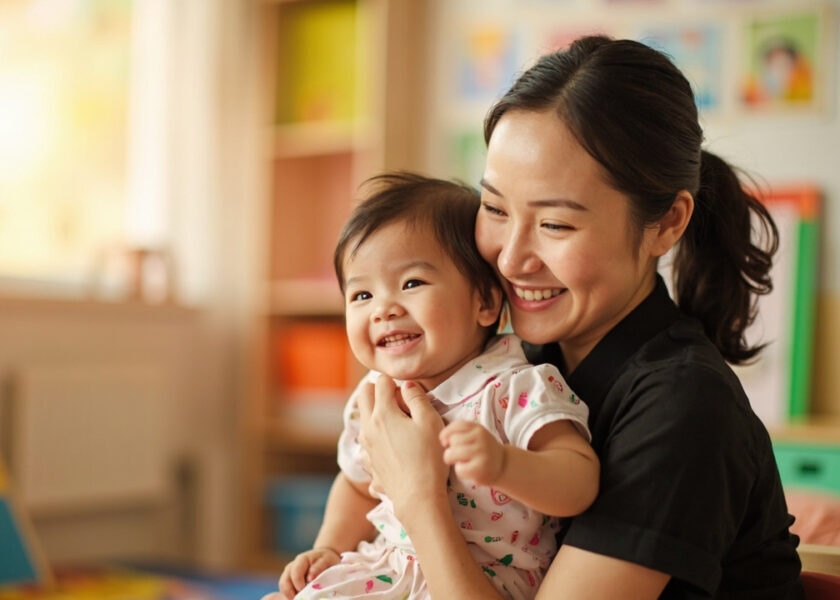
You have seen your child return from time with a caregiver and instead of pulling away, instead of shutting down, they are more available. More open. More present with you, not less. They have been so securely held by someone else that they can relax fully into being with you.
That is not a coincidence. That is attachment doing exactly what it was designed to do.
The Foundation: John Bowlby and Mary Ainsworth
Attachment theory, first articulated by the British psychiatrist John Bowlby, rests on a deceptively simple idea: children are biologically wired to form deep emotional bonds with the adults who care for them, and those bonds serve a single vital purpose—to keep the child safe enough to explore the world.
Bowlby’s colleague and collaborator, Mary Ainsworth, later demonstrated through careful observation that the quality of these early bonds matters enormously. Children who experience consistent, warm, responsive care develop what researchers call secure attachment. They carry that security forward. It becomes the internal working model through which they understand relationships for the rest of their lives.
The Insight That Changes Everything
But here is the part that so few people talk about—and the part that matters most for you right now: children do not have a fixed number of attachment bonds they can form. Attachment is not a zero-sum system. Your child is not dividing a finite emotional pie. A child’s attachment world does not work like that. It works more like a map—dynamic, expandable, and in healthy development, growing richer over time.
Bowlby himself was clear on this. The child’s primary attachment to a parent forms the foundational anchor. But secondary attachments—to grandparents, to trusted family friends, to trained caregivers—do not erode that foundation. They extend it. They create additional nodes of emotional safety from which your child can venture, learn, and return.
Think of it less like your child giving away something they owe you, and more like your child learning that the world contains reliable, loving people—not just one. And that is one of the greatest gifts you can give a child in a complex, connected, modern world.
What the Research Shows
This is not speculation dressed in scientific language. This is decades of developmental research, replicated across cultures, showing that children with multiple secure attachment relationships demonstrate greater emotional regulation, more confident social exploration, and yes—deeper, not weaker, engagement with their primary caregivers.
A landmark study published in Child Development found that children with secure secondary attachments showed significantly better ability to manage frustration and distress—skills that translated directly into calmer, more regulated behaviour at home. Other research has consistently shown that what matters is not the quantity of caregivers but the quality of the bonds formed.
Warmth, consistency, and responsiveness are the variables that predict healthy development. Not the absence or presence of additional caregivers.
Understanding the Difference: Unhealthy Dependency vs. Healthy Attachment
Now, let me address something that sits at the heart of the fear we started with—the worry that a child forming a strong bond with a caregiver will somehow become dependent in an unhealthy way. This is worth distinguishing carefully, because the word dependency carries a great deal of unnecessary fear.
There is a difference between unhealthy dependency and healthy attachment. Unhealthy dependency is rooted in anxiety—the child who cannot be comforted by anyone but one person, who falls apart at every separation, who has not developed the internal sense that the world is a safe place even when primary figures come and go.
Healthy attachment, by contrast, is characterized by what developmental psychologists call the secure base phenomenon. The child uses the caregiver as a launching pad. They venture out, explore, test their limits, and return—not because they have to, but because they want to. They are confident that the caregiver will be there. And that confidence frees them to be curious, bold, and emotionally present.
What You Actually Want
What you want—what every parent wants—is not a child who clings. You want a child who can venture, who can engage, who can regulate their own emotions when small frustrations arise, who can look someone in the eye and feel safe doing so.
That child is not made by keeping other people away. That child is made by allowing other safe people in. And the caregiver who understands this is not creating a substitute attachment—they are building the secondary security your child needs to become a confident, socially fluent person.
What Quality Childminding Actually Looks Like
So let us talk about what quality actually looks like—because not every bond, unfortunately, is a secure one. A child can form an attachment to a caregiver that is anxious, avoidant, or disorganized, just as they can to a parent. The difference lies in how the caregiver responds to the child’s signals.
A caregiver who is trained in attachment awareness understands that every cry is a message, not just a noise. They understand that when a baby reaches out and is met with consistent warmth, something fundamental is being built inside that baby—something that will determine, in part, how that child handles disappointment at age five, how they form friendships at age ten, and how they navigate intimacy as an adult.
This is the kind of training that sets premium childminding apart. It is not enough for a caregiver to be kind, though kindness is indispensable. It is not enough to be present, though presence is everything. A caregiver who understands attachment science brings something additional to the relationship—a deliberate, informed awareness of what they are doing and why. They know they are not filling in for you. They know they are participating in your child’s emotional architecture in a specific, intentional way. And they act accordingly.
Signs of a Healthy Secondary Attachment
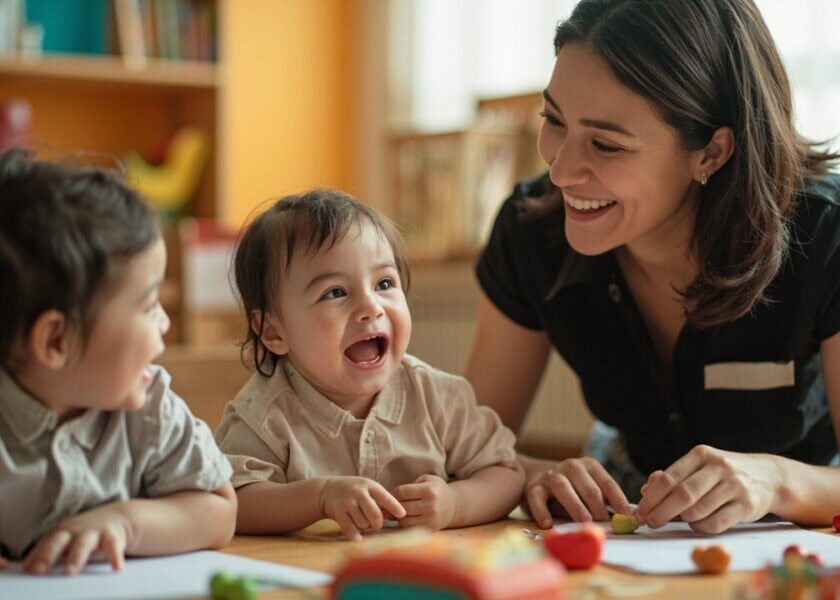
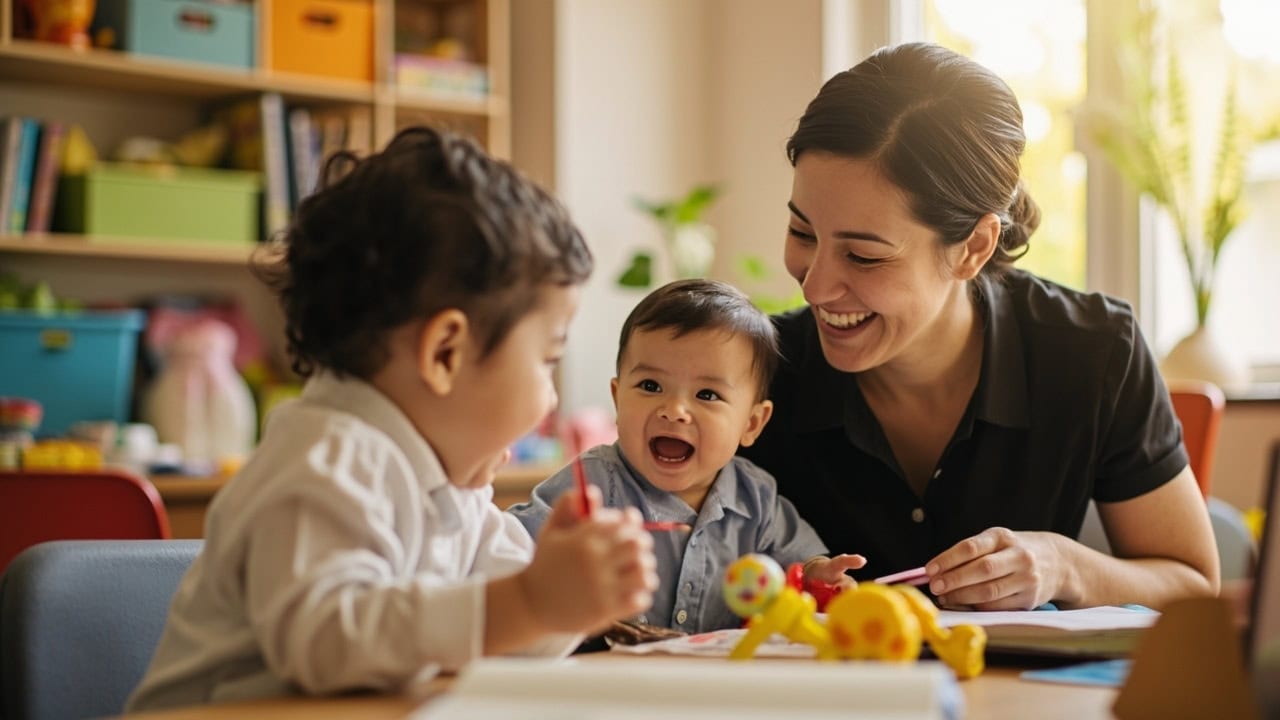
You can observe this in real time. Watch a child who has formed a healthy secondary attachment. You will notice something beautiful:
- They are not conflicted about their caregiver. They do not love their caregiver instead of their parent. They love their caregiver alongside their parent.
- The result is a child who is more settled, not less. More emotionally available, not more anxious.
- They are more capable of playing deeply and independently, because they are not operating from a background hum of emotional scarcity.
- After a full day of attuned care, children come home in a different state. They are not overstimulated, not dysregulated, not clinging. They are ready to engage.
They have been so emotionally fed during the day that they can be present for the evening—for the bath, the story, the quiet moments on the couch. The quality of the time you spend with your child is not diminished by the quality of the care they received during the day. In most cases, it is enhanced by it.
What Singapore Parents Should Look For
Not just logistics. Not just credentials. Not just proximity to home or office. When choosing a childcare arrangement, Singapore parents should look for caregivers who understand what they are participating in emotionally—caregivers who have been trained to read infant cues, to respond with consistency, to build trust deliberately.
Because the difference between a caregiver who simply keeps a child safe and a caregiver who actively contributes to the child’s attachment map is profound. And it is observable. You can see it in the way a child moves through the world—confident but not reckless, affectionate but not anxious, curious and socially at ease.
Key Questions to Ask
- Does the caregiver understand attachment theory and its developmental significance?
- How does the caregiver respond to a child’s distress? Is there consistency?
- Does the caregiver speak about their role as complementary to, rather than a replacement for, the parent?
- What training has the caregiver received in infant emotional development?
- How does the caregiver support the transition between parent and caregiver?
The EduNanny Approach: Attachment-Aware Care in Singapore
EduNanny by BUTLER operates from this understanding. Our caregivers are not simply assigned to families as childcare solutions. They are trained as attachment-aware professionals who comprehend the weight of the role they hold.
When an EduNanny caregiver enters your home, they understand that the child they are caring for is in the midst of one of the most critical periods of emotional development that person will ever experience—and they carry that understanding into every interaction, every response, every moment of attunement.
We do not position our caregivers as supplements to your parenting. We position them as trained attachment partners who work alongside you, within your family context, to support your child’s emotional development. Our caregivers understand the science. They understand the responsibility. And they understand that the parent-child bond is not to be competed with but to be actively protected and nurtured from within the childcare environment.
Making Quality Care Accessible
EduNanny participates in the ECDA Childminding Pilot, and for families within that pilot, the fee structures are designed to be affordable.
For families navigating the financial dimension of childcare—which is very real and very present in Singapore—the CDA and Baby Bonus frameworks can be applied, making premium, attachment-aware care within reach rather than a luxury reserved for a privileged few. This is not an afterthought. It is a deliberate commitment to ensuring that the children who benefit most from this kind of care are not sorted out by their parents’ income bracket.
Building Trust Through Transparency
We know that trust, for Singapore parents, is not an abstract concept. It is a practical requirement. That is why communication and transparency are woven into every aspect of the EduNanny experience.
Where deployed, measures such as CCTV provide families with visibility into daily care—never as surveillance of the caregiver, but as reassurance for the parent who is sitting in a meeting room across the city wondering how their child is doing at this exact moment. These are not substitutes for trust. They are bridges to it, until the trust is solid enough to stand on its own.
The Reframe That Changes Everything
The caregiver is not a buffer between you and your child. The caregiver is an extension of the emotional safety your child experiences, and that extended safety creates a child who can receive you more fully when you are together.
When a caregiver holds your child with this understanding, they are not doing something separate from what you do as a parent. They are doing something complementary to it—extending the circle of safety your child lives inside, so that the circle can grow wider and stronger.
This is childminding elevated to its proper purpose. It is not about supervision. It is not about convenience. It is about recognizing that in a city like Singapore, where families are shaped by pressures and realities that previous generations never faced, children still need what they have always needed: consistent, warm, attuned care that teaches them the world is a place where people show up for them.
And when that care is delivered by someone trained in its developmental significance, it becomes something extraordinary—not just childcare, but a deliberate contribution to your child’s emotional foundation.
Begin the Conversation
Choosing a caregiver who understands attachment is not a compromise. It is a decision to give your child more emotional security, not less. It is a decision to partner with someone whose training, warmth, and awareness will complement what you are already doing.
When you watch your child reach for their caregiver with genuine trust, you are watching something that should not frighten you. You are watching your child’s emotional world expand. You are watching them learn that love is not a limited resource, that safety can come from more than one source, that the people who care for them can be trusted and that trust is a gift worth giving.
That trust does not diminish what your child feels for you. It builds upon it. It proves it. It shows that the foundation you have created is so solid that your child can reach beyond it and still feel held.
And the caregiver who receives that trust—not as a replacement for the parent, but as a continuation of what the parent has begun—is participating in something that is genuinely important. They are adding a line to your child’s emotional architecture. They are being a second anchor in a world that will require your child to navigate currents you cannot always control.
Your child’s world is bigger than you alone can fill. That is not a limitation—it is an invitation. And the right caregiver is not the one who stands between you and your child. The right caregiver is the one who stands beside you, helping your child grow into someone who is ready for everything the world will ask of them.
At EduNanny, we believe that every family deserves caregivers who understand what they are participating in—developmentally, emotionally, and with genuine care. Connect with our team to explore how attachment-aware childminding can support your family.